![[IUCr Home Page]](/iucr-top/logos/iucrhome.gif)
![[Commission Home Page]](/iucr-top/logos/cteach.gif)


The Laue method dealt with white radiation, a stationary single crystal and a fixed sheet of film. The rotation method deals with monochromatic radiation, a moving single crystal and a fixed sheet of film.
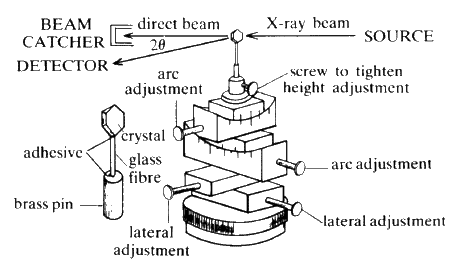
A single crystal (edge lengths between 0.1 and 2 mm) is attached to a glass fibre which is in turn mounted on a spindle. The crystal orientation is adjusted until the crystal can be rotated about a real crystallographic axis (see Fig. 23).
A collimated beam of monochromatic X-rays falls on the crystal
perpendicular to the rotation axis, and the crystal is rotated. The various
planes in the crystal will reflect the beam as the rotation brings each in
turn into the diffracting position, i.e. the Bragg equation is satisfied. Let
the rotation axis correspond with the real c axis. All planes (hkl) with a
common l index will produce reflections along the surface of a common
cone the apex angle of which is defined by the Laue condition
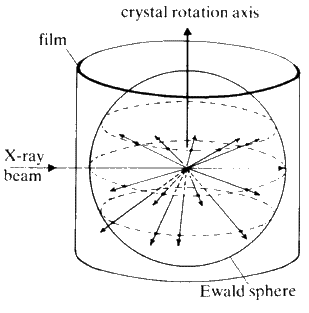
 . The film is usually wrapped around the crystal in the form
of a cylinder, coaxial with the rotation axis of the camera (see Fig. 24).
. The film is usually wrapped around the crystal in the form
of a cylinder, coaxial with the rotation axis of the camera (see Fig. 24).
The photograph obtained consists of individual reflections from the crystal forming straight lines across the film. From the spacing between the lines, the length of the `rotation' axis of the crystal can be calculated. The symmetry of the pattern of spots on the film gives information about the symmetry of the unit cell.
Copyright © 1981, 1997 International Union of Crystallography
IUCr Webmaster