![[IUCr Home Page]](/iucr-top/logos/iucrhome.gif)
![[Commission Home Page]](/iucr-top/logos/cteach.gif)


Let us consider a plane monochromatic wave incident on a crystal and let
ko = s be its wave vector. Each scatterer will diffuse
this wave in every direction with the same wavelength (coherent scattering).
The total amplitude scattered in a particular direction sh will be
obtained by summing the amplitudes scattered in this particular direction by all
scatterers, taking into account their phase relations. Let A and B be two
homologous points in the structure, that is AB = r is a direct
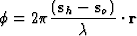
lattice vector. The phase differences between the waves scattered by A and
B is equal to:
be its wave vector. Each scatterer will diffuse
this wave in every direction with the same wavelength (coherent scattering).
The total amplitude scattered in a particular direction sh will be
obtained by summing the amplitudes scattered in this particular direction by all
scatterers, taking into account their phase relations. Let A and B be two
homologous points in the structure, that is AB = r is a direct
lattice vector. The phase differences between the waves scattered by A and
B is equal to:
 |
(5.1) |
There will be diffraction of the incident wave by the crystal if the wavelets
diffracted by all homologous points are in phase, that is if  is equal to
an integer times 2
is equal to
an integer times 2 whatever the direct lattice vector r. The
phase may also be written:
whatever the direct lattice vector r. The
phase may also be written:
 |
(5.2) |
 is the so-called
diffusion vector.
is the so-called
diffusion vector.
The modulus of the diffusion vector has the dimension of the reciprocal of a length. R can therefore be expanded in reciprocal space:

The position vector r can in the same way be expressed in terms of its
coordinates u, v, w in direct space. Applying relations (2.3), we may
therefore write the phase difference in the following way:
 |
(5.3) |
We may note that u, v, w being the coordinates of a direct lattice vector are
integers. If is to be equal to an integer times 2 whatever u, v,
w, we conclude that h, k, l are necessarily also equal to integers; in other
words, the diffusion vector is a reciprocal lattice vector . This is the
diffraction condition in reciprocal space. Bragg`s law and the Ewald sphere
construction are easily deduced from this result.
Let O be the origin of the reciprocal lattice and IO and IH
vectors respectively equal to s and s .The vector OH is therefore equal to R (Fig. 7). If the
diffraction condition is satisfied, H is a reciprocal lattice node. We have
therefore the following construction: we draw through O a line parallel to the
incident direction, let
.The vector OH is therefore equal to R (Fig. 7). If the
diffraction condition is satisfied, H is a reciprocal lattice node. We have
therefore the following construction: we draw through O a line parallel to the
incident direction, let  , then draw a sphere centered in I
with radius 1/. If it passes through another reciprocal lattice node
H, there is a reflected beam parallel to IH.
, then draw a sphere centered in I
with radius 1/. If it passes through another reciprocal lattice node
H, there is a reflected beam parallel to IH.
We may notice in the triangle IOH that OH/2 = IH  sin
sin  ,calling the angle between IO or IH with the bissectrix of OIH,
that is with the trace of the set of direct lattice planes associated with the
node H.
,calling the angle between IO or IH with the bissectrix of OIH,
that is with the trace of the set of direct lattice planes associated with the
node H.
We know from (2.8) that


A reciprocal lattice node may thus be associated with each Bragg reflection .
This result can also be obtained directly through the properties of Fourier transforms. The basic assumption of the geometrical theory of diffraction is that the amplitude of the incident wave at each scatterer is constant. This assumption is acceptable if the interaction between the incident wave and the scatterers is small enough. The total diffracted amplitude in a given direction is therefore simply equal to the sum of the amplitudes scattered in this direction by every scatterer, taking into account their phase relationships. It is equal to:
 |
(5.4) |
 (r) the density of scatterers electrons if we consider X-ray
diffraction for instance. The integral is extended over the volume of the
crystal. We shall assume it here to be infinite. Expression (5.4) shows that
the distribution of diffracted amplitudes is the Fourier transform of the
electron density (r). If the diffracting medium is crystalline,
it is triply periodic. The Fourier transform of (r) is then a
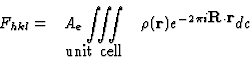
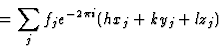
distribution of Dirac masses at each reciprocal lattice node. The weight
associated with each one of them is equal to the structure factor:
(r) the density of scatterers electrons if we consider X-ray
diffraction for instance. The integral is extended over the volume of the
crystal. We shall assume it here to be infinite. Expression (5.4) shows that
the distribution of diffracted amplitudes is the Fourier transform of the
electron density (r). If the diffracting medium is crystalline,
it is triply periodic. The Fourier transform of (r) is then a
distribution of Dirac masses at each reciprocal lattice node. The weight
associated with each one of them is equal to the structure factor:
| (5.5) |
Copyright © 1981, 1998 International Union of Crystallography
IUCr Webmaster