France
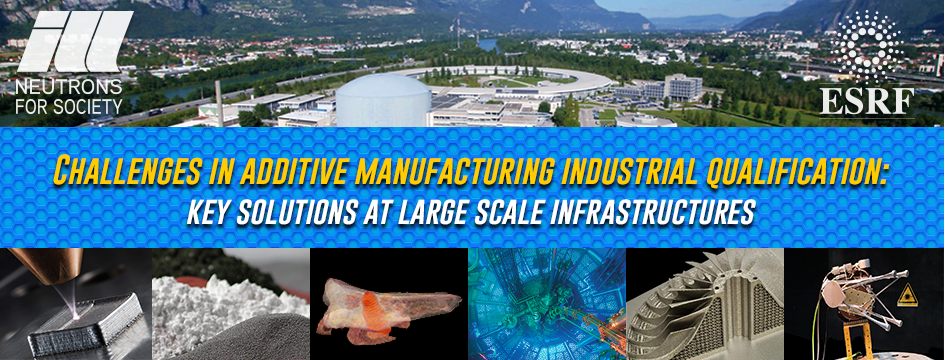
Challenges in additive manufacturing industrial qualification: key solutions at large scale infrastructures
| - |
In Grenoble
From process qualification until component certification, additive manufacturing presents big challenges as a new field of material processing with multiple new parameters. Therefore, new insights concerning characterization are envisaged for process and component standards and certification, as well as for experimental benchmark input for modellings.
European large installations ILL and ESRF offer a common frame for additive manufacturing industrial investigations, where unique static (scanning) and dynamic (in situ) studies on stresses and imaging, from the nanometre until several centimetres range, are possible. To foster industrial escalation of additive manufacturing, we aim at bringing together industry and applied sciences to address key manufacturing issues regarding final quality assessment of products.
Why neutrons?
- For non-destructive and bulk characterization: neutrons can penetrate several cm into matter.
- For new information: neutrons interact in a different way with matter, hence giving another contrast, i.e. for hydrogen!
- For sample environment and in situ studies
Why Synchrotron?
- High energy X-rays, allowing higher penetration depth for real 3D imaging of high density samples.
- High intensity X-rays for non-destructive probing of material structure and devices with high spatial resolution from millimetres to nanometres.
- High intensity X-rays for real time measurements with less than a microsecond time resolution and high-throughput analysis under real manufacturing and operating conditions.