Opening Plenary Lecture
6 October 2016; 7.00 - 8.00 PM
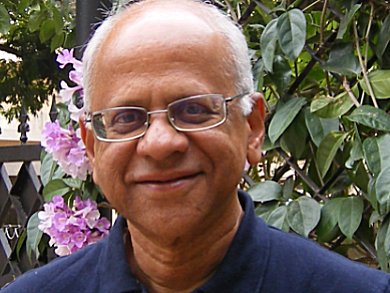
Gautam R. Desiraju (IUCr Immediate Past President, IISc Bangalore, India)
From molecule to crystal
Abstract
How do molecules aggregate in solution, and how do these aggregates consolidate themselves in crystals? What is the relationship between the structure of a molecule and the structure of the crystal it forms? Why do some molecules give more than one crystal structure? Why do some crystal structures contain solvent? How does one design a crystal structure with a specified topology of molecules, or a specified coordination of molecules and/or ions, or even with a specified property? What are the relationships between crystal structures and properties, for molecular crystals? These are some of the questions that are being addressed today by the crystal engineering community, which is drawn from the larger communities of organic, inorganic and physical chemists, and, of crystallographers and solid state scientists. This talk will give a brief historical introduction to crystal engineering itself, and an assessment of the importance and utility of the supramolecular synthon which is one of the most important concepts in the practical use and application of the subject. It is also hoped to provide a look to the future, and indicate some directions in which the subject of crystal engineering might be moving, also in the context of crystallographic endeavors in the African continent.
G. R. Desiraju, Angew. Chem. Int. Ed., 46, 8342, 2007
G. R. Desiraju, J. Am. Chem. Soc., 135, 9952, 2013
G. R. Desiraju, Science, 343, 1057, 2014
Closing Plenary Lecture
10 October 2016; 11.00 - 12.00 AM
Ron Lifshitz (Raymond and Beverly Sackler School of Physics & Astronomy, Tel Aviv University, Israel)
What is a crystal? - New answers to an old question
Abstract
In 1982 Dan Shechtman discovered a new kind of crystal that seemed to contradict the laws of nature. His discovery for which he was awarded the 2011 Nobel Prize in Chemistry ignited a scientific revolution that demonstrated that, in science, what may seem impossible today might turn out to be real tomorrow. We shall review this scientific revolution and the many effects it had on crystallography, science in general, and even beyond.