Events
Lectures
Distinguished Lectures on Quantum Crystallography and Complementary Fields: Lecture 3
|
In Online
Dylan Jayatilaka: Quantum Crystallography: Past, Present, and Future
At 4.00-6.00pm European/Warsaw time
Â
Â
CBMS Lecture - Christopher Topp
|
In Online
WEDNESDAY, DECEMBER 15, 13:30 (EST or New York City Time Zone)
The Topp Lab's integrated phenomics approach to uncovering the molecular basis of root traits in multiple crop species will be presented. We specialize in developing root and rhizosphere imaging technologies and analytics: in particular X-ray CT, positron emission tomography, and statistical and deep learning methods. By integrating these efforts with natural variation and genomics, we focus on the development of new crop and cover crop varieties with root systems tailored to the local environment that enhance drought tolerance, efficient nutrient uptake, and ecosystem services towards sustainable agriculture goals.
Distinguished Lectures on Quantum Crystallography and Complementary Fields
|
In Online
CBMS Lecture Series: Seeing The â€Å"Invisible†Virus Assembly Instruction Manual In Action
|
In Online via zoom
Professor Peter Stockley

University of Leeds

WEDNESDAY, NOVEMBER 17, 13:30 (EST; NY time)
Â
Abstract:

Many viruses that package single-stranded RNA genomes into a protective infectious virion regulate their assembly by sequence-specific RNA-coat protein (CP) contacts. These occur at defined sequences/motifs (PSs) dispersed across viral genomes (gRNAs), but vary in sequence and hence affinity for their cognate CPs, creating a preferred assembly pathway. Uniquely X-ray foot-printing has allowed us detect these CP-gRNA contacts within infectious particles. Similar PS-like contacts occur within a self-assembling enzyme cage artificially evolved so that it packages its mRNA more efficiently. This implies that PS-mediated assembly is relevant far beyond virology.

For our major model virus, foot-printing reveals that most PSs dissociate post-assembly facilitating genome release for the next round of infection. Here, and potentially in all viruses, molecular frustration appears to be a major driving force regulating the life cycle.
International School of Crystallography. 46th Course, Crystallography under extreme conditions: the future is bright and very compressed
| - |
In Erice
Subjecting matter to extreme conditions reveals a multitude of fascinating phenomena, and is applicable to a wide range of disciplines. From the extremophiles that exist in the deepest depths of our oceans to the exotic new materials that are made when atoms are pushed ever closer together, understanding the structure of materials at extreme conditions affects Biology, Chemistry, Physics, Geoscience and Material Science. In order to achieve its goals, high pressure research has been always at the vanguard of technical progress. It is a discipline in which equipment plays a particularly important role. State-of-the-art diamond anvil cells can now achieve megabar ranges of pressure, millions of times atmospheric pressure, with this beaten by an order of magnitude in dynamic compression experiments. In this manner, scientists are able to mimic the conditions in the interiors of giant planets. Nature is even more ambitious, as in the stars petapascal pressures (the order of tens to hundreds billion atmospheres) are reached. In the laboratory, we can even create conditions of pressure, temperature and magnetic fields that are not found naturally, allowing us to complement nature to explore more exotic phases of matter.
Therefore, the course will cover broad ground in the application of extreme conditions crystallography. The topics will span from fundamentals of high-pressure single crystal and powder diffraction, to presenting the many flavors of static and dynamic compression, to reviews of sources for extreme conditions work (synchrotrons, neutrons and free electron lasers). Complementary experimental (Mössbauer spectroscopy, X-ray magnetic circular dichroism, X-ray absorption spectroscopy, inelastic scattering) and computational methods will also be discussed. Diffraction analysis on the structure of liquids, glasses and nanocrystalline materials as well as multigrain crystallography will also be introduced. The lectures will be harmonized with the related sessions of interactive tutorials, providing hands-on experience to the attendees. These workshops will be focused on basic laboratory skills and the elements of data processing software related to the high pressure.
CSHL X-ray Methods in Structural Biology Course
| - |
In Cold Spring Harbor, NY
We anticipate holding the course in person as long as the pandemic situation continues to improve. Appropriate COVID-19 precautions will be followed to ensure the safety of all participants. Everyone will be required to provide documentary proof of a prior FDA or EMA approved vaccine.
Â
This immersive course is an outstanding place to learn both the theoretical and practical aspects of Macromolecular Crystallography because of the extensive lectures from world-renowned teachers, which are combined with hands-on experiments. This 2021 course will be lead by Jim Pflugrath (Rigaku, ret.), Tassos Perrakis (NKI), Paul Adams (LBL), Janet Newman (CSIRO; likely remote)), Tom Peat (CSIRO; likely remote) and an All-Star cast of lecturers. Attendees can expect to participate in a course that is unparalleled in the world, with experts each devoting several days to teaching the fundamentals, theory and practical considerations of crystallographic structure solution.
Topics to be covered include
- Basic diffraction theory
- Crystallization (proteins, nucleic acids, complexes and membrane proteins)
- Synchrotron X-ray sources and optics
- Data collection and processing
- Structure solution by experimental phasing methods (SAD, MAD, MIR, and others) and molecular replacement
- Electron density maps improvement
- Model building and refinement
- Structure validation
- Coordinate deposition
- Structure presentation
The course is limited to 16 participants due to the very hands-on nature of the experiments and the intimate seminar room and laboratory settings. Please check the above web link for more details. In particular, please note the information about fellowships, scholarships, and stipends that are available. It is often possible for applicants to receive some level of support to help offset the course fee.

#TheLightStuff: Controlling the orderliness and pore size of mesoporous silica COK-12
|
In Online
Online lectures on materials science with scattering and diffraction
#TheLightStuff: Controlling the orderliness and pore size of mesoporous silica COK-12Start: 27/11/2020 03:30 PM End: 27/11/2020 04:30 PM
Location
zoom online
see meeting join link below
Organized by: Bundesanstalt für Materialforschung und -prüfung and Diamond Light Source, UK
Please note the given time above is CET (UTC + 1).
Topic
Controlling the orderliness and pore size of mesoporous silica COK-12
Presenter: Laura M. Henning, Technische Universität Berlin, DE
Summary
Ordered mesoporous silica COK-12, such as the well-known SBA-15, is characterized by high surface areas and defined mesopores, making it interesting for a variety of applications, such as catalysis, adsorption, or drug delivery. However, in contrast to common hydrothermal synthesis pathways, COK-12 can be synthesized at atmospheric pressure and near neutral pH, utilizing inexpensive sodium silicate as a precursor. This presentation deals with the effect of an additional aging step at different temperatures during the synthesis. Its effect on the orderliness and pore size of COK-12 could be ascertained with SAXS.
Registration fee
These lectures are free and can be attended via Zoom by to up to 100 attendees.
The lectures will be recorded as well, and (with permission of the presenter) will be made available online afterwards for a broader educational reach.
To participate, use the meeting join link here.
For further questions, please contact [email protected].
Further Information
Technische Universität Berlin (TU Berlin), Institut für Werkstoffwissenschaften und -technologien / Keramische Werkstoffe#TheLightStuff: Neutron Scattering: An Invaluable Addition to the Nuclear Materials Characterization Toolbox
|
In Online
Online lectures on materials science with scattering and diffraction
#TheLightStuff: Neutron Scattering: An Invaluable Addition to the Nuclear Materials Characterization ToolboxStart: 13/11/2020 03:30 PM End: 13/11/2020 04:30 PM
Location
Zoom online
see meeting join link below
Organized by: Bundesanstalt für Materialforschung und -prüfung and Diamond Light Source, UK
Please note the given time above is CET (UTC + 1).
Topic
Neutron Scattering: An Invaluable Addition to the Nuclear Materials Characterization Toolbox
Presenter: Dr Caleb Massey, ORNL, US
Summary
Small angle neutron scattering (SANS) is an effective tool for understanding processing and irradiation effects on materials, especially when combined with other complimentary analysis techniques. In this presentation, the value of this technique will be highlighted using two recent case studies pertaining to nuclear materials: irradiation enhanced Cr-rich precipitation in FeCrAl alloys and nanoprecipitate optimization in oxide dispersion strengthened Fe-based alloys.
Registration fee
These lectures are free and can be attended via Zoom by to up to 100 attendees.
The lectures will be recorded as well, and (with permission of the presenter) will be made available online afterwards for a broader educational reach.
To participate, use the meeting join link here.
For further questions, please contact [email protected].
#TheLightStuff: Nanoscale magnetization distribution in nanoparticles
|
In Online
Online lectures on materials science with scattering and diffraction
#TheLightStuff: Nanoscale magnetization distribution in nanoparticlesStart: 30/10/2020 03:30 PM End: 30/10/2020 04:30 PM
Location
Zoom online
see meeting join link below
Organized by: Bundesanstalt für Materialforschung und -prüfung and Diamond Light Source, UK
Please note the given time above is CET (UTC + 1).
Topic
Nanoscale magnetization distribution in nanoparticles
Presenter
Dr Sabrina Disch, University of Cologne, DE
Summary
Magnetic nanoparticles reveal unique magnetic properties which make them relevant for biomedical applications such as magnetic hyperthermia. Being intrinsic to nanomaterials, disorder effects crucially determine the magnetization properties and can thus also affect the heating performance of magnetic nanoparticles. In view of the technological relevance, it is therefore important to understand the nanoscale distribution of order and disorder within nanoparticles.
We use magnetic SANS to investigate the magnetization distribution and spin disorder within magnetic nanoparticles. In this talk I will give an introduction to the technique and present our most recent work on ferrite nanoparticles.
Registration fee
These lectures are free and can be attended via Zoom by to up to 100 attendees.
The lectures will be recorded as well, and (with permission of the presenter) will be made available online afterwards for a broader educational reach.
To participate, use the meeting join link here.
For further questions, please contact [email protected].
#TheLightStuff: Neutron 'Sees' Hydrogen Confined in Nanopores
|
In Online
Online lectures on materials science with scattering and diffraction
#TheLightStuff: Neutron ‘Sees’ Hydrogen Confined in NanoporesStart: 23/10/2020 03:30 PM End: 23/10/2020 04:30 PM
Location
Zoom online
see meeting join link below
Organized by: Bundesanstalt für Materialforschung und -prüfung and Diamond Light Source, UK
Please note the given time above is CEST (CEST = UTC + 2; BST = UTC + 1)
Topic
Neutron ‘Sees’ Hydrogen Confined in Nanopores
Presenter:
Dr Mi Tian, University of Exeter, GB
Summary
Nanoporous materials can adsorb large quantities of gases owing to the increased density of the gas inside the pores. Hydrogen, in its solid-state, offers far more compact energy storage density and capacity. We employed inelastic neutron scattering (INS) to prove the formation of solid-like hydrogen confined in nanopores. We identified the optimal porous structure to achieve the immobilised hydrogen with an extremely high density at mild conditions, without which we would not achieve such high hydrogen density. Then quasielastic neutron scattering (QENS) was then used to quantitatively illustrate the immobile and partially mobile H2 confined in pores at 35 K up to 130 K, indicating the population of immobile and partially mobile H2 is temperature-dependent. This confirmation of the effects of pore geometry and pore size on the confinement of molecules is essential in understanding and guiding the development and scale-up of porous adsorbents that are tailored for maximising H2 storage capacities, in particular for sustainable energy applications.
Registration fee
These lectures are free and can be attended via Zoom by to up to 100 attendees.
The lectures will be recorded as well, and (with permission of the presenter) will be made available online afterwards for a broader educational reach.
To participate, use the meeting join link here.
For further questions, please contact [email protected].
#TheLightStuff: The path to LoKI & SANS at the ESS
|
In Online
Start 09/10/2020 03:30 PM End 09/10/2020 04:30 PM
Location
Zoom online - see meeting join link below
Organized by
Bundesanstalt für Materialforschung und -prüfung and Diamond Light Source, UK
Please note the given time above is CEST (CEST = UTC + 2; BST = UTC + 1)
Topic: The path to LoKI & SANS at the ESS
Presenter: Dr Judith Houston, ESS, SE
Summary
As one of two small-angle neutron scattering beamlines under construction at the ESS, LoKI has been designed specifically with the needs of the soft matter, materials, and bio-science communities in mind. For example, its high flux and wide simultaneous Q-range will make it ideal for performing spatially-resolved and time-resolved studies.
In this talk, we want to take you through LoKI’s design, our progress with construction, and finally, give some highlights of the main scientific areas which are expected to benefit from this instrument.
Registration fee
These lectures are free and can be attended via Zoom by to up to 100 attendees.
The lectures will be recorded as well, and (with permission of the presenter) will be made available online afterwards for a broader educational reach.
To participate, use the meeting join link here.
For further questions, please contact [email protected].
#TheLightStuff: Effects of annealing and pressure on the Grazing Incidence X-ray Scatterings of Conjugated Polymer blends used in Organic Solar Cells
|
In Online
Start: 02/10/2020 03:30 PM End: 02/10/2020 04:30 PM
Please note the given time above is CEST (CEST = UTC + 2; BST = UTC + 1)
Location: Zoom online
Organized by: Bundesanstalt für Materialforschung und -prüfung and Diamond Light Source, UK
Topic
Effects of annealing and pressure on the Grazing Incidence X-ray Scatterings of Conjugated Polymer blends used in Organic Solar Cells
Presenter:
Dr Benjamin Agyei-Tuffour, University of Ghana, GH
Summary
This presentation shows the results of an experimental study of the effects of pressure and annealing on the conjugated polymer chain configurations in poly (3-hexylthiophene) and [6,6]-phenyl C61-butyric acid methyl ester (P3HT:PCBM) blends that are used in bulk heterojunction organic photovoltaic cells (OPVs). Annealing and the application of static loads on P3HT:PCBM blends on glass substrates were investigated. Microscopy and grazing incidence x-ray scattering techniques were adopted to analyze the surface morphologies, nano-/micro-structures and the chain configurations in the conjugated polymer blends. The OPV devices fabricated resulted in the I-V characteristics that have large dependence on the changes in the nano-/ micro-structures of the polymer blends. The pressure induced polymer chain configurations that were in the direction of the applied pressure (edge-on), led to a reduced lamellae spacing between the polymer units. This increased the crystallinity in the blend and played significant role in the organic solar cell performance. The findings of the study are discussed to influence the design and control of the nano-/micro-structures and the performance of bulk heterojunction organic solar cells.
Registration fee
These lectures are free and can be attended via Zoom by to up to 100 attendees.
The lectures will be recorded as well, and (with permission of the presenter) will be made available online afterwards for a broader educational reach.
To participate, use the meeting join link here.
For further questions, please contact [email protected].
#TheLightStuff: The MIEZE technique and its application towards examining magnetic materials
|
We introduce MIEZE, a variant of the spin-echo technique optimized for the study of dynamic processes in magnetic materials. We show how MIEZE can be applied to these materials with the help of several examples: fluctuations around the Curie point in iron, spin dynamics in paramagnetic Ho2Ti2O7 and weak crystallization of fluctuating skyrmion textures in MnSi.
Presenter: Dr Johanna Jochum from Technical University Munich, Germany
Organized by Bundesanstalt fur Materialforschung und -prufung and Diamond Light Source, UK.
Each in this series of online lectures on scattering and diffraction is free and can be attended via Zoom by to up to 100 attendees.
The lectures will be recorded and (with permission of the presenter) will be made available online afterwards for a broader educational reach.
To participate, use the meeting join link here.
#TheLightStuff: Probing Gel Structure using Scattering â€" an Insight into Designing New Soft Materials
|
In order to be able to design new soft materials, such as gels, understanding how they form is a critical first step. Bulk measurements, like rheology, provide excellent information on their properties, but understanding their structure can be more challenging. In this talk I will show how combining small-angle X-ray and neutron scattering can give insight into gel formation and how seemingly subtle changes in the molecular chemistry of gelators can lead to sometimes unexpected new outcomes.
Dr Annela Seddon from University of Bristol, UK
Organized by Bundesanstalt fur Materialforschung und -prufung and Diamond Light Source, UK.
Each in this series of online lectures on scattering and diffraction is free and can be attended via Zoom by to up to 100 attendees.
The lectures will be recorded and (with permission of the presenter) will be made available online afterwards for a broader educational reach.
To participate, use the meeting join link here.
#TheLightStuff: X-ray Total Scattering: a tool for multi-length scale atomic characterisation
|
Time-resolved synchrotron X-ray total scattering gives access to the dynamic atomic structure during in situ and operando experiments providing access to multi-length scale information. Here the unusual redox properties of ceria-based catalysts are probed following the formation of an oxyhydride phase during the activation of hydrogen using X-ray total scattering and X-ray absorption spectroscopy.
Presenter: Dr Adam H. Clark from Paul Scherrer Institute, Switzerland
Organized by Bundesanstalt fur Materialforschung und -prufung and Diamond Light Source, UK.
Each in this series of online lectures on scattering and diffraction is free and can be attended via Zoom by to up to 100 attendees.
The lectures will be recorded and (with permission of the presenter) will be made available online afterwards for a broader educational reach.
To participate, use the meeting join link here.

FROLIC GOATS: 13th HIGH-PRESSURE DIFFRACTION WORKSHOP
| - |
In PoznaÃ...„, Poland
Its primary goal is to disseminate practical skills allowing one to perform high-pressure experiments in an x-ray lab, and to outline possibilities to continue one's studies at dedicated high-pressure beamlines in synchrotrons, nuclear reactors and spallation sources.
Modern x-ray diffraction equipment installed in most laboratories can be used for high-pressure experiments straightforwardly, or after few minor modifications - these modifications can be as simple as mounting a shorter collimator and re-positioning the beam-stop to provide space for the diamond- anvil cell (DAC). The DAC is a simple and relatively cheap device, so crystal structures in high pressure can be studied in most x-ray labs.

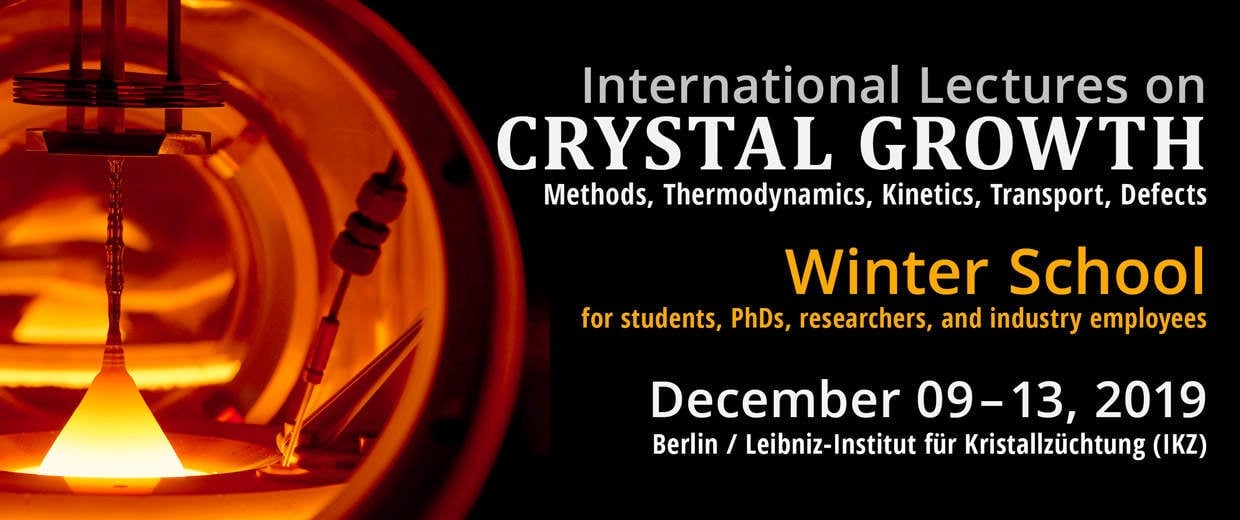
International Lectures on Crystal Growth Methods, Thermodynamics, Kinetics, Transport, Defects
| - |
In Berlin
MLZ User Meeting
| - |
In Munich
Starting around lunchtime, the first afternoon will be dedicated to specialised workshops organised by our Science Groups, while the second day will be divided between plenary talks in the morning and a poster session in the afternoon.

EMBO global exchange lecture course *Structural and biophysical methods for biological macromolecules in solution*
| - |
In Santiago
structural and biophysical techniques employed for characterization of
proteins and nucleic acids under close to native conditions. It includes
lectures on: small angle X-ray and neutron scattering, NMR, mass
spectrometry, analytical ultracentrifugation, bioinformatic tools,
cryoEM and interdisciplinary approaches. The registration fee of 170
euro will be requested from the academic participants covering the event
materials, lodging and meals. A limited number of travel grants and
child care grants are available.

Frolic Goats: High-Pressure Diffraction Workshop
| - |
In Poznan
Its primary goal is to disseminate practical skills allowing one to perform high-pressure experiments in an x-ray lab, and to outline possibilities to continue one's studies at dedicated high-pressure beamlines in synchrotrons, nuclear reactors and spallation sources.
Modern x-ray diffraction equipment installed in most laboratories can be used for high-pressure experiments straightforwardly, or after few minor modifications - these modifications can be as simple as mounting a shorter collimator and re-positioning the beam-stop to provide space for the diamond- anvil cell (DAC). The DAC is a simple and relatively cheap device, so crystal structures in high pressure can be studied in most x-ray labs.