Topics
Free-electron laser
47th Annual Mid-Atlantic Macromolecular Crystallography Meeting
| - |
In Baltimore, MD
Ultrafast X-ray Summer School (UXSS2017)
| - |
In Hamburg
UXSS is an annual event jointly organized by the Center for
Free-Electron Laser Science (CFEL) at DESY and the PULSE institute at
SLAC National Accelerator Laboratory. As you can see from the list of
speakers below, the program will be highly interdisciplinary, with
topics ranging from accelerator physics to molecular biology. There
will also be a coursework exercise involving a mock proposal for the
European XFEL, with the help of experienced mentors.
Registration will open on the 31st January 2017. Please
note that the number of summer school participants will be limited. In
order to facilitate the selection of participants, we ask applicants to
provide a short description of their educational and scientific
background and their motivation for applying for participation in UXSS
2017. The registration deadline will be the 31 March 2017.
Financial support for UXSS 2017 is very kindly provided by the Joachim
Herz Stiftung, meaning that participants will be asked to pay a
registration fee of only 100 EUR. Accepted applicants will receive
a financial contribution towards travel and accommodation expenses.
List of lecturers:
Rasmus Ischebeck (PSI), FEL diagnostics
Hae Ja Lee (SLAC), matter in extreme conditions
Filipe Maia (Uppsala University), coherent diffractive imaging
Giorgio Margaritondo (EPFL), fundamentals of X-ray sources
Arwen Pearson (CUI & University of Hamburg), structural biology
Robin Santra (DESY, University of Hamburg), X-ray - matter interactions
Joachim Stohr (SLAC, Stanford University), condensed matter and magnetism
Simone Techert (DESY & Göttingen Campus), structural dynamics
Linda Young (Argonne/UChicago), atomic and molecular physics

Macromolecular Crystallography School 2017
| - |
In Madrid
The eighth edition of the Macromolecular Crystallography School is to be held at the Institute QuÃmica-FÃsica Rocasolano - CSIC (Madrid).
 Invited speakers and tutors:
- Paul Adams, Berkeley, USA
- Pavel Afonine, Berkeley, USA
- Armando Albert, Madrid, Spain
- Roeland Boer, Barcelona, Spain
- Jose M Carazo, Madrid, Spain
- Kay Diederichs, Konstanz, Germany
- Paul Emsley, Cambridge, UK
- Rafael Fernández-Leiro, Cambridge, UK
- Carmelo Giacovazzo, Bari, Italy
- Xavier Gomis-Ruth, Barcelona, Spain
- Juan A. Hermoso, Madrid, Spain
- Eugene Krissinel, Oxford, UK
- José MartÃn-GarcÃa, Arizona, USA
- Rob Nicholls, Cambridge, UK
- Maria Solá, Barcelona, Spain
- Isabel Usón, Barcelona, Spain
The workshop has been designed for postgraduate, postdoctoral and research scientists that deal with macromolecular crystallography but need further knowledge on the routine uses, the state of the art and fundamentals that underlie the modern techniques for macromolecular crystallography. The topics will cover crystallographic computing and fundamentals using XDS, CCP4 and Phenix, as well as the state of the art on topics such as the strategies for protein production, data collection,phasing and refinement with ARCIMBOLDO, SHELX and SIR2014 and modeling with COOT.
This year a full-day on breakthrough techniques such as XFEL and cryo EM has been introduced.
MCS2017 will provide six days of lectures and workshops. The course is designed for 25 highly motivated attendants.
Requests to participate must be sent by a free-formated E-mail, before March 10, 2017 to the following address: [email protected], indicating the motivation to participate and experience on macromolecular crystallography and including a letter of recommendation from PhD Director (only for PhD students).
Accepted participants will be notified by e-mail before March 17, 2017.
Organizers: Armando Albert ([email protected]), Juan A. Hermoso
([email protected]) and Isabel Usón ( [email protected]).
6th Joint Workshop on High Pressure, Planetary and Plasma Physics (HP4)
| - |
In Göttingen
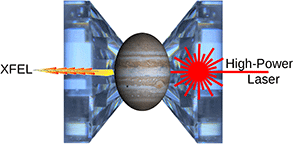
- The generation and diagnostics of extreme states of matter as appearing in the interior of planets, brown dwarfs and stars is one of the key scientific challenges in a number of scientific fields. These include:
- Generation of such conditions at FLASH and the future free electron laser facility (European XFEL).
- Generation of higher pressures in static experiments both in the laboratory and at synchrotron facilities (PETRA III).
- Development of new diagnostic tools.
- Predictions of high pressure and temperature properties of materials from ab initio methods.
- Application of such results to the study of interior of planetary and astrophysical bodies.
CLEO/Europe - EQEC2017
| - |
In Munich
Conference on Lasers and electro-optics - European Quantum Electronics Conference
CA - Solid-state Lasers
CB - Semiconductor Lasers
CC - Terahertz Sources and Applications
CD - Applications of Nonlinear Optics

CE - Optical Materials, Fabrication and Characterisation
CF - Ultrafast Optical Technologies
CG - High-Field Laser and Attosecond Science
CH - Optical Sensing and Metrology

CI - Optical Technologies for Communications and Data Storage
CJ - Fibre and Guided Wave Lasers and Amplifiers

CK - Micro- and Nano-Photonics

CL - Photonic Applications in Biology and Medicine
CM - Materials Processing with Lasers
EQEC 2017 Topics
Â
EA - Quantum Optics
EB - Quantum Information, Communication, and Sensing
EC â€" Ultracold Quantum Matter and Quantum Simulation
ED â€" Precision Metrology and Frequency Combs
EE - Ultrafast Optical Science
EF - Nonlinear Phenomena, Solitons and Self-organization
EG â€" Light-matter Interactions at the Nano-scale
EH â€" Plasmonics and Metamaterials
EI - Two-dimensional Materials
EJ â€" Theoretical and Computational Photonics
CLEO®/Europe-EQEC 2017 Joint Symposia Topics
JSI - Free Electron Lasers and Applications
JSIV - Topological Insulators in Optics
JSV - Perovskite Optoelectronics
ISBC2017. 6th International School on Biological Crystallization
| - |
In Granada
ISBC2017 will provide five days of lectures and practical demonstrations related to the crystallization of biological macromolecules, biominerals and biomimetic materials, with one full day devoted to case studies on the crystallization of membrane proteins, viruses and large macromolecular complexes.
ISBC Granada 2017 will focus on the fundamentals of crystallization from solution and its applications for the crystallization of biological materials.
- Nucleation: Classical and non-classical approaches
- Crystal growth kinetics and mechanisms
- Properties of macromolecular solutions (DLS/SAXS)
- Screening: The search for crystallization conditions
- Crystallization techniques: Batch, Vapour and Counter Diffusion, How do they work?
- Crystallization and diffusion transport: gels, microfluidics and microgravity
- Crystallization of large crystals for Neutron diffraction
- In vivo crystallization of tiny crystals for XFEL
- Polymorphism in protein crystals
- Robotics and crystallization
- Case studies in Membrane Protein Crystallization
- Lipid cubic phase, bicelles and detergents
- Case studies in crystallization of Large Macromolecular Complexes
- In vitro and in vivo studies of Biomineralization processes
WIRMS 2017- Infrared Microscopy and Spectroscopy with Accelerator Based Sources Workshop
| - |
In Oxford
WIRMS 2017 will be a key meeting for staff and users of IR/THz beamlines at Synchrotron (SR), Energy Recovery Linac (ERL) and Free Electron Laser (FEL) facilities around the globe, to discuss new science and innovative technology across the whole IR spectrum. It will offer an opportunity to meet and exchange ideas among scientists from the broadest variety of IR research fields, along with scientists from Diamond and the UK IR user community.
New IR Sources and Facilities Developments- Synchrotron sources and IR/THz Beamlines
- FEL, ERL Sources and IR/THz Beamlines
- Coherent SR and Ultrafast IR/THz Radiation
- New Instrumentation
- Biology and Medicine
- Soft Matter and Material Science
- Condensed Matter Physics and Chemistry
- Atmospheric and Astrophysical Applications/ Gas phase
- Geology and Environmental Sciences
- Cultural Heritage and Archaeology
- Multidisciplinary Applications
- Near-Field IR/THz Spectroscopy and Nanoscopy
- Ellipsometry
- Tomography
- Extreme Environments
- Time-resolved/Pump-and-Probe/Multicolour Experiments
Hot topics in contemporary crystallography (HTCC)
| - |
In PoreÄ
Dynamic crystallography based on synchrotron and X-ray free electron laser sources
Non-ambient crystallography
Experimental charge density studies expanding to quantum crystal charge in the near future
SwissFEL Users’ Kick-off Meeting
|
In PSI, Villigen

FXE Instrument User Workshop (Femtosecond X-ray Experiments)
| - |
In Schenefeld, Berlin
Joint DESY Photon Science and European XFEL Users' Meeting: Research with Synchrotron Radiation and FELs
| - |
In Hamburg (DESY)
WAVEFRONT: New Frontiers and Advanced Applications of 4th generation light sources to Atomic, Molecular, Optical and Cluster Science
| - |
In Trieste (ICTP)
IWORID2016 â€" 18th International Workshop on Radiation Imaging Detectors
| - |
In Barcelona
The International Workshops on Radiation Imaging Detectors are held yearly and provide an international forum for discussing current research and developments in the area of position sensitive detectors for radiation imaging, including semiconductor detectors, gas and scintillator-based detectors. The workshop will have plenary sessions with invited and contributed papers presented orally and in poster sessions. The invited talks will be chosen to review recent advances in different areas covered in the workshop.
Topics
Sensor Materials, Device Processing & Technologies, Front end electronics and readout, Imaging Theory, Material & life science, Multi wavelength techniques, High resolution imaging, Sub ns imaging, TOF and particle tracking, High energy physics, High power lasers, Applications at X-ray free electron lasers, Electron microscopy, Neutron imaging, Security systems and other Industrial applications, Space and Astronomy applications, Nuclear physics, Fusion research, instrumentation, detector R&D, radiation
NOXSS. 68th Course: The Free Electron Laser for Ultrafast Imaging at the Nanoscale.
| - |
In Erice, Sicily
Topics
- Overall perspectives of research with the FEL and X-FEL facilities
- Design of experiments with FEL sources
- Imaging by coherent diffraction in Transmission Electron Microscopy
- Phasing and information retrieval in CDI
- Single-shot imaging of nano-objects with X-FEL
- Molecular Movies in biology using an X-FEL
- X-ray interaction with matter at the nanoscale
- The strong excitation density regime in time-dependent density-functional theory
- Modelling extreme spectroscopy and scattering
- Sample strategies for single particles (clusters, viruses) and for solids
- Acceleration technologies that work â€" towards CW-FEL
- Seeding and seeding-like properties of X-ray FELs / Quantum FEL
- Challenges in detection
- Key parameters of sources, detectors, and data handling in present and future FEL experiments
5th Joint Workshop on High Pressure, Planetary and Plasma Physics (HP4)
| - |
In Hamburg
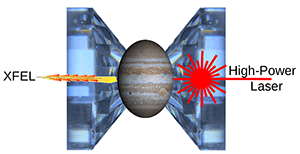
- The generation and diagnostics of extreme states of matter as appearing in the interior of planets, brown dwarfs and stars is one of the key scientific challenges in a number of scientific fields. These include:
- Generation of such conditions at FLASH at the future free electron laser facility (European XFEL).
- Generation of higher pressures in static experiments both in the laboratory and at synchrotron facilities (PETRA III).
- Development of new diagnostic tools.
- Predictions of high pressure and temperature properties of materials from ab initio methods.
- Application of such results to the study of interior of planetary and astrophysical bodies.
To bring together researchers from these different fields in the physical sciences a workshop series has been established by DESY, XFEL GmbH, DLR Berlin, the University of Rostock and Bayerisches Goinstitut to discuss related topics and problems. Earlier workshops were held at DESY Hamburg (2012), DLR Berlin (2013), University of Rostock (2014) and the Bayerisches Geoinstitut at the University of Bayreuth. The aim of the upcoming workshop is to continue the discussion of scientific questions with relevance for extreme planetary environments in terms of high pressure (HP) and high temperature (HT). The conditions prevalent in the deep interiors and atmospheric envelopes of solar system planets, their satellites as well as massive solid and gas giant extrasolar planets, respectively, and are not fully accessible by conventional experimental and theoretical methods. New and enabling techniques to be used in the HP/HT regime are based on the combination of intense pulsed X-ray sources with pulsed sample excitation, in particular but not exclusively related to high energy optical lasers. Simultaneously, ab initio simulations for matter under extreme conditions provide a more and more predictive data set for planetary interiors in this HP/HT regime.
The following topics will be part of the workshop:
- Evolution and structure of giant planet interiors
- Interior structure, bulk composition, and internal geodynamics of solid planets
- Deep volatile cycles and exchange processes between geochemical reservoirs
- Physics and chemistry of impact processes
- Equations of state, petrology, and geochemistry of planetary materials
- Melting relations and phase transformations of materials at extreme states
- Dynamic and ultrafast processes in strongly excited solids or similar,
- Compression experiments using high-power optical and free electron lasers
- Laboratory experiments using multi-anvil and diamond-anvil cells
- Ab initio simulation studies for matter under extreme conditions
Science@FELs
| - |
In Trieste
Synchrotron and Free electron laser Radiation: generation and application (SFR-2016)
| - |
In Novosibirsk (BINP)
VUVX2016. 39th International conference on Vacuum Ultraviolet and X-ray Physics
| - |
In Zurich
VUVX2016 is the third conference following a merger of two long standing conference series â€" the International Conference on Vacuum Ultraviolet Radiation Physics (last meeting was the 15th in that series, VUV-15 in Berlin, Germany in July 2007) and the International Conference on X-ray and Inner-shell Processes (last meeting was the 21st in that series, X-08 held in Paris in June 2008).Â
This international conference will bring together scientists from all over the world, working in fields involving electromagnetic radiation in the vacuum ultraviolet (VUV), soft X-ray and hard X-ray spectral regions generated by synchrotron, laser, or plasma based sources. Topics to be covered range from instrumentation and methods development to applications in a variety of fields.
Topics
- New Sources: diffraction limited storage rings, free electron lasers, ultrashort pulse XUV lasers and X-ray tabletop sources
- Resonant elastic and inelastic X-ray scattering
- X-ray absorption spectroscopy incl. linear, circular and magnetic dichroism spectroscopy
- Photoemission (angle/spin/time resolved, soft X-ray, hard X-ray, resonant, etc.)
- Imaging with nanoscale resolution: X-ray microscopy, coherent diffraction imaging, scanning small-angle X-ray scattering etc.
- Coincidence spectroscopy
- Theory of X-ray spectroscopy and diffraction
- Advanced data analysis methods
- Time-resolved spectroscopy
- In situ and operando applications
REXS2016. Resonant Elastic X-ray Scattering
| - |
In Hamburg
REXS2016 conference on resonant elastic x-ray scattering is the 3rd in a row after the very successful events in Aussois 2011 and the subsequent conference in Oxford 2013.
The REXS conference series re-started again almost 20 years after the conference on Resonant Anomalous X-ray Scattering 1992 in Malente and the first conference on Resonant X-ray Scattering 1974 in Madrid. The conference is aimed at stimulating interaction and discussion of scientists working in the field of hard condensed matter research with synchrotron radiation and using spectroscopy and scattering methods, that base upon resonance effects occurring close to the X-ray absorption edges.
Anomalous or resonant elastic X-ray scattering takes advantage of resonance enhancement of the scattered signal at the X-ray absorption edges and associated polarization effects. Experiments in this area range from conventional anomalous scattering and resonant magnetic diffraction to the investigation of exotic multipolar order or nuclear resonant diffraction. In addition, at REXS2016 we would like to emphasize the intrinsic ties and complementarity between scattering and spectroscopic methods (XMCD) for the investigation of properties of hard condensed matter materials and would like to bridge the gap between the two communities both in the soft and hard X-ray regime.The conference will cover the following topics:- Basic concepts/theory
- Electronic correlations
- Extreme conditions (pressure, electric/magnetic fields …)
- Nanostructures
- Chemistry
- Time resolved diffraction /XFEL
- Soft condensed matter/Life sciences
- Ultra-fast scattering studies (XFEL)
- Coherent scattering studies (at XFEL and storage rings)
- Combined XMCD / REXS studies

Trends in Free Electron Laser Physics. Erice School+Workshop
| - |
In Erice (Sicily)
 The list of addressed topics is as following:
- Generation of ultra-cold electron beams
- Quantum aspects of beam physics
- Quantum and classical FEL theory
- Collective effects in Bose-Einstein condensate
- Transverse and longitudal FEL coherence
- Compact Undulators (Magnetic, Optical and RF)
- Advanced gamma-rays Compton and FEL sources