Events
Training courses
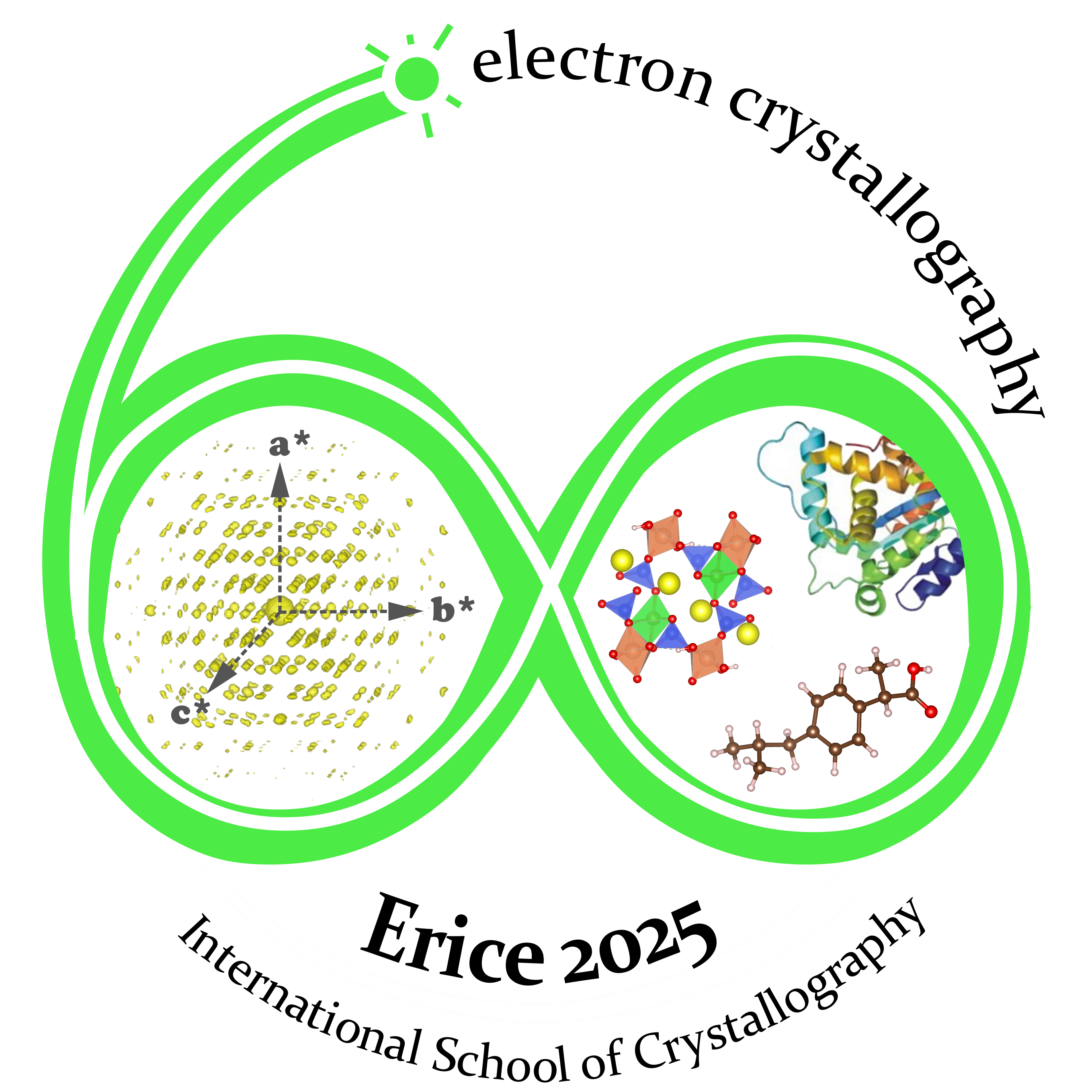
International School on Electron Crystallography 2025
| - |
In Erice
Dates: 30 May - 7 June 2025 Location: Ettore Majorana Foundation and Centre for Scientific Culture, Erice, Italy
About the School: The International School on Electron Crystallography offers a comprehensive learning experience for participants at all levels, from beginners to advanced researchers. Through lectures, hands-on tutorials, and interactive sessions, attendees will gain valuable insights into the principles and applications of electron crystallography, including electron diffraction, 3D electron diffraction (3D ED), structure determination, and the latest innovations in the field.
Key Topics: Fundamentals of electron crystallography and diffraction 3D electron diffraction techniques Structure determination of molecular and inorganic materials Applications in nanomaterials, pharmaceuticals, and structural biology Recent advances in instrumentation and data analysis Who Should Attend: The school is designed for students, postdocs, and professionals working in electron microscopy, crystallography, materials science, chemistry, physics, and related disciplines. Whether you are new to electron crystallography or looking to deepen your expertise, this school provides a unique opportunity to expand your knowledge and network with experts in the field.
Travel and Grants: Various travel grants from different organizations will be advertised on the school's webpage to support student participation.
How to Apply: Details on registration, abstract submission, and travel grant applications will be made available on the official website: https://crystalerice.org/2025/
Join us in Erice for an inspiring week of learning, networking, and exploring the beautiful surroundings of Sicily!
For further information, please visit our website or contact the course directors: Alexander Eggeman (University of Manchester, UK), Mauro Gemmi (Istituto Italiano di Tecnologia, Pisa, IT), Tatiana Gorelik (Forschungszentrum Juelich, DE).
International School on Quantum Crystallography
| - |
In Erice
Tomography Short Course
| - |
In New York

EMBO Practical Course - In situ CLEM at room temperature and in cryo
| - |
In Heidelberg
International School on Quantum Crystallography 2025 â€" Erice, Italy
| - |
In Erice, Italy
During this school, we will provide an accessible and in-depth education in quantum mechanics and related semi-empirical methods, tailored to provide a solid foundation in understanding materials structure, physicochemical properties, and the response of materials to physical changes and experimental probes. The theoretical foundations of crystallographic experiments will be briefly recalled, and the methodology of data collection and analysis for quantum crystallography methods will be presented and trained in detail. Speakers at this school will go beyond just theoretical calculations, to demonstrate the deep interplay between theory and experiment: for example, by showing how experimental observations could be used to restrain or constrain first-principles calculations or otherwise showing how calculations could improve the interpretation of an experimental result.
In keeping with this overall aim, the synergy between theoretical and experimental areas will be highlighted to provide a holistic view of the different fields in Quantum Crystallography. This area of knowledge is going through an important boost in the last years, thanks to new coupled approaches and new communities getting in touch with each other. This school will bring together students from these two communities, feeding this new area of knowledge and letting interdisciplinary grow among the students.
Workshops will provide hands-on tutorials on the use and development of software related to the topics, including the development of required input data, and using case studies.
Additionally, the school will benefit from the synergy with the Electron Crystallography School running in parallel, with several lectures shared between the two schools. This will offer a unique opportunity to explore interdisciplinary applications of crystallography in quantum science and structural research.
International School on Electron Crystallography 2025 â€" Erice, Italy
| - |
In Erice, Italy
We are excited to announce the International School on Electron Crystallography, which will be held in the charming town of Erice, Italy, from 30 May - 7 June 2025. This event will bring together leading experts, researchers, and students in the field of electron crystallography to explore the latest developments and techniques.
Dates: 30 May - 7 June 2025
Location: Ettore Majorana Foundation and Centre for Scientific Culture, Erice, Italy
About the School:
The International School on Electron Crystallography offers a comprehensive learning experience for participants at all levels, from beginners to advanced researchers. Through lectures, hands-on tutorials, and interactive sessions, attendees will gain valuable insights into the principles and applications of electron crystallography, including electron diffraction, 3D electron diffraction (3D ED), structure determination, and the latest innovations in the field.
Key Topics:
- Fundamentals of electron crystallography and diffraction
- 3D electron diffraction techniques
- Structure determination of molecular and inorganic materials
- Applications in nanomaterials, pharmaceuticals, and structural biology
- Recent advances in instrumentation and data analysis
Who Should Attend:
The school is designed for students, postdocs, and professionals working in electron microscopy, crystallography, materials science, chemistry, physics, and related disciplines. Whether you are new to electron crystallography or looking to deepen your expertise, this school provides a unique opportunity to expand your knowledge and network with experts in the field.
Travel and Grants:
Various travel grants from different organizations will be advertised on the school's webpage to support student participation.
How to Apply:
Details on registration, abstract submission, and travel grant applications will be made available on the official website: https://crystalerice.org/2025/
Join us in Erice for an inspiring week of learning, networking, and exploring the beautiful surroundings of Sicily!
For further information, please visit our website or contact the course directors: Alexander Eggeman (University of Manchester, UK), Mauro Gemmi (Istituto Italiano di Tecnologia, Pisa, IT), Tatiana Gorelik (Forschungszentrum Juelich, DE).
IPEMtomo 2024 course - Image Processing for Electron Microscopy/Tomography
| - |
In Paris
Attendees: 12 participants (entire training)

Deadline for application: October 10, 2024
CCDC Virtual Workshop: Introduction to Pharmacophore Searching Using CSD-CrossMiner
|
In Online
If you are working in the field of drug discovery and want to learn how to perform pharmacophore searches to uncover new ligands, then this free, 90-minute, hands-on workshop is for you!
Pharmacophore searching is a key component in many drug discovery efforts and represents an effective mechanism of virtual screening, for example. In this approach, a pharmacophore query is created to describe features that are essential for the molecule to carry out its function. The query is then used to identify new possible lead compounds by searching a three-dimensional structural database.
In this free 90-minute hands-on CCDC Virtual Workshop, designed for complete beginners to CSD-CrossMiner, you will learn hands-on the basics of how to perform a pharmacophore search using the CCDC's software CSD-CrossMiner.
What we will cover
In this workshop we will focus on performing a pharmacophore search using CSD-CrossMiner. The session will include presentations and demonstrations by CCDC expert tutors and a hands-on part for you to try the software, with the tutors available to help you and answer your questions.
You will learn:
-
What CSD-CrossMiner is and how it can be used in your research.
-
How to navigate the CSD-CrossMiner interface.
-
How to set up an interactive pharmacophore query.
-
How to perform pharmacophore searches across biologically relevant subsets of the Cambridge Structural Database (CSD) and the Protein Data Bank (PDB).
-
How to analyse and interact with your results, and save them.
The workshop will be recorded and all registered participants will have access to the recording.
Software requirements
As this is an interactive workshop, you’ll need access to CSD-CrossMiner with a CSD-Discovery or CSD-Enterprise licence. Full academic licences include the software we use in this workshop. If you are unsure whether your institution already has a license, please get in touch with us using the form on the Contact Us webpage.
If you do not have access to the CSD, we can provide you with a temporary licence. When you register, please check "No" to the question:Â "Do you or your institution have a current full CSD licence?" and we'll get you set up.
If you have already got the CSD installed you will need to check you have the most up to date version of the software. Click here for more information.
Entry Requirements
This workshop is open to everyone who wants to learn hands-on how to use CSD-CrossMiner to perform pharmacophore searches in the CSD and PDB. This is an entry-level session, so anyone can join and no prior experience is required.
Who should attend?
-
Discovery scientists.
-
Research scientists investigating pharmacophore searching and drug discovery.
-
PhD and post-doc level scientists in academia interested in pharmacophore searching and drug discoveryÂ
-
 Industrial / commercial scientists working in pharmacophore searching and drug discovery.
-
Scientists using computational methods in drug discovery.
-
Educators in the biochemistry and biomedical area looking to incorporate the CSD into their teaching.
CCDC Virtual Workshop: ConQuest to Mercury â€" From Searching to Data Analysis
|
In Online
If you are looking to search for crystal structures in the Cambridge Structural Database (CSD) to gain insights into your own structures and trends in the database, and you wish to improve your searching skills and enhance them with deeper structural analysis tools, then this free, 90-minute, hands-on workshop is for you!
The Cambridge Structural Database (CSD) now contains data for over 1.25M organic and metal-organic crystal structures. The database is fully discoverable and accessible and CoreTrustSeal certified data repository; it is used by researchers across the pharmaceutical, agrochemical, and fine chemicals industries to predict and guide future discoveries.
In this free 90-minute hands-on CCDC Virtual Workshop, you will learn hands-on the how to search the CSD using ConQuestand how to gain more insights into the results using the Data Analysis module in Mercury.
What we will cover
In this workshop you will explore a workflow to have an in-depth look at trends and behaviours of defined 3D parameters, such as inter- and intra- molecular distances, angles and torsions, and crystallographic parameters for relevant groups of structures in the CSD. The session will include presentations and demonstrations by CCDC expert tutors and a hands-on part for you to try the software, with the tutors available to help you and answer your questions.
You will learn:
-
How to set up a search of the CSD using ConQuest.
-
Tips and trick on searching in ConQuest and how to define 3D parameters for further analysis.
-
How to export ConQuest results to Mercury and analyse them with the Data Analysis module.Â
The workshop will be recorded and all registered participants will have access to the recording.
Software requirements
As this is an interactive workshop, you’ll need access to ConQuest and Mercury.
All academic licenses give you access to the full range of features covered in this workshop. If you are unsure whether your institution already has a license, please get in touch with us using the form on the Contact Us webpage.
If you do not have access to the CSD, we can provide you with a temporary licence. When you register, please check "No" to the question:Â "Do you or your institution have a current full CSD licence?" and we'll get you set up.
If you have already got the CSD installed you will need to check you have the most up to date version of the software. Click here for more information.
Entry requirements
This workshop is open to everyone who wants to learn hands-on how to search, visualize and analyse structures in the CSD, from beginners to experienced users.
Familiarity with the basics of Mercury would be ideal. If you have not used Mercury before, we would recommend the following module from our on-demand CSDU courses:
 Who should attend?
-
Crystallographers and structural scientists.
-
Academic and industrial chemists interested in exploring molecules in the solid form.
-
PhD and post-doc researchers in the field of crystallography and materials science.
-
Researchers and scientists who work with the CSD or their own structural databases.
-
Industrial scientists using structural informatics to design new materials.
-
Educators looking to incorporate the CSD into their teaching.
CCDC Virtual Workshop: First Steps in Protein-Ligand Docking With GOLD
|
In Online
If you are working in the field of drug discovery and want to learn step-by-step how to perform protein-ligand docking, then this free, 90-minute, hands-on workshop is for you!
In drug discovery, it is important to understand how a small molecule (ligand) and a protein will bind. Protein-ligand docking is a computational method to predict the configuration of such interactions and an important step during drug design.
In this free 90-minute hands-on CCDC Virtual Workshop, designed for complete beginners to GOLD, you will learn hands-on the basics of how to perform protein-ligand docking using the CCDC's docking software GOLD.
What we will cover
In this workshop we will focus on performing a docking simulation using GOLD. The session will include presentations and demonstrations by CCDC expert tutors and a hands-on part for you to try the software, with the tutors available to help you and answer your questions.
You will learn:
-
The basics of the Hermes interface, the CCDC’s 3D visualiser for proteins.
-
Step-by-step basics of docking using GOLD.
-
Where to get started with your docking simulation and how to run a standard protein-ligand dock with GOLD.
-
How to identify the correct binding modes reliably and with confidence.
The workshop will be recorded and all registered participants will have access to the recording.
Software requirements
As this is an interactive workshop, you’ll need access to GOLD, which can be found in CSD-Discovery or CSD-Enterprise licence. Full academic licences include the software we use in this workshop. If you are unsure whether your institution already has a license, please get in touch with us using the form on the Contact Us webpage.
If you do not have access to the CSD, we can provide you with a temporary licence. When you register, please check "No" to the question:Â "Do you or your institution have a current full CSD licence?" and we'll get you set up.
If you have already got the CSD installed you will need to check you have the most up to date version of the software. Click here for more information.
Entry Requirements
This workshop is open to everyone who wants to learn hands-on how to use GOLD to perform protein-ligand docking simulations. This is an entry-level session, so anyone can join and no prior experience is required.
Who should attend?
-
Discovery scientists.
-
Research scientists investigating protein-ligand docking.
-
PhD and post-doc level scientists in academia interested in protein-ligand docking.
-
Industrial / commercial scientists working on protein-ligand docking.
-
Scientists using computational methods in drug discovery.
-
Educators in the biochemistry and biomedical area looking to incorporate the CSD into their teaching.
Small Angle Neutron and X-ray Scattering from biomolecules in solution. EMBO practical course.practical course
| - |
In Grenoble
Single particle cryo-EM course for beginners
| - |
In Leeds
Registration is now open for our upcoming Single particle cryo-EM course for beginners, which will be held in person at The Astbury Biostructure Laboratory, University of Leeds.
Â
This course, part of the cryo-EM Wellcome/MRC training program, is designed for students and postdocs interested in using single particle cryo-EM for their research. It provides comprehensive theoretical knowledge and practical experience in cryo-EM single particle analysis.
Crash Course: Python Scripting for Molecular Docking
|
In Online
At the completion of this workshop, users will be able to:
Perform advanced searches of the RCSB Protein Data Bank with the rcsbsearchapi package
Modify chemical structures with the rdkit library
Dock ligands with enzymes, yielding visual and quantitative energy results
This virtual event will take place Thursday, July 18, 2024 from 1-5pm Eastern, 10am-2pm Pacific.
Participation is free, but registration is required. Please register for this event to receive confirmation and the Zoom meeting information by email.
The workshop is intended for:
Undergraduate students in any STEM discipline
Graduate students and postdoctoral researchers in life sciences and data collection
Faculty members who want to incorporate Python scripting into their teaching or research
Professionals involved in collecting and analyzing data, particularly big data
A virtual office hour may be held on Monday July 15 (3pm-5pm Eastern) to help users with Python/Jupyter notebooks before the Crash Course. Please indicate on the registration form if interested.
Questions? Please contact [email protected].

Applied Crystallization Workshop: 20-21 August 2024
| - |
In Buffalo, NY
The Applied Crystallization Workshop at the National Crystallization Center at HWI in Buffalo, NY, USA.  Does your macromolecular crystallization project feel like the Wild West? Join our two-part Crystallization Workshop to learn to wrangle your crystals!
What is it? A macromolecular crystallization workshop
- Two separate 1.5 day on-site components in June OR August 2024 (apply here:https://forms.gle/y1BYJazpY5gsMoj9A) Â
Who is it for? Open to researchers at all levels: students, postdocs, PIs
Favored applicants for on-site workshop will have submitted samples for high-throughput screening prior to the virtual workshop and have a sample to bring to set up.
Deadlines:
Applications for the August 20-21 workshop must be submitted by July 8th, 2024
For the on-site portion of the workshop, applicants must be available to travel on-site to Buffalo, New York during the dates of August 20-21, 2024. On-site workshop spaces are limited and applicants will be selected based on suitability of project and application. Note some travel support is available for researchers at US-based universities.
Workshop supported by NIH R24GM141256. We gratefully acknowledge the workshop sponsors MiTeGen, Formulatrix, SPTLabtech, and Hampton Research.
Applied Crystallization Workshop: 20-21 June 2024
| - |
In Buffalo
The Applied Crystallization Workshop at the National Crystallization Center at HWI in Buffalo, NY, USA.  Does your macromolecular crystallization project feel like the Wild West? Join our two-part Crystallization Workshop to learn to wrangle your crystals!
What is it? A macromolecular crystallization workshop
- One day virtual component on May 23 2024 (register here:https://us06web.zoom.us/meeting/register/tZclfuGpqDgvHNZNhBxWgGA2wT4zdd5AuDsW)Â
- Two separate 1.5 day on-site components in June OR August 2024 (apply here:https://forms.gle/y1BYJazpY5gsMoj9A) Â
Who is it for? Open to researchers at all levels: students, postdocs, PIs
Favored applicants for on-site workshop will have submitted samples for high-throughput screening prior to the virtual workshop and have a sample to bring to set up.
Deadlines:
Applications for the June 20-21 workshop must be submitted by May 6th, 2024
Applications for the August 20-21 workshop must be submitted by July 8th, 2024
For the on-site portion of the workshop, applicants must be available to travel on-site to Buffalo, New York during the dates of June 20-21, 2024 OR August 20-21, 2024. On-site workshop spaces are limited and applicants will be selected based on suitability of project and application. Note some travel support is available for researchers at US-based universities.
Workshop supported by NIH R24GM141256. We gratefully acknowledge the workshop sponsors MiTeGen, Formulatrix, SPTLabtech, and Hampton Research.
Instruct course on flexibility analysis and integrative modelling using Scipion
| - |
In Madrid
The aim of this course is to help researchers get introduced to the area
of flexibility/heterogeneity analysis, one of the most advanced topics
in SPA. We will present the theory behind some of the most used methods
in the field (some developed by us, some by others) and conduct short
practical sessions. These sessions will take place within the
integrative Scipion Flexibility Hub environment to assist in the use of
these multiple methods.
Wellcome-iNEXT Cryogenic Electron Microscopy in Structural Biology 2024
| - |
In Didcot and via Zoom
Due to limited space, in-person places are strictly limited to 12 delegates:

 7 spaces are reserved for our internal DTP Students (attendance by invitation) and are funded by the Wellcome Trust

 5 spaces are available by application to selected PhD students from the community (application details below) - these spaces are available for non-UK based PhD students and are funded by iNEXT-Discovery
Fourth annual Cryo-EM Course at LBMS
| - |
In Online
Â
Confirmed speakers and instructors include:
- Ben Barad (OHSU)Â
- Muyuan Chen (Stanford)Â
- Oliver Clarke (Columbia)Â
- David DeRosier (Brandeis)Â
- Wim J. Hagen (ThermoFisher)Â
- Guobin Hu (BNL)Â
- Jake Kaminsky (BNL)Â
- Jianfeng Lin (Yale)Â
- Qun Liu (BNL)Â
- Jun Liu (Yale)Â
- Mike Martynowycz (HWI)Â
- Dongyan Tan (SBU)Â
- Liguo Wang (BNL)Â
- Fred Sigwroth (Yale)Â
- Yong Xiong (Yale)
Course Topics
- Introduction to LBMS
- Introduction to electron microscopy and structural biology
- Introduction to electron microscope and image formation process
- Introduction to negative staining and cryo-electron microscopy
- Single-particle sample preparation tutorial and demonstration (negative staining and cryogenic vitrification)
- Single particle reconstruction: theory, application and available software
- MicroED: theory, application and available softwareCryo-electron tomography
- EPU single particle data collection tutorial and demonstration
- Model building, refinement, and validation.
- Cryo-FIB sample preparation tutorial and demonstration
- SerialEM electron tomography data collection tutorial and demonstration
- Single-particle data analysis workflow tutorial and demonstration
- Tomographic data analysis workflow including subtomography average tutorial and demonstration
The full schedule can be found at https://www.bnl.gov/cryoemcourse/files/pdf/agenda.pdf
EMBO Practical Course on Volume Correlative Light Electron Microscopy
| - |
In London
X-Ray and Neutron Science - International Student Summer Programme
| - |
In Grenoble