Events
Training courses
Neutrons and Biology
| - |
In Carqueiranne
The aim of the school is to present an overview of the use of neutrons to probe the structure and dynamics of biological systems, including basic tutorials on neutron diffraction and scattering and instrumentation, accompanied by practical courses.
For further details please visit:Â https://sites.google.com/view/bioneutrons2018
Registration deadline: 30th June 2018
The registration is free of charges for CNRS employees.Â
Summer School on the Fundamentals of Neutron Scattering
| - |
In Gaithersburg, MD
This year's summer school is devoted to methods and applications of small angle neutron scattering (SANS) and neutron reflectometry, and is targeted at those who have no or little previous experience with neutron scattering methods. The school will consist of a combination of introductory lectures and training in scattering techniques and will provide participants with an unique opportunity to become familiar with neutron scattering methods and their application to current research topics.
Attendance is limited to 35 students and to people affiliated with US universities and US industry. Financial support for PhD students, postdoctoral fellows and junior faculty members will be made available, on request.
For further information and more contact details, please visit:Â https://www.ncnr.nist.gov/summerschool/ss18/index.html
Application deadline: 2nd April 2018
3rd Pasteur Course on Integrative Structural Biology
| - |
In Paris
not be solved by one technique alone, but need to be solved by a
combination of methods, including NMR, X-ray crystallography, electron
microscopy, structural mass spectrometry, and SAXS. The heterogeneous
data coming from these methods need to be combined with advanced
molecular modeling techniques. The goal of the course is to provide
young scientists that have more specialized knowledge in one of the
techniques an overview over the broad range of modern structural methods
available. Special emphasis will be given to computational approaches to
integrate data (such as IMP, ARIA).
The course is principally aimed at the mature graduate student /
postdoctoral level, but applications from scientists at all levels are
encouraged. The course will consist of lectures, which will give
introductions into the principles and limitations of the different
techniques, and practical work on data analysis with the major structure
refinement / modeling programs.

Solution Scattering from Biological Macromolecules
| - |
In Hamburg
The course participants will have the possibility to learn the basics of SAXS/SANS, sample preparation, experiment design, data interpretation and will get hands-on experience with the latest modelling programs. The participants are encouraged to bring their own samples to perform synchrotron solution scattering experiments on-site; the results will be used for practical tutorials and discussed on the last day of the course.
The course is limited to 26 participants. Application deadline is 31st August 2018.
For more information and registration, please visit:Â http://meetings.embo.org/event/18-sas#Register
EPF Lausanne MOOC course: Synchrotrons and X-Ray Free Electron Lasers
| - |
In Web
The Massive Open Online Course (MOOC) from the EPFL (Ecole Polytechnique Federale de Lausanne) covers introductory aspects of synchrotron and XFEL radiation. A link to the course can be found at
https://www.edx.org/course/synchrotrons-and-x-ray-free-electron-laser.
A short 'teaser' video is also viewable at https://www.youtube.com/watch?v=CyIGssgri50, which gives an insight into the course contents.
The course is aimed at a broad scientific audience from historical-artefact restorators and paleontologists, through biologists, biochemists and chemical engineers, to materials scientists and physicists. It includes the following themes:
- Interaction of X-rays with matter;
- The production and physics of synchrotron and XFEL radiation;
- X-ray optics, beamlines, and instrumentation;
- X-ray diffraction and scattering;
- UV and X-ray spectroscopies;
- X-ray imaging (mainly tomography and lensless imaging/ptychography);
- Extra week on phasing techniques in macromolecular crystallography.
The course begins next Monday 5th March 2018 and lasts for nine weeks - each week, two to three new videos are released (youTube videos embedded in the edX player, which can be downloaded and viewed at leisure), each approximately 20 minutes long, plus optional problems (and optional final exam at the end of the course). Enrollment on the course (see above link) is free; a Verified Certificate can be purchased at the end for those who so wish and have achieved the pass grade.
This is an excellent opportunity, especially for younger staff and students, to learn more about the fascinating and interdisciplinary world of synchrotron science and all its myriad possibilities in an engaging and exciting manner!

CETS 2018
| - |
In Budapest
The 12th Central European Training School on neutron techniques will be held at the Budapest KFKI Campus of Hungarian Academy of Sciences on 6th-11th May 2018.
All newcomers (PhD and Master's students, post-doctoral researchers and young researchers) into this field of structural research are welcome. The school will consist of 2 full days of lectures and 3 days of experimental work, around the topic of neutron scattering and imaging techniques.Â
Application deadline is 15th March 2018.Â
A limited number of grants are available for EU students.Â
For more information and registration, please visit:Â https://www.kfki.hu/cets/
Â
Cryo-Electron Microscopy
| - |
In Cold Spring Harbor, NY
Techniques to be Taught:
• Electron microscope alignment
• Negative stain and cryoEM sample preparation
• Automated Data Acquisition
• Single Particle Analysis
• Tomography data collection &analysis
• Atomic model building and validation
Paul Adams, Lawrence Berkeley Laboratory
Bridget Carragher, New York Structural Biology Center
Michael Cianfrocco, University of Michigan
David DeRosier, Brandeis University
Robert Glaeser, Lawrence Berkeley National Laboratory
Timothy Grant, Janelia Research Campus
Graham Johnson, Allen Institute for Cell Science
Dmitry Lyumkis, The Salk Institute for Biological Studies
Eva Nogales, University of California Berkeley
Christopher Russo, MRC Laboratory of Molecular Biology, United Kingdom

FEBS 2018: Advanced Methods in Macromolecular Crystallization
| - |
In Nove Hrady
This practical crystallization course is meant for undergraduates, postgraduates and postdocs with an interest in macromolecular crystallization. The course consists of theoretical lectures, seminars, practical work and demonstrations, with a focus on protein crystallization.Â
Participants of the course are encouraged to present their own work at the planned poster section.Â
Applications deadline for attending the course is 31st March 2018.Â
For further information and contact form, please visit:Â Â https://macromolcryst2018.febsevents.org/
Muon Training Course 2018
| - |
In Rutherford Appleton Laboratory
Muons are a valuable and versatile probe of condensed matter. The µSR (muon spin rotation / relaxation / resonance) spectroscopic techniques are used to investigate magnetic, superconducting, semiconducting, molecular, ionic and metallic systems.
The aim of the Muon Spectroscopy Training School is to provide a practical training course for Ph.D. students and post-doctoral researchers on the use of muons in condensed matter research.
Â
Â

ISIS Neutron Training Course
| - |
In Cosener's House, Abingdon
The annual ISIS Practical Neutron Training Course is aimed at PhD and post-doctoral researchers who have little or no experience of neutron scattering, but whose future research program aims to make use of neutron scattering techniques at ISIS.
Atelier de BioCristallographie 2018
| - |
In Saint Aubin
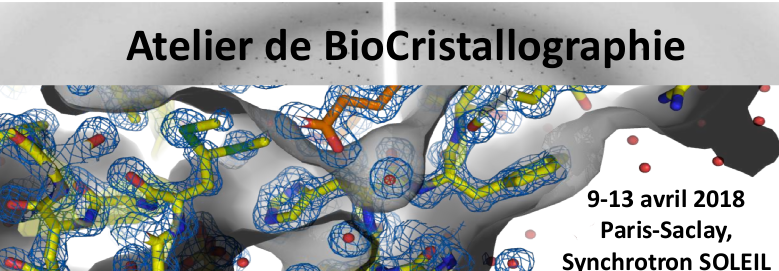
We are pleased to announce that the next ''Atelier de BioCristallographie 2018'' organised by the University Paris-Saclay, the Ecole Polytechnique (Marc Graille), the University Paris-Sud (Inès Gallay), the Synchrotron SOLEIL (Serena Sirigu), and the I2BC (Julie Ménétrey and Marie-Hélène Le Du) will be held at the Synchrotron SOLEIL (Saint Aubin, France) from the 9th to the 13th of April 2018.
The course is aimed to French speaking PhD students, post-doctoral fellows, researchers and engineers who already know the basics but wish to deepen their knowledge of X-ray crystallographic structure determination of biological macromolecules.
The workshop will include morning lessons and afternoon practicals and will cover the following program:
- Crystal freezing
- X-ray data collection and processing on the Proxima1/2 Beamline at the Synchrotron SOLEIL
- Phasing (Anomalous Dispersion and Molecular Replacement)
- Structure refinement and validation
The participants are expected to attend the MOOC “Voyage au cÅ"ur du vivant avec les Rayons X : la Cristallographie†prior to attending the workshop.
Registrations are limited to 12 participants and will be closed on February 16, 2018.
DL_Software Training Workshop
| - |
In Daresbury

The application of analytical SEM and EPMA in the earth sciences
| - |
In London
Instruct/CIISB Fragment Screening using crystallography laboratory equipment
| - |
In Vestec
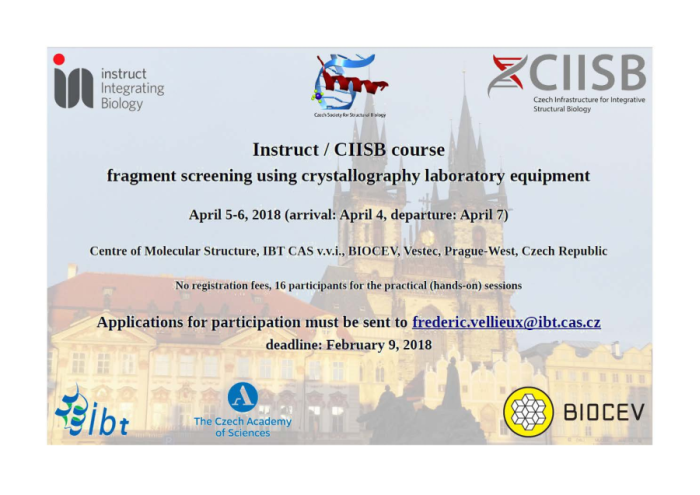
The course has two parts: half a day devoted to lectures on April 5 morning, in the Biocev auditorium - no registration is needed, everyone is welcome to attend the presentations and lectures given by:
Jan Dohnalek (IBT Biocev Vestec)
Andreas Heine (IPC Marburg)
Bohdan Schneider (IBT Biocev Vestec)
Tomas Koval (IBT Biocev Vestec)
Petr Pompach (CMS IBT Biocev Vestec)
Manfred Weiss (Bessy II)
Sameer Velankar (to be confirmed, or another speaker from EBI)
John Darby (Chemistry, U. of York)
The remaining part of the workshop (three half days, April 5 afternoon, April 6 morning and April 6 afternoon) consist of a "workshop", hands on sessions for 16 registered participants. This part will be dealing with
- The initial pre-screening using biophysical methods (Tatsiana Charnavets, CMS)
- Dispensing target protein crystals to a fragment library (Jiri Pavlicek, CMS)
- In situ testing of crystal diffraction, data collection and evaluation of the results (Jiri Pavlicek, CMS)
Due to generous Instruct funding, there will be no registration fees for the 16 registered participants (hands-on sessions), all costs will be covered from the first night (April 4 to April 5) in hotel u Krbu in Vestec (ca. 15 minutes walk from the Biocev) to the departure from the hotel on April 7 after breakfast. For those accepted, of course you are most welcome to arrive earlier and / or depart from the Prague area later in order to discover / visit one of Europe's most beautiful cities, Prague. There are numerous hotels and "BnB" style accomodation available. This isn't part of the course and must be arranged by yourselves. Registered participants (and also the people wanting to attend the lectures only) must cover the cost of travelling to the venue.
Deadline for submission of applications is February 9, 2018
Â
ICDD Rietveld Refinement & Indexing Workshop
| - |
In Newtown Square, PA
ICDD Clinic on X-ray Powder Diffraction: Session II - Advanced Methods in X-ray Powder Diffraction
| - |
In Newtown Square, PA
ICDD Clinic on X-ray Powder Diffraction: Session I - Fundamentals of X-ray Powder Diffraction
| - |
In Newtown Square, PA
ICDD X-ray Fluorescence Clinic
| - |
In Newtown Square, PA
RapiData 2018
| - |
In Stanford, CA
RapiData 2018 at SSRL is a practical course in macromolecular X-ray diffraction data collection, data processing and structure solution. The aim of the RapiData course is to educate and train young scientists in data collection and processing methods at synchrotron beamlines, using state-of-the-art software and instrumentation
The course will comprise hands-on experiments at the SSRL beamlines, software tutorials, and lectures on the following topics:
- Specimen preparation, tactics in data collection
- X-ray light sources
- X-ray detectors
- Data reduction
- Structure solving by MAD, SAD and Molecular replacement
- Complementary methods (spectroscopy and small angle scattering)
EMBO Practical Course on Characterization of macromolecular complexes by integrative structural biology
| - |
In Grenoble