Topics
Materials
Conductivity & Magnetism in Molecular Materials. Gordon Research Conference
| - |
In South Hadley, MA
Molecular Materials: Frontiers in Functional Design
Biomineralization. Gordon Research Conference
| - |
In Girona
Interactions Between Organic and Inorganic Materials Across Time and Length Scales
Bioinspired Materials (GRS)
|
In Les Diablerets
Translating Biological Mechanisms into Functional Materials
ICRS10. International Conference on Residual Stresses
| - |
In Sydney
Debye & Rietveld: A 100 & 50 year celebration
|
In Amsterdam, the Netherlands
Diffraction of radiation is used to determine the atomic structure of materials. The technique developed more than 100 years ago, using single crystals, which are hard to get or to make.
Exactly 100 years ago, Peter Debye alleviated this limitation with the invention of powder diffraction, making sample preparation a piece of cake.
Then 50 years later, Hugo Rietveld introduced a data analysis method that enabled accurate determination of the 3D crystal structure from the obtained powder data.
These two major steps forward make powder diffraction a standard tool in academia and industry today.
We want to celebrate the centennial + golden jubilee with you on 22 September 2016.
Day Programme
09:00 Registration and coffee 09:30 WelcomeHuub Kooijman (Shell) 09:40 The Rietveld Method
t.b.a. 10:00 Debye-Scherrer: An Accidental InventionÂ
Jurrie Reiding (Maastricht University) 10:30 Coffee 10:45 Powder diffraction in direct space: How the Pair Distribution Function can complement powder diffraction
Reinhard Neder (Univ. Erlangen) 11:25 Powder diffraction: providing one of the best views of the material world
Bill David (Univ. Oxford) 12:05 lunch, posters, exhibition 13:30 How much information can be deduced from a powder pattern: A tribute to Peter Debye and Hugo Rietveld
Robert Dinnebier (MPI Stuttgart) 14:10 Debye and Rietveld in industrial applications
Jaap Louwen (Albemarle) 14:40 Debye equation: How did it evolve?
Paolo Scardi (Univ. Trento) 15:20 Tea and posters 15:50 Neutrons And X-rays for battery materials
Marnix Wagemaker (TU Delft) 16:20 Macromolecular Powder Diffraction: Past, Present, Future
Irene Margiolakis (Univ. of Patras)
Evening Programme
17:00 Boat cruise leaving from STCA through Amsterdam canals 19:00 Dinner at restaurant along the IJ river.Â

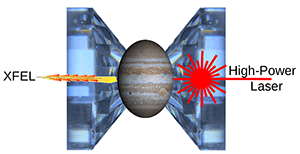
5th Joint Workshop on High Pressure, Planetary and Plasma Physics (HP4)
| - |
In Hamburg
- The generation and diagnostics of extreme states of matter as appearing in the interior of planets, brown dwarfs and stars is one of the key scientific challenges in a number of scientific fields. These include:
- Generation of such conditions at FLASH at the future free electron laser facility (European XFEL).
- Generation of higher pressures in static experiments both in the laboratory and at synchrotron facilities (PETRA III).
- Development of new diagnostic tools.
- Predictions of high pressure and temperature properties of materials from ab initio methods.
- Application of such results to the study of interior of planetary and astrophysical bodies.
To bring together researchers from these different fields in the physical sciences a workshop series has been established by DESY, XFEL GmbH, DLR Berlin, the University of Rostock and Bayerisches Goinstitut to discuss related topics and problems. Earlier workshops were held at DESY Hamburg (2012), DLR Berlin (2013), University of Rostock (2014) and the Bayerisches Geoinstitut at the University of Bayreuth. The aim of the upcoming workshop is to continue the discussion of scientific questions with relevance for extreme planetary environments in terms of high pressure (HP) and high temperature (HT). The conditions prevalent in the deep interiors and atmospheric envelopes of solar system planets, their satellites as well as massive solid and gas giant extrasolar planets, respectively, and are not fully accessible by conventional experimental and theoretical methods. New and enabling techniques to be used in the HP/HT regime are based on the combination of intense pulsed X-ray sources with pulsed sample excitation, in particular but not exclusively related to high energy optical lasers. Simultaneously, ab initio simulations for matter under extreme conditions provide a more and more predictive data set for planetary interiors in this HP/HT regime.
The following topics will be part of the workshop:
- Evolution and structure of giant planet interiors
- Interior structure, bulk composition, and internal geodynamics of solid planets
- Deep volatile cycles and exchange processes between geochemical reservoirs
- Physics and chemistry of impact processes
- Equations of state, petrology, and geochemistry of planetary materials
- Melting relations and phase transformations of materials at extreme states
- Dynamic and ultrafast processes in strongly excited solids or similar,
- Compression experiments using high-power optical and free electron lasers
- Laboratory experiments using multi-anvil and diamond-anvil cells
- Ab initio simulation studies for matter under extreme conditions
MLZ Conference: Neutrons for Energy
| - |
In Bad Reichenhall
This conference covers major topics of neutron analytics for energy research like energy storage and energy transformation (including batteries, fuel cells, electrolysis, H2-storage, thermoelectrics, and magnetocalorics), solar energy applications, catalysis, as well as engineering and industrial applications. In addition methodological instrument developments are an important contribution to enhance energy research with neutrons.
Topics
- Energy storage & transformation
- Solar Energy
- Catalysis
- Nuclear Energy
- Engineering & Industrial applications
- Advanced and Complementary methods
The conference will be directly followed by the HGF Programme "From Matter to Materials and Life": Workshop of In-house Research Theme: "Materials and Processes for Energy and Transport Technologies" (21st-22nd July 2016).
The Future of X-Ray and Electron Spectroscopies
| - |
In Uppsala

X-Ray and Neutron Science - International Student Summer Programme
| - |
In Grenoble
Hydrogen School 2016
| - |
In Berlin
Neutron scattering applications to hydrogen storage materials
Energy research is an important scientific area today and hydrogen is one of the most promising sources of energy due to its highest energy density by weight. The efficient hydrogen storage depends on development of the new materials. Neutron scattering and -diffraction are powerful, non-destructive tool for the analysis of structure and dynamics in matter in a broad space and time domain.High sensitivity to hydrogen makes neutron scattering techniques ideally suitable to study the process in hydrogen storage systems. The goal of this school is to introduce participants to basics of neutron scattering techniques and show how these techniques can be applied for exploration of hydrogen storage materials.The lectures and practical exercises will give basics to:Â Â Â
- Hydrogen economy and hydrogen storage technologies  Â
- Fundamentals of the gas storage Â
- Basics of neutron scattering and in particular in situ neutron diffraction  Â
- Characterizing sorption behavior of porous materials by ab initio and crystal structure refinements

Defects in Semiconductors. Gordon Research Conference
| - |
In New London, NH
Fundamental Research on Defects: Enabling Technological Advances in Semiconductor-Based Devices
Conductivity & Magnetism in Molecular Materials. Gordon Research Conference
| - |
In South Hadley, MA
Molecular Materials: Frontiers in Functional Design
Multiferroic & Magnetoelectric Materials. Gordon Research Conference
| - |
In Lewiston, ME
Multiferroics: From Fundamentals to Novel Functionalities and Applications
Electron Donor-Acceptor Interactions. Gordon Research Conference
| - |
In Newport, RI
Fundamentals of Electron- and Energy-Transfer Processes in Materials and Biology
Electron Donor-Acceptor Interactions (GRS)
| - |
In Newport, RI
New Frontiers in Energy Harvesting and Storage from Biological Systems to Nanostructured Materials
Ceramics, Solid State Studies in. Gordon Research Conference
| - |
In South Hadley, MA
Creating Functionality of Advanced Ceramics by Innovative Materials Processing
Ceramics, Solid State Studies in (GRS)
| - |
In South Hadley, MA
Ceramics at the Microscale: State-of-the-Art in Processing, Properties and Microsctructure
VI-th National Crystallographic Symposium (NCS2016)
| - |
In Sofia
We are happy to announce VI-th National Crystallographic Symposium (NCS2016) that will be held on October 05-07, 2016, Sofia, Bulgaria.
As you may have already recognized this is will be the sixth "NCS" of the series started in 2009.
We have already started the preparation of the next issue of the conference (submitted manuscripts will be published in the journal “Bulgarian Chemical Communicationsâ€, a special issues due April 2017).NCS16 papers will also be online available in full text via the present platform.  You are warmly invited to come and join us!
NCS2016 is held under the auspices of BCS and is the major event on Crystallography, crystal growth, structure analyses and related techniques in Bulgaria. The Symposium aims at the applications of different crystallographic techniques in combination with other methods in the fields of materials sciences, mineralogy, biology, environmental engineering, computational methods etc. Bringing together researchers from different areas NCS16 will provide them with a high-qualified platform for them to share their latest studies and to assist further findings and collaboration.
With passionate participants from the world, NCS2016 Â would be perfect for you to present your research and find collaboration for your future work.

Water & Aqueous Solutions. Gordon Research Seminar & Conference
| - |
In New Hampshire

Solid State Chemistry. Gordon Research Conference
| - |
In New London, NH