Topics
NMR crystallography
SMARTER 6
| - |
In Ljubljana
The series of SMARTER meetings aims to bring together scientists in the areas of computation, diffraction, and NMR spectroscopy to promote combining various techniques and develop smarter approaches for structure determination of complex inorganic, organic and biological materials.
Registration and more information about the meeting can be found here:Â Â https://smarter6.ki.si/index.php/smarter6/
Registration opens in Spring 2018.Â
Bridging Solution Methods: From NMR to X-ray Scattering and Biophysics (iNEXT course)
| - |
In Patras

Computational Aspects - Biomolecular NMR (GRC)
| - |
In Newry, ME
Uniting NMR and Computational Approaches to Push the Frontiers of Dynamic Structure and Conformational Transitions Critical to Function and Dysfunction
AUC 2017 - The 23rd International AUC Workshop and Symposium
| - |
In Glasgow, Scotland
The focus of AUC 2017 is on solution studies of biological macromolecules, interacting systems, synthetic polymers, nanoparticles and colloids. Techniques such as analytical ultracentrifugation (AUC), dynamic and static light scattering (DLS, MALLS), small angle X-ray and neutron scattering (SAXS, SANS), NMR, SPR, field flow fractionation (FFF), and calorimetry (ITC, DSC) are featured.
AUC 2017 will open with several workshops, which begin on the afternoon of Sunday 23rd July, and end on the afternoon of Tuesday 25th July. These workshops will be given by leading experts in the workshop topics.
A symposium will follow the workshop, starting in the evening of Tuesday 25th July with our keynote lecture and continue until the afternoon of Friday 28th July. The symposium will offer two poster sessions, an exhibitor fair, and round-table discussions.
21st National Seminar on Crystal Growth and Applications
| - |
In Tiruchichirappalli
Combining Simulation and Experiment in Molecular Imaging
|
In Southampton
VI-th National Crystallographic Symposium (NCS2016)
| - |
In Sofia
We are happy to announce VI-th National Crystallographic Symposium (NCS2016) that will be held on October 05-07, 2016, Sofia, Bulgaria.
As you may have already recognized this is will be the sixth "NCS" of the series started in 2009.
We have already started the preparation of the next issue of the conference (submitted manuscripts will be published in the journal “Bulgarian Chemical Communicationsâ€, a special issues due April 2017).NCS16 papers will also be online available in full text via the present platform.  You are warmly invited to come and join us!
NCS2016 is held under the auspices of BCS and is the major event on Crystallography, crystal growth, structure analyses and related techniques in Bulgaria. The Symposium aims at the applications of different crystallographic techniques in combination with other methods in the fields of materials sciences, mineralogy, biology, environmental engineering, computational methods etc. Bringing together researchers from different areas NCS16 will provide them with a high-qualified platform for them to share their latest studies and to assist further findings and collaboration.
With passionate participants from the world, NCS2016 Â would be perfect for you to present your research and find collaboration for your future work.

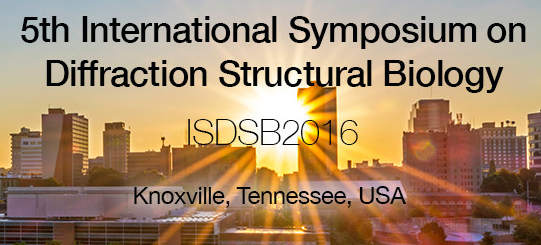
5th International Symposium on Diffraction Structural Biology (ISDSB2016)
| - |
In Knoxville, TN
This symposium will report on the latest discoveries in structural biology using X-ray, neutron, and electron diffraction, and complementary techniques such as small-angle scattering, nuclear magnetic resonance spectroscopy, electron microscopy, and advanced computational approaches. Scientific insights at the molecular level allow structure guided drug discovery and protein engineering for improved biocatalysis. This basic research is important for supporting applications in the pharmaceutical industry and for new, sustainable, and environmentally friendly approaches to the production of chemical reagents and biofuels.
Session topics include:
- Bioenergy Drug Design
- Enzyme Mechanism and Allostery
- Macromolecular Complexes
- Membranes
- Membrane Proteins
- New Instruments and Methods
- Sources and Facilities
The Symposium will be accompanied by two optional 1-day workshops on August 6, focused on Neutron Protein Crystallography and on Small-Angle Scattering, respectively.
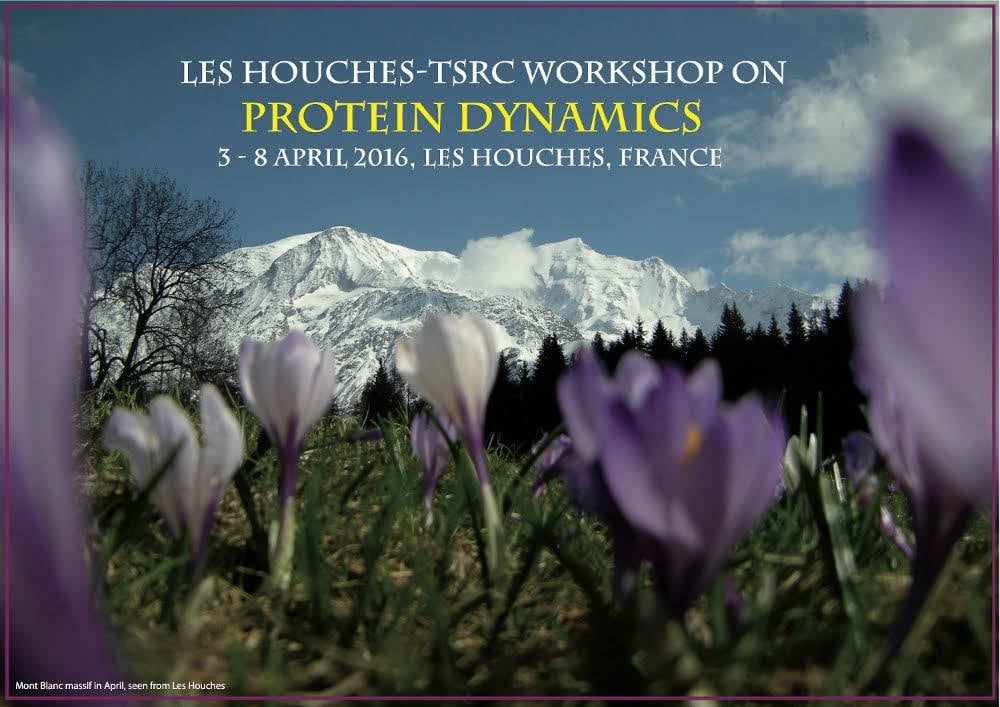
Les Houches-TSRC Workshop on Protein Dynamics
| - |
In Les Houches
This workshop is a forum for presenting, teaching and discussing results
from the application of state-of-the-art experimental and theoretical
and computational approaches to studying protein dynamics, including
optical spectroscopy, NMR spectroscopy, X-ray crystallography, XFELs,
electron microscopy, AFM and scattering methods.
 Confirmed speakers
Bai, Xiaochen (LMB Cambridge, UK)
Barends, Thomas (MPI Heidelberg, Germany)
Blackledge, Martin (Institut de Biologie Structurale, France)
Cammarata, Marco (U de Rennes, France)
Colletier, Jacques-Philippe (Institut de Biologie Structurale, France)
Fenimore, Paul (Los Alamos NL, USA)
Havenith, Martina (U Bochum, Germany)
Hilser, Vincent (Johns Hopkins University, USA)
Heyden, Matthias (MPI Mülheim, Germany)
Ishii, Kunihiko (Riken, Japan)
Katona, Gergely (U Gothenburg)
Klostermeier, Dagmar (U Münster, Germany)
Lindorff-Larsen, Kresten (U Copenhagen, Denmark)
Lewandowski, Jozef (U Warwick, UK)
Mulder, Frans (U Aarhus, Denmark)
Palmer, Arthur (Columbia University, USA)
Parrinello, Michele (ETH Lugano)
Schanda, Paul (Institut de Biologie Structurale, France)
Schirò, Giorgio (Institut de Biologie Structurale, France)
Sprangers, Remco (MPI Tübingen, Germany)
Stock, Gerhard (U Freiburg, Germany)
Uchihashi, Takayuki (U Kanazawa, Japan)
Van den Bedem, Henry (Stanford University, USA)
Van Thor, Jasper (Imperial College London, UK)
Wand, Josh (U Pennsylvania, USA)
Australasian Soft Matter Scattering Workshop
| - |
In Melbourne
This scattering workshop is for those with an interest in soft condensed matter as found in biology, polymer science, the colloidal domain and interfacial science.
The workshop has some leading experimentalists giving tutorials on light scattering, small-angle scattering, grazing incidence scattering, pulsed field gradient NMR and reflectivity.
We will also host a small number of science talks but the primary focus of the meeting is to introduce researchers to a range of scattering techniques, with emphasis on their application to research in soft matter.
The workshop will be held at RMIT University's Melbourne city campus from the 11th to the 12th of Feb. Attendance is free but registration is necessary. There is some support available for students to attend the meeting from Australia and New Zealand.
Organisers: Dr Chris Garvey ([email protected]) or Prof Gary Bryant ([email protected])
HERCULES 2016 - European School. 26 Years of Neutron & Synchrotron Radiation Science
| - |
In Grenoble
HERCULES is a European course for PhD students and young researchers using Neutrons and Synchrotron Radiation for applications in Biology, Chemistry, Physics, Hard & Soft Condensed Matter.
   The 1-month school includes lectures (60%), hands-on practicals and tutorials at partner institutes (DESY and European XFEL in Hamburg, Ellettra and FERMI in Trieste, ESRF, ILL in Grenoble, Soleil and LLB near Paris, SLS in Switzerland) and Grenoble Laboratories (CEA, CNRS, EMBL, IBS).
   The school includes a common part and two parallel sessions:
- Biomolecular, soft condensed matter structure & dynamics
- Physics and chemistry of condensed matter
  Â
   Why join Hercules ?
- to learn new techniques using neutron and synchrotron radiation
- to expand your theoretical and practical knowledge, not only for your present research but for your scientific career
- to experiment these techniques on world-class instruments & beamlines
- to build a network of relations with fellow young researchers and experienced teachers from all around the World
Deadline for application:Â Â 31 October 2015
Bursaries/reduced costs: a limited number of bursaries will be available either to reduce registration fees or cover travel costs.
Common Lectures:
- Interaction of X-rays and neutrons with matter (absorption, elastic and inelastic interactions, ...)
- Sources (neutron, synchrotron, XFEL)
- Detectors
- Optics &instrumentation
- Diffraction (single crystal, powder..)
- Scattering (elastic, inelastic..)
- Spectroscopy
- Imaging (Absorption, coherent,..)
- etc.
Session A: Applications to Biomolecular, Soft Condensed matter, Structure and Dynamics
- Protein structure and dynamics
- Studies in solutions
- Partially ordered systems
- Membranes, fibres and muscles
- Crystallography of viruses and ribosomes
- Structural genomics
- Biomedical applications (imaging, therapy)
- Time-resolved and ultra-fast X-ray science
- Biology with 4th generation sources
- etc.
Session B: Applications to Physics and Chemistry of Condensed Matter
- Neutron and X-ray (and UV and IR) spectroscopies
- X-ray reflectivity and diffraction of nano systems
- Single crystal and powder diffraction
- Coherent imaging and tomography
- Neutron and X-ray magnetic scattering
- Polarized X-rays and neutrons
- FEL and ultra fast X-ray science
- etc.

BRSG Christmas Meeting 2015: NMR & Crystallography
|
In Institute of Physics, London
The annual "Christmas" meeting of the BRSG in London (UK) will this year bring together solid-state NMR researchers with crystallographers and modellers to present research of common interest. Invited overseas speaker: Marek Potrzebowski (Lòdz, Poland).

Computational Aspects - Biomolecular NMR. Gordon Research Seminar
| - |
In Lucca, Barga
Membrane Protein Structures 2015 Meeting (MPS 2015) and one-day workshop on Membrane Protein Technologies
| - |
In Argonne National Laboratory, Lemont, IL
Workshops on Membrane Protein Technologies: April 9, 2015
MPS 2015 Meeting: April 10-12, 2015
The goal of the meeting is to share developments in technologies appropriate for the determination of the structure of membrane proteins, membrane protein complexes with other proteins and ligands, and to highlight recent results. The meeting brings together keynote lectures, oral presentations and poster presentations. Subjects range from membrane protein construct design, expression to mass spectrometry, spectroscopic, X-ray diffraction, electron microscopy imaging, and hybrid approaches.Â
Industry sponsors are invited to participate fully in the meeting. Students and postdoctoral scholars are encouraged to submit abstracts for oral or poster presentations. Workshops are offered that share experience and training in most recent developments in areas including but are not limited to membrane protein expression systems, protein purification, solubilization, crystallization, LCP, free electron laser sample preparation, and NMR.
Â
Â

Computational Aspects - Biomolecular NMR: Exploring the Frontiers of NMR, Computations and Complementary Biophysical Methods. Gordon Research Conference
| - |
In Lucca (Barga
Chair:Â Alexandre Bonvin
Vice Chair:Â Valerie Daggett
The Gordon Research Conference on Computational Aspects of Biomolecular NMR provides a unique forum for the presentation and discussion of emerging methods at the intersection of experimental Nuclear Magnetic Resonance (NMR), computational methods and other complementary biophysical techniques.
NMR is one of the most versatile methods for the investigation of biomolecular systems, whether these are proteins, nucleic acids, glycans, membranes, or functioning cellular and in vivo systems. In the modern toolbox of researchers, NMR is one of the well-established methods, which, in combination with other complementary biophysical and computational methods, contributes to our understanding and diagnosis of disease, the development of therapeutics to combat disease and the engineering of novel or improved biomolecules with a wide range of applications in heath, food and materials. NMR can provide unique structural, dynamical and functional information to achieve these goals. Continuous advances are pushing back the frontiers of NMR in numerous application fields, enabling the study of systems of ever increasing complexity and/or in more natural, cellular environments. All these can, however, only be achieved by integrating new types of data and learning to use them in combination with other experimental information sources. Computational methods, whose importance for the field has been recognized by the awarding of the 2013 Nobel prize in chemistry, play here a key role in this integration process.
This GRC conference will bring together practitioners in NMR, computational structural biology and other complementary biophysical techniques for the purpose of generating new ideas and promoting collaborations in order to generate the next generation of integrative methods that will allow us to tackle ever more challenging systems.
The 2015 meeting, which will take place at the beautiful location of Il Ciocco in Toscane. It will have sessions devoted to advances in integrative structural biology, complementary biophysical techniques, frontiers in solid state NMR, signal processing, intrinsically disordered systems and interactions, ligand interactions and metabolomics, conformational variability and challenges in structure determination. Further, the importance of NMR for industry will be highlighted in a dedicated session. The prominent list of speakers, along with the small format of the conference, will provide unique opportunities for graduate students, postdocs, and those new to this research area, to discuss their research with leaders in the field. Extensive poster sessions, along with promoted talks, will facilitate this process.
A Gordon Research Seminar on "Molecular Simulation for the Interpretation of NMR Data" will precede the conference. Besides providing an excellent opportunity for graduate students and postdocs to become familiar with the atmosphere of a Gordon Conference, the Seminar will feature keynote talks from leaders in the field and speaking slots for a number of students and postdocs. Application for the Seminar and Conference are separate, and those interested should consult the Seminar description.
Preliminary Program
A list of preliminary session topics and speakers is displayed below (discussion leaders are noted in italics). The detailed program is currently being developed by the Conference Chair and will be available by February 7, 2015. Please check the conference website for updates.
- Â
- Keynote Session: Advances in Integrative Structural Biology
(Antonio Rosato / Andrej Sali / Adam Lange) - Conformational Variability and Dynamics
(Andrew Baldwin / Christian Griesinger / Claudio Luchinat / Arthur Palmer / David Fushman) - NMR and Computations in Industry
(Ben Davis / Greg Siegal / Michael Schaefer / Chun-Wa Chung) - Ligand Interactions and Metabolomics
(Giovanna Musco / Robert Konrat / James Prestergard / Rafael Bruschweiler / David Wishart) - Signal Processing
(Christina Redfield / Jeffrey Hoch / Tatyana Polenova / Vladislav Orekhov) - Pushing the Limits of Solid State NMR
(Tatyana Polenova / Marc Baldus / Mei Hong / Lyndon Emsley / Anne Ulrich) - Frontiers of NMR: Complementary Methods
(Alexandre Bonvin / Pau Bernardo / Alexander Leitner / Holger Stark) - Challenges in Structure Determination
(Torsten Herrmann / Ad Bax / Tobias Madl / Chad Rienstra / Angela Gronenborn) - Intrinsically Disordered Systems and Interactions
(Valerie Daggett / Frans Mulder / Carine Van Heijenoort / Martin Blackledge)
56th Experimental Nuclear Magnetic Resonance Conference
| - |
In Pacific Grove, CA
 Welcome Back to Asilomar!
April 19-24, 2015
Asilomar Conference Center
800 Asilomar Blvd
Pacific Grove, California
Chair
Teresa CarlomagnoEMBL Heidelberg
Important Dates
- October 31, 2014 Deadline for Laukien Prize nominations
- January 12, 2015 Deadline for abstracts to be considered for talks and for early decision
- January 12, 2015 Deadline for student travel stipend applications and Ritchey Travel Award applications
- March 9, 2015 Deadline for post deadline late-breaking abstracts
- March 20, 2015 Deadline for Conference registration and Asilomar housing
SMARTER4
| - |
In Durham
SMARTER4 is the latest in a series of meetings on resolving structural questions by the combined use of NMR, diffraction and computation. The format of and scale of meeting is designed to encourage cross-fertilisation across subject boundaries, with keynote speakers chosen to reflect the diversity of approaches required to solve complex structural problems, such as obtaining crystal structures from powdered samples or understanding disordered systems.
SMARTER stands for Structure elucidation by coMbining mAgnetic Resonance, compuTation modEling and diffRactions.