Events
IUCr sponsored meetings
International Rietveld School Sofia 2015
| - |
In Sofia
Introduction to the theoretical background of the Rietveld method and principles of crystal structure refinement from powder diffraction data.
This six day long school aims to introduce participants to the way the information about crystal structure and sample microstructure is contained in X-ray powder diffraction patterns and how to get use of it.
The school provides a set of lectures, devoted to the main aspects of crystal structure description and fundamentals of powder diffraction. Main concepts, that Rietveld structure refinement is based on, will be covered as well.
Practical sessions are designed to initiate and promote basic skills for working with powder diffraction data and respective data treatment software. Tutors will be on disposal to help participants in the course of training.

9th AOFSRR Cheiron School
| - |
In Hyogo

2015 IUCr High-Pressure Workshop
| - |
In Campinas
IXS 2015. 9th International Conference on Inelastic X-ray Scattering
| - |
In Hsinchu

ESCG. European School on Crystal Growth
| - |
In Bologna
The aim of the ESCG School is to bring together PhD students and young researchers from all over Europe and the rest of the world in a warm and stimulating atmosphere to introduce them to the fundamental concepts and mechanisms governing crystal growth processes. Nowadays, many schools, tutorials and brief courses on specific aspects of the growth of advanced materials are being offered to the International Crystal Growth community; however, the importance of raising the new generation of crystal growers with an in-depth knowledge of the fundamental concepts at the basis of crystal growth science is never enough emphasized. To fill the gap, the ESCG School intends to address the fundamental aspects of the science and technology of crystal growth, with emphasis on the fundamental thermodynamics, fluid-dynamics, kinetics and atomistic mechanisms ruling crystal growth processes; these mechanisms will be presented along with principles of crystallization from the melt, liquid and vapour, for application to the synthesis of bulk, epitaxial, and nanosized crystals. The ambition of the School is to give the attendees a unitary view of the science and technology of crystal growth, despite the many and apparently diverse materials fields it nowadays applies. Selected senior experts in the field will give the lectures, answer your questions and are available for discussions.
ESCG is also the official AIC School 2015. It will take place in conjunction with the Fifth European Conference on Crystal Growth (ECCG5), which will be held also in Bologna in the days after the School. We cordially invite you to participate in this school and mark the dates in your agenda.

Electron Diffraction for Quantitative Surface Structure Determination. ICSOS workshop-3 on surface structures
| - |
In Lodz
SS-VII. Size-Strain VII. Diffraction Analysis of the Microstructure of Materials
| - |
In Oxford
Following the previous two meetings held in Garmisch (V) and Giens (VI), the present conference deals with materials microstructure and properties, as they can be studied by diffraction methods, with a special interest in the application of diffraction techniques to polycrystalline materials, methodologies for the study of lattice defects, residual stress and texture in thin films, surfaces and nanostructures, line-broadening analysis, line-profile fitting and modelling based on fundamental parameters for applications in materials science problems. New topics, added at SS-VI, were microbeam diffraction and coherent diffraction. SS-VII will add X-ray and neutron imaging, and PDF (pair distribution function) analysis to the list of methodologies covered.
 The seventh Size-Strain conference will take place in the historic city of Oxford. Scientific sessions will take place at the University of Oxford's Department of Engineering Science and accommodation will be available to book in nearby Trinity College. A half day trip to Diamond and ISIS will be arranged and transport provided.
 Co-chairs: Ian Robinson (UCL) and Alexander Korsunsky (Oxford)
ECS2. Second European Crystallography School
| - |
In Mieres (Asturias)
Crystallography: Fundamentals, Online Tools and Applications
The European Crystallographic Association (ECA) and the University of Oviedo invite the world-wide crystallographic community (and all scientists and students working in any related field) to an intensive session of working together and learning crystallography from each other.
With help from our sponsors, we have achieved a registration cost of 570 euros (young academic, including accommodation and meals). We expect to have student bursaries available to reduce the cost further for a limited number of attendees. The number of attendees is limited to 90 students.
The application deadline is March 31st, 2015.
Programme
The programme schedule aims to answer the new and challenging requirements of the crystallography education and training during the 2nd century of modern crystallography. It is divided into four different modules:

Pre-school basic tools:
- Matrix calculus in crystallography
- Symmetry elements and symmetry operations
- Basic group theory
- Introduction to Reciprocal Space
Fundamental Crystallography:
- Symmetry groups and types of symmetry in direct space
- Space groups and their description in International Tables for Crystallography, Vol. A
- Group-subgroup relations â€" On line tools.
- Crystal-structure descriptions â€" On line tools.
- Crystal-structure relations â€" On line tools.
- Diffraction and Phasing.
- Diffraction Methods for Metal-Organic and Inorganic crystals.
- Diffraction Methods for biological crystals.
- Diffraction Methods for Nanomaterials â€" Electron diffraction.
- Diffraction Metodos for Magnetic Materials.
- Practical sessions on Online Tools â€" Tutorials : Sir/Expo-Janaâ€"Toposâ€"Fullprof
 Specific Subjects:
- Biological Crystallography
- Materials Crystallography
- On line tools â€" Tutorials: CCP4, SHELX, SIR
Hot topic Subjects:
- Time resolved Crystallography
- XFEL Crystallography
- Electron Crystallography
- Crystallography in the Space
Second Balkan School on Fundamental Crystallography / Workshop on Magnetic Symmetry and its Application in Magnetic Structure Description
| - |
In Istanbul
Symmetry and group theory
| - |
In Tsukuba
Pre-requisites
The participants are expected to know basic matrix algebra (how to multiply matrices and vectors, how calculate determinant and trace of a matrix: however, an optional half-day is devoted to revise these notions), fundamental electromagnetism (waves, diffraction) and basic chemistry.
Program
The training course will span five full days, from 9 to 13 March, 2015. Monday morning (March 9) is optional for those needing to revise general concepts about matrix algebra and abstract algebra (general introduction to group theory). Exercices proposed during the whole course are integral part of the course: participants are expected to actively participate and solve the proposed exercises.
Monday, 9 March
- Morning: optional session on matrix and abstract algebra
- Afternoon: introduction to crystallographic symmetry and lattices
Tuesday, 10 March 15
- Morphological symmetry
- Stereographic projection, with exercises
- Crystallographic point groups and geometric crystal classes
- Matrix representation of point group operations
- Symmetry elements with a translational component (screw axes and glide planes)
Wednesday, 11 March
- Introduction to space groups
- Graphical construction of space groups
- Metric tensor and applications
- Change of axial settings and alternative settings of space groups
Thursday, 12 March
- Reciprocal lattice and systematic absences
- Matrix representation of space group operations
- Crystallographic orbits
Friday, 13 March
- Group-subgroup relations
- Structure-substructure relations and applications to displacive phase transitions
The 5th Winter School on Soft X-Rays in Macromolecular Crystallography
| - |
In Athens, GA
The aim of the School is to bring together experts and young scientists interested in exploiting the anomalous signal from light atoms (e.g. S, P, Ca, K, Mg) native to the protein or crystal for macromolecular structure determination using soft (wavelengths > 1.5Ã...) X-rays in order to help train the next generation of scientists in this maturing field. The 5th Winter School on Soft X-rays in Macromolecular Crystallography is a continuation of similar workshops held in Europe since 2003 as indicated:
1st Winter School:Â Bressanone/Brixen, Italy; Feb. 25-27, 2003
2nd Winter School: Seefeld, Austria; March 22-25, 2006
3rd Winter School:Â Berlin, Germany; February 18-20, 2009
4th Winter School:Â Grenoble, France, February 6-8, 2012
Topics Covered
SAD Theory & Historical Perspectives These lectures will address the theoretical aspects of overcoming the phase problem in using SAD and S-SAD data and highlight the historical perspectives of two initial de novo structures solved by S-SAD.Source/Beamline Considerations These lectures and Case Studies will cover the optimization of the experiment setup in terms of the hardware, choice of wavelength and other source specific parameters.
Data Collection Strategies This lecture will cover techniques and problems associated with collecting sulfur-SAD data including crystal centering, data collection setup and methods used to increase the anomalous scattering signal to noise ratio in the data. The lecture will highlight common areas where problems can occur and suggest how best to eliminate them.
Data Reduction Theory and Strategies These lectures and Case Studies will focus on the data reduction process (indexing, integration and scaling) using several popular data reduction programs as examples, highlighting critical program input parameters and program output. The lecture will highlight common areas where problems can occur and suggest how best to eliminate them. New methods such as Multi-Crystal and Single Crystal Multi-dataset averaging will be described.
Anomalous Substructure Determination & Phasing This lecture and Case Study will describe the use of SHELXCDE [9] and HKL2MAP to determine the anomalous scattering substructure, the correct handedness of the anomalous scattering substructure, the generation of initial protein phases and interpreting the quality of the resulting electron density map.

IYCr2014 Opening Ceremony
| - |
In Paris
- See the photo galleryÂ
- Read a report by Chris Howard for the Newsletter of the Society of Crystallographers of Australia and New Zealand
Frontiers of Structural Biology: New Advances in X-ray Diffraction and Cryo-Electron Microscopy
| - |
In Indian National Science Academy, New Delhi
As part of the celebration of the International year of Crystallography (2014), Indian National Science Academy (INSA), New Delhi and Regional Centre for Biotechnology (RCB), Gurgaon are jointly organizing a Symposium-cum-Workshop entitled "Frontiers of Structural Biology: New Advances in X-ray Diffraction and Cryo-electron Microscopy" during December 15-17, 2014 at INSA premises witha view to bringing together leading scientists in the field to discuss the major new advances in Structural Biology. The meeting will focus primarily on progressive developments in macromolecular crystallography, Cryo-electron Microscopy and X-ray Free Electron Laser (XFEL) Sources for structure determination.
The three day event will feature keynote lectures, poster presentations and workshop tutorials by distinguished experts from India and overseas. The workshop is highly encouraging participation of young scientists from India as well as the South Asian and Asia-Pacific region.
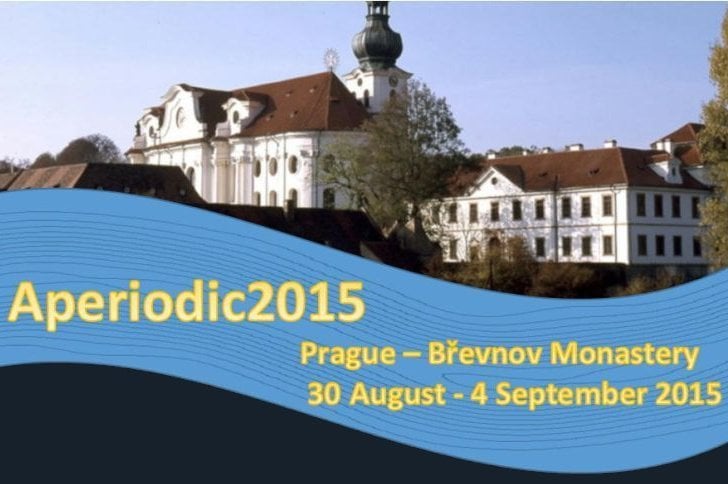
Aperiodic 2015
| - |
In Prague
This will be the eighth of a series of events held triennially since the first Aperiodic in Les Diablerets in 1994. The aim of the conference is to bring together scientists dealing with all aspects of aperiodic crystals and related problems. The conference will be hosted in the baroque building of the Brevnov monastery - the first male monastery in Bohemia founded in 993 AD. Despite of the historical origin, the venue offers all the necessary comfort for a successful and pleasant conference.
The venue is situated only about two kilometres from the Prague castle and about 20 minutes by tram from the famous historical city centre of Prague. Being considered by many one of the most beautiful cities in the world, we believe that the participants will enjoy not only the scientific programme, but also the opportunity to explore the magic and beauty of this city in the heart of Europe.
XV Intensive Teaching School in X-ray Structure Analysis
| - |
In Durham
The main focus of the school is on chemical and materials science. Topics to be covered will include:
- Growth and evaluation of non-macromolecular crystals
- Space group determination
- Background theory to data acquisition for small molecules and inorganics
- Practical aspects of data collection
- Practical aspects of data processing
- Fourier syntheses
- Patterson syntheses and direct methods for crystal structure determination
- Charge flipping
- Refinement of inorganic, organic and metal-organic structures
- Derivation of results
- Random and systematic errors
- Twinning
- Validation of results
- Crystallographic databases (CSD, ICSD, etc)
Latin American Summit Meeting on Biological Crystallography and Complementary Methods
| - |
In CNPEM, Campinas
Structural Biology has been chosen as the theme for the Latin American summit. Under the auspices of UNESCO and the IUCr, the summit meeting intends to provide a forum for stimulating the application of crystallography to complex biological phenomena. The meeting will consist of a series of scientific presentations by invited scientists from the region and will serve as a showcase for the progress which has been made in protein crystallography and related subjects over the course of the last 25 years. The relatively small number of participants (around 100) should guarantee a friendly environment conducive to discussing the scientific future of the region and specifically the contribution that crystallography can make to that future. It is hoped to have representatives from Brazil, Argentina, Uruguay, Paraguay, Peru, Venezuela and Mexico amongst others. The importance of creating greater integration with the wider scientific community will be emphasized by the participation of world-class Latin American scientists who have had successful careers outside of the region as well as by the opening lecture to be given by Nobel Laureate Ada Yonath.
Scope and objectives
2014 has been designated the International Year of Crystallography (IYCr2014) under the auspices of UNESCO and the International Union of Crystallography. The major objectives of the IYCr2014 are:
- To increase public awareness of the science of crystallography and how it underpins most technological developments in our modern society;
- To inspire young people through public exhibitions, conferences and hands-on demonstrations in schools;
- To illustrate the universality of science;
- To intensify the programme Crystallography in Africa and create similar programmes in Asia and Latin America;
- To foster international collaboration between scientists worldwide, especially Northâ€"South cooperation;
- To promote education and research in crystallography and its links to other sciences;
- To involve the large synchrotron and neutron radiation facilities worldwide in the celebrations of IYCr2014, including the SESAME project set up under UNESCO auspices.

IYCr Pan African and South African Summit
| - |
In Bloemfontein
Crystallography as vehicle to promote Science in Africa and beyond
The event will consist of a three-day Workshop [12-15 October] in the form of high-level scientific presentations, also by young scientists in particular. This will be followed by the IYCr2014 Summit Meeting [15-17 October] as platform wherein Science Policy Makers in Africa will be brought together, and ways to promote the expansion of Science in Africa are explored and debated.
Â
VI School of the Argentinian Crystallographic Association
| - |
In Mar del Plata
Structural Biology: Using Synchrotron Radiation to Visualize Biological Molecules
| - |
In Trieste
The Advanced Workshop is organized by the Abdus Salam International centre for Theoretical Physics (ICTP).
The objective of this Workshop is to expose the participants to the methodologies used to solve macromolecular structures, using synchrotron radiation X-ray diffraction and scattering techniques. Structural biology is an interdisciplinary research area, requiring expertises from both the life sciences and the physical sciences, so it is often difficult to educate and train young scientists with the necessary breath of experience. The Workshop is meant to provide a comprehensive overview of the state of the art in the fields of macromolecular crystallography and small-angle X-ray scattering, and aims to bridge the gap between physics and biology by covering the entire process, starting from the gene to obtain the atomic structure. A few practical sessions will provide thestudents with some hands-on experience in some of the subjects covered by the lectures
This event is part of a joint initiative between ICTP, IAEA, Elettra and SESAME, the Middle East Synchrotron Radiation facility in Jordan.
Topics will include:
- Protein production
- Crystallization
- MX data collection and processing
- MX structure determination
- Refinement
- Model building
- SAXS data collection and structure determination
- Complementary techniques.
Hands-on sessions will include:
- Crystallization
- Synchrotron data collection
- Data processing
- Refinement Model building
Participation:
Scientists and students from all countries that are members of the United Nations, UNESCO or IAEA may attend the Workshop, with particular emphasis on scientists coming from countries that are active members of the SESAME consortium. As it will be conducted in English, participants should have an adequate working knowledge of this language. Although the main purpose of the Centre is to help research workers from developing countries , through a programme of training activities within a framework of international cooperation, a limited number of students and post-doctoral scientists from developed countries are also welcome to attend.
2014 Kuo Symposium on 3D Cryo-EM Molecular Imaging and 7th K.H. Kuo Summer School of Electron Microscopy and Crystallography
| - |
In Shanghai
The 2014 Kuo Symposium on 3D Cryo-EM Molecular Imaging to be held July 28 - 30, 2014, in Shanghai, China. There will be a two-day workshop: The 7th K. H. Kuo Summer School of Electron Microscopy & Crystallography (July 26 - 27) immediately before the symposium. The symposium is partially sponsored by the K.H. Kuo Education Fund and the Chinese Academy of Sciences. The scientific program is being arranged by an organizing committee that includes Huilin Li (SUNY Stony Brook, USA), Yifan Cheng (UCSF, USA), Yao Cong (SIBCB, China) and Yongning He (SIBCB, China).
As a background, the annual EM meeting series is named after the late Prof K.H. Kuo, a prominent electron microscopist who discovered quasi-crystals and first introduced cryo-EM to China, who also trained a generation of electron microscopists in China, including some of us organizing this symposium/summer school. The Kuo Education Fund was established by his over 100 former graduate students as a tribute to Kuo as a great scientist and a loving mentor. The subject of the school series alternates between biology and material science. The cryoEM meeting has evolved from a summer school aimed to bring modern cryoEM technology to Chinese students into an important international symposium in the field of cryoEM in Asia. It has witnessed rapid growth of cryoEM community in China as well as other Asia countries. The last (3rd) biological cryo-EM meeting was held in Huangshan (Yellow Mountain) in September 2012 and was chaired by Hong Zhou ( http://cryoem.csp.escience.cn/dct/page/1) and attended by students from mainland China, Taiwan, Korea, Singapore and Europe.