Topics
Biological macromolecules
ECS2. Second European Crystallography School
| - |
In Mieres (Asturias)
Crystallography: Fundamentals, Online Tools and Applications
The European Crystallographic Association (ECA) and the University of Oviedo invite the world-wide crystallographic community (and all scientists and students working in any related field) to an intensive session of working together and learning crystallography from each other.
With help from our sponsors, we have achieved a registration cost of 570 euros (young academic, including accommodation and meals). We expect to have student bursaries available to reduce the cost further for a limited number of attendees. The number of attendees is limited to 90 students.
The application deadline is March 31st, 2015.
Programme
The programme schedule aims to answer the new and challenging requirements of the crystallography education and training during the 2nd century of modern crystallography. It is divided into four different modules:

Pre-school basic tools:
- Matrix calculus in crystallography
- Symmetry elements and symmetry operations
- Basic group theory
- Introduction to Reciprocal Space
Fundamental Crystallography:
- Symmetry groups and types of symmetry in direct space
- Space groups and their description in International Tables for Crystallography, Vol. A
- Group-subgroup relations â€" On line tools.
- Crystal-structure descriptions â€" On line tools.
- Crystal-structure relations â€" On line tools.
- Diffraction and Phasing.
- Diffraction Methods for Metal-Organic and Inorganic crystals.
- Diffraction Methods for biological crystals.
- Diffraction Methods for Nanomaterials â€" Electron diffraction.
- Diffraction Metodos for Magnetic Materials.
- Practical sessions on Online Tools â€" Tutorials : Sir/Expo-Janaâ€"Toposâ€"Fullprof
 Specific Subjects:
- Biological Crystallography
- Materials Crystallography
- On line tools â€" Tutorials: CCP4, SHELX, SIR
Hot topic Subjects:
- Time resolved Crystallography
- XFEL Crystallography
- Electron Crystallography
- Crystallography in the Space
UXSS2015. Ultrafast X-ray Summer School 2015
| - |
In DESY Campus, Hamburg
UXSS 2015 is jointly organized by the Center for Free-Electron Laser Science (CFEL) at DESY and the PULSE institute at SLAC National Accelerator Laboratory. The summer school program will be highly interdisciplinary, with topics ranging from accelerator physics to molecular biology.Please note that the number of summer school participants will be limited. In order to facilitate the selection of participants, we are asking applicants to provide a short text describing their educational and scientific background and their motivation for applying for participation in UXSS 2015. The applicants will be asked to pay a registration fee in the amount of 100 EUR. Accepted applicants will receive financial support for travel and local expenses, provided by the VolkswagenStiftung.
Please forward this announcement to doctoral students and postdoctoral research associates who you think might be interested in participating in UXSS 2015.
 List of speakers at UXSS 2015
----------------------------------------
- Giorgio Margaritondo, EPFL, Switzerland: X-ray light sources
- Robin Santra, DESY & Univ. of Hamburg, Germany: Fundamentals of X-ray--matter interaction
- David Reis, SLAC & Stanford Univ., USA: Ultrafast X-ray application in condensed matter physics
- Linda Young, Argonne Natl. Lab., USA: Atomic and molecular physics using ultrafast X-rays
- Markus Gühr, SLAC, USA: Ultrafast chemical dynamics
- Simone Techert, DESY & Univ. of Göttingen, Germany: Time-resolved structural biology and chemistry
- Thomas White, DESY, Germany: Serial femtosecond crystallography
- Wilfried Wurth, DESY & Univ. of Hamburg, Germany: Ultrafast electronic dynamics in solids
- Ulf Zastrau, Univ. of Jena, Germany: Matter under extreme conditions

CSSB Spring School 2015.
| - |
In DESY, Hamburg
Structural Systems Biology - From Molecules to Organisms is organised by Joachim Herz Stiftung and CSSB Â
The CSSB Spring School will provide an introduction to advanced biophysical approaches for Structural Systems Biology.Â
- Courses in sample preparation and analysis, advanced microscopy, single particle analysis, structure determination at atomic resolution and modeling of structure and dynamic of complexes.
- It will allow young researchers (experienced students, PhD students and postdocs) to view challenging problems from interdisciplinary scientific topics like Infection Biology from various methodical angles. Â
5th Annual CLS Mx Data Collection School
| - |
In Saskatoon
With special topic: Phenix
The Canadian Macromolecular Crystallography Facility (CMCF) is pleased to announce an intensive 5-day hands-on synchrotron data collection school at the Canadian Light Source. Participants will attend a series of lectures and be actively engaged in macromolecular crystallography (Mx) data collection at CMCF beamlines. Completing the school will enable participants to make effective use of the beamlines remotely and will better equip participants to collect diffraction data on-site. This year's invited speaker is Dr. Paul Adams from the Lawrence Berkeley Laboratory. He will guide participants through an in-depth look at using Phenix during structure solution. Participants should have a basic grounding in crystallography prior to attending the course. Given enough interest, an optional introductory review will be offered on Monday, June 1.

Preclinical Form & Formulation for Drug Discovery. Gordon Research Conference
| - |
In Waterville Valley, NH
Understanding Design and Delivery of Active Pharmaceuticals Including Biomolecules and Parenteral Drugs
Bioorganic Chemistry. Gordon Research Conference
| - |
In Andover, NH
Chemical Tools for Decoding Biology and Advancing Medicine
Computational Aspects - Biomolecular NMR. Gordon Research Seminar
| - |
In Lucca, Barga
Calcium Signalling. Gordon Research Seminar
| - |
In Newry, ME
Insights into Molecular Signaling, Cellular Function and Disease
Nucleic Acids. Gordon Research Conference
| - |
In Biddeford, ME
DNA and RNA Metabolism: Fundamental Biological Mechanisms with Key Intersections
ISBIO 2015. Second edition
|
In Caparica, Lisbon
Integrative Structural Biology tools for the study of protein-ligand interactions

Sixth edition of the Macromolecular Crystallography School 2015
| - |
In Madrid
Invited speakers and tutors:
Paul Adams, Berkeley, USA
Pavel Afonine, Berkeley, USA
Armando Albert, Madrid, Spain
Jose Maria Carazo, Madrid, Spain
Kay Diederichs, Konstanz, Germany
Paul Emsley, Cambridge, UK
Carmelo Giacovazzo, Bari, Italy
Xavier Gomis-Ruth, Barcelona, Spain
Juan Hermoso, Madrid, Spain
Eugene Krissinel, Oxford, UK
Rob Nicholls, Cambridge, UK
Maria Solá, Barcelona, Spain
Isabel Usón, Barcelona, Spain
Applicants:
The workshop has been designed for postgraduate, postdoctoral and research scientists that deal with macromolecular crystallography but need further knowledge on the routine uses and fundamentals that underlie the modern techniques for macromolecular crystallography. The topics will cover crystallographic computing and fundamentals using XDS, CCP4 and Phenix, as well as the state of the art on topics such as the strategies for protein production, phasing with ARCCIMBOLDO, SHELX and SIR2014, modeling with COOT and low resolution techniques. MCS2015 will provide five days and a half of lectures and workshops. The course is designed for 25 highly motivated students.
Requests to participate must be sent by a free-formated E-mail, before March 21, 2015 to the following address: [email protected], indicating the motivation to participate and including a letter of recommendation from PhD Director (only for PhD students).
Accepted participants will be notified by e-mail before April 4, 2015.
Organizers:
Armando Albert ([email protected] ), Juan Hermoso ([email protected]) and Xavier Gomis-Rüth ([email protected] )
Â
Â

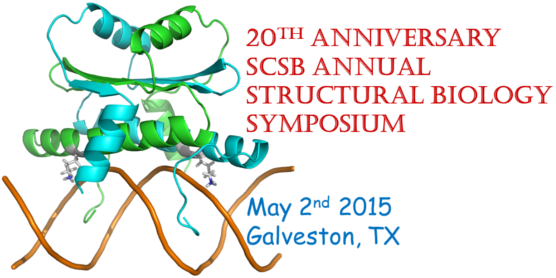
20th Anniversary Structural Biology Symposium (SCSB)
|
In Galveston Island, TX
The Symposium is to be held at Levin Hall on the University of Texas Medical Branch Campus on Galveston Island
Speakers:
A. Keith Dunker, Indiana Univ. School of Med.Â
Lewis Kay, University of Toronto
Junji Iwahara, Univ. Texas Medical Branch
George Rose, Johns Hopkins University
Susan S. Taylor, Univ. California, San DiegoRobert D. Wells, Texas A&M Health Science Center
Minischool on Biophysics of Protein Interactions
| - |
In Sao Paulo, Brazil
The proposed school will compare and creatively confront different modern approaches to highly charged, structured, and disordered Coulomb systems. Its primary purpose will be to merge the different theoretical, experimental and simulation approaches in order to progress towards a unified description of the electrostatic interactions in soft- and bio-matter. An overview of approximate analytical theories as well as sophisticated simulations will put the students in contact with the state-of-the art research in biophysics and will allow them to build connections between these different theoretical approaches, as well as with the available experimental data.
Besides a poster session, attendants will be also invited to give short talks about their research activity. This school is aimed at graduate students and researchers in the fields of statistical mechanics, materials science, biophysics and nanobiotechnology. There is no registration fee and limited funds are available for travel and local expenses.
This school will be preceded on Sunday March 8 by a one-day minicourse by Prof. Jose Nelson Onochic (Rice University) on Energy Landscapes in Biophysics.
Â
Organizers / Lecturers:
Fernando LuÃs Barroso da Silva (USP-Ribeirão Preto, Brazil): On the peculiar electrostatic effects observed in protein systems â€" a computational approach
Roland Netz (Freie Universität Berlin, Germany): Hydration and dielectric effects at surfaces
Rudolf Podgornik (U. Ljubljana, Slovenia): Charge regulation and electrostatic interactions in proteins
Invited Lecturers:
Mathias Boström (University of Oslo, Norway): Hofmeister effects, Van der Waals forces and material modeling of cellulose in solution
Hernan Chaimovich (USP-São Paulo, Brazil): Trifluoromethane sulfonate as a surfactant counterion: properties and applications
Ralf Eichhorn (Nordita, Sweden): Theory of phoretic effects induced by the (counter-)ions in the system
Rosângela Itri (USP-São Paulo, Brazil): Protein interactions as revealed by small-angle x-ray scattering
Yan Levin (UFRGS, Brazil): Introduction to statistical mechanics of charged systems
João Ruggiero Neto (UNESP-Rio Preto, Brazil): Electrostatic and non-electrostatic features in the interaction of lytic peptides with model membranes
Jose Nelson Onuchic (Rice Univ.):Â Onuchic Minicourse on Energy Landscapes in Biophysics

ICCBM-16. 16th International Conference on the Crystallization of Biological Macromolecules
| - |
In Prague
Main topics
- Biomedicine crystallography
- Nanocrystallography
- Membrane protein crystallization
- Advanced crystallization
- Crystallization in education
XXIV Biennial Conference on Phage/Virus Assembly
| - |
In Les Diablerets
The PVA Conference on Phage/Virus Assembly is a continuation of a series that was initiated in 1968. At first it was a meeting of scientists working on mechanisms of bacteriphage assembly, it expanded to include animal and plant viruses. The conference alternates with the FASEB Virus Assembly meeting.
At present the Conference is highly interdisciplinary, bringing together virologists, geneticists, biochemists, biophysicists and structural biologists working on various aspects of virus assembly and virus infection, including medically relevant viruses and archaeal viruses.
The value of training and support the new generation of researchers in virus assembly is a priority of the Conference.
Organiser : Petr Leiman, Ecole Polytechnique Fédérale de Lausanne, Switzerland (EPFL)
XIII Discussions in Structural Molecular Biology
| - |
In Nové Hrady
Advances and Progress in Drug Design. 14th Annual Conference
| - |
In London
From Punk-Rock to Proteins; building a successful Biotech Company
|
In Leggate Theatre, Liverpool University
A Science and Society 2015 lecture by Dr Harren Jhoti, President & CEO, Astex Pharmaceuticals (Cambridge)
Dr Harren Jhoti co-founded Astex in 1999 and was Chief Scientific Officer until 2007 when he was appointed Chief Executive. During its development, Astex successfully raised more than £50 million from US and European venture capitalists and established multiple alliances with major pharmaceutical companies such as Novartis, AstraZeneca, Johnson & Johnson and GlaxoSmithKline.
As part of these alliances, Astex applied its proprietary Fragment-Based Drug Discovery technology to generate novel drug candidates for patients with cancer and other life-threatening diseases. In 2013 Astex was acquired by Otsuka Pharmaceuticals for $886 million, one of the largest transactions in UK Biotechnology, and now operates as a wholly-owned subsidiary of Otsuka.
In 2007 Dr Jhoti was named by the Royal Society of Chemistry as 'Chemistry World Entrepreneur of the Year' and was awarded the Prous Institute-Overton and Meyer Award for New Technologies in Drug Discovery by the European Federation for Medicinal Chemistry in 2012.
But before being a successful chemist and business man, Dr Jhoti had interrupted his studies to start a rock band. During the talk, he will tell about his determination to succeed after his failed attempt at becoming a rock star.
Tickets for the event can be obtained from
https://www.liv.ac.uk/events/science-and-society/form.php
FMC2015. Frontiers in Medicinal Chemistry 2015
| - |
In Antwerp
Frontiers in Medicinal Chemistry 2015 will be jointly organised by EFMC, ACS and the local Dutch and Belgian organisers: the Medicinal and Bioorganic Chemistry Division of the Royal Flemish Chemical Society (KVCV, Belgium), the Société Royale de Chimie (SRC, Belgium), and the Section Medicinal Chemistry of the Royal Netherlands Chemical Society (KNCV, The Netherlands).
The 2015 edition of the symposium will take place in Antwerp, Belgium, from September 14-16, 2015.
This biennial meeting is a key symposium in its field with traditionally around 300 participants, from industry and academia. The Frontiers Meeting attracts a highly targeted audience composed of experts in drug discovery and development, in particular medicinal and synthetic chemists, together with scientists active in the fields of computer assisted drug design, biology, DMPK, pharmacology, early toxicology, as well as chemical and pharmaceutical development. The scientific programme for Frontiers 2015 will feature a plenary session, followed by sessions covering the latest advances in medicinal chemistry.

ESB2015 European Conference on Biomaterials
| - |
In Krakow
Conference topics include but are not limited to:
- Smart biomaterials
- Surface modification and functionalization
- Advanced manufacturing
- Antimicrobial surfaces and materials
- Biointerfaces
- Bioimaging and biosensing
- Tissue engineering / Regenerative medicine
- Angiogenesis / Vascularization
- Drug and gene delivery
- Cell encapsulation and delivery
- Stem cells
- Cancer therapy
- Bone and cartilage
- Neural regeneration
- Cardiovascular applications
- Wound healing
- Clinical trials
- Translation and commercialization
