Topics
Chemical crystallography
2022 IUCr High Pressure Workshop â€Å"Advanced High Pressure Crystallographyâ€Â
| - |
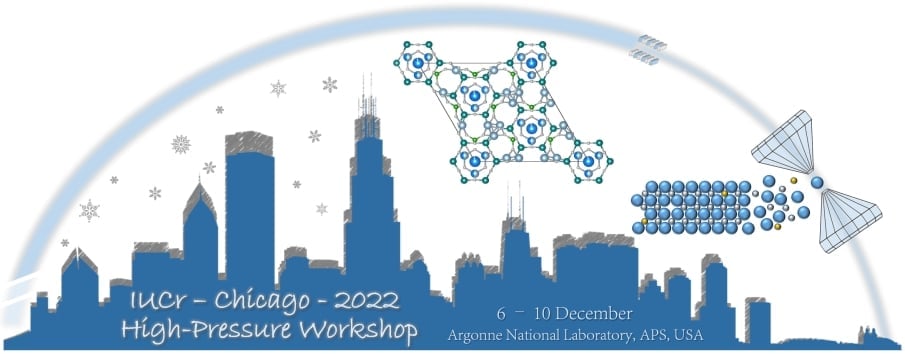
In Chicago
For the past three decades high pressure research has made breakthrough progress in many fields of science mainly due to the significant improvements in the high-pressure apparatus and developments of advanced static and dynamic probes. Most of the experiments at extreme conditions are very challenging and require dedicated techniques to collect crystallographic data with unprecedented speed and resolution to quantitatively characterize pressure/temperature induced transformations in the crystalline lattice. The tunability, brilliance, and collimation of synchrotron X-ray sources provides scientists with unique capabilities for probing the structural, chemical, and physical properties of various types of materials in-situ at extreme pressure, temperature, and strain with ultra-high spatial, temporal and energy resolution. However, in many cases the complex energy landscapes of multicomponent chemical systems require the use of the predictive power of computational methods that play an essential role in extreme-conditions crystallography coupled with physical experiments.
The purpose of the 2022 workshop of the International Union of Crystallography (IUCr) Commission on High Pressure is to bring together researchers who apply extreme-conditions crystallography in combination with other experimental and computational methods to study a wide range of material properties covering various fields of science, including condensed-matter physics, solid-state chemistry, geophysics, materials science, biology, nanotechnology etc. The workshop aims to facilitate extensive discussion and interdisciplinary collaboration.
Students, postdocs and early carrier scientists in particular will find this workshop helpful in gaining improved familiarity with available state-of-the-art methods and how they can be applied to their research.
We plan to organize a tour to the relevant APS beamlines for workshop attendees (pandemic permits) and a half-day tutorial with hands on examples.
GEOMETRY AND TOPOLOGY IN CONTEMPORARY MATERIAL SCIENCE - INTERNATIONAL SUMMER SCHOOL 2022
|
In Copenhagen
• Mesoporous silicates
• Metal organic frameworks and coordination polymers
• Amphiphiles, lipids, star polyphiles forming lyotropic liquid crystals
• Block copolymers including star miktoarm copolymers
Lectures will emphasise the fundamental structural aspects, with an introduction to the following concepts from modern geometry, crystallography and topology:
• Two-dimensional symmetries and orbifolds (wallpaper and point groups)
• Graph theory and net embeddings, knots and entanglement
• Triply-periodic minimal surfaces and related polycontinuous patterns
• 2D hyperbolic tilings and their embedding in 3D
No specialised mathematical knowledge is assumed, apart from some elementary familiarity with the shape of space, polyhedra and symmetry. The course will introduce students to unifying structural concepts in a range of ordered multi-phase hard/soft materials. We encourage students with theoretical or experimental backgrounds to attend.
The course will familiarise students with open-source software for construction and characterisation of structures from nets to surfaces. Hands-on tutorials will explore the concepts, via models and software like Kaleidotile, Surface Evolver, Houdini, GAVROG (3dt and Systre), RCSR, EPINET and HooMD for molecular simulations.
Zurich School of Crystallography 2022: Bring your own crystals
| - |
In Zurich
International School of Crystallography. 46th Course, Crystallography under extreme conditions: the future is bright and very compressed
| - |
In Erice
Subjecting matter to extreme conditions reveals a multitude of fascinating phenomena, and is applicable to a wide range of disciplines. From the extremophiles that exist in the deepest depths of our oceans to the exotic new materials that are made when atoms are pushed ever closer together, understanding the structure of materials at extreme conditions affects Biology, Chemistry, Physics, Geoscience and Material Science. In order to achieve its goals, high pressure research has been always at the vanguard of technical progress. It is a discipline in which equipment plays a particularly important role. State-of-the-art diamond anvil cells can now achieve megabar ranges of pressure, millions of times atmospheric pressure, with this beaten by an order of magnitude in dynamic compression experiments. In this manner, scientists are able to mimic the conditions in the interiors of giant planets. Nature is even more ambitious, as in the stars petapascal pressures (the order of tens to hundreds billion atmospheres) are reached. In the laboratory, we can even create conditions of pressure, temperature and magnetic fields that are not found naturally, allowing us to complement nature to explore more exotic phases of matter.
Therefore, the course will cover broad ground in the application of extreme conditions crystallography. The topics will span from fundamentals of high-pressure single crystal and powder diffraction, to presenting the many flavors of static and dynamic compression, to reviews of sources for extreme conditions work (synchrotrons, neutrons and free electron lasers). Complementary experimental (Mössbauer spectroscopy, X-ray magnetic circular dichroism, X-ray absorption spectroscopy, inelastic scattering) and computational methods will also be discussed. Diffraction analysis on the structure of liquids, glasses and nanocrystalline materials as well as multigrain crystallography will also be introduced. The lectures will be harmonized with the related sessions of interactive tutorials, providing hands-on experience to the attendees. These workshops will be focused on basic laboratory skills and the elements of data processing software related to the high pressure.
The Zurich School of Crystallography 2021: Bring Your Own Crystals
| - |
In Zurich
CCDC Science Day
|
As a partner institute of the University of Cambridge, the CCDC supports graduate students with their studies and research.Â
Join our virtual Science Day - showcasing the research our current students have planned and completed. We welcome participation and questions during the day.
Anybody with an interest in upcoming research at the CCDC is welcome to join us.
CCDC Global User Group Meeting
|
09:00 - 16:00 BST
We are inviting all users of CSD around the world to join us in a Global user group meeting.
This is a free event.
Theme:Â Rethinking the future of in silico science
Confirmed Speakers:- Robin Taylor, Emeritus Research Fellow (Keynote)
- Chris Radoux, Exscientia
- Elena Besley, Nottingham University
- John Liebeschuetz, Astex
-Â Alice Brink, University of the Free State in South Africa
- Simon Parsons, University of Edinburgh
- Jeremie Mortier, Bayer Berlin
-Â Colin Seaton, Bradford University
- Thierry d' Almeida, Research Director, Commissariat à l’Energie Atomique et aux Energies Alternatives (CEA)
FIZ Karlsruhe and CCDC: interactive event
|
Following on from the webinar in August we are hosting a joint interactive session to better understand your requirements and priorities for the development of more advanced searches and services across the CSD and the ICSD. The interactive event in October will be an open, guided discussion designed to collect together your use cases and requirements for a more advanced search interface across the CSD and ICSD.
CCG Autumn Meeting 2020
|
In Online event
The British Crystallographic Association Chemical Crystallography Group (CCG) are hosting their Autumn Meeting on Wednesday 18th November 2020. The event will run over one day and will be held this year in a virtual format.
The Autumn meeting confirmed speakers include plenary speaker Dr Rachel Crespo-Otero from Queen Mary University of London and, winner of the CCDC Chemical Crystallography Prize for Younger Scientists 2020, Dr Karen Robertson from the University of Nottingham.
The day will also include selected talks from the Chemical Crystallography community. To submit your abstract for consideration, email CCG Chair Dr Iain Oswald: [email protected].
For the latest details about the meeting including registration visit the CCG website https://ccg.crystallography.org.uk/.
Bruker SC-XRD webinar: Ways to Improve the Productivity of Your Single Crystal Diffractometer
|
In Webinar
On Wednesday 8 July 2020
Session 1: 9:00 am CEST (Berlin) and 3:00 pm SGT (Singapore)
Session 2: 6:00 pm CEST (Berlin) and 11:00 am CDT (Chicago)
Speakers: Dr Vernon Smith and Dr Martin Adam
Bruker SC-XRD webinar: Smallest crystals - How modern microfocus sources can help you determine the structure from weak diffractors
|
In Webinar
On Tuesday 16 June 2020: 10:00 am CDT (Chicago) and 5.00 pm CET (Berlin)
Speakers:Â Dr Michael Ruf and Dr Jurgen Graf
MX raw image data formats, metadata and validation
|
In Prague
Satellite Workshop of the XXV IUCr Congress
"Macromolecular crystallography (MX) is the dominant means of determining the three-dimensional structures of biological macromolecules. Over the last few decades, most MX data have been collected at synchrotron beamlines using a large number of different detectors produced by various manufacturers and taking advantage of various protocols and goniometry. These data came in their own formats, sometimes proprietary, sometimes open. The associated metadata rarely reached the degree of completeness required for data management according to Findability, Accessibility, Interoperability and Reusability (FAIR) principles. Efforts to reuse old data by other investigators or even by the original investigators some time later were often frustrated. In the culmination of an effort dating back more than two decades, a large portion of the research community concerned with High Data-Rate Macromolecular Crystallography (HDRMX) has now agreed to an updated specification of data and metadata for diffraction images produced at synchrotron light sources and X-ray free electron lasers (XFELs). This Gold Standard will facilitate processing of datasets independent of the facility at which they were collected and enable data archiving according to FAIR principles, with a particular focus on interoperability and reusability. This agreed standard builds on the NeXus/HDF5 NXmx application definition and the International Union of Crystallography (IUCr) imgCIF/CBF dictionary and is compatible with major data processing programs and pipelines. Just as with the IUCr CBF/imgCIF standard from which it arose and to which it is tied, the NeXus/HDF5 NXmx Gold Standard application definition is intended to be applicable to all detectors used for crystallography, and all hardware and software developers in the field are encouraged to adopt and contribute to the standard." [A. Förster, H. J. Bernstein, A. Bhoemick, A. S. Brewster, S. Brockhauser, L. Geliso, D. R. Hall, F. Leonarski, V. Mariani, G. Santoni, C. Vonrhein, G. Winter, "A Gold Standard for Macromolecular Diffraction Data", in preparation]
This is a tutorial workshop presented by the developers of the Gold Standard to introduce the community to this important upgrade to the interoperability and reusability of macromolecular crystallographic data for both synchrotrons and XFELS,and to give the participants an opportunity to work with and comment on the Gold Standard. To widely share best practices for metadata recording, we encourage the participation of neutron and chemical crystallographers.
The workshop will function as a purely virtual meeting via Zoom from 9 am to 3 pm Prague time (3 am to 9 pm New York time, 8 am to 2 pm London time) on 14 August 2021 with two breaks. In order to participate and receive the Zoom meeting room URL and agenda, contact Herbert J. Bernstein, [email protected], giving your name, institutional affiliation and email address by no later than 6 pm Prague time (noon New York time, 5 pm London time) on Friday 6 August 2021. Registration is limited to 100 persons. There will be no additional fee for the workshop virtual meeting registration.
Reminder: The CommDat user forum is at https://forums.iucr.org
When should small molecule crystallographers publish raw diffraction data?
| - |
In Online
Satellite Workshop of the XXV IUCr Congress
Following on from a recent survey of the community, this full-day workshop is aimed at: (1) educating those who generate and deal in crystallographic data on best practices in data management; (2) how to communicate those best practices to students and other novice users; (3) discussing current practices in data archival; and (4) exploring current and future use cases for archival of raw data.
Attendees will gain an appreciation of the importance of archiving raw data and an understanding of how to archive their own raw data effectively. The workshop will lay the groundwork for a large-scale community driven effort to standardize small-molecule raw data archival with a view to ensuring that best practice in the laboratory leads to appropriate and FAIR availability of raw data to the wider community. A key goal is to explore how to make this process seamless and integrated with current facility, research and publishing practices.
Reminder: The CommDat user forum is at https://forums.iucr.org
2020 ACA Summer Course in Chemical Crystallography
| - |
In Purdue University
Dear Friends and Colleagues
We are thrilled to announce that the 2020 ACA Summer Course in Chemical Crystallography, to be held at Purdue University on May 31st to June 7th, is now open for applications.
The ACA Summer Course in Chemical Crystallography is a week long program that is now well into its third decade of instruction here in the United States. The course is directed towards Single-Crystal Chemical Crystallography and Powder Diffraction techniques, as applicable to small molecule studies and is designed to instruct attendees in the theory and practice of these two aspects of crystallography. Mornings are full with lectures on the theory of the experiment and afternoons and early evenings are covering hands-on workshops.
More information can be found at https://acasummercourse.net/ or https://acasummercourse.net/application/. To submit your application, please visit the address https://acasummercourse.net/2020-application/
Please do not hesitate contacting us at [email protected] with any questions you might have
For the organizers,
Matt Zeller, Purdue University
Christos Malliakas, Northwestern University
Charlotte Stern, Northwestern University
Allen Oliver, Notre Dame University
Normal 0 false false false EN-US X-NONE X-NONE /* Style Definitions */ table.MsoNormalTable {mso-style-name:"Table Normal"; mso-tstyle-rowband-size:0; mso-tstyle-colband-size:0; mso-style-noshow:yes; mso-style-priority:99; mso-style-parent:""; mso-padding-alt:0in 5.4pt 0in 5.4pt; mso-para-margin-top:0in; mso-para-margin-right:0in; mso-para-margin-bottom:8.0pt; mso-para-margin-left:0in; line-height:107%; mso-pagination:widow-orphan; font-size:11.0pt; font-family:"Calibri",sans-serif; mso-ascii-font-family:Calibri; mso-ascii-theme-font:minor-latin; mso-hansi-font-family:Calibri; mso-hansi-theme-font:minor-latin; mso-bidi-font-family:"Times New Roman"; mso-bidi-theme-font:minor-bidi;}BCA Industrial and Chemical Groups meeting "By hook or by crook â€" structural solutions from challenging crystals"
|
In Stevenage, UK
BILL2019: "Bilayers at the ILL" Workshop
| - |
In ILL, Grenoble
The aim of the workshop is to bring together researchers working with on the physico-chemical characterization of lipid bilayers by means of experimental (including scattering and direct space techniques) and theoretical approaches.
Some of the specific subjects that will be covered are:
- structure and self-assembly
- interactions
- dynamics
- natural membranes (including natural lipids for artificial membranes)
- numerical simulations
- applications of bilayer-based systems
- emerging methods
Oral Presentation Abstract Application Deadline: 6th September 2019
Poster Presentation Abstract Application Deadline: 4th November 2019
American Geophysical Union Fall Meeting
| - |
In San Francisco, CA
57th European High Pressure Research Group Meeting on High Pressure Science and Technology
| - |
In Prague
The European High Pressure Research Group (EHPRG) was established in the sixties of the last century to support a development of both the basic as well as the applied high pressure research by the annual meetings. To create a close contact of all the workers in scientific and technological high pressure disciplines, the wide scope of the EHPRG conferences is traditional and characteristic feature of these meetings. A relatively rapid increase of high pressure activities in almost all areas of Physics, Geosciences, Material Research, Chemistry and namely in Biosciences during the last decades demands a similarly rapid exchange of knowledge in high pressure research and technology.
Gordon Conference on Research at High Pressure
| - |
In Holderness, NH, US
The 77th Annual Pittsburgh Diffraction Conference
| - |
In Oak Ridge, TN
You’re invited to the 77th Annual Pittsburgh Diffraction Conference at Oak Ridge National Laboratory (ORNL), which is located in Oak Ridge, Tennessee (near Knoxville). The conference will take place over three days and feature sessions focused on all areas of diffraction, from powders to protein crystals. Topics will include emerging technologies/techniques, Total scattering, Magnetic scattering, and Integrative Structural Biology. The Chung Soo Yoo Award, established by the Pittsburgh Diffraction Society to honor Dr. Yoo’s memory, and a $400 cash prize will be given to the graduate student having the best poster presentation at the conference.