Topics
Chemical crystallography
Free Virtual Workshop: Introduction to Mercury and ConQuest Software To Investigate Crystal Structures With a Focus on Powder Diffraction
|
In Online
Structural databases such as the CSD contain a wealth of information that can be used to derive new knowledge and gain deeper insights into your own crystal structures. In particular, functionality from the CSD Portfolio is designed to help you search, visualize and analyse structures. In the field of powder diffraction, accurately matching and optimizing crystal structures is a critical task. CSD Portfolio tools can help you with the process of comparing experimental patterns with predicted ones, which can help identify the most likely structure of a material.
You will learn hands-on how to search and visualise structures in the CSD using ConQuest and Mercury with a focus on structures determined by powder diffraction, and how to use functionality to calculate powder patterns.
What we will cover In this workshop you will explore the basics of searching and visualising structures using the CSD Portfolio, and advanced analysis features for powder patterns. The session will include presentations and demonstrations by CCDC expert tutors and a hands-on part for you to try the software, with the tutors available to help you and answer your questions.
You will learn: - How to search structures in the CSD, in particular finding structures determined by powder diffraction. - How to visualize crystal data. - How to simulate powder patterns from over 1.3 million structures in the CSD and from your own cif files in Mercury. - How to match and optimize experimental powder patterns with simulated ones using functionality based on AutoFIDEL algorithms. - The workshop will be recorded and all registered participants will have access to the recording.
Who should attend? - Crystallographers and structural scientists. - Academic and industrial chemists interested in exploring molecules in the solid form. - PhD and post-doc researchers in the field of crystallography and materials science. - Researchers and scientists who work with the CSD or their own structural databases. - Researchers and scientists who work with powder diffraction. - Industrial scientists using structural informatics to design new materials. - Educators looking to incorporate the CSD into their teaching.
CCDC Webinar: How To Match Powder Patterns to Crystal Structures
|
In Online
The FIDEL method can compensate for the preferred orientation frequently seen in powder data. It involves optimising the match between the experimental pattern and the simulated pattern of a selected structure, through varying the structure’s lattice parameters. It has proven effective for factors like preferred orientation and sample height displacement.Â
Â
During this webinar, we will show:
- What is AutoFIDEL and how to access it;
- The process of powder matching and optimization of crystal structures;
- Live demonstration of the process.
Â
Who should attend:
- Solid-state computational chemists
- Data scientists working with chemical data.
- Solid form scientists in academia or industry.
Cheminformaticians.
Distinguished Lectures on Quantum Crystallography and Complementary Fields: Lecture 44
|
In Online
Lecture 44: "Energy formalism of an X-ray electron density of large biological molecules" by Louis Massa (The City University of New York, USA)
One can register here. You can also find the abstract and CV of the speaker at the above web page. The lecture is free and open to everyone; this lecture is expected to last ca. 45â€"50 min + up to 15min for Q&A. Please regiester beforehand using the link above.
35 European Crystallographic Meeting
|
In PoznaÃ...„
 At the XXV Congress and General Assembly of the International Union of Crystallography in Prague, it was decided that the 35th edition of the European Crystallographic Meeting would be held in Lviv, Ukraine, in 2025.
 Unfortunately, there is a war in Ukraine, and it is not reasonable to organize a great scientific event in Lviv in 2025. An alternative was thus elaborated where, thanks to a collaboration between the Ukrainian Crystallographic Committee and the Polish Crystallographic Association, the conference site will be Poznan, a city in neighbouring Poland.
CCDC Webinar: How To Match Powder Patterns to Crystal Structures
|
In Online
Accurately matching an experimental powder X-ray pattern to a crystal structure is essential for identifying materials, especially for polymorphs in complex landscapes. The CSD-Materials suite now includes a CSD Python API feature based on the FIDEL method, known as AutoFIDEL, which allows for matching and optimizing crystal structures against experimental powder diffraction patterns, without requiring high-resolution transmission data and with preferred orientation.
The FIDEL method can compensate for the preferred orientation frequently seen in powder data. It involves optimising the match between the experimental pattern and the simulated pattern of a selected structure, through varying the structure's lattice parameters. It has proven effective for factors like preferred orientation and sample height displacement.
During this webinar, we will show:
-
What is AutoFIDEL and how to access it;
-
The process of powder matching and optimization of crystal structures;
-
Live demonstration of the process.
Who should attend:
-
Solid-state computational chemists
-
Data scientists working with chemical data.
-
Solid form scientists in academia or industry.
-
Cheminformaticians.
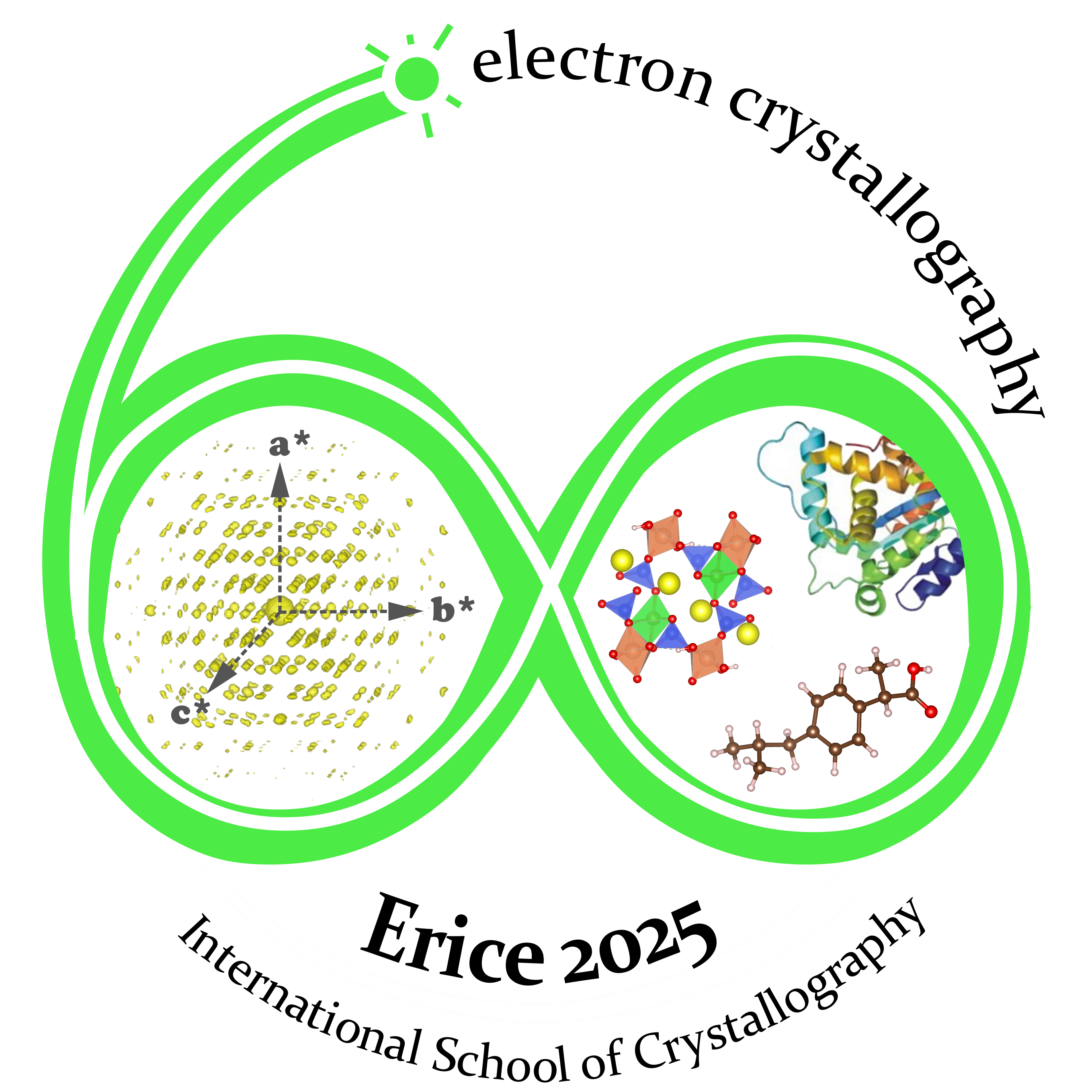
International School on Electron Crystallography 2025
| - |
In Erice
Dates: 30 May - 7 June 2025 Location: Ettore Majorana Foundation and Centre for Scientific Culture, Erice, Italy
About the School: The International School on Electron Crystallography offers a comprehensive learning experience for participants at all levels, from beginners to advanced researchers. Through lectures, hands-on tutorials, and interactive sessions, attendees will gain valuable insights into the principles and applications of electron crystallography, including electron diffraction, 3D electron diffraction (3D ED), structure determination, and the latest innovations in the field.
Key Topics: Fundamentals of electron crystallography and diffraction 3D electron diffraction techniques Structure determination of molecular and inorganic materials Applications in nanomaterials, pharmaceuticals, and structural biology Recent advances in instrumentation and data analysis Who Should Attend: The school is designed for students, postdocs, and professionals working in electron microscopy, crystallography, materials science, chemistry, physics, and related disciplines. Whether you are new to electron crystallography or looking to deepen your expertise, this school provides a unique opportunity to expand your knowledge and network with experts in the field.
Travel and Grants: Various travel grants from different organizations will be advertised on the school's webpage to support student participation.
How to Apply: Details on registration, abstract submission, and travel grant applications will be made available on the official website: https://crystalerice.org/2025/
Join us in Erice for an inspiring week of learning, networking, and exploring the beautiful surroundings of Sicily!
For further information, please visit our website or contact the course directors: Alexander Eggeman (University of Manchester, UK), Mauro Gemmi (Istituto Italiano di Tecnologia, Pisa, IT), Tatiana Gorelik (Forschungszentrum Juelich, DE).
International School on Quantum Crystallography
| - |
In Erice
Webinar: Searching for Aromatic-Aromatic Interactions in the CSD: What You Really Need To Know
|
Much has been published in the scientific literature on aromaticâ€"aromatic interactions, leading many to believe there isn't more to discover. However, the rapid growth of the Cambridge Structural Database (CSD) and the Protein Data Bank (PDB) continues to create new opportunities for new insights in this area.
During this webinar, John Liebeschuetz, Computational Chemist at Astex Pharmaceuticals, will focus on the theory and practice of mining structural databases for aromaticâ€"aromatic interactions and analysing the findings. He will examine the geometric corrections needed for plotting data in reduced dimensions and how these results compare to theoretical expectations.
We will discuss important considerations when comparing search results from the CSD with theoretical models and results from the PDB. By the end of the talk, attendees should have a clear framework for understanding and appreciating the role of aromatic-aromatic interactions in both material science and life sciences.
Â
Who should attend:Â
-
Experienced users of the CSD in academia or industry
-
Computational chemistry scientists
-
Materials scientists
Â
The World Conference on GOLD 2025!
|
In San Sebastian (Spain), at Kursaal Zurriola Hiribidea, 1, 20002 Donostia, Gipuzkoa, Spain
Following the success of the previous tri-annual GOLD conferences on the applications of gold in high-technology (Québec 2022; Paris 2018; Cardiff 2015), the GOLD 2025 conference (10th ) will be held on May 11-14, 2025, in San Sebastian, Spain. The event will take place at the Kursaal Convention Center, a splendid venue by the seaside.
BCA-IG Autumn Group Meeting 2024, Nov 21st @ Johnson Matthey, Reading
|
In Reading, UK
International School on Quantum Crystallography 2025 â€" Erice, Italy
| - |
In Erice, Italy
During this school, we will provide an accessible and in-depth education in quantum mechanics and related semi-empirical methods, tailored to provide a solid foundation in understanding materials structure, physicochemical properties, and the response of materials to physical changes and experimental probes. The theoretical foundations of crystallographic experiments will be briefly recalled, and the methodology of data collection and analysis for quantum crystallography methods will be presented and trained in detail. Speakers at this school will go beyond just theoretical calculations, to demonstrate the deep interplay between theory and experiment: for example, by showing how experimental observations could be used to restrain or constrain first-principles calculations or otherwise showing how calculations could improve the interpretation of an experimental result.
In keeping with this overall aim, the synergy between theoretical and experimental areas will be highlighted to provide a holistic view of the different fields in Quantum Crystallography. This area of knowledge is going through an important boost in the last years, thanks to new coupled approaches and new communities getting in touch with each other. This school will bring together students from these two communities, feeding this new area of knowledge and letting interdisciplinary grow among the students.
Workshops will provide hands-on tutorials on the use and development of software related to the topics, including the development of required input data, and using case studies.
Additionally, the school will benefit from the synergy with the Electron Crystallography School running in parallel, with several lectures shared between the two schools. This will offer a unique opportunity to explore interdisciplinary applications of crystallography in quantum science and structural research.
International School on Electron Crystallography 2025 â€" Erice, Italy
| - |
In Erice, Italy
We are excited to announce the International School on Electron Crystallography, which will be held in the charming town of Erice, Italy, from 30 May - 7 June 2025. This event will bring together leading experts, researchers, and students in the field of electron crystallography to explore the latest developments and techniques.
Dates: 30 May - 7 June 2025
Location: Ettore Majorana Foundation and Centre for Scientific Culture, Erice, Italy
About the School:
The International School on Electron Crystallography offers a comprehensive learning experience for participants at all levels, from beginners to advanced researchers. Through lectures, hands-on tutorials, and interactive sessions, attendees will gain valuable insights into the principles and applications of electron crystallography, including electron diffraction, 3D electron diffraction (3D ED), structure determination, and the latest innovations in the field.
Key Topics:
- Fundamentals of electron crystallography and diffraction
- 3D electron diffraction techniques
- Structure determination of molecular and inorganic materials
- Applications in nanomaterials, pharmaceuticals, and structural biology
- Recent advances in instrumentation and data analysis
Who Should Attend:
The school is designed for students, postdocs, and professionals working in electron microscopy, crystallography, materials science, chemistry, physics, and related disciplines. Whether you are new to electron crystallography or looking to deepen your expertise, this school provides a unique opportunity to expand your knowledge and network with experts in the field.
Travel and Grants:
Various travel grants from different organizations will be advertised on the school's webpage to support student participation.
How to Apply:
Details on registration, abstract submission, and travel grant applications will be made available on the official website: https://crystalerice.org/2025/
Join us in Erice for an inspiring week of learning, networking, and exploring the beautiful surroundings of Sicily!
For further information, please visit our website or contact the course directors: Alexander Eggeman (University of Manchester, UK), Mauro Gemmi (Istituto Italiano di Tecnologia, Pisa, IT), Tatiana Gorelik (Forschungszentrum Juelich, DE).
CCDC Virtual Workshop: Introduction to Pharmacophore Searching Using CSD-CrossMiner
|
In Online
If you are working in the field of drug discovery and want to learn how to perform pharmacophore searches to uncover new ligands, then this free, 90-minute, hands-on workshop is for you!
Pharmacophore searching is a key component in many drug discovery efforts and represents an effective mechanism of virtual screening, for example. In this approach, a pharmacophore query is created to describe features that are essential for the molecule to carry out its function. The query is then used to identify new possible lead compounds by searching a three-dimensional structural database.
In this free 90-minute hands-on CCDC Virtual Workshop, designed for complete beginners to CSD-CrossMiner, you will learn hands-on the basics of how to perform a pharmacophore search using the CCDC's software CSD-CrossMiner.
What we will cover
In this workshop we will focus on performing a pharmacophore search using CSD-CrossMiner. The session will include presentations and demonstrations by CCDC expert tutors and a hands-on part for you to try the software, with the tutors available to help you and answer your questions.
You will learn:
-
What CSD-CrossMiner is and how it can be used in your research.
-
How to navigate the CSD-CrossMiner interface.
-
How to set up an interactive pharmacophore query.
-
How to perform pharmacophore searches across biologically relevant subsets of the Cambridge Structural Database (CSD) and the Protein Data Bank (PDB).
-
How to analyse and interact with your results, and save them.
The workshop will be recorded and all registered participants will have access to the recording.
Software requirements
As this is an interactive workshop, you’ll need access to CSD-CrossMiner with a CSD-Discovery or CSD-Enterprise licence. Full academic licences include the software we use in this workshop. If you are unsure whether your institution already has a license, please get in touch with us using the form on the Contact Us webpage.
If you do not have access to the CSD, we can provide you with a temporary licence. When you register, please check "No" to the question:Â "Do you or your institution have a current full CSD licence?" and we'll get you set up.
If you have already got the CSD installed you will need to check you have the most up to date version of the software. Click here for more information.
Entry Requirements
This workshop is open to everyone who wants to learn hands-on how to use CSD-CrossMiner to perform pharmacophore searches in the CSD and PDB. This is an entry-level session, so anyone can join and no prior experience is required.
Who should attend?
-
Discovery scientists.
-
Research scientists investigating pharmacophore searching and drug discovery.
-
PhD and post-doc level scientists in academia interested in pharmacophore searching and drug discoveryÂ
-
 Industrial / commercial scientists working in pharmacophore searching and drug discovery.
-
Scientists using computational methods in drug discovery.
-
Educators in the biochemistry and biomedical area looking to incorporate the CSD into their teaching.
CCDC Virtual Workshop: ConQuest to Mercury â€" From Searching to Data Analysis
|
In Online
If you are looking to search for crystal structures in the Cambridge Structural Database (CSD) to gain insights into your own structures and trends in the database, and you wish to improve your searching skills and enhance them with deeper structural analysis tools, then this free, 90-minute, hands-on workshop is for you!
The Cambridge Structural Database (CSD) now contains data for over 1.25M organic and metal-organic crystal structures. The database is fully discoverable and accessible and CoreTrustSeal certified data repository; it is used by researchers across the pharmaceutical, agrochemical, and fine chemicals industries to predict and guide future discoveries.
In this free 90-minute hands-on CCDC Virtual Workshop, you will learn hands-on the how to search the CSD using ConQuestand how to gain more insights into the results using the Data Analysis module in Mercury.
What we will cover
In this workshop you will explore a workflow to have an in-depth look at trends and behaviours of defined 3D parameters, such as inter- and intra- molecular distances, angles and torsions, and crystallographic parameters for relevant groups of structures in the CSD. The session will include presentations and demonstrations by CCDC expert tutors and a hands-on part for you to try the software, with the tutors available to help you and answer your questions.
You will learn:
-
How to set up a search of the CSD using ConQuest.
-
Tips and trick on searching in ConQuest and how to define 3D parameters for further analysis.
-
How to export ConQuest results to Mercury and analyse them with the Data Analysis module.Â
The workshop will be recorded and all registered participants will have access to the recording.
Software requirements
As this is an interactive workshop, you’ll need access to ConQuest and Mercury.
All academic licenses give you access to the full range of features covered in this workshop. If you are unsure whether your institution already has a license, please get in touch with us using the form on the Contact Us webpage.
If you do not have access to the CSD, we can provide you with a temporary licence. When you register, please check "No" to the question:Â "Do you or your institution have a current full CSD licence?" and we'll get you set up.
If you have already got the CSD installed you will need to check you have the most up to date version of the software. Click here for more information.
Entry requirements
This workshop is open to everyone who wants to learn hands-on how to search, visualize and analyse structures in the CSD, from beginners to experienced users.
Familiarity with the basics of Mercury would be ideal. If you have not used Mercury before, we would recommend the following module from our on-demand CSDU courses:
 Who should attend?
-
Crystallographers and structural scientists.
-
Academic and industrial chemists interested in exploring molecules in the solid form.
-
PhD and post-doc researchers in the field of crystallography and materials science.
-
Researchers and scientists who work with the CSD or their own structural databases.
-
Industrial scientists using structural informatics to design new materials.
-
Educators looking to incorporate the CSD into their teaching.
CCDC Virtual Workshop: First Steps in Protein-Ligand Docking With GOLD
|
In Online
If you are working in the field of drug discovery and want to learn step-by-step how to perform protein-ligand docking, then this free, 90-minute, hands-on workshop is for you!
In drug discovery, it is important to understand how a small molecule (ligand) and a protein will bind. Protein-ligand docking is a computational method to predict the configuration of such interactions and an important step during drug design.
In this free 90-minute hands-on CCDC Virtual Workshop, designed for complete beginners to GOLD, you will learn hands-on the basics of how to perform protein-ligand docking using the CCDC's docking software GOLD.
What we will cover
In this workshop we will focus on performing a docking simulation using GOLD. The session will include presentations and demonstrations by CCDC expert tutors and a hands-on part for you to try the software, with the tutors available to help you and answer your questions.
You will learn:
-
The basics of the Hermes interface, the CCDC’s 3D visualiser for proteins.
-
Step-by-step basics of docking using GOLD.
-
Where to get started with your docking simulation and how to run a standard protein-ligand dock with GOLD.
-
How to identify the correct binding modes reliably and with confidence.
The workshop will be recorded and all registered participants will have access to the recording.
Software requirements
As this is an interactive workshop, you’ll need access to GOLD, which can be found in CSD-Discovery or CSD-Enterprise licence. Full academic licences include the software we use in this workshop. If you are unsure whether your institution already has a license, please get in touch with us using the form on the Contact Us webpage.
If you do not have access to the CSD, we can provide you with a temporary licence. When you register, please check "No" to the question:Â "Do you or your institution have a current full CSD licence?" and we'll get you set up.
If you have already got the CSD installed you will need to check you have the most up to date version of the software. Click here for more information.
Entry Requirements
This workshop is open to everyone who wants to learn hands-on how to use GOLD to perform protein-ligand docking simulations. This is an entry-level session, so anyone can join and no prior experience is required.
Who should attend?
-
Discovery scientists.
-
Research scientists investigating protein-ligand docking.
-
PhD and post-doc level scientists in academia interested in protein-ligand docking.
-
Industrial / commercial scientists working on protein-ligand docking.
-
Scientists using computational methods in drug discovery.
-
Educators in the biochemistry and biomedical area looking to incorporate the CSD into their teaching.
6th International Symposium on Halogen Bonding (ISXB6)
| - |
In Dubrovnik, Croatia.
Normal 0 21 false false false HR X-NONE X-NONE /* Style Definitions */ table.MsoNormalTable {mso-style-name:"Table Normal"; mso-tstyle-rowband-size:0; mso-tstyle-colband-size:0; mso-style-noshow:yes; mso-style-priority:99; mso-style-parent:""; mso-padding-alt:0cm 5.4pt 0cm 5.4pt; mso-para-margin-top:0cm; mso-para-margin-right:0cm; mso-para-margin-bottom:8.0pt; mso-para-margin-left:0cm; line-height:107%; mso-pagination:widow-orphan; font-size:11.0pt; font-family:"Calibri",sans-serif; mso-ascii-font-family:Calibri; mso-ascii-theme-font:minor-latin; mso-hansi-font-family:Calibri; mso-hansi-theme-font:minor-latin; mso-bidi-font-family:"Times New Roman"; mso-bidi-theme-font:minor-bidi; mso-fareast-language:EN-US;}
The ISXB series of symposium aim to bring together researchers from all over the world who are interested in the fascinating phenomenon of halogen bonding and related interactions, from fundamental principles to applied technologies, covering both experimental and theoretical approaches in various areas of research ranging from advanced materials to medicinal chemistry and chemical biology.
The ISXB6 will feature keynote addresses and invited lectures by internationally renowned experts, contributed presentations, posters, and flash communications by young and promising researchers. The Symposium will also provide ample opportunities for networking and socializing in a friendly and stimulating atmosphere.
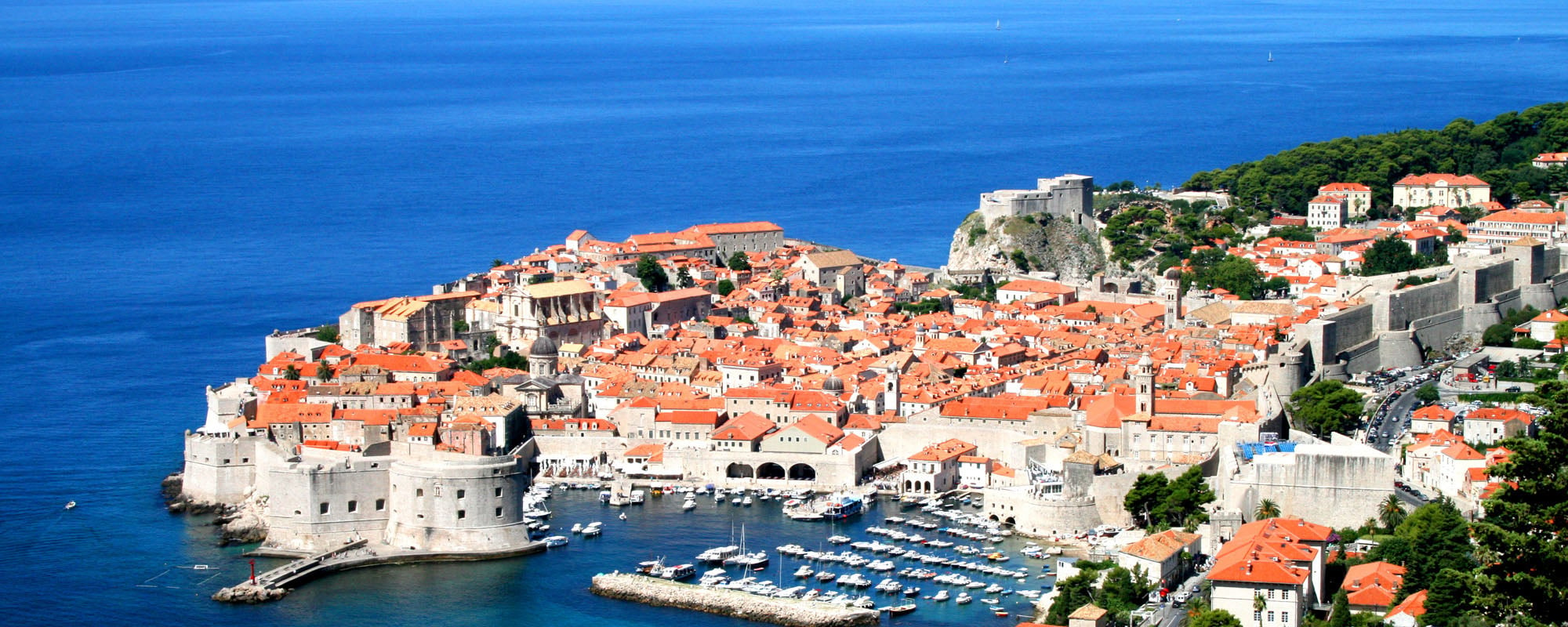
It will be held in Dubrovnik, Croatia, from October 20-25, 2024. The symposium will take place at the Sheraton Dubrovnik Riviera Hotel, a modern resort located in a secluded beachfront location in the vicinity of the Dubrovnik Old Town.
Sagamore XX Conference on Quantum Crystallography
| - |
In Shiv Nadar Institution of Eminence - Delhi NCR
Sagamore is a prestigious conference that has been held triennially since 1964 under the auspices of the IUCr Commission on Quantum Crystallography (formerly the Charge, Spin, and Momentum Densities).
The Sagamore conferences have traditionally concerned interchange between researchers interested in property densities or distributions of materials such as the electron distribution, spin distribution, nuclear particle distribution, and electrostatic potential studied by the most accurate theoretical methods, and using the most advanced experimental techniques. There has been a focus on diffraction and scattering methods, and reconciling differences between the different methodologies.
The field has undergone rapid change in the last decade, with the term “Quantum Crystallography†being used to emphasize wave function based modelling methods. At the same time, both the quantity and precision of data have also increased due to advances in detector technology. There is a race to make the data from these methods available to general chemists, and to reveal new physical and chemical insights that may be exploited.
For the first time, the Sagamore conference will be held in India on the beautiful grounds of Shiv Nadar Institution of Eminence, one of the 12 Institutions of Eminence designated by the Government of India. A tour of the Taj Mahal, one of the Seven Wonders of the World, is also included in the program.
Â
65th Polish Crystallographic Meeting - Konwersatorium Krystalograficzne
| - |
In WrocÃ...‚aw
The Polish Crystallographic Meeting, Scientific Workshop and Session of the Young Crystallographers Sections of PCrA will be held at the Institute of Low Temperature and Structure Research of the Polish Academy of Sciences, ul. Okólna 2 in Wrocław.
The Workshop is devoted to selected issues and problems of modern crystallography.
The Scientific Session of the Young Crystallographers Section of PCrAÂ is a forum for exchanging experiences addressed primarily to students, PhD students and young doctors (maximum 5 years after defense).
The topics of the Meeting include basic and applied research on the ideal and real structure of crystals carried out with the use of X-ray radiation obtained both with traditional methods and in synchrotrons, research with the use of neutrons and electrons, problems of symmetry, phase transformations and crystal growth, new research and computational methods and all other aspects of crystallography. The conference is an annual meeting place and a forum for exchanging ideas of all Polish crystallographers.
British Association for Crystal Growth 2024 Annual Conference
| - |
In Loughborough
Abstract Submission
We welcome abstract submissions for oral or poster presentations in the following categories
Â
Crystal Features and Engineering Designs
Â
Molecular Synthesis, Crystal Structure, Molecular Interaction, Molecular Simulation, Defect Engineering, Computational Modelling, Special Crystal Properties, etc.
Â
Basic Fundamentals and Theory Advancement
Â
Phase Equilibria, Nucleation, MSZW, Thermodynamics, Kinetics, Population Balance Modelling, Crystal Growth Mechanisms, Multi-scale Modelling, etc.
Â
Crystallization Process and Particle Technology Innovations
Â
Process Control, Particle Size Distribution, PAT, Process Intensification, Polymorph Control, Particle Synthesis, Nanotechnology, Particle Modification, Powder Rheology, etc
Â
New Applications and Transformative Approaches
Â
Sustainability, Resource Recycling, Biomolecules, Crystalline Polymer, Biomineralization, Digitalisation, High Throughput Screening, Big Data Analysis, Machine Learning, etc.
29th Conference of The Serbian Crystallographic Society
| - |
In Ruma
The annual meeting of the Serbian Crystallographic Society. The Conference will be a live event.
Language
The official language of the Conference is English.
Topics
All fields of crystallography.
Presentations                                                       Â
- Plenary lectures
- Oral presentations
- Poster presentations
Awards
“The Best Oral Presentation†and “The Best Poster Presentation†prizes will be awarded at the Conference closing session.
Social activities
On Thursday afternoon, June 27th, an excursion will be organized.
On Friday evening, June 28th, SCS will organize a Conference dinner.
The price of the excursion and gala dinner is included in the regular registration fee.
Conference material
At the beginning of the Conference every participant will receive the Book of abstracts in Serbian and English.