Topics
Electron crystallography
Nanoanalysis of Steels and Structural Alloys. MEETING CANCELLED
| - |
In Drymen
International Autumn School on Fundamental Crystallography and Electron Crystallography (IASFEC)
| - |
In Sofia
Necessary background (assumed achieved by all participants)
- Basic matrix algebra (matrix multiplication, calculation of determinant and trace)
- Interaction of radiation with matter.
- Elementary physics of scattering and diffraction. Fourier transform, atomic scattering factor and structure factor.
- Reciprocal lattice
- Bragg's law and Ewald's sphere.
ICTMS 2017: 3rd International Conference on Tomography of Materials and Structures
| - |
In Lund
This biannual conference of IntACT (International Association of Computed Tomography) will focus on the use of 3D tomographic methods for (non-clinical) studies of the internal structures of materials and their evolution.
ICTMS 2017 will bring together an international group of scientists, from universities, research organisations and industry, to discuss a broad range of issues related to 3D/4D tomographic imaging of materials and structures.
The call for abstracts will remain open until 28 January 2017.
The main focus of this conference will be recent advances in the following areas:
- Tomography acquisition hardware, software and associated experimental set-ups.
- In situ and in-operandi experiments
- "Standard" and novel modalities of tomographic imaging for material analysis (using diffraction, refraction, absorption... of X-rays, neutrons, electrons...)
- Tomographic reconstruction techniques
- 3D and 4D image analysis to extract pertinent information on internal structures and their evolution
- Case studies including applications to further the understanding of materials, structures and processes.
SPIDER & Scipion Workshop: Image-processing of electron micrographs
| - |
In Munich

Mineral Fibres: Crystal Chemistry, Chemical-Physical Properties, Biological Interaction and Toxicity
| - |
In Modena
The 2017 EMU (European Mineralogical Union) School
The school will cover different multidisciplinary aspects related to the study of natural fibres and is thus aimed at students with a background in Biology, Chemistry, Geology, Material Science, Medicine, Physics who strive for working in the field of mineral fibre and asbestos and want to acquire both a strong background in this specific area of environmental protection and a multidisciplinary open vision of the asbestos related problems.
The following topics will be covered:
- Crystal structure and crystallography, occurrence of mineral fibres, and natural occurring asbestos
- experimental methods for the investigation of mineral fibres: optical microscopy, X-ray diffraction, electron microscopy, vibrational spectroscopy, iron spectroscopy and synchrotron radiation based techniques
- Surface and bio-chemical properties of mineral fibres
- Illustration of asbestos related diseases and bio-chemical mechanism inducing toxicity effects in the human body
- In vitro and in vivo tests to assess cyto/genotoxicity and carcinogenicity of mineral fibre
- Dissolution and biodurability of mineral fibres
- Epidemiological studies of asbestos related diseases
- Genetic factors, mutations and toxicity of mineral fibres
Â
3rd edition of the Swiss Society for Optics and Microscopy (SSOM) Interdisciplinary Symposium on 3D Microscopy
| - |
In Les Diablerets
IWORID2016 â€" 18th International Workshop on Radiation Imaging Detectors
| - |
In Barcelona
The International Workshops on Radiation Imaging Detectors are held yearly and provide an international forum for discussing current research and developments in the area of position sensitive detectors for radiation imaging, including semiconductor detectors, gas and scintillator-based detectors. The workshop will have plenary sessions with invited and contributed papers presented orally and in poster sessions. The invited talks will be chosen to review recent advances in different areas covered in the workshop.
Topics
Sensor Materials, Device Processing & Technologies, Front end electronics and readout, Imaging Theory, Material & life science, Multi wavelength techniques, High resolution imaging, Sub ns imaging, TOF and particle tracking, High energy physics, High power lasers, Applications at X-ray free electron lasers, Electron microscopy, Neutron imaging, Security systems and other Industrial applications, Space and Astronomy applications, Nuclear physics, Fusion research, instrumentation, detector R&D, radiation
Advances and Challenges in Multimodal Characterizations of Functional Materials
| - |
In Cancun
Exploring, understanding, and designing structures and functionalities of materials for energy, information and technological applications has been the main goal of materials discovery. This goal has inspired new efforts to develop integrated approaches to probe the dynamical processes of materials synthesis, as well as the evolution of structures, properties and performance of functional materials. Light-source-based X-ray methods, high flux source enabled neutron techniques and advanced (scanning) transmission electron microscopy have been tremendously developed to meet fast-growing research needs in materials science.
Structural Glycoscience
| - |
In Grenoble
NOXSS. 68th Course: The Free Electron Laser for Ultrafast Imaging at the Nanoscale.
| - |
In Erice, Sicily
Topics
- Overall perspectives of research with the FEL and X-FEL facilities
- Design of experiments with FEL sources
- Imaging by coherent diffraction in Transmission Electron Microscopy
- Phasing and information retrieval in CDI
- Single-shot imaging of nano-objects with X-FEL
- Molecular Movies in biology using an X-FEL
- X-ray interaction with matter at the nanoscale
- The strong excitation density regime in time-dependent density-functional theory
- Modelling extreme spectroscopy and scattering
- Sample strategies for single particles (clusters, viruses) and for solids
- Acceleration technologies that work â€" towards CW-FEL
- Seeding and seeding-like properties of X-ray FELs / Quantum FEL
- Challenges in detection
- Key parameters of sources, detectors, and data handling in present and future FEL experiments
VI-th National Crystallographic Symposium (NCS2016)
| - |
In Sofia
We are happy to announce VI-th National Crystallographic Symposium (NCS2016) that will be held on October 05-07, 2016, Sofia, Bulgaria.
As you may have already recognized this is will be the sixth "NCS" of the series started in 2009.
We have already started the preparation of the next issue of the conference (submitted manuscripts will be published in the journal “Bulgarian Chemical Communicationsâ€, a special issues due April 2017).NCS16 papers will also be online available in full text via the present platform.  You are warmly invited to come and join us!
NCS2016 is held under the auspices of BCS and is the major event on Crystallography, crystal growth, structure analyses and related techniques in Bulgaria. The Symposium aims at the applications of different crystallographic techniques in combination with other methods in the fields of materials sciences, mineralogy, biology, environmental engineering, computational methods etc. Bringing together researchers from different areas NCS16 will provide them with a high-qualified platform for them to share their latest studies and to assist further findings and collaboration.
With passionate participants from the world, NCS2016 Â would be perfect for you to present your research and find collaboration for your future work.

EMBO practical course on Correlative Light Electron Microscopy
| - |
In Bristol
This EMBO Practical Course aims to train young scientists in the available techniques in the Correlative Light Electron Microscopy field of life science.
Students will be given a theoretical overview of available techniques and importantly the rationale why a particular method is applied to a specific scientific question will be discussed. Following the theoretical part students will get hands on experience of most of the techniques and they will be provided with practical tips and tricks by the experienced teaching staff.
This course aims at having a strong interaction / discussion between the students and the lecturers, where students are encouraged to challenge the techniques, propose alternatives, and discuss how CLEM can be applied to their own specific research questions. To this end a lot of the work will be performed in small groups with a high staff to student ratio (almost 1:1).
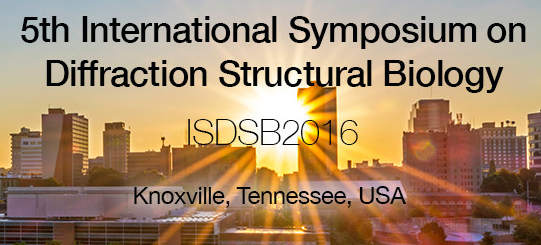
5th International Symposium on Diffraction Structural Biology (ISDSB2016)
| - |
In Knoxville, TN
This symposium will report on the latest discoveries in structural biology using X-ray, neutron, and electron diffraction, and complementary techniques such as small-angle scattering, nuclear magnetic resonance spectroscopy, electron microscopy, and advanced computational approaches. Scientific insights at the molecular level allow structure guided drug discovery and protein engineering for improved biocatalysis. This basic research is important for supporting applications in the pharmaceutical industry and for new, sustainable, and environmentally friendly approaches to the production of chemical reagents and biofuels.
Session topics include:
- Bioenergy Drug Design
- Enzyme Mechanism and Allostery
- Macromolecular Complexes
- Membranes
- Membrane Proteins
- New Instruments and Methods
- Sources and Facilities
The Symposium will be accompanied by two optional 1-day workshops on August 6, focused on Neutron Protein Crystallography and on Small-Angle Scattering, respectively.
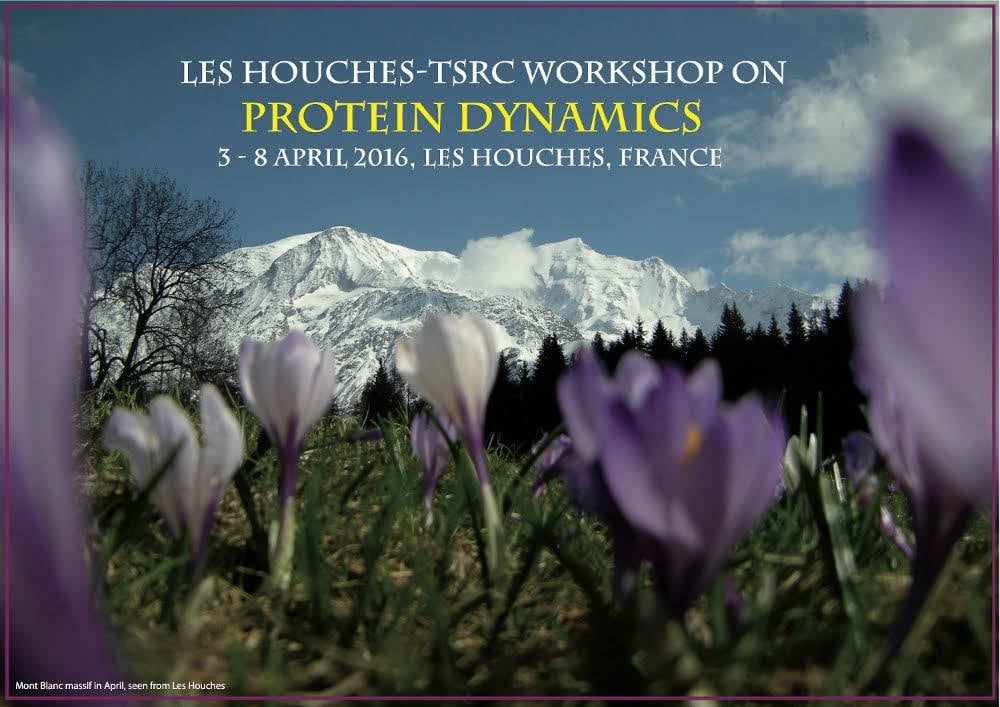
Les Houches-TSRC Workshop on Protein Dynamics
| - |
In Les Houches
This workshop is a forum for presenting, teaching and discussing results
from the application of state-of-the-art experimental and theoretical
and computational approaches to studying protein dynamics, including
optical spectroscopy, NMR spectroscopy, X-ray crystallography, XFELs,
electron microscopy, AFM and scattering methods.
 Confirmed speakers
Bai, Xiaochen (LMB Cambridge, UK)
Barends, Thomas (MPI Heidelberg, Germany)
Blackledge, Martin (Institut de Biologie Structurale, France)
Cammarata, Marco (U de Rennes, France)
Colletier, Jacques-Philippe (Institut de Biologie Structurale, France)
Fenimore, Paul (Los Alamos NL, USA)
Havenith, Martina (U Bochum, Germany)
Hilser, Vincent (Johns Hopkins University, USA)
Heyden, Matthias (MPI Mülheim, Germany)
Ishii, Kunihiko (Riken, Japan)
Katona, Gergely (U Gothenburg)
Klostermeier, Dagmar (U Münster, Germany)
Lindorff-Larsen, Kresten (U Copenhagen, Denmark)
Lewandowski, Jozef (U Warwick, UK)
Mulder, Frans (U Aarhus, Denmark)
Palmer, Arthur (Columbia University, USA)
Parrinello, Michele (ETH Lugano)
Schanda, Paul (Institut de Biologie Structurale, France)
Schirò, Giorgio (Institut de Biologie Structurale, France)
Sprangers, Remco (MPI Tübingen, Germany)
Stock, Gerhard (U Freiburg, Germany)
Uchihashi, Takayuki (U Kanazawa, Japan)
Van den Bedem, Henry (Stanford University, USA)
Van Thor, Jasper (Imperial College London, UK)
Wand, Josh (U Pennsylvania, USA)
Microscopy & Microanalysis (M&M2016)
| - |
In Columbus, OH
Integrating X-ray crystallography and scattering with electron microscopy
| - |
In Oeiras (NOVA ITQB)
The course covers a multidisciplinary approach to study the structure of
challenging proteins, focusing on membrane proteins and large complexes.
The basic principles will be provided for each addressed technique
(Macromolecular Crystallography, Mass Spectrometry and Electron
Microscopy); their applications in biological systems, major benefits
and limitations will also be discussed.
The Workshop is organized with lectures in the mornings followed by
hands-on training. The course is aimed primarily at PhD students and
young Post-Doctoral researchers interested in Structural Biology.
Confirmed speakers are Jose Maria Carazo, Dmitri Svergun and Isabel de
Moraes.
 Participants will be limited to 20. Candidate selection will be based on
a short CV, a motivation letter from the applicant, and a recommendation
letter from the supervisor.
Registration deadline is February 23. Please send your application to
[email protected]. Registration fee is 180Eur including
accommodation.
Â

Introduction to ISIS and Diamond facilities for CDT students 2016
| - |
In Rutherford Appleton Laboratory
Diamond Light Source and the ISIS neutron and muon facility will host a four-day general introduction to these facilities, aimed at first-year PhD students within UK research-council funded Centres of Doctoral Training.
The course will provide an introduction to facilities and techniques, based on the following techniques: Imaging & Tomography; Small Angle Scattering & Disordered Systems; Surfaces, Films & Multilayers; Powder & Single Crystal Diffraction; Electronic & Molecular Spectroscopy; Muon Studies. Â The School will be comprised of numerous short introductory talks and selected tutorial/practical sessions, plus evening research seminars given by experienced facility users. It will be suitable for first-year PhD students who have a broad interest in science, and will require no prior experience of the techniques. (Note that ISIS and Diamond provide specialist training in specific techniques, with information available via facility web pages).EMAG
| - |
In Durham
24th Annual Meeting of the German Crystallographic Society (DGK)
| - |
In Stuttgart

International School on Charge and Spin Density: From Experimental Determination to Interpretation
| - |
In Nancy
Robert F. Stewart school on electron density and related properties
High resolution X-ray diffraction and polarized neutron diffraction are the most relevant methods for respectively modeling charge density and magnetic moment (spin) distributions. Combining both experimental methods in a joint refinement leads to a precise spin resolved electron distributions in magnetic materials.
The aim of this School is to teach all participants the basic knowledge about paired and unpaired electron density distributions using neutron and X-ray diffraction methods and to practice existing refinement software.
This school is dedicated to electron density and its analysis with the emphasis on the combination of complementary experimental methods to enrich the electron density models leading to more complete description of the electronic behavior of crystalline solids.
The school will end with a round table about application of topological analysis and electrostatic properties of a charge distribution in chemistry, biochemistry and physics. Also we will discuss the role of the spin density in material science and how to combine experimental and theoretical methods for a better electron density modeling.
Target Audience: The audience will be typically early career scientists e.g. assistant professors, post-doctoral research fellows, and graduate students of crystallography, medicinal chemistry, solid state and materials science, biochemistry, theoretical, quantum and computational chemistry.
The number of participants is limited to 50.
The bursaries application can be made for ECA and AFC