Topics
Solid-state chemistry
Magnetic Resonance and Muons - A Complementary View of Materials
|
In London
Organised by the IOP BRSG: Magnetic Resonance Group
This one-day meeting will discuss the complementarity of muon techniques with well established magnetic resonance methods. Presentations will cover many aspects of condensed matter physics and chemistry, highlighting the novel information muon measurements can provide.
10:30
 ÂRegistration and refreshments Â
11:00
ÂSemiconductor and Oxide Muonics
Steve Cox, STFC, Rutherford Appleton Laboratory, UK
11:30
ÂTowards Green and Safe Rechargeable Batteries
Martin Mansson, PSI and EPFL, Switzerland
12:00
ÂUnconventional Superconductivity in Alkali Fullerides
Kosmas Prassides, University of Durham, UK
12:30
 Lunch14:00
ÂOpportunities for µSR
Adrian Hillier, STFC, Rutherford Appleton Laboratory, UK
Local Probe Investigations of Highly Frustrated Kagome Antiferromagnets
Fabrice Bert, University Paris Sud, France
14:45
ÂSpin Dynamics and Onset of Correlations in Dilute LiY1-xHoxF4
Mike Graf, Boston College, USA
15:15
ÂSpin Diffusion in the Low-Dimensional Molecular Quantum Heisenberg Antiferromagnet Cu(pyz) (NO3)2 Detected with Implanted Muons
Fan Xiao, University of Durham, UK
15:45
 Refreshments16:15
ÂInterfacial transfer in Microemulsions by Muon Spectroscopy
Nigel Clayden, University of East Anglia, UK
16:45
ÂSpin Probes in Soft Matter
Iain McKenzie, TRIUMF and Simon Fraser University, Canada
17:15
 Close of meetingKey dates
-
Early registration deadline:
18 November 2014 -
Registration deadline:
9 December 2014
Studies of Dynamically Compressed Matter with X-rays Workshop
| - |
In ILL Chadwick Amphitheatre
Scope of the Workshop
The aim of the workshop is to discuss the scientific opportunities and technical challenges opened by the recent improvements in the study of dynamically compressed matter using X-rays. For example, the feasibility of synchrotron radiation single shot X-Ray Diffraction, X-ray Absorption and X-Ray Imaging experiments has been recently assessed and opens many new and exciting opportunities to extend these experiments to a wider user community.
Invited Speakers
Alessandra Benuzzi Mounaix, LULI Palaiseau, France
Roberto Bini, University of Florence, Italy
Simon Bland, Imperial College London, UK
Federica Coppari, LLNL Livermore, USA
Thierry d'Almeida*, CEA/DAM Gramat, France
Thibault de Rességuier, ENSMA Poitiers, France
Fabien Dorchies, CELIA Bordeaux, France
Philippe Gillet, EPFL Lausanne, Switzerland
Yogendra Gupta*, Institute for Shock Physics Pullman, USA
Jianbo Hu, Caltech Pasadena, USA
Hanns-Peter Liermann, DESY Hamburg, Germany
Paul Loubeyre, CEA Bruyères-le-Chatel, France
Stéphane Mazevet*, OBSPM Paris, France
Malcolm McMahon, University of Edinburgh, UK
Guillaume Morard, IMPMC Paris, France
Florent Occelli, CEA Bruyères-le-Chatel, France
Norimasa Ozaki, Osaka University, Japan
Arnaud Sollier, CEA Bruyères-le-Chatel, France
Dylan Spaulding, Harvard University Cambridge, USA
Participation in the workshop is free of charge.
22nd International Conference on the Chemistry of the Organic Solid State (ICCOSS XXII)
| - |
In Niigata
The conference will cover research in all aspects of the chemistry and physics of organic solids, with lectures focused on the following topics:
- Crystallization Processes
- Polymorphism
- Crystal Engineering
- Pharmaceutical Materials
- Molecular Motions in Crystals
- Chemical Reactions in Organic Solids
- Biomaterials
- Crystal Structure Prediction
- Chirality in Organic Crystals
- Inclusion Compounds and Supramolecular Materials
- Mechanochemistry of Organic Solids
- Metal-organic Frameworks
- Nano-structured Organic Materials
- Organic Polymers
- Amorphous Organic Solids
- Liquid Crystals
- Optical, Electrical, and Magnetic Properties
- Industrial Applications of Organic Solids
- Experimental and Computational Techniques
Confirmed Speakers
- Joanna Aizenberg, Harvard University
- Kunio Awaga, Nagoya University
- Graeme M. Day, University of Southampton
- Robert Dinnebier, Max Planck Institute for Solid-State Research, Stuttgart
- Karl-Heinz Ernst, Swiss Federal Laboratories for Materials Science and Technology
- Tomislav Friscic, McGill University
- Makoto Fujita, University of Tokyo
- Miguel A. Garcia-Garibay, University of California, Los Angeles
- Kenneth D.M. Harris, Cardiff University
- Masahiro Irie, Rikkyo University
- Bart Kahr, New York University
- Yuji Ohashi, Tokyo Institute of Technology
- Masami Sakamoto, Chiba University
- Lian Yu, University of Wisconsin-Madison
Â
3rd School on Crystal Structure Determination from Diffraction Data: Application on Powder Samples
| - |
In Sousse
The 3rd School on Crystal Structure Determination from Diffraction Data Application on Powder samples is organised by The “Association tunisienne des matériaux et de l’environnement†and the “Unité de recherche de Chimie des Materiaux et de l’Environmentâ€, Université de Tunis El Manar -Tunisia in collaboration with The Department of Structure Analysis, Institute of Physics of the Academy of Sciences of the Czech Republic, The « Institut des Sciences Chimiques de Rennes » (UMR 6226, CNRS - Université Rennes 1) and The DICAM Department at the University of Trento.
The number of participants will be limited to about 60 to ensure a convivial atmosphere, and the possibility to share dinners between all participants. The school will bring together specialists from the various sub-fields of crystallography and materials sciences with the aim to raise mutual interest and to teach under- and postgraduate students, young post-docs as well as senior scientists interested to be introduced to determination of crystal structure from powder diffraction data.
This school introduces the theory of powder diffraction and the methods available for crystal structure determination and for microstructure analysis from powder diffraction data (indexing, space group determination, structural and microstructural refinement techniques).
One unique aspect of this school will be the extensive use of computer programs during hands-on sessions dedicated to educational exercises.
Â
The Scientific advisory committee of the CS3D school is composed of: Prof. R. BEN HASSEN (Tunisia), Prof. V. PETRICEK (Czech Rep.), Prof. A. BEN SALAH (Tunisia), Prof. A. KABADOU, Dr T. ROISNEL (France), Dr. M. AMAMI, Dr M. PASTUREL (France), Prof. M. LEONI (Italy), Dr. Jan ROHLICEK (Czech Rep.).
The Organizers: Prof. R. BEN HASSEN, Prof. T. BEN AYED, Dr S. CHERIF, Dr M. AMAMI, Dr G. LASSOUAD, Dr H. CHAKER, Dr B. BELGACEM, Dr S. OUNI, Dr A. GHOUILI, Dr. L. BEN FARHAT.
Physical and Chemical Characterization of Surfaces at Different Scales: From Theory to Applications. International School.
| - |
In Saclay (at SOLEIL)
School aims and scope
The international school aims at providing a thorough background in physical and chemical surface characterization, based on methods and instruments, to interested PhD students, post-docs and scientists working at European and non-European universities and laboratories. The school will cover the different aspects of surface analysis and appropriate analytical techniques in detail, from the most conventional (Raman spectroscopy, AFM/STM, IBA) to the most innovative requiring Synchrotron X-ray (X-ray spectroscopy, X-ray microscopy, X-ray diffraction/scattering). The complementarity between laboratory and X-ray based techniques will be presented.
Plenary lectures and tutorials are given by specialists of materials science, solid state-physics, physico-chemical interface from CEA, Synchrotron SOLEIL and Paris Sud University. A substantial part of the programme is devoted to practical sessions carried out on cutting edge instruments, at the facilities of partner institutes and laboratories. In addition, a practical exercise on how to prepare a successful beam time proposal is given, as well as a poster session and a tour of SOLEIL. Examples presented during the lectures cover the variety of existing applications to physics and chemistry of condensed matter.
The attendees will be able to discuss their own projects with the speakers and other participants.

2015 HERCULES in Taiwan
| - |
In Hsinchu
HERCULES 2015 - European School.
| - |
In Grenoble, Paris (France) AND Switzerland
25 Years of Neutron & Synchrotron Radiation Science
This school provides training for students, postdoctoral and senior scientists from European and non-European universities and laboratories, in the field of Neutron and Synchrotron Radiation for condensed matter studies (Biology, Chemistry, Physics, Materials Science, Geosciences, Industrial applications).
The 1-month school includes lectures (60%), hands-on practicals and tutorials at partner institutes (ESRF, ILL in Grenoble, Soleil and LLB near Paris, SLS in Switzerland) and Grenoble Laboratories (CEA, CNRS, EMBL, IBS).
The school includes a common part and two parallel sessions:
Biomolecular, soft condensed matter structure & dynamics,
Physics and chemistry of condensed matter
HERCULES is a yearly event, established in 1991.

Interdisciplinary Surface Science Conference (ISSC-20)
| - |
In Birmingham
ISSC-20 is the latest meeting in the series of interdisciplinary surface science conferences covering all experimental and theoretical aspects of surfaces, interfaces and nanoscale physics and chemistry.

Corrosion Chemistry. Faraday Discussion
| - |
In London
Introduction
Over the last decade or so, there has been immense progress in the development of tools, both experimental and theoretical, for probing the solid/fluid interface at the nanoscale. These advances open the way towards mechanistic understanding, and potentially prediction, of chemical processes occurring at this interface. Amongst the fields beginning to benefit from such effort is corrosion science, which is primarily concerned with degradation of metallic materials immersed in either liquid or gaseous environments, and control thereof. Corrosion science does not always attract the plaudits of other more fashionable subjects, but is nevertheless of huge strategic importance. This statement is increasingly true as we move towards a world where every atom counts, e.g. in maintaining the performance of nano-devices, as well for ensuring sustainability through optimum use of natural resources.
Aims
The aim of this Faraday Discussion is to bring together experimentalists and theoreticians concerned with understanding at the nanoscale interfacial chemical processes relevant to corrosion and its control.
Format
The Faraday Division have been organising high impact Faraday Discussions in rapidly developing areas of physical chemistry and its interfaces with other scientific disciplines for over 100 years.
Faraday Discussions have a special format where research papers written by the speakers are distributed to all participants before the meeting, and most of the meeting is devoted to discussing the papers. Everyone contributes to the discussion - including presenting their own relevant research. The research papers and a record of the discussion are published in the journal Faraday Discussions.
Themes
- Solid/Fluid Interface
In this session, studies concerned with nanoscale elucidation of the structure and fundamental chemical processes (e.g. ion adsorption) at solid/fluid interfaces will be discussed. Particular attention will focus on the solid/aqueous solution interface, as it is of central importance to corrosion. Contributions will cover experimental work, with particular emphasis on in situ studies using state-of-the-art probes, and theoretical modeling.
- Corrosion Scales and Passive Films
Substrate adhered corrosion scales and passive films, which can both significantly affect corrosion (e.g. a passive film can reduce corrosion to a negligible rate), will be the topics of discussion here. Experimental/theoretical studies of both engineering and model (e.g. single crystal) substrates will be presented. Relationships between the composition-structure-chemistry-corrosion resistance of the scales/films will be addressed, together with insight into processes governing their initiation and growth, including the impact of environmental conditions
- Localised Corrosion
Spatially confined corrosion phenomena (e.g. pitting), which can lead to rapid failure of otherwise corrosion resistant substrates, will be of concern in this session. Studies aiming to understand at the nanoscale the combined influences of substrate microstructure/geometry, mechanical distortion, and fluid chemistry on local corrosion initiation/progression will be presented. Modeling of these processes will also feature, as prediction of their occurrence is of huge technological concern
- Corrosion Control
To complement the above sessions, this final session will address nanoscale understanding of corrosion control methods. In particular, it will be concerned with approaches where chemistry plays a key role, namely coatings, paints, and corrosion inhibitors. Topics of discussion will centre on those critical to gain mechanistic insight into corrosion resistance performance, including substrate bonding, structure/morphology, interfacial transport, and degradation mechanisms.
XV Intensive Teaching School in X-ray Structure Analysis
| - |
In Durham
The main focus of the school is on chemical and materials science. Topics to be covered will include:
- Growth and evaluation of non-macromolecular crystals
- Space group determination
- Background theory to data acquisition for small molecules and inorganics
- Practical aspects of data collection
- Practical aspects of data processing
- Fourier syntheses
- Patterson syntheses and direct methods for crystal structure determination
- Charge flipping
- Refinement of inorganic, organic and metal-organic structures
- Derivation of results
- Random and systematic errors
- Twinning
- Validation of results
- Crystallographic databases (CSD, ICSD, etc)
Multifunctional, Hybrid and Nanomaterials (Hybrid Materials 2015)
| - |
In Sitges (near Barcelona)
Fourth International Conference
Energy, the environment and human health have emerged as strategic priorities not only in research but in all aspects of our lives. Hybrid materials have already demonstrated good promise in addressing and offering solutions in each of these priority areas.
The main objective of this large interdisciplinary conference is to bring together, at a truly international level, people with shared interests in hybrid materials, including:
- Polymer chemists, physicists and engineers
- Biomaterials chemists, physicists and engineers
- Organic chemists
- Inorganic chemists
- Solid state chemists
- Sol-gel chemists
- Composites scientists
- Colloid chemists and physicists
- Zeolite, meso- and microporous materials scientists
- Broad nano- and materials scientists
Each day will start with a Plenary Lecture followed by 3 parallel symposia focusing on the following topics:
- Biohybrids and biomaterials
- Functional hybrid nanomaterials, nanocomposites and their applications (this symposium will run in two streams)
- Functional porous materials

Condensed Matter in Paris 2014. CMD25-JMC14
| - |
In Paris
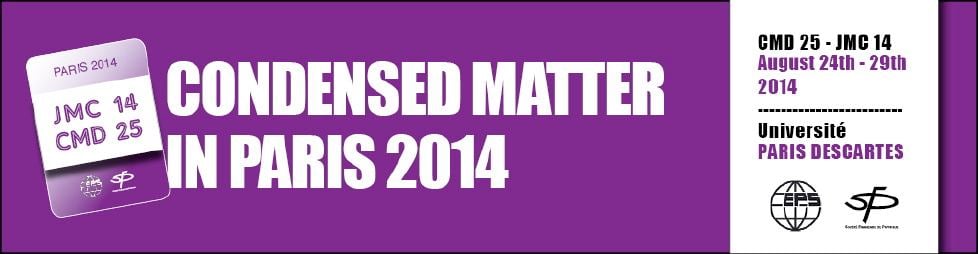
“Condensed Matter in Paris†is an international conference covering all aspects of condensed matter physics, including soft condensed matter, liquid physics, biophysics, materials science, quantum physics and quantum simulators, low temperature physics, quantum fluids, strongly correlated materials, semiconductor physics, magnetism, surface and interface physics, electronic, optical, structural, and mechanical properties of materials, acoustics, and disordered media. An important place will be granted to interdisciplinary topics as well as to the development of research infrastructure in Europe.
“Condensed Matter in Paris†is jointly organised by the Condensed Matter Divisions of the French Physical Society SFP and of the European Physical Society EPS, and will unite the 14th Journées de la Matière Condensée (JMC14) and the 25th Conference of the Condensed Matter Division of the EPS (CMD25) in a single event.
 “Condensed Matter in Paris†is the next in the series of biyearly JMC and CMD conferences, the last of which were held in Montpellier and Edinburgh, respectively. It will also host the biyearly French-Singaporean workshop on physics, which, this year, will have “Graphene†as its main theme.
ISACS13. Challenges in Inorganic and Materials Chemistry
| - |
In Dublin
Challenges in Inorganic and Materials Chemistry (a Royal Society of Chemistry Conference) will be the follow-up event to successful conferences ISACS 3 and ISACS 8 held in 2010 and 2012 respectively, by bringing together leading scientists from across the world to share scientific developments.
The Scientific Committee warmly invites you to take part in ISACS 13 and looks forward to welcoming you to Dublin.
Themes
- Main Group Chemistry
- Metals in Biology
- Organometallic Chemistry and Catalysis
- Porous and Solid State Materials
- Supramolecular Materials
Â
Resonant Elastic X-ray Scattering 2013 (REXS 13)
| - |
In Oxford
REXS 2013 - Workshop on Resonant Elastic X-ray Scattering in Condensed Matter
15-19 July 2013, Oxford, UK
This workshop aims to bring together experts in experimental and theoretical aspects of this vibrant science area, along with researchers who are new to the field, to discuss important recent results and the fundamentals of the techniques.
Building on the success of REXS11 (Aussois) the workshop will include an introduction to techniques, software for data analysis and modelling, the fundamental physics of resonant X-ray scattering and future directions, and its application to a broad range of science. Â The conference will start with a special student day at Diamond, and will provide introductory talks, a description of the terminology used for the meeting, and tutorials on the use of software for data visualization and modelling. Following the Student Day, a welcome reception and early registration will be held at Diamond Light Source with the option to take a tour of the facility. The main conference commences on Tuesday 16th July at the Medical Sciences Teaching Centre in Oxford.
Dynamic Structural Photocrystallography in Chemistry and Materials Science
| - |
In Buffalo, NY
Topics
- Chemical reactions, linkage isomers, and photoinduced molecular excited states
- Experimental techniques used for in-house experiments at high intensity sources, at synchrotron beamlines, and at Free-Electron Laser sources
- New computational techniques for processing time-resolved data
- Interpretation of the results
The program will consist of lectures, software exercises, a poster session, and demonstrations. The workshop will open with a welcoming reception on the evening of Sunday, June 16th and close in the morning of June 20th.
Class size is limited to 45 participants. Registration deadline is April 1st or until the workshop is filled.
Organizing Committee
- Philip Coppens, general organization
- Elzbieta Trzop and Bertrand Fournier, software exercises
- Lisa Zimmerman, organization and facilities
International Advisory Committee
- Eric Collet, Professor, University of Rennes, France
- Masaki Takata, Professor, University of Tokyo, Japan
International School on Resonant Elastic X-ray Scattering in Condensed Matter (REXS 2011)
| - |
In Aussois
Resonant Elastic X-ray Scattering 2011
The proceedings of the REXS 2011 conference are now available as open access articles in European Physical Journal Special Topics 208.The REXS 2011 conference is now over ! We hope you had a great time in Aussois!
The first conference dedicated to Anomalous or Resonant X-ray Scattering took place in Madrid in 1974, followed in 1992 by Malente conference (Hamburg, Germany, published as: "Resonant Anomalous X-Ray Scattering", by G. Materlik, C.J. Sparks & K. Fischer,North-Holland,1994). The aim was to bring together scientists using this novel technique specific to synchrotron radiation in a variety of fields.
20 years or so later, scientists of third generation synchrotrons intensively use this technique that opened to a broad range of applications such as magnetism and nanoscience. A need emerges of a school / conference with published synthesis that would set a similar milestone in condensed matter research. In order to favor scientific exchanges, we restrict the topics to elastic resonant scattering in condensed matter.
Aim of the conference: bring together young and experienced scientists from different fields in condensed matter to share their experience on the application of Elastic Anomalous/Resonant Small, or/and Wide Angle Scattering (including diffraction and reflectivity).
The conference will cover the following topics:
- Fundamentals of elastic resonant scattering
- Electronic correlations
- Magnetism
- Nanostructures
- Soft condensed matter, polymers and glasses
- Materials science and chemistry
- Instrumentation

XX Jubilee International School on Physics and Chemistry of Condensed Matter
| - |
In Bialowieza
ICCOSS XIX (International Conference on the Chemistry of the Organic Solid State)
| - |
In Genoa
ICCOSS meetings have a well established tradition and a few of the past meetings have been held at Jerusalem (1993), Matsuyama (1995), Stony Brook (1997), Cambridge (1999), Mainz (2001), Sydney (2003), Los Angeles (2005), and Merida (2007).
Conference Topics
ICCOSS deals with various aspects of the crystalline state and reactivity of organic and hybrid materials from preparation to characterization. It includes the investigation of  crystal structures and supramolecular architectures, crystal growth and design, inclusion compounds, topochemical reactions, nanostructures, heterogeneous interfaces. Nanoporous materials useful in gas storage and separation for energetic and environmental reasons will be highlighted. Special focussed sessions will be dedicated to polymorphism of pharmaceutical solids and to molecular machines and rotors in the solid state.
First School on Materials Applications of the Organic Solid State (SMAOSS) and XVIII International Conference on the Chemistry of the Organic Solid State (XVIII-ICOSS)
| - |
In Merida
Fifth International Conference on Solid State Crystals and Eighth Polish Conference on Crystal Growth (ICSSC-5 and PCCG-8)
| - |
In Zakopane