Topics
Structural chemistry
GEOMETRY AND TOPOLOGY IN CONTEMPORARY MATERIAL SCIENCE - INTERNATIONAL SUMMER SCHOOL 2022
|
In Copenhagen
• Mesoporous silicates
• Metal organic frameworks and coordination polymers
• Amphiphiles, lipids, star polyphiles forming lyotropic liquid crystals
• Block copolymers including star miktoarm copolymers
Lectures will emphasise the fundamental structural aspects, with an introduction to the following concepts from modern geometry, crystallography and topology:
• Two-dimensional symmetries and orbifolds (wallpaper and point groups)
• Graph theory and net embeddings, knots and entanglement
• Triply-periodic minimal surfaces and related polycontinuous patterns
• 2D hyperbolic tilings and their embedding in 3D
No specialised mathematical knowledge is assumed, apart from some elementary familiarity with the shape of space, polyhedra and symmetry. The course will introduce students to unifying structural concepts in a range of ordered multi-phase hard/soft materials. We encourage students with theoretical or experimental backgrounds to attend.
The course will familiarise students with open-source software for construction and characterisation of structures from nets to surfaces. Hands-on tutorials will explore the concepts, via models and software like Kaleidotile, Surface Evolver, Houdini, GAVROG (3dt and Systre), RCSR, EPINET and HooMD for molecular simulations.
How to design solid structures and assess their stability in Mercury
|
In Online
- Overview of the tools available in the CSD-Materials suite, focusing on tools for:
-
- data-driven solid form design
- solid form assessment during early stages of the development process
- How to use Mercury to perform:
-
- Crystal Packing Feature searches
- Crystal Packing Similarity searches
How to design solid structures and assess their stability in Mercury
|
In Online
- Overview of the tools available in the CSD-Materials suite, focusing on tools for:
-
- data-driven solid form design
- solid form assessment during early stages of the development process
- How to use Mercury to perform:
-
- Crystal Packing Feature searches
- Crystal Packing Similarity searches
Searching crystal structure data in the CSD with ConQuest and WebCSD
|
In Online
- The basics of ConQuest searching
- Use of some advanced query options
- Introduction to WebCSDÂ
- The differences between searching with ConQuest and with WebCSDÂ
Gordon Research Conference - Crystal Engineering
|
In Sunday River, Maine (USA)
The 2022 Gordon Research Conference on Crystal Engineering (GRC-CE) is a biannual meeting. The 2022 GRC-CE will bring together organic, inorganic, physical, computational chemists, as well as pharmaceutical scientists, materials scientists, data scientists, and others in a uniquely and highly interactive environment to discuss latest results at the cutting edge of the field. The program for the 2022 GRC-CE GRC includes sessions on Order, Disorder and Defects, Crystal Assembly, Polymorphs and Mixtures, Crystals Under Pressure, Crystal Reactivity, Pharmaceuticals and Cocrystals, Big Data and Informatics, Porosity and Open Framework Materials, and Engineering Across Different Length Scales.Â
An associated Graduate Research Seminar (GRS) prior to the GRC-CE conference ensures that young scientist are well represented as attendees at the GRC-CE. The highly interactive format of both the GRC and GRS ensures it will be a valuable experience for the next generation of researchers in the field. Â
Zurich School of Crystallography 2022: Bring your own crystals
| - |
In Zurich
30th Annual Meeting of the German Crystallographic Society
| - |
In Munich
The 30th Annual Meeting of the German Crystallographic Society (DGK 30), which will take place in the historical main building of the Ludwig-Maximilians-University in Munich, will feature presentations and discussions of recent and exciting results of research on crystallographic topics.
International School of Crystallography. 46th Course, Crystallography under extreme conditions: the future is bright and very compressed
| - |
In Erice
Subjecting matter to extreme conditions reveals a multitude of fascinating phenomena, and is applicable to a wide range of disciplines. From the extremophiles that exist in the deepest depths of our oceans to the exotic new materials that are made when atoms are pushed ever closer together, understanding the structure of materials at extreme conditions affects Biology, Chemistry, Physics, Geoscience and Material Science. In order to achieve its goals, high pressure research has been always at the vanguard of technical progress. It is a discipline in which equipment plays a particularly important role. State-of-the-art diamond anvil cells can now achieve megabar ranges of pressure, millions of times atmospheric pressure, with this beaten by an order of magnitude in dynamic compression experiments. In this manner, scientists are able to mimic the conditions in the interiors of giant planets. Nature is even more ambitious, as in the stars petapascal pressures (the order of tens to hundreds billion atmospheres) are reached. In the laboratory, we can even create conditions of pressure, temperature and magnetic fields that are not found naturally, allowing us to complement nature to explore more exotic phases of matter.
Therefore, the course will cover broad ground in the application of extreme conditions crystallography. The topics will span from fundamentals of high-pressure single crystal and powder diffraction, to presenting the many flavors of static and dynamic compression, to reviews of sources for extreme conditions work (synchrotrons, neutrons and free electron lasers). Complementary experimental (Mössbauer spectroscopy, X-ray magnetic circular dichroism, X-ray absorption spectroscopy, inelastic scattering) and computational methods will also be discussed. Diffraction analysis on the structure of liquids, glasses and nanocrystalline materials as well as multigrain crystallography will also be introduced. The lectures will be harmonized with the related sessions of interactive tutorials, providing hands-on experience to the attendees. These workshops will be focused on basic laboratory skills and the elements of data processing software related to the high pressure.
Virtual Workshop: Searching and analysing using ConQuest and Mercury
|
In Virtual
Wednesday, 21st July from 3pm to 4.30pm (BST)
Â
In this workshop you will explore advanced tips and tricks to search and analyse metal-organic structures by:
- Learning advanced searching options in ConQuest.
- Learning how to use subsets in ConQuest.
- Learning how to export and analyse hitlists in Mercury.
The workshop will focus on metal-organic structures, but is open to scientists interested to other structures in the CSD.
Â
Requirements:
- Feeling comfortable with basics of Mercury visualisation:
- Navigating the Mercury interface.
- Editing styles, and colours.
- Displaying packing diagrams.
If not, consider reviewing our self-guided visualisation workshop before the event.Â
- Feeling comfortable with the basics of searching in ConQuest:
- Navigating the ConQuest interface, and in particular the Build Queries tab options.
- Drawing substructures in the Draw window.
If not, consider reviewing our self-guided searching workshop before the event.Â
- A current, valid CSD licence - CSD-Core or above.
Virtual Workshop: How to analyse small molecules interactions with Full Interaction Maps.
|
In Virtual
Wednesday, 14th July from 12.30pm to 2pm (BST)
Â
In this workshop you will explore tools from the CSD Software to assess structural stability, in particular studying intermolecular interactions for small molecules using Full Interaction Maps (FIMs). You will:
- Learn how informatics and data-driven approaches can be used to understand the solid state.
- Familiarise yourself with what tools are available in the CSD-Materials suite and what they can be used to do.
- Learn how to use Full Interaction Maps to analyse a structure.
Â
Requirements:
- Feeling comfortable with basics of Mercury visualisation:
- Navigating the Mercury interface.
- Editing styles, and colours.
- Displaying packing diagrams.
- Displaying hydrogen bonds.
If not, consider reviewing our self-guided visualisation workshop before the event.Â
- A current, valid CSD licence - CSD-Material or above.

Virtual Workshop: How to analyse molecular geometry with Mogul
|
In Virtual
Wednesday, 7th July from 10am to 11.30am (BST)
In this virtual workshop you will explore how to use Mogul to assess the geometry of a molecule using the information in over 1.1 million structures in the CSD by learning:
- How to run a geometry check in Mercury.
- How to launch Mogul from Mercury.
- How to interpret the results obtained.
- How to restrict the geometry check to a specific feature of a molecule loaded.
Â
Requirements:
- Feeling comfortable with basics of Mercury visualisation:
- Navigating the Mercury interface.
- Editing styles, and colours.
- Displaying packing diagrams.
If not, consider reviewing our self-guided visualisation workshop before the event.Â
- A current, valid CSD licence - CSD-Core or above.
11th Belgian Crystallography Symposium
|
In Online
Given the current situation and the fact that knowledge dissemination has to continue, the BCS meeting will be an 'open for all', free of charge event. Registration is required for organizational purposes.
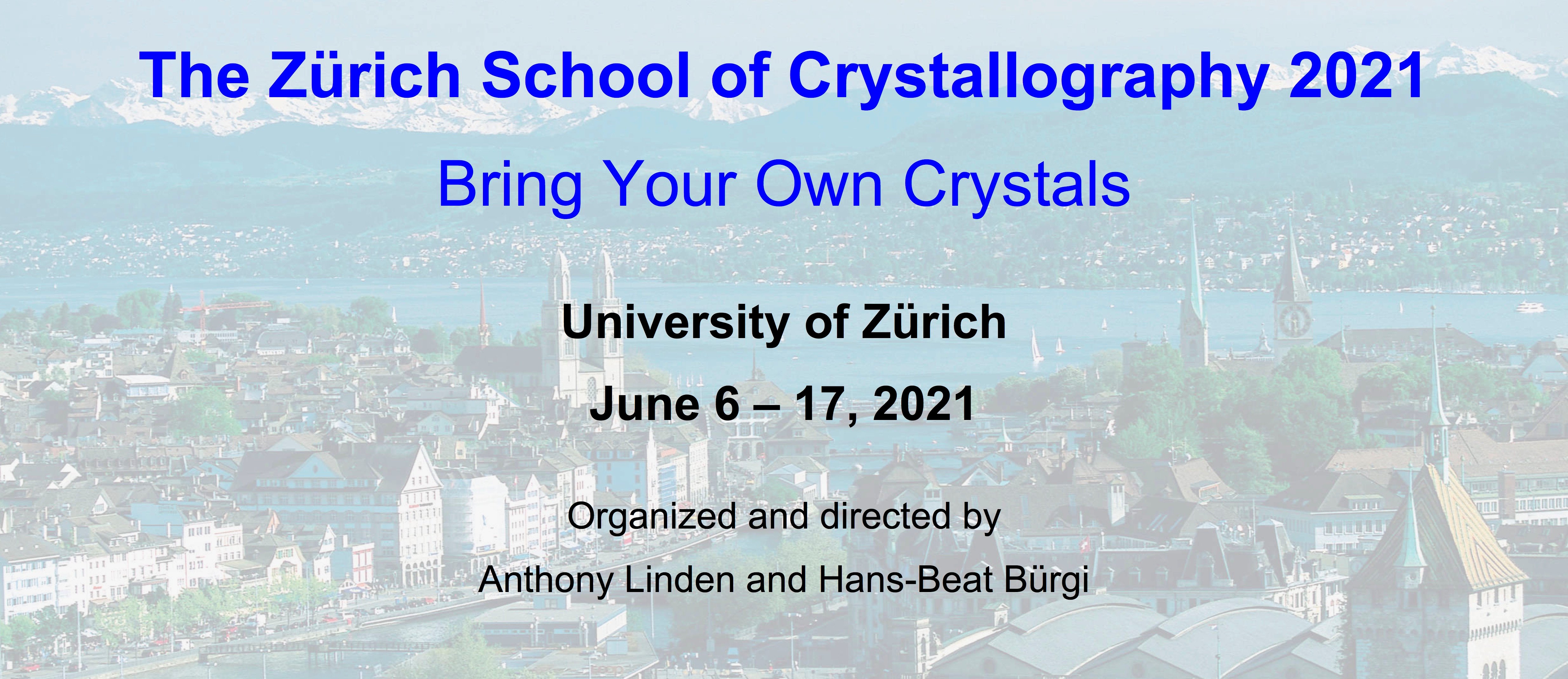
The Zurich School of Crystallography 2021: Bring Your Own Crystals
| - |
In Zurich
FIZ Karlsruhe and CCDC: interactive event
|
Following on from the webinar in August we are hosting a joint interactive session to better understand your requirements and priorities for the development of more advanced searches and services across the CSD and the ICSD. The interactive event in October will be an open, guided discussion designed to collect together your use cases and requirements for a more advanced search interface across the CSD and ICSD.
ECHC 2020 - XXIX European Colloquium on Heterocyclic Chemistry
| - |
In Rouen
37th National Medicinal Chemistry Symposium (ACS meeting)
| - |
In New York City, NY
Atomically Precise Nanochemistry. Gordon Research Conference
| - |
In Galveston, TX
Toward Atomic Precision in Nanochemistry: From Synthesis to Function
2020 ACA Summer Course in Chemical Crystallography
| - |
In Purdue University
Dear Friends and Colleagues
We are thrilled to announce that the 2020 ACA Summer Course in Chemical Crystallography, to be held at Purdue University on May 31st to June 7th, is now open for applications.
The ACA Summer Course in Chemical Crystallography is a week long program that is now well into its third decade of instruction here in the United States. The course is directed towards Single-Crystal Chemical Crystallography and Powder Diffraction techniques, as applicable to small molecule studies and is designed to instruct attendees in the theory and practice of these two aspects of crystallography. Mornings are full with lectures on the theory of the experiment and afternoons and early evenings are covering hands-on workshops.
More information can be found at https://acasummercourse.net/ or https://acasummercourse.net/application/. To submit your application, please visit the address https://acasummercourse.net/2020-application/
Please do not hesitate contacting us at [email protected] with any questions you might have
For the organizers,
Matt Zeller, Purdue University
Christos Malliakas, Northwestern University
Charlotte Stern, Northwestern University
Allen Oliver, Notre Dame University
Normal 0 false false false EN-US X-NONE X-NONE /* Style Definitions */ table.MsoNormalTable {mso-style-name:"Table Normal"; mso-tstyle-rowband-size:0; mso-tstyle-colband-size:0; mso-style-noshow:yes; mso-style-priority:99; mso-style-parent:""; mso-padding-alt:0in 5.4pt 0in 5.4pt; mso-para-margin-top:0in; mso-para-margin-right:0in; mso-para-margin-bottom:8.0pt; mso-para-margin-left:0in; line-height:107%; mso-pagination:widow-orphan; font-size:11.0pt; font-family:"Calibri",sans-serif; mso-ascii-font-family:Calibri; mso-ascii-theme-font:minor-latin; mso-hansi-font-family:Calibri; mso-hansi-theme-font:minor-latin; mso-bidi-font-family:"Times New Roman"; mso-bidi-theme-font:minor-bidi;}CONEXS conference: Emerging Trends in X-Ray Spectroscopy
| - |
In Newcastle (U.K.)
CONEXS Conference
Emerging Trends in X-Ray Spectroscopy
Â
The Collaborative Network for X-Ray Spectroscopy (CONEXS) is an EPSRC-funded network in partnership between Newcastle University and Diamond Light Source. The first CONEXS Conference will be taking place at Newcastle University on the 18-20 February 2020, bringing together leading national and international experts to discuss emerging trends in X-ray Spectroscopy and examine the intersection of experiment and theory.
Â
Date: 18-20 February 2020
Venue: Newcastle University, UK
Call for Abstracts
We are now welcoming submissions for abstracts for both oral presentations and posters, the abstract guidance and the submission form are available here:Â https://research.ncl.ac.uk/conexs/conference/abstractsubmission/.
Â
Registration (https://research.ncl.ac.uk/conexs/conference/registration/)
Registration for the conference is now open, at a rate of £150 (standard) or £75 (students/ECRs). This price includes attendance at the conference dinner.
Keynote speakers
•            Prof. Serena DeBeer, Professor and Director, Max Planck Institute for Chemical Energy Conversion
•            Prof. John Rehr, Professor Emeritus of Physics, University of Washington
•            Prof. Sonia Coraini, Professor in Physical Chemistry, University of Denmark
•            Dr. Anna Regoutz, Lecturer in Materials Chemistry, University College London
•            Prof. Matthias Bauer, Professor in Inorganic Chemistry, University of Paderborn
•            Prof. Neil Hyatt, Professor of Nuclear Materials Chemistry, University of Sheffield
•            Dr. Marius Retegan, Scientist, European Synchrotron Radiation Facility
•            Dr. Olga Safonova, Senior Scientist, Paul Scherrer Institute
•            Dr. Mihaela Gorgoi, Beamline Scientist, EMIL Berlin
•            Prof. Jakub Szlachetko, Associate Professor, Institute of Nuclear Physics PAS
Â
Conference website: https://research.ncl.ac.uk/conexs/conference/
Normal 0 false false false EN-GB X-NONE X-NONE MicrosoftInternetExplorer4 /* Style Definitions */ table.MsoNormalTable {mso-style-name:"Table Normal"; mso-tstyle-rowband-size:0; mso-tstyle-colband-size:0; mso-style-noshow:yes; mso-style-priority:99; mso-style-parent:""; mso-padding-alt:0cm 5.4pt 0cm 5.4pt; mso-para-margin:0cm; mso-para-margin-bottom:.0001pt; mso-pagination:widow-orphan; font-size:10.0pt; font-family:"Times New Roman",serif;}
4th International Symposium on Halogen Bonding (ISXB4)
| - |
In Stellenbosch