Topics
Applied crystallography
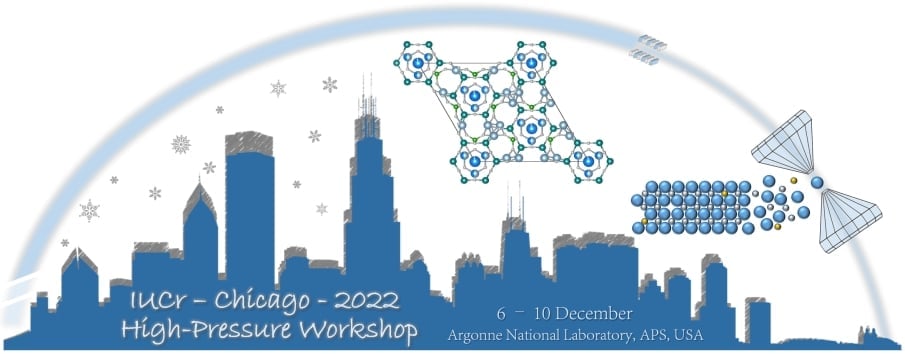
2022 IUCr High Pressure Workshop â€Å"Advanced High Pressure Crystallographyâ€Â
| - |
In Chicago
For the past three decades high pressure research has made breakthrough progress in many fields of science mainly due to the significant improvements in the high-pressure apparatus and developments of advanced static and dynamic probes. Most of the experiments at extreme conditions are very challenging and require dedicated techniques to collect crystallographic data with unprecedented speed and resolution to quantitatively characterize pressure/temperature induced transformations in the crystalline lattice. The tunability, brilliance, and collimation of synchrotron X-ray sources provides scientists with unique capabilities for probing the structural, chemical, and physical properties of various types of materials in-situ at extreme pressure, temperature, and strain with ultra-high spatial, temporal and energy resolution. However, in many cases the complex energy landscapes of multicomponent chemical systems require the use of the predictive power of computational methods that play an essential role in extreme-conditions crystallography coupled with physical experiments.
The purpose of the 2022 workshop of the International Union of Crystallography (IUCr) Commission on High Pressure is to bring together researchers who apply extreme-conditions crystallography in combination with other experimental and computational methods to study a wide range of material properties covering various fields of science, including condensed-matter physics, solid-state chemistry, geophysics, materials science, biology, nanotechnology etc. The workshop aims to facilitate extensive discussion and interdisciplinary collaboration.
Students, postdocs and early carrier scientists in particular will find this workshop helpful in gaining improved familiarity with available state-of-the-art methods and how they can be applied to their research.
We plan to organize a tour to the relevant APS beamlines for workshop attendees (pandemic permits) and a half-day tutorial with hands on examples.
44th COSPAR Scientific Assembly and Associated Events (COSPAR 2022)
|
In Athens, Greece
Abstract Deadline:Â Â Â Â Â Â Â Â Â Â Â Â Â Â Â Â Â Â Â Â Â Â Â Â Â Â Â Â
Mid-February 2022
Â
Topics:Â
Approximately 140 meetings covering the fields of COSPAR Scientific Commissions (SC) and Panels:
- SC A:Â The Earth's Surface, Meteorology and Climate
- SC B:Â The Earth-Moon System, Planets, and Small Bodies of the Solar System
- SC C:Â The Upper Atmospheres of the Earth and Planets Including Reference Atmospheres
- SC D:Â Space Plasmas in the Solar System, Including Planetary Magnetospheres
- SC E:Â Research in Astrophysics from Space
- SC F:Â Life Sciences as Related to Space
- SC G:Â Materials Sciences in Space
- SC H:Â Fundamental Physics in Space
- Panel on Satellite Dynamics (PSD)
- Panel on Scientific Ballooning (PSB)
-Â Panel on Potentially Environmentally Detrimental Activities in Space (PEDAS)
- Panel on Radiation Belt Environment Modelling (PRBEM)
- Panel on Space Weather (PSW)
- Panel on Planetary Protection (PPP)
- Panel on Capacity Building (PCB)
- Panel on Education (PE)
- Panel on Exploration (PEX)
- Panel on Interstellar Research (PIR)
- Panel on Innovative Solutions (PoIS)
- Task Group on Establishing a Constellation of Small Satellites (TGCSS)
- Special events:Â interdisciplinary lectures, round table, etc.
Â
Selected papers published in Advances in Space Research and Life Sciences in Space Research, fully refereed journals with no deadlines open to all submissions in relevant fields.
International conference on Materials Science and Engineering
| - |
In Brisbane
It is a great pleasure and honour to invite colleagues from academia and business, as well as young researchers and students from all parts of the world to attend the Materials Science Conference. The conference, scheduled from October 11-14, 2021 is organized by Prism Scientific Services in collaboration with The University of Queensland.
Â
The conference will underpin the need and importance of collaboration and cooperation by individuals from a wide range of professional backgrounds. Materials Oceania will bring together a multidisciplinary group of scientists and engineers from all over the world to present latest findings and to exchange their ideas. This in turn paves the way for further discoveries, which most often happen where disciplines and specialists meet and congregate. In fact the development of materials was, is and will be fundamental for all technological applications, and in the entire field of applied science targeting the improvement of quality of life for humanity. At the end of the materials conference, we hope that attendees will feel they have generated the most up-to-date information available.
Â
We hope that you will join us for a symphony of outstanding science, and to also take a little extra time to enjoy the spectacular and unique beauty of Brisbane City.
MX raw image data formats, metadata and validation
|
In Prague
Satellite Workshop of the XXV IUCr Congress
"Macromolecular crystallography (MX) is the dominant means of determining the three-dimensional structures of biological macromolecules. Over the last few decades, most MX data have been collected at synchrotron beamlines using a large number of different detectors produced by various manufacturers and taking advantage of various protocols and goniometry. These data came in their own formats, sometimes proprietary, sometimes open. The associated metadata rarely reached the degree of completeness required for data management according to Findability, Accessibility, Interoperability and Reusability (FAIR) principles. Efforts to reuse old data by other investigators or even by the original investigators some time later were often frustrated. In the culmination of an effort dating back more than two decades, a large portion of the research community concerned with High Data-Rate Macromolecular Crystallography (HDRMX) has now agreed to an updated specification of data and metadata for diffraction images produced at synchrotron light sources and X-ray free electron lasers (XFELs). This Gold Standard will facilitate processing of datasets independent of the facility at which they were collected and enable data archiving according to FAIR principles, with a particular focus on interoperability and reusability. This agreed standard builds on the NeXus/HDF5 NXmx application definition and the International Union of Crystallography (IUCr) imgCIF/CBF dictionary and is compatible with major data processing programs and pipelines. Just as with the IUCr CBF/imgCIF standard from which it arose and to which it is tied, the NeXus/HDF5 NXmx Gold Standard application definition is intended to be applicable to all detectors used for crystallography, and all hardware and software developers in the field are encouraged to adopt and contribute to the standard." [A. Förster, H. J. Bernstein, A. Bhoemick, A. S. Brewster, S. Brockhauser, L. Geliso, D. R. Hall, F. Leonarski, V. Mariani, G. Santoni, C. Vonrhein, G. Winter, "A Gold Standard for Macromolecular Diffraction Data", in preparation]
This is a tutorial workshop presented by the developers of the Gold Standard to introduce the community to this important upgrade to the interoperability and reusability of macromolecular crystallographic data for both synchrotrons and XFELS,and to give the participants an opportunity to work with and comment on the Gold Standard. To widely share best practices for metadata recording, we encourage the participation of neutron and chemical crystallographers.
The workshop will function as a purely virtual meeting via Zoom from 9 am to 3 pm Prague time (3 am to 9 pm New York time, 8 am to 2 pm London time) on 14 August 2021 with two breaks. In order to participate and receive the Zoom meeting room URL and agenda, contact Herbert J. Bernstein, [email protected], giving your name, institutional affiliation and email address by no later than 6 pm Prague time (noon New York time, 5 pm London time) on Friday 6 August 2021. Registration is limited to 100 persons. There will be no additional fee for the workshop virtual meeting registration.
Reminder: The CommDat user forum is at https://forums.iucr.org
When should small molecule crystallographers publish raw diffraction data?
| - |
In Online
Satellite Workshop of the XXV IUCr Congress
Following on from a recent survey of the community, this full-day workshop is aimed at: (1) educating those who generate and deal in crystallographic data on best practices in data management; (2) how to communicate those best practices to students and other novice users; (3) discussing current practices in data archival; and (4) exploring current and future use cases for archival of raw data.
Attendees will gain an appreciation of the importance of archiving raw data and an understanding of how to archive their own raw data effectively. The workshop will lay the groundwork for a large-scale community driven effort to standardize small-molecule raw data archival with a view to ensuring that best practice in the laboratory leads to appropriate and FAIR availability of raw data to the wider community. A key goal is to explore how to make this process seamless and integrated with current facility, research and publishing practices.
Reminder: The CommDat user forum is at https://forums.iucr.org
4th Summer School on Neutron Detectors and Related Applications
| - |
In Riva del Garda
The aim of the school is to illustrate principles, methodologies and most recent applications of neutron detection technologies. In particular, the school will tackle various arguments that span from neutron interaction principles, materials for neutrons detectors, neutron sources, Monte Carlo simulation codes, up to applications with neutrons.
2020 ACA Summer Course in Chemical Crystallography
| - |
In Purdue University
Dear Friends and Colleagues
We are thrilled to announce that the 2020 ACA Summer Course in Chemical Crystallography, to be held at Purdue University on May 31st to June 7th, is now open for applications.
The ACA Summer Course in Chemical Crystallography is a week long program that is now well into its third decade of instruction here in the United States. The course is directed towards Single-Crystal Chemical Crystallography and Powder Diffraction techniques, as applicable to small molecule studies and is designed to instruct attendees in the theory and practice of these two aspects of crystallography. Mornings are full with lectures on the theory of the experiment and afternoons and early evenings are covering hands-on workshops.
More information can be found at https://acasummercourse.net/ or https://acasummercourse.net/application/. To submit your application, please visit the address https://acasummercourse.net/2020-application/
Please do not hesitate contacting us at [email protected] with any questions you might have
For the organizers,
Matt Zeller, Purdue University
Christos Malliakas, Northwestern University
Charlotte Stern, Northwestern University
Allen Oliver, Notre Dame University
Normal 0 false false false EN-US X-NONE X-NONE /* Style Definitions */ table.MsoNormalTable {mso-style-name:"Table Normal"; mso-tstyle-rowband-size:0; mso-tstyle-colband-size:0; mso-style-noshow:yes; mso-style-priority:99; mso-style-parent:""; mso-padding-alt:0in 5.4pt 0in 5.4pt; mso-para-margin-top:0in; mso-para-margin-right:0in; mso-para-margin-bottom:8.0pt; mso-para-margin-left:0in; line-height:107%; mso-pagination:widow-orphan; font-size:11.0pt; font-family:"Calibri",sans-serif; mso-ascii-font-family:Calibri; mso-ascii-theme-font:minor-latin; mso-hansi-font-family:Calibri; mso-hansi-theme-font:minor-latin; mso-bidi-font-family:"Times New Roman"; mso-bidi-theme-font:minor-bidi;}Advanced Nanomaterials and Methods - ANAM2019
| - |
In Yerevan
BCA Industrial and Chemical Groups meeting "By hook or by crook â€" structural solutions from challenging crystals"
|
In Stevenage, UK
Le Colloque National Mécamat
| - |
In Aussois (Savoie)
L'association Mécamat tient son colloque national annuel au Centre Paul Langevin du CNRS à Aussois (Savoie) à la fin du mois de janvier. Chaque colloque propose une thématique différente, proposée par une équipe diversifiée. Sur une semaine, le colloque propose un état de l'art exhaustif de cette thématique. Des exposés longs sont présentés par les meilleurs spécialistes nationaux, et de larges espaces réservés pour la discussion.
Materials Science & Nanotechnology Conference
| - |
In Sana Malhoa Hotel, Lisbon
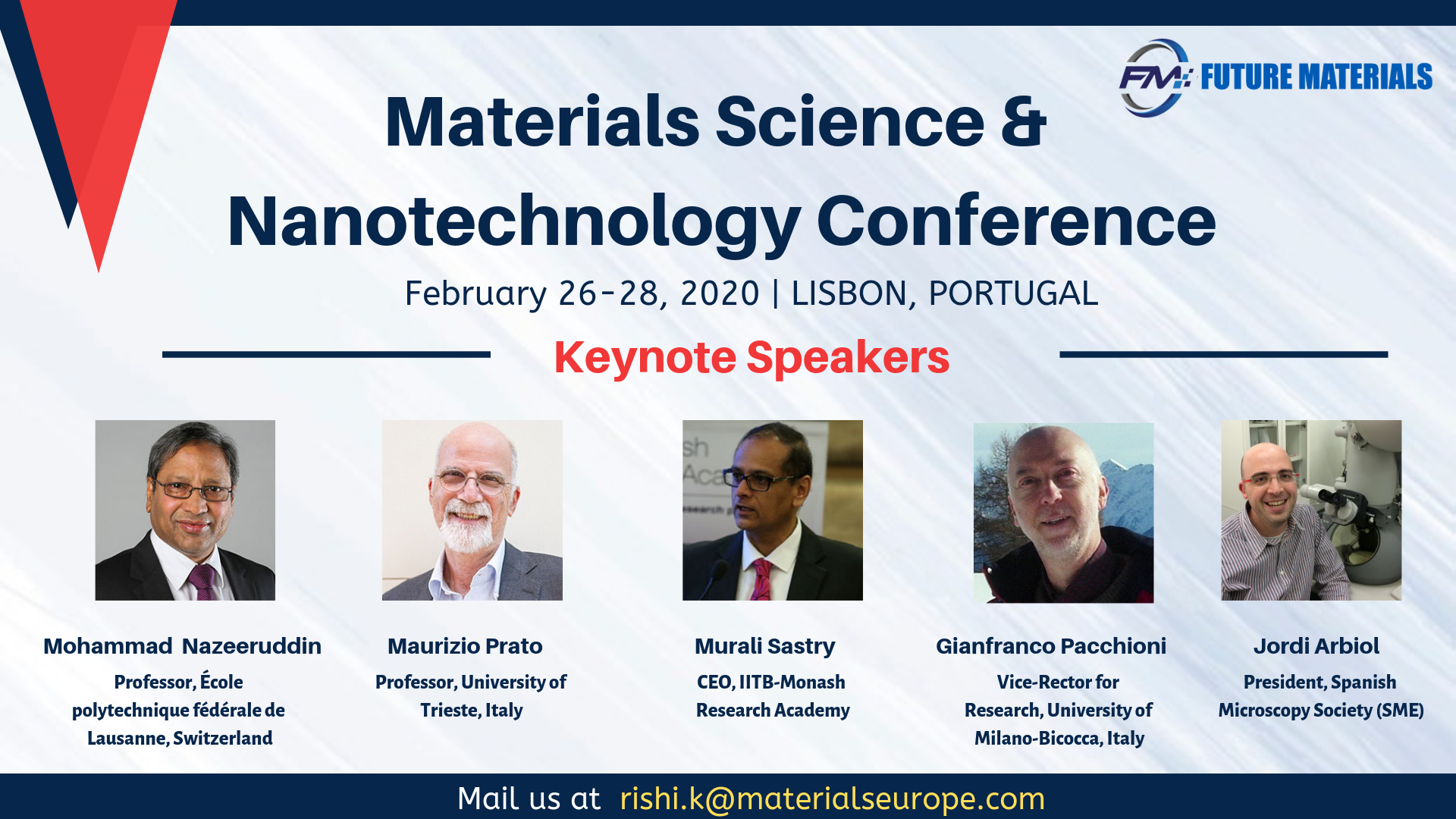
Committee Members invites participants from across the globe to join in this annual flagship conference on Materials Science and Nanotechnology. Future Materials 2020 moto is to share latest researches amongst the professionals from industries and Institutes also provides a platform for students from research areas of Materials Science, Nanotechnology, Chemistry and Physics to share their ideas, experiences and indulge in interactive discussions and technical sessions at the event. The event will also provide space for several institutes and organizations to present their services, products, innovations and research results.
The 77th Annual Pittsburgh Diffraction Conference
| - |
In Oak Ridge, TN
You’re invited to the 77th Annual Pittsburgh Diffraction Conference at Oak Ridge National Laboratory (ORNL), which is located in Oak Ridge, Tennessee (near Knoxville). The conference will take place over three days and feature sessions focused on all areas of diffraction, from powders to protein crystals. Topics will include emerging technologies/techniques, Total scattering, Magnetic scattering, and Integrative Structural Biology. The Chung Soo Yoo Award, established by the Pittsburgh Diffraction Society to honor Dr. Yoo’s memory, and a $400 cash prize will be given to the graduate student having the best poster presentation at the conference.
International Conference on Materials Science and Engineering
| - |
In Melbourne, Australia
Keeping updated on the latest trends in material science across a wide range of industries can be an intimidating task. Realizing this imperative, PRISM is set to organize International Conference on Materials Science and Engineering which is going to take place during September 16-18, 2019 at Melbourne, Australia with a view to promote awareness and enhance research aiming in developing solutions for the challenges encountered.
This materials science conference will provide an international medium to share and exchange the theoretical and experimental studies and research related to the electronic, electrochemical, ionic, magnetic, optical, and biosensing properties of solid state materials in bulk, thin film and particulate forms. It focuses on synthesis, processing, characterization, structure, physical properties and computational aspects of nano-crystalline, crystalline, amorphous and glassy forms of ceramics, semiconductors, layered insertion compounds, low-dimensional compounds and systems, fast-ion conductors, polymers and dielectrics.
Materials Oceania aims to bring together leading academic scientists, industrialist, research scholars, students, delegates and exhibitors to exchange and share their experiences, research results about all aspects of Materials Science, Nanotechnology, Chemistry and Physics. This engineering conference is also providing a platform to the companies and/or institutions to present their services, products, innovations and research results.
Meet the Objective Business sector with individuals from and around the globe concentrated on finding out about Materials science and Engineering, this is the best chance to achieve the biggest collection of members from all over the world. This materials science conferences in australia will lead you to get disperse data, meet with current, make a sprinkle with another product offering and get name acknowledgement at this occasion. Widely acclaimed speakers, the latest methods, strategies, and the most up to date overhauls in Materials science and Engineering are signs of this meeting.
Â
For more details please visit:Â https://www.materialsconferenceaustralia.com
Dynamic Light Scattering workshop
|
In Nottingham
This workshop is open to anyone who uses Dynamic Light Scattering (DLS) technology to characterise their samples. Discuss your experiences, challenges and successes in using DLS in your day to day workflow.
MAUD 2018
| - |
In Trento
The aim is to bring together participants from various fields of both the academic and non-academic world and give them the necessary information and tools to be able to characterize their own samples using the combined analysis method and the software MAUD.Â
XRD, XRF and electron microscopy equipment available at the Dipartimento Ingegneria Industriale (DII) and Fondazione Bruno Kessler (FBK) will be used to demonstrate technical aspects and to support the theoretical and practical issues of this course.
BCA-Industrial Group Autumn meeting
| - |
In Durham
XXIV Conference on Applied Crystallography
| - |
In Bieszczady Mountains near PrzemyÃ...›l
7th Meeting 'X-ray and other techniques in investigations of the objects of cultural heritage'
| - |
In Krakow

42nd International Symposium on Archaeometry ISA 2018
| - |
In Merida
MOOC: Biological Crystallography Course
| - |
This course, entitled "Voyage au cÅ"ur du vivant avec les rayons X : la cristallographie", is run as a collaboration between the CEA, the Synchrotron Soleil, the Ecole Polytechnique, the CNRS, and the University Paris Sud. The course will focus on the teaching of biological crystallography to biology students, from the history of the method to its application.
The course, which starts on 6th November 2017, is open to biologists at all levels (from Master's level up to full-time researchers).
Access to the course is free on the France University website:Â https://www.fun-mooc.fr/courses/course-v1:ParisSaclay+71002+session01/about
The course language is French.Â
Â