Topics
Biological macromolecules
In situ Methods in Cell Biology and Cellular Biophysics. EMBO workshop
| - |
In Berlin
To be held at the Max Delbruck Communications Center (Berlin)
International speakers
Uri Alon | Weizmann Institute of Science, IL
Madan Babu | Laboratory of Molecular Biology (LMB-MRC), UK
Marc Baldus | Utrecht University, NL
John Briggs | Laboratory of Molecular Biology (LMB-MRC), UK
Michael Elowitz | Caltech, USA
Daniella Goldfarb | Weizmann Institute of Science, IL
Tom Kirchhausen | Harvard Medical School, US
Edward Lemke | European Molecular Biology Laboratory, DE
Julia Mahamid | European Molecular Biology Laboratory, DE
Gael McGill | Harvard Medical School & Digizyme, US
Sean O'Donoghue | Garvan Institute of Medical Research & CISRO, AU
Paola Picotti | ETH Zurich, CH
Gary Pielak | University North Carolina, US
Gaia Pigino | Max Planck Institute of Molecular Cell Biology & Genetics, DE
Juergen Plitzko | Max Planck Institute of Biochemistry, DE
Stephan Preibisch | Berlin Institute of Medical Systems Biology & MDC, DE
Jody Puglisi | Stanford University, US
Stephen Quake | Stanford University, US
Aleksandra Radenovic | EPFL Lausanne, CH
Juri Rappsilber | Wellcome Trust Centre for Cell Biology, University of Edinburgh, UK & TU Berlin, DE
Petra Schwille | Max Planck Institute of Biochemistry, DE
Michal Sharon | Weizmann Institute of Science, IL
Ilaria Testa | KTH Royal Institute of Technology, SE
10th International Workshop on Radiation Damage to Biological Samples
| - |
In Brookhaven
Sessions will cover:
- Basic Understanding of Radiation Damage Mechanisms
- Biological Studies Affected by Radiation Damage
- Practical Aspects of Reducing Radiation Damage at Synchrotrons
- Damage at New Sources - XFEL and 4th generation synchrotrons
- Radiation Damage in Complementary Fields including Biological Imaging
BCA/CCP4 Summer School in Protein Crystallography
| - |
In Didcot (Diamond), UK
he BCA/CCP4 Protein Crystallography Summer School is intended for students
and researchers new to crystallography. Its dual aims are to provide
comprehensive training in crystallography and to promote best practise
within the British crystallographic community. The lectures cover the gamut
of techniques required for a structure solution, from protein expression
through to structure validation. Intensively supervised computer tutorials
enable students to relate the theory presented in the lectures to practice.
Although CCP4 programs will primarily be used in these tutorials, the aim
will be to approach crystallographic questions in a software-agnostic
manner. There will also be a crystal manipulation and cooling workshop.
Note that the course is scheduled during Diamond synchrotron downtime, so
there will not be active data collection at the Diamond beamlines.
Up to 10 places for those with BBSRC studentships will be fully funded.
Diffraction Methods in Structural Biology (GRS)
| - |
In Lewiston, ME
Crystallography 2.0: Restructuring the Field Around a New Wave of Experiments
COMPPÃ…. Symposium on Membrane Protein Production and Analysis
| - |
In New York, NY
To be held at the Roy and Diana Vagelos Education Center, Columbia University.
Topics will include production, structure determination, functional analysis and engineering of integral membrane proteins.
23rd Annual Structural Biology Symposium
|
In Galveston Island, TX
To be held at Levin Hall on the University of Texas Medical Branch Campus on beautiful Galveston Island. The meeting is organized by the Sealy Center for Structural Biology & Molecular Biophysics and co-sponsored by the Keck Center for Computational & Structural Biology.
This year’s speakers include:
      Grant Jensen, Ph.D.,  California Institute of Technology
        “Progress and Challenges in Electron Cryotomographyâ€
        Ayyalusamy Ramamoorthy, Ph.D., University of Michigan
   “Membrane-Assisted Dynamic Protein-Protein Interactions by NMR"
       Andrew Routh, Ph.D., University of Texas Medical Branch
  “Parallel ClickSeq and Nanopore Deep-Sequencing Characterizes the
         Emergence and Evolution of Defective Viral Genomesâ€
    Joan-Emma Shea, Ph.D., University of California Santa Barbara
     “Binding and Assembly of Intrinsically Disordered Peptideâ€
                  Yizhi Tao, Ph.D., Rice University
                   “The Tail of a Nematode Virusâ€
              Adam Zlotnick, Ph.D., Indiana University
     “Multiple Mechanisms for Assembly-Directed HBV Antiviralsâ€
Â
Exploiting Disease Genomics to Catalyse New Medicines
|
In Oxford
Time, Work and Function: Time-Resolved Synchrotron and Neutron Techniques for Studies of Soft, Biological and Hard Matter (TWF2018)
| - |
In Oslo
This workshop will focus on scattering techniques and in particular time-resolved and in operando studies of kinetic processes. The main topics to be covered in the workshop will include Energy Materials, Soft Matter, Biological Matter, Inorganic Functional Materials and Catalysis. Due to support from the Norwegian Research Council and ESS & MAX IV, registration for the workshop is free; however, there is a limit of 100 participants and those with connections to the local InterReg project will gain priority in obtaining a position at the workshop.Â
For further information and contact details, please visit:Â https://www.twf2018.com/
Registration deadline: 29th April 2018
Abstract deadline: 6th April 2018
To complete registration, please visit:Â https://nettskjema.uio.no/answer/93111.html;Â or sent your abstract by email (with "NNSP-TWF2018" as the subject heading) to Reider Lund at this address: [email protected]
Neutrons and Biology
| - |
In Carqueiranne
The aim of the school is to present an overview of the use of neutrons to probe the structure and dynamics of biological systems, including basic tutorials on neutron diffraction and scattering and instrumentation, accompanied by practical courses.
For further details please visit:Â https://sites.google.com/view/bioneutrons2018
Registration deadline: 30th June 2018
The registration is free of charges for CNRS employees.Â
3rd International Workshop on Biological Membranes
| - |
In Helsinki
Tiny Lipids With Grand Functions
3rd Pasteur Course on Integrative Structural Biology
| - |
In Paris
not be solved by one technique alone, but need to be solved by a
combination of methods, including NMR, X-ray crystallography, electron
microscopy, structural mass spectrometry, and SAXS. The heterogeneous
data coming from these methods need to be combined with advanced
molecular modeling techniques. The goal of the course is to provide
young scientists that have more specialized knowledge in one of the
techniques an overview over the broad range of modern structural methods
available. Special emphasis will be given to computational approaches to
integrate data (such as IMP, ARIA).
The course is principally aimed at the mature graduate student /
postdoctoral level, but applications from scientists at all levels are
encouraged. The course will consist of lectures, which will give
introductions into the principles and limitations of the different
techniques, and practical work on data analysis with the major structure
refinement / modeling programs.

Les Houches/TSRC Workshop on Protein Dynamics
| - |
In Chamonix Valley
results from state-of-the-art experimental approaches (including optical
spectroscopy, NMR spectroscopy, X-ray crystallography, XFELs, electron
microscopy, atomic-force microscopy and scattering methods), and
theoretical and computational methods to studying protein dynamics.
The Les Houches â€" TSRC Protein Dynamics Workshop complements the
long-standing TSRC Protein Dynamics Workshop, held every other year in
the odd calendar years at the Telluride Science Research Center
in Telluride, Colorado. In Les
Houches, about 30 invited speakers will give oral presentations that
comprise a pedagogic introduction to the methodology employed, followed
by applications from their own work. Each 30-minute presentation will be
followed by 15 minutes of discussion. In addition to the 30 invited
speakers, there will be space for 30 student/postdoctoral participants
that can present posters. Its relatively small number of
participants favors exchange of ideas across disciplines and
fostering of collaborations. A few slots for oral presentations are still
available.
The Ecole de Physique des Houches can be conveniently reached from
Geneva Airport (including the train station at the airport with direct
connections to Zurich) by shuttle-bus service within 80 minutes.
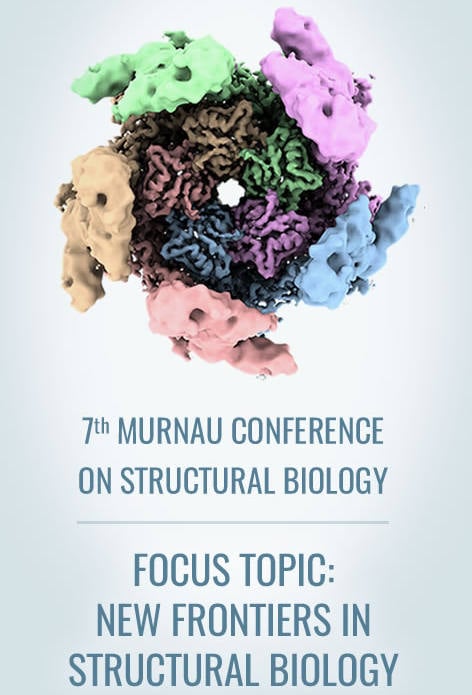
7th Murnau Conference on Structural Biology
| - |
In Murnau, Bavaria
Focus Topic: New Frontiers in Structural Biology
Biannually, the German Society for Biochemistry and Molecular Biology (GBM) brings together leading structural biologists, junior researchers and industry exhibitors at the Murnau conference. Scientists from all over the world present groundbreaking new discoveries and discuss the latest technical developments.Â
Kurt Wuethrich | ETH Zurich and TSRI La Jolla, USA (Murnau lecture 2018)
Elena Conti | MPI of Biochemistry, Martinsried              Â
Helmut Grubmueller | MPI of Biophysical Chemistry, Goettingen
Anne Houdusse | Institut Curie, Paris, France   Â
Grant Jensen | Caltech, Pasadena, USA  Â
Ernest Laue | University of Cambridge, UK  Â
Kaspar Locher | ETH Zurich     Â
Jan Loewe | MRC Cambridge, UK   Â
Lori Passmore | MRC Cambridge, UK
Michael Sattler | TU and Helmholtz Zentrum Munich
Ben Schuler | University of Zurich                           Â
Brenda Schulman | MPI of Biochemistry, Martinsried                      Â
Phil Selenko | FMP Berlin Â
The small size with maximally 200 participants and the familiar atmosphere in the center of the Bavarian Heartland make this meeting a highlight in the national and international conference calendar. Especially for the young generation of scientists the Murnau conference is the ideal platform to bring their work to the attendance of the community and to get in contact with scientific leaders in the field.Â
Â
Cryo-EM at VARI
| - |
In Van Andel Research Institute, Grand Rapids, MI
An intense half-week workshop for gifted graduate students
Taught by internationally recognized Cryo-EM experts, the inaugural workshop gives gifted graduate students an intense overview of the latest innovative methodologies and their application across several fields including cancer and neurodegenerative disease research.
Scottish Centre for Macromolecular Imaging - Symposium and opening
| - |
In Glasgow
Established as a consortium of Scottish Universities (Glasgow, Dundee, Edinburgh and St. Andrews), SCMI will provide access to top-flight cryoEM capabilities for structural biologists across Scotland and Northern England.
We will soon be taking delivery of our front-line instrument - a JEOL Cryo-ARM 300.
As we shall be among the first to take delivery of this new machine, we anticipate that the cryoEM community may be enthusiastic to learn about its design and capabilities.
To celebrate the launch of SCMI, we are planning to hold a symposium and opening event on the 10th and 11th of September.
Solution Scattering from Biological Macromolecules
| - |
In Hamburg
The course participants will have the possibility to learn the basics of SAXS/SANS, sample preparation, experiment design, data interpretation and will get hands-on experience with the latest modelling programs. The participants are encouraged to bring their own samples to perform synchrotron solution scattering experiments on-site; the results will be used for practical tutorials and discussed on the last day of the course.
The course is limited to 26 participants. Application deadline is 31st August 2018.
For more information and registration, please visit:Â http://meetings.embo.org/event/18-sas#Register
32nd Annual ResMed: Residential School on Medicinal Chemistry and Biology in Drug Discovery
| - |
In Drew University, Madison NJ
ResMed is a week-long graduate level course organized to provide an accelerated program for chemists, biologists and other industrial and academic scientists who wish to broaden their knowledge of drug discovery and development. The School's aim is to concentrate on the fundamentals that are useful in drug discovery spanning initial target validation through clinical development. The program provides ample opportunity for discussions with distinguished faculty from industry and academia.
The purpose of the School is to provide a strong background in the principles of drug discovery and development to enhance collaborative drug discovery programs. Previous attendees with backgrounds in macromolecular crystallography have found the course of great value in their research projects.
Â
Â
Topics for 2018 ResMed
- Principles of Med Chem
- Enzyme Inhibition
- Kinase Inhibitors
- G-Protein Coupled Receptors
- Receptor Binding Assays
- Drugs Affecting Ion Channels
- Epigenetics
- Bioisosteres
- Hit-to-Lead Process in Drug Discovery
- Princ. of Lead Optimization
- Drug-like Properties in Drug Discovery
- Fragment-based Drug Design
- Chemoinformatics
- Molecular Modeling
- Structure-Based Drug Design
- Protein-Protein Interactions
- Pharmacokinetics
- Drug Metabolism
- Improving Drug Candidates by Design
- Designing Around Toxicophores
- Preclinical Toxicology
- Clinical Development
- Four Case History Presentations
Scalable and Reproducible Structural Bioinformatics Workshop & Hackathon 2018
| - |
In San Diego, CA
The second MMTF workshop.
This workshop is sponsored by the NIH Big Data to Knowledge (BD2K) initiative. Air travel and 4-day lodging can be provided for non-commercial participants, including a limited number of international participants. Applicants will be selected based on the best fit to the program on a rolling basis.
This 3-day hands-on workshop and hackathon introduces you to:
- Application of state-of-the-art Big Data technologies to Structural
- Bioinformatics
- Data mining and machine learning
- 2D/3D visualization and deployment in Jupyter Notebooks
The first two days of the workshop combine lectures, hands-on applications, and programming sessions. On the third day, participants apply the new technologies to their own projects. This workshop is aimed at graduate students, postdocs, staff, faculty, industrial researchers, and scientific software developers. Experience with Python is required.

EPF Lausanne MOOC course: Synchrotrons and X-Ray Free Electron Lasers
| - |
In Web
The Massive Open Online Course (MOOC) from the EPFL (Ecole Polytechnique Federale de Lausanne) covers introductory aspects of synchrotron and XFEL radiation. A link to the course can be found at
https://www.edx.org/course/synchrotrons-and-x-ray-free-electron-laser.
A short 'teaser' video is also viewable at https://www.youtube.com/watch?v=CyIGssgri50, which gives an insight into the course contents.
The course is aimed at a broad scientific audience from historical-artefact restorators and paleontologists, through biologists, biochemists and chemical engineers, to materials scientists and physicists. It includes the following themes:
- Interaction of X-rays with matter;
- The production and physics of synchrotron and XFEL radiation;
- X-ray optics, beamlines, and instrumentation;
- X-ray diffraction and scattering;
- UV and X-ray spectroscopies;
- X-ray imaging (mainly tomography and lensless imaging/ptychography);
- Extra week on phasing techniques in macromolecular crystallography.
The course begins next Monday 5th March 2018 and lasts for nine weeks - each week, two to three new videos are released (youTube videos embedded in the edX player, which can be downloaded and viewed at leisure), each approximately 20 minutes long, plus optional problems (and optional final exam at the end of the course). Enrollment on the course (see above link) is free; a Verified Certificate can be purchased at the end for those who so wish and have achieved the pass grade.
This is an excellent opportunity, especially for younger staff and students, to learn more about the fascinating and interdisciplinary world of synchrotron science and all its myriad possibilities in an engaging and exciting manner!
Membranes Beyond: International Workshop on Status and Perspectives in Research on Membrane Structure and Interaction
| - |
In Hamilton, ON
This workshop will highlight recent approaches and developing ideas in research on membrane structure and interaction.Â
Topics will include:Â
- Membrane phase behaviour
- Membrane dynamics
- Membrane mixtures and rafts
- Lipid-peptide interaction
- Lipid-protein interactionÂ
- Simulation of membrane systems
- Drug delivery systems
- Membranes and signalling
- Membrane fusion
Registration will open on 1st March 2018. The deadline for submission of abstracts is 31st March 2018, and the deadline for registration is 31st May 2018.
Â