Topics
Data analysis
School and Conference on Analysis of Diffraction Data in Real Space
| - |
In Grenoble
TR+: Time-resolved methods for Life Sciences at MAX IV â€" LINXS ChemLife-MAX IV event
| - |
In Lund
The TR+ workshop will provide exciting insight into the broad range of synchrotron-based techniques available at MAX IV to investigate dynamics on a variety of length scales and timescales in biomolecules using X-ray spectroscopy, scattering, serial crystallography, and combined methods.
This workshop will focus on the practical considerations in performing time-resolved synchrotron studies including sample preparation and delivery, reaction triggering methods, and large data analysis and interpretation. Early career and established researchers interested in pursuing new techniques are encouraged to attend.
Scientific achievements through serial crystallography â€" LINXS ChemLife-MAX IV event
| - |
In Lund
82nd Pittsburgh Diffraction Conference
| - |
In Brookhaven National Laboratory, Stony Brook University Stony Brook, NY 11794-4040 USA
2025 Pittsburgh Diffraction Conference (PDC)
Hosted by Brookhaven National Laboratory
October 9â€"12, 2025
On behalf of the Conference Committee, we are delighted to invite you to 82nd annual Pittsburgh Diffraction Conference (PDC). This year’s conference will be held October 9â€"12, 2025 at Brookhaven National Laboratory, on New York’s beautiful Long Island.
The Pittsburgh Diffraction Conference is one of the longest-running scientific meetings in North America focused on the advancement of structural science through diffraction-based methods. Bridging both life sciences and materials sciences, the conference brings together researchers who utilize laboratory-based instruments, X-ray light sources, electron diffraction, and neutron scattering to explore the structure and dynamics of matter. It serves as a vibrant forum for sharing recent scientific breakthroughs, fostering interdisciplinary collaborations, and highlighting innovations across experimental and computational frontiers
This year’s program features a diverse and timely selection of breakout sessions, reflecting key areas of growth in the field. Topics include energy storage, emphasizing structural insights that enable next-generation energy technologies; AI and its applications in the development of emergent materials; novel materials with transformative properties; and the effects of extreme environments on structures, reveling details on dynamic processes and molecular motion that lead to biomolecular functions and a better understanding of complex soft materials.
Â
Conference Web Page and Registration:Â Â
https://www.bnl.gov/pittsburgh-diffraction-conference/index.phpÂ
Â
Important dates:
April 21, 2025Â Â Â Â Â Â Â Â General registration opens
July 31, 2025Â Â Â Â Â Â Â Â Deadline to submit an abstract for an oral/poster presentation
September 19, 2025Â Â Â General registration closes
Pre-event workshops:
PDF 101: A Hands on Tutorial to Total Scattering Methods (organizers: Milinda Abeykoon, Daniel Olds)
Hands-on Workshop: Crystal Clear Insights: Mastering Protein Crystallization (organizers: Crissy Traver, Vivian Stojanoff)
Â
Evening Events:
Brookhaven National Lab facility tour.
Friday, October 10, 2025
https://www.bnl.gov/pittsburgh-diffraction-conference/nsls2tour.php
Banquet Dinner
Danfords Hotel and Marina
25 E Broadway, Port Jefferson, NY 11777
Date: Friday, October 10, 2025, 7-9 p.m.
Awards Dinner
Charles B. Wang Center
100 Nicolls Road, Stony Brook, NY 11794
Date: Saturday, October 11, 2025, 7-9 p.m.
Webinar: Structural Insights with CSD 6.00: New Data Fields, Disorder Modelling & Future Improvements
|
In Online
The latest Cambridge Structural Database (CSD) 6.00 release brought many improvements and innovations. During this live webinar, we will explore the new and improved features and demonstrate them in Mercury and the CSD Python API.
-
The New Data Fields for Enhanced Analysis
Discover how new fields let you filter for data quality and enhance downstream analyses of the over 1 million structures in the CSDs. Plus, look into computed MOF propertiesâ€"pore surface area, void diameter, dimensionalityâ€"now accessible in Mercury and via the CSD Python API. -
Advanced Disorder Modelling
See how disorder is no longer suppressedâ€"over 165,000 structures now feature fully modelled major and minor conformations. Learn to visualize and switch these in Mercury, utilise color-coded disorder components, and programmatically access disorder via APIâ€"improving clarity and insight in your workflows. -
CSD 6.00 Data Format Upgrade & What’s Next
Understand how CSD 6.00’s updated data format underpins both the new metadata and disorder features, and supports future enhancements. We’ll demonstrate how the format streamlines workflows, and preview some features in future releasesâ€"like expanded disorder, publication metadata, mmCIF support, and structure optimisation tools.
Who should attend:
-
Crystallographers, materials scientists, and computational chemists;
-
Researchers working with crystal structures.

PAQMAN: a satellite workshop to ICNS 2025
| - |
In Stavanger
International Workshop on Powder Diffraction - IWPD2025
| - |
In Bari
This intensive three-day workshop offers a thorough introduction to modern powder diffraction techniques, combining theoretical foundations with practical applications. The program is designed for graduate students, researchers, and professionals aiming to deepen their understanding and hands-on skills in phase identification, quantitative analysis, and structure determination using powder X-ray diffraction data.
The course begins with the fundamental principles of powder diffraction and qualitative phase analysis, including the use of databases and software (PDF-5+, JADEPro and Qualx2.0). Day 2 focuses on quantitative phase analysis, structure solution, and Rietveld refinement, supported by guided exercises using EXPO and TOPAS software. The final day explores advanced topics such as total scattering, Pair Distribution Function (PDF) analysis, and microstructural characterization through size-strain analysis.
Throughout the course, participants will engage in practical sessions aimed at developing autonomy in data interpretation, profile fitting, and structure modelling using widely adopted software packages in the field.

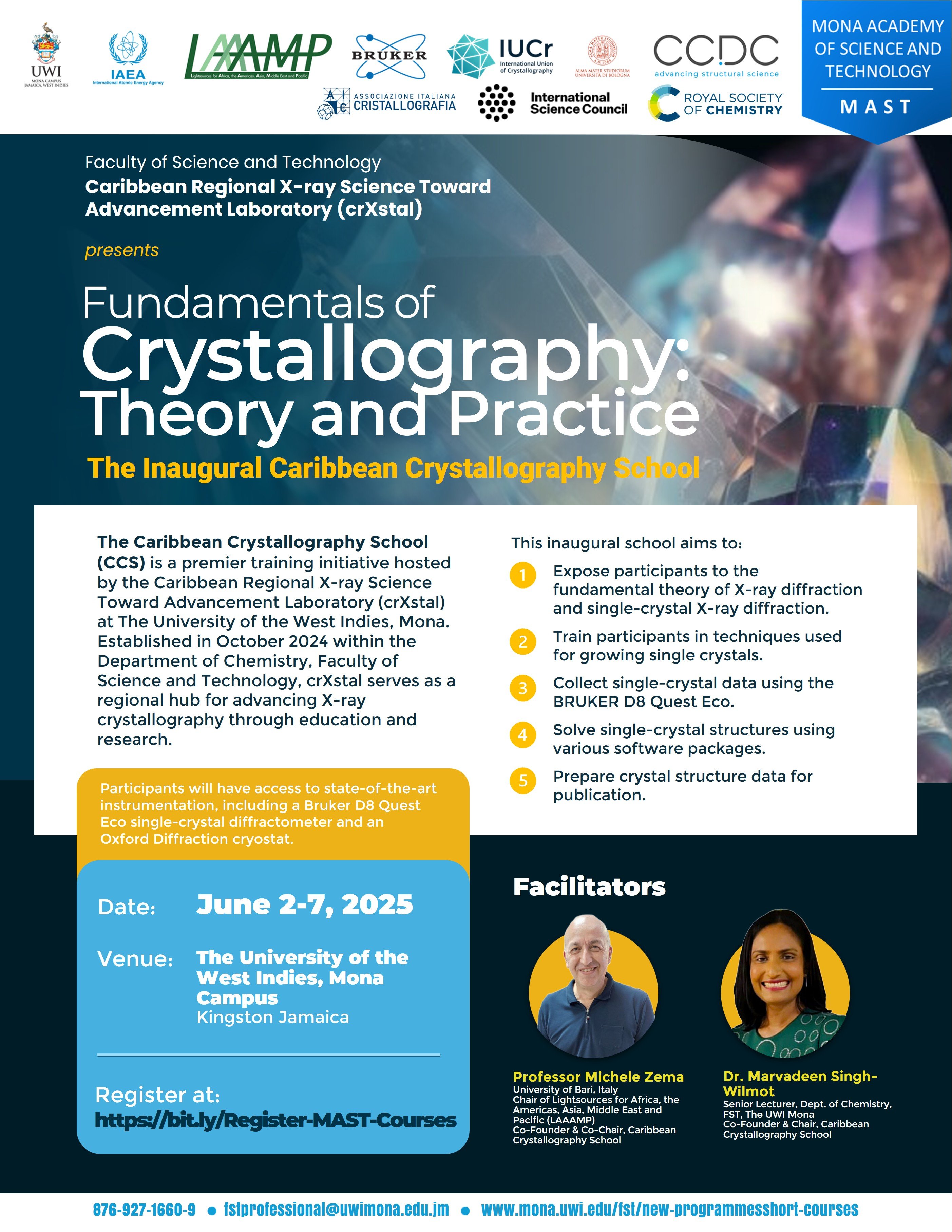
Inaugural Caribbean Crystallography School
| - |
In Kingston
Fundamentals of Crystallography: Theory and Practice
 The Caribbean Regional X-ray Science Toward Advancement Laboratory (crXstal) was established in October 2024 in the Department of Chemistry, Faculty of Science and Technology at The University of the West Indies, Mona, Jamaica, as a regional hub dedicated to capacity building in X-ray crystallography through education and research. Its primary objectives are: 1) to teach X-ray crystallography through short courses, training schools and outreach activities aimed at popularizing the technique especially among youth; 2) to facilitate cutting-edge research that address regional challenges and position the Caribbean as a global leader in innovation and 3) crXstal is presently equipped with a Bruker D8 Quest Eco single-crystal diffractometer and an Oxford Diffraction cryostat.
Â
Topics to be covered: Symmetry in crystals. Lattices, unit cells, point groups and space groups. Diffraction of X-rays by crystals. Bragg’s Law. The reciprocal lattice and the Ewald Sphere. Systematic absences, structure factors and electron densities. Use of the International Tables for Crystallography Vol. A. Crystal growth techniques. Crystal selection and mounting. Data collection and reduction. Structure solution and refinement. Structural analysis and reporting â€" molecular graphics and the CIF file. Use of various software packages for structure solution, refinement and display. Structure validation and publication. The Cambridge Structural Database. Introduction to crystallography using synchrotron radiation. Examples of applications of single crystal X-ray diffraction. The programme will include hands-on sessions on the Bruker D8 ECO Quest so students will have the opportunity to collect their own data and solve the structures.
Target Audience: Postgraduate students and researchers/ faculty members from any university, and Industry persons in a STEM discipline.Â
Pre-course Requirement: A voluntary, online two-day pre-course will be held one week before the start of the school with the aim of levelling the background. It will cover basic principles of symmetry and linear algebra with exercises.
Modality: Face-to-Face
Cost: USD 700 (excludes accommodation, airfare, and local travel to and from airport)
Lecturers:
- Â Andrea Araya-Sibaja, LANOTEC, Costa Rica (F)
- Â Christopher Cahill, George Washington University, USA (M)
- Â Javier Alcides Ellena, University of Sao Paulo, Brazil (M)
- Â Ilaria Gimondi, CCDC, UK (F)
- Â Lucia Maini, University of Bologna, Italy (F)
- Â Marvadeen Singh-Wilmot, University of the West Indies (F)
- Â Leopoldo Suescun, University of Montevideo, Uruguay (M)
- Â Serena C. Tarantino, University of Pavia, Italy (F)
- Â Suzanna Ward, CCDC, UK (F)
- Â Michele Zema, University of Bari, Italy (M)
- Â Application scientist, Bruker AXS, USA, to be nominated
Tutors/Lab Assistants:
- Â Jermaine Smith (M), PhD candidate, The UWI, Mona, Jamaica
- Â Dr. Zeyar Min (M), Lecturer, UTech, Kingston, Jamaica.
3rd CryoNET
| - |
In Copenhagen
Course Objectives
- To provide training in state-of-the-art techniques for high resolution structure determination by cryoEM, including hands-on practical training in latest software suites for image processing
- Discuss data collection strategies
- Training in basic principles of structure determination using cryoEM
- Develop problem solving skills through discussions and practical sessions in the presence of international experts in the field
- Networking with experts, software developers, and researchers in cryoEM and learn not only the latest but also upcoming developments
Cold Spring Harbor Macromolecular Crystallography Course
|
In Cold Spring Harbor
Structural Biology 2.0 : integrating X-ray diffraction and modern computational tools
| - |
In Montevideo

Data Quality Workshop with application examples and what we can learn from error analysis: Day 2
|
In Online
Program Day 2
Some new and established metrics in greater detail: mean value of weighted residuals, agreement factor gap for small molecules, errors caused by SHELXL-like weighting scheme, software dependent errors.
at 14:00 CET
Data Quality Workshop with application examples and what we can learn from error analysis
|
In Online
Program Day 1 (12th of March 2025)
Basic concepts and principles of data quality evaluation. Mathematical background. New metrics and their applications; The need to evaluate evaluation processes as well, rewarding errors with practical examples, established misconceptions, metrics as an environment for survival of the fittest data sets, adaptions and evolution processes in data quality evaluation. Challenges for overall progress in the field. Influence of metrics on decision making in crystallographic experiments.
There will be a follow workshop:
Program Day 2 (19th of March 2025)
Some new and established metrics in greater detail: mean value of weighted residuals, agreement factor gap for small molecules, errors caused by SHELXL-like weighting scheme, software dependent errors.
On both days at at 14:00 CET.
Structural Biology 2.0 : integrating X-ray diffraction and modern computational tools
| - |
In Montevideo
Frontiers in Data: Preparing Structural Science Data for 2085 - Panel Webinar
|
In Online
In the new economy, your data is your worth.
How can leaders plan and execute a structural science data strategy to last the next 60 years?
Join our expert panel from top international data institutions, to learn how they are preparing in the face of change. From team skills and training, to technological changes, to maintaining data integrity â€" get insights to inform your proprietary data plans and policies.
Part of a series celebrating 60 years of The CCDC and the Cambridge Structural Database; the world’s largest database of small-molecule organic and metal-organic structures in the world. All are experimentally determined, fully curated, and used by thousands of scientists globally.
Join us to explore:
- How can organizations ensure resilience in their structural chemistry and biology data for the future
- How can scientific data leaders best plan for technological changes?
- How should quality and quantity be balanced in an increasingly data-hungry world?
- How can structural science data integrity be maintained as data sets become more complex?
- What skills do teams in scientific data management need to be ready for the future?
- What key data standards should be set today to ensure we’re ready for the next 60 years?
The panellists:
- Suzanna Ward, Head of Data and Community for the Cambridge Structural Database (CSD)
- Stephen Burley, Director of the RCSB Protein Data Bank (PDB)
- Tom Blanton, Executive Director of the International Centre for Diffraction Data (ICDD)
- Silke Rehme, Head of Specialist Services at Fiz Karlsruhe for the Inorganic Crystal Structure Database (ICSD)
Who should attend?
- Leaders in Science and Pharmaceutical organizations
- Chief Technical Officers
- Chief Data Officers
- Chief Scientific Officers
- Data Quality Managers
- Bioinformatics and Cheminformatics Scientists and Leaders
- AI/ML Scientists
- Data Scientists
- Drug Discovery Data Specialists
Distinguished Lectures on Quantum Crystallography and Complementary Fields: Lecture 44
|
In Online
Lecture 44: "Energy formalism of an X-ray electron density of large biological molecules" by Louis Massa (The City University of New York, USA)
One can register here. You can also find the abstract and CV of the speaker at the above web page. The lecture is free and open to everyone; this lecture is expected to last ca. 45â€"50 min + up to 15min for Q&A. Please regiester beforehand using the link above.
20th BCA/CCG Intensive Teaching School in X-Ray Structure Analysis
| - |
In Durham
Applications are currently open and will close at 17:00 (GMT) on Thursday 9th of January 2025. The main focus of the school is on the background theory for single crystal X-ray diffraction as applied to chemical and materials science. Topics to be covered will include:
Growth and evaluation of non-macromolecular crystals Space group determination Background theory to data acquisition for small molecules and inorganics Practical aspects of data collection Practical aspects of data processing Fourier syntheses Patterson syntheses and direct methods for crystal structure determination Charge flipping Refinement of inorganic, organic and metal-organic structures Derivation of results Random and systematic errors Twinning Validation of results Crystallographic databases (CSD, ICSD, etc) Following on from the school there will be an optional 1 day hands on Olex2 online workshop on Sunday the 6th of April 2025 (10:00-16.00). For more details please click here.
35 European Crystallographic Meeting
|
In PoznaÃ...„
 At the XXV Congress and General Assembly of the International Union of Crystallography in Prague, it was decided that the 35th edition of the European Crystallographic Meeting would be held in Lviv, Ukraine, in 2025.
 Unfortunately, there is a war in Ukraine, and it is not reasonable to organize a great scientific event in Lviv in 2025. An alternative was thus elaborated where, thanks to a collaboration between the Ukrainian Crystallographic Committee and the Polish Crystallographic Association, the conference site will be Poznan, a city in neighbouring Poland.
International School on Electron Crystallography 2025
| - |
In Erice
Dates: 30 May - 7 June 2025 Location: Ettore Majorana Foundation and Centre for Scientific Culture, Erice, Italy
About the School: The International School on Electron Crystallography offers a comprehensive learning experience for participants at all levels, from beginners to advanced researchers. Through lectures, hands-on tutorials, and interactive sessions, attendees will gain valuable insights into the principles and applications of electron crystallography, including electron diffraction, 3D electron diffraction (3D ED), structure determination, and the latest innovations in the field.
Key Topics: Fundamentals of electron crystallography and diffraction 3D electron diffraction techniques Structure determination of molecular and inorganic materials Applications in nanomaterials, pharmaceuticals, and structural biology Recent advances in instrumentation and data analysis Who Should Attend: The school is designed for students, postdocs, and professionals working in electron microscopy, crystallography, materials science, chemistry, physics, and related disciplines. Whether you are new to electron crystallography or looking to deepen your expertise, this school provides a unique opportunity to expand your knowledge and network with experts in the field.
Travel and Grants: Various travel grants from different organizations will be advertised on the school's webpage to support student participation.
How to Apply: Details on registration, abstract submission, and travel grant applications will be made available on the official website: https://crystalerice.org/2025/
Join us in Erice for an inspiring week of learning, networking, and exploring the beautiful surroundings of Sicily!
For further information, please visit our website or contact the course directors: Alexander Eggeman (University of Manchester, UK), Mauro Gemmi (Istituto Italiano di Tecnologia, Pisa, IT), Tatiana Gorelik (Forschungszentrum Juelich, DE).