Topics
Industrial crystallography
Polymorphism: applications in industry. SATELLITE EVENT: V LACA SCHOOL
| - |
In San José
Third Pan African Conference on Crystallography (PCCr3)
| - |
In Nairobi
Theme
Harnessing Crystallography for Africa’s Research and Technology TransformationÂ
Sub-Themes
- Inorganic and Industrial Materials
- Crystal Engineering and Structural Chemistry
- Crystallography and Life Sciences
- Diffraction Physics and Phase Transformations
- Crystallographic Databases
- Application of Crystallography in Materials Science, Agricultural and Geological Sciences
Bursary applications
Please apply here.

British Crystallographic Association Chemical Crystallography Group Autumn meeting 2022
|
In Online
BCA CCG Autumn meeting 2022
Going beyond the data for chemical crystallographers
Registration for the Chemical Crystallography Group Autumn meeting is now live! The meeting will be held online on Wednesday 16th November 2022. For details and registration, visit: https://www.eventbrite.co.uk/e/chemical-crystallography-group-autumn-meeting-2022-tickets-425715124397

Annual Meeting of the British Zeolite Association
| - |
In Manchester
The British Zeolite Association (BZA) was founded in 1977 to provide a forum where zeolite scientists could meet to review and share their latest findings. Today the (ordered) nanoporous materials community in the UK numbers several hundred active research scientists and engineers, from both industry and the academic sector, who reflect the great variety of applications of micro- and mesoporous materials, from catalysis and petrochemical processing to chemical separations, detergents and environmental clean-up.
The major event of the BZA's year is the annual meeting, which brings together scientists from the UK and overseas to present and discuss the latest research in the area. Strong emphasis is given to presentations from research students and young postdoctoral workers.

European Conference on Neutron Scattering (ECNS 2023)
| - |
In Garching near Munich
The MLZ is delighted to host the Eighth European Conference on Neutron Scattering after successful events atÂ
- Interlaken 1996
- Budapest 1999
- Montpellier 2003
- Lund 2007
- Prag 2011Â
- Zaragoza 2015
- St. Petersburg 2019
The conference is organized on behalf of the European Neutron Scattering Association (ENSA) and is one of the most important scientific events in the field of neutron research.Â
The conference will take place at the TUM Department of Mechanical Engineering and the new Science Congress Center Munich - both located in the immediate vicinity of the MLZ at Garching.Â
After a warm Welcome on March 19th, we are looking forward to four days of thrilling talks, pleasant posters, and decent discussions of the European neutron scattering community between March 20th and 23rd!Â
Â

Diffraction Methods in Structural Biology Gordon Research Conference
|
In Lewiston, ME; USA
Structural biology is entering a new era. Not just the virus and biomedicine, not just astounding breakthroughs in prediction, but new and complimentary approaches are exploding onto the scene. It is time to imagine what could be achieved if there were no barriers to structural information, and to contemplate how we will combine our diverse strengths to overcome obstacles we always believed were insurmountable. An excellent place to start is crystallization, where the impact of any improvement would be very high, but predictive theory remains elusive. Preparation of electron microscopy grids faces a similar challenge. Each session will focus on a critical barrier in structural biology, and the goal will be formulating the best advice to newcomers to the field who will face these challenges. Where possible, test data with a clear scoring system will be defined, and friendly competition between proponents of different approaches will be encouraged. Current best practices will be described, evaluated and compared and the relative effectiveness of alternative approaches will be announced at the meeting. Open discussion is expected to uncover new insights, new approaches, new algorithms, and no doubt flaws in the tests. By the end of the meeting we will have established not only new best practices, but also improved the criteria we use to assess them.
School on Advanced Light Sources: Principles, Methods and Multidisciplinary Applications | (smr 3439)
| - |
In Trieste
The School targets young scientists to introduce them to the exceptional research opportunities offered by synchrotron and free-electron-laser (FEL) facilities worldwide for exploring the properties of all types of matter.
The school will provide an overview of the production and characteristics of synchrotron and free-electron-laser light, its interaction with matter and the numerous experimental methods enabled by these interactions that have become indispensable tools spanning over all domains of basic and applied research. The school lecturers will demonstrate the multidisciplinary applications and the most recent instrumental developments and science breakthroughs in the fields relevant to their expertise. The program will also include discussions of the lecturers with the students, talks describing the open access to these facilities based on the merits of the proposed project and possible industrial application. Demonstration sessions will be organized at the beamlines of Elettra's synchrotron and FEL facilities.
Topics:
- Production of Synchrotron and FEL Radiation
- Properties of Synchrotron and FEL Light
- Photon-Matter Interactions
- Photon Transport and Beamline Instrumentation
- X-ray Absorption and Fluorescence Spectroscopy
- Photoelectron Spectroscopy Methods
- X-ray Diffraction Methods
- X-ray Scattering Techniques - SAXS, WAXS, XPCS, RIXS
- Imaging Techniques using Synchrotron and FEL Light
- X-ray and IR Spectromicroscopy.
- Time-resolved Approaches and non-linear X-ray Optics
Grants: A limited number of grants are available to support the attendance of selected participants, with priority given to participants from developing countries. There is no registration fee.

BCA Industrial and Chemical Groups meeting "By hook or by crook â€" structural solutions from challenging crystals"
|
In Stevenage, UK
Materials Science & Nanotechnology Conference
| - |
In Sana Malhoa Hotel, Lisbon
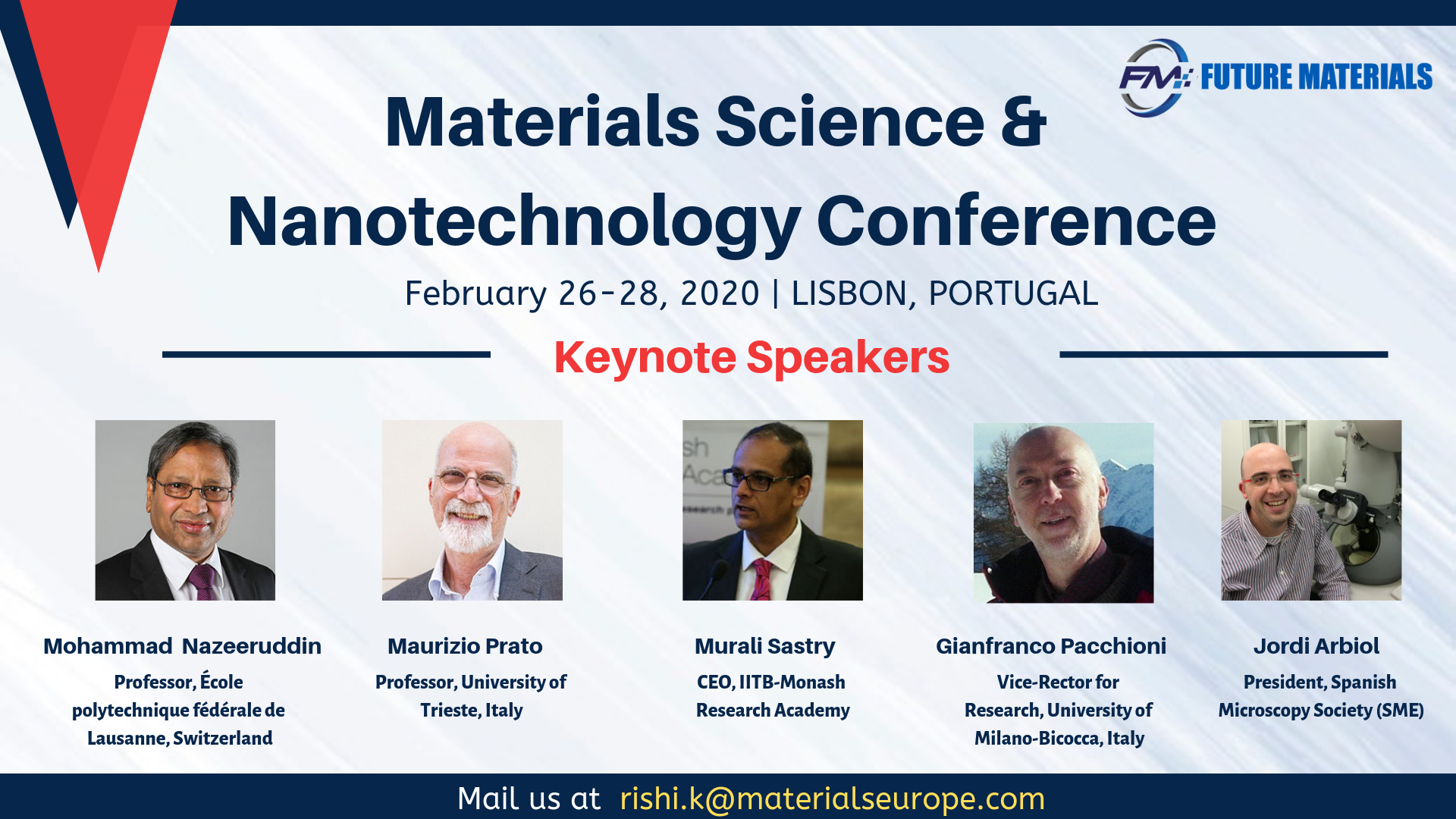
Committee Members invites participants from across the globe to join in this annual flagship conference on Materials Science and Nanotechnology. Future Materials 2020 moto is to share latest researches amongst the professionals from industries and Institutes also provides a platform for students from research areas of Materials Science, Nanotechnology, Chemistry and Physics to share their ideas, experiences and indulge in interactive discussions and technical sessions at the event. The event will also provide space for several institutes and organizations to present their services, products, innovations and research results.
Joint BCA/RSC XRF Meeting
|
In Sheffield
An outstanding opportunity to visit the stands of our XRF exhibitors at a one day UK meeting with a varied programme of contributed talks in a friendly environment for networking with morning parallel sessions for both beginners and experienced users - Â check out our previous meeting reports.

Challenges in additive manufacturing industrial qualification: key solutions at large scale infrastructures
| - |
In Grenoble
From process qualification until component certification, additive manufacturing presents big challenges as a new field of material processing with multiple new parameters. Therefore, new insights concerning characterization are envisaged for process and component standards and certification, as well as for experimental benchmark input for modellings.
European large installations ILL and ESRF offer a common frame for additive manufacturing industrial investigations, where unique static (scanning) and dynamic (in situ) studies on stresses and imaging, from the nanometre until several centimetres range, are possible. To foster industrial escalation of additive manufacturing, we aim at bringing together industry and applied sciences to address key manufacturing issues regarding final quality assessment of products.
Why neutrons?
- For non-destructive and bulk characterization: neutrons can penetrate several cm into matter.
- For new information: neutrons interact in a different way with matter, hence giving another contrast, i.e. for hydrogen!
- For sample environment and in situ studies
Why Synchrotron?
- High energy X-rays, allowing higher penetration depth for real 3D imaging of high density samples.
- High intensity X-rays for non-destructive probing of material structure and devices with high spatial resolution from millimetres to nanometres.
- High intensity X-rays for real time measurements with less than a microsecond time resolution and high-throughput analysis under real manufacturing and operating conditions.

Industrial Biostructures America
| - |
In San Diego, CA,
This conference brings together structural biologists from across the pharmaceutical and biotech industry to showcase their cutting-edge research.
Scientific sessions will cover the following topics:
• Cryo-EM
• X-ray crystallography
• Lead discovery using NMR
• Protein design
• Membrane crystallography

SYNERGI2018. (SYnchrotron and NEutron Radiation Go Industrial
| - |
In Amsterdam

ISC2018. International School of Crystallization
| - |
In Granada
Drugs, Food, Agrichemicals, Minerals and New Materials
Topics of the School
- Solution properties
- Nucleation: classical and non-classical approaches
- Crystal growth kinetics and mechanisms
- Crystallization routes
- Crystallization techniques
- Crystal morphology
- Mineral textures
- Polymorphism
- Hydrates and solvates
- Crystallization screening
- Industrial (mass) crystallization
- Chirality
- Biomineralization
- Co-crystals

Chemical Development & Scale-Up in the Fine Chemical and Pharmaceutical Industries
| - |
In Edinburgh
Topics
- Synthetic Route Discovery
- Costing of Chemical Processes
- The Investigative Approach to Chemical Development
- Solvent Effects
- Statistical Methods of Optimisation
- Analytical Issues
- Work Up
- Planning for Scale-Up
- Appreciation of Chemical Engineering Principles
- Crystallisation and Polymorphism
- New and Emerging Technologies in Process R&D
- Thermal Hazard Testing and Runaway Reactions
- Effluent Minimisation and Control
Joint annual XRF and XRD meetings of the BCA Industrial Group
| - |
In Leicester

ISIC20. 20th International Symposium on Industrial Crystallography
| - |
In Dublin

PPXRD-15: Pharmaceutical Powder X-Ray Diffraction Symposium. A satellite meeting to the 24th IUCr Congress and General Assembly
| - |
In Hyderabad
Topics will include:
- Qualitative Phase Analysis with XRPD
- Quantitative Phase Analysis: Single-peak, Whole-Pattern Methods and Beyond
- Amorphous, Mesomorphous and Nano Materials
- Non-Ambient Powder X-ray Diffraction
- New Developments/Complementary Techniques
- Formulation and Product Development
- Polymorph, Salt and Co-crystal Screening
- Crystal Structure Prediction, Elucidation and Verification from Powder Diffraction Data
Industrielle Kristallzüchtung (Industrial Crystal Growth)
| - |
In Fraunhofer THM (Freiberg)
Co-Crystals
|
In Nijmegen
The meeting is organized by the Dutch Association for Crystal Growth (NVKG) and
the Dutch Crystallographic Society (NVK) and will have the character of a workshop/symposium.
The design of multicomponent crystals provides a means to alter physicochemical properties of crystals without changing the chemical properties of the molecule of interest. This is particularly useful in the case of active pharmaceutical ingredients (APIs), but also in the field of agrochemical products.
Although solvates and salts are commonly used in this context, the formation of co-crystals has only more recently been considered, which has significantly increased the solid forms available for formulation.
This one-day symposium intends to give an overview of important aspects in the design of co-crystals, ranging from the search for suitable co-former candidates to possible legislation issues.