Topics
Synchrotron radiation
Dynamiques observées en Rayonnement Synchrotron et XFEL
|
In Paris

RapiData 2017 at SSRL
| - |
In Stanford, CA
Data Collection and Structure Solving: A Practical Course in Macromolecular X-ray Diffraction Measurement
Â
The aim of the RapiData course is to educate and train young scientists in data collection and processing methods at synchrotron beamlines, using state-of-the-art software and instrumentation
The course will comprise hands-on experiments at the SSRL beamlines, software tutorials, and lectures on the following topics:
- Specimen preparation, tactics in data collection
- X-ray light sources
- X-ray detectors
- Data reduction
- Structure solving by MAD, SAD and Molecular replacement
- Complementary methods (spectroscopy and small angle scattering)
MATRAC 2 Winter School. Application of Neutrons and Synchrotron Radiation in Materials Science with special focus on Fundamental Aspects of Materials
| - |
In Utting/Ammersee
The school will be held in Utting/Ammersee and Garching/Munich, Germany, in cooperation with the Röntgen-Ã...ngström-Cluster (http://www.rontgen-angstrom.eu) and the BMBF (Bundesministerium für Bildung und Forschung, Germany).
The Winter School will provide a systematic overview of the application of neutrons and synchrotron radiation to the structural analysis of materials. The school starts with the fundamentals of synchrotron radiation and neutron scattering. The focus is subsequently shifted towards neutron techniques and their application to specific problems in materials science. Different classes of modern functional materials are presented and it will be shown how neutron scattering, on the one hand, and synchrotron radiation, on the other hand, can be used to explore the microscopic mechanisms that are responsible for their properties. While fundamental aspects are dominating, application related phenomena will be covered as well.
After a two-day theoretical course in Utting/Ammersee the participants will spend two days at the FRM II in Garching (near Munich) doing practicals. The fifth day of the school offers further talks and a final discussion. All relevant experimental methods will be covered.
Registration deadline has been extended to December 8th, 2016
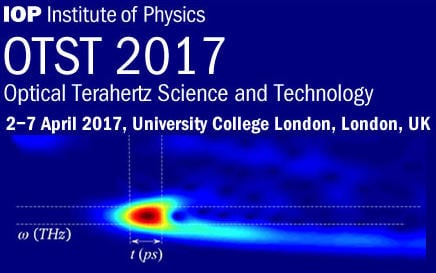
OTST2017. Optical Terahertz Science and Technology
| - |
In London
Major research areas covered at the conference include:
- THz spectroscopy applications in Physics, Chemistry, Biology and Medicine
- THz imaging
- THz near-field microscopy
- Ultrafast dynamics and Time-resolved spectroscopy
- Ultrafast measurement techniques
- THz sources and detectors
- Advances in THz quantum cascade lasers
- Nanoscale THz devices
- THz communications
- THz industrial applications
- Novel THz devices, instruments and techniques
- THz waveguides
- THz metamaterials and plasmonic devices
International Collaboration on Advanced Neutron Sources (ICANS XXII) Meeting
| - |
In Oxford
The 22nd meeting of the International Collaboration on Advanced Neutron Sources (ICANS XXII) will be held on the 27th -31st March 2017 in Oxford, England.
For more details, visit: Â http://icansxxii.iopconfs.org/home
 The abstract submission deadline is 30 November 2016.  ICANS is an informal network of laboratories whose scientists and engineers are involved in developing pulsed neutron sources and accelerator based spallation neutron sources.  The collaboration was founded in 1977 as a forum to promote discussions and collaborative work, and to share information on three main topics: accelerators, targets and moderators, and instruments.  After 24 years, the meeting returns to the UK and will be hosted by the ISIS Neutron and Muon Source at the Said Business School, University of Oxford with accommodation at St Anne’s College.  In addition to the core areas of accelerators, target and instrumentation, other key areas such as sample environment, data analysis and computing, polarisation, detectors, shielding and neutronics will be discussed.  It is the principal goal of ICANS to promote and facilitate informal discussions and, as such, the meeting will comprise several workshop sessions.   Key dates: Abstract submission deadline: 30 November 2016 Early registration deadline: 31 January 2017 Registration deadline: 17 March 2017 Paper submission deadline: 27 March 2017
The First UAE Synchrotron User Meeting
|
In Dubai
The purpose of the workshop is to bring together the best scientists from the United Arab Emirates (UAE) and synchrotron experts and see how the most strategic fields for the UAEÂ can be addressed through synchrotron science. UAE scientists will include both national and non-national speakers. International top synchrotron experts will give a talk at the event.
One of the main points will be to understand what the requirements of the UAE scientists are in terms of synchrotron research (what types of beamlines, techniques, etc.). Once these are defined, we will try to understand what would be the best option in terms of costs and benefits for the UAE.
14th SESAME Users’ Meeting
| - |
In Amman
SPB/SFX User Workshop (Single Particles, Clusters and Biomolecules and Serial Femtosecond Crystallography)
| - |
In Schenefeld, Berlin
ESRF User Meeting 2017
| - |
In Grenoble
User-dedicated Microsymposia 8th February
UDM1. Advances and new science with resonant inelastic X-ray scattering ([email protected])
UDM 2. Quantitative coherent X-ray diffraction imaging ([email protected])
UDM 3. Operando structural studies in Materials Science ([email protected])
Tutorials 6th February
- T1. Social Media: a new challege for communication science?
- T2. MX-BAG meeting
- T3. XRF Analysis with PyMca
- T4. X-ray Absorption Spectroscopy: tutorials, data analysis and hands-on-practicals
- T5. Coherence reconstruction Software including hands-on practicals
- T6. Volume image analysis of tomographic data
- T7. Overview of SAXS/WAXS Data reduction and analysis using WiSAXS
- T8. Nuclear resonance application including hands-on-practicals

Joint DESY Photon Science and European XFEL Users' Meeting: Research with Synchrotron Radiation and FELs
| - |
In Hamburg (DESY)
WAVEFRONT: New Frontiers and Advanced Applications of 4th generation light sources to Atomic, Molecular, Optical and Cluster Science
| - |
In Trieste (ICTP)
Les Deuxièmes Journées. Théorie àSOLEIL
|
In Synchrotron SOLEIL
12th Soleil Users' Meeting
| - |
In Gif-sur-Yvette
Australian Synchrotron User Meeting 2016
| - |
In Melbourne
HERCULES European School
| - |
In Grenoble
This one month course, coordinated by the Université Grenoble Alpes, is designed to provide training for students, postdoctoral and senior scientists from European and non-European universities and laboratories, in the field of Neutron and Synchrotron Radiation for condensed matter studies (Biology, Chemistry, Physics, Materials Science, Geosciences, Industrial applications). It includes lectures, practicals and tutorials, visits of Large Facilities and a poster session (each participant puts up a poster about her/his thesis or research topic for a day).
- PART I: BASIC METHODS AND INSTRUMENTS :
(This part is common for all the participants - 1.5 weeks) - PART II is divided into two parallel specialized sessions (3.5 weeks) :
- Session A: PHYSICS AND CHEMISTRY OF CONDENSED MATTER
- Session B: BIOMOLECULAR STRUCTURE AND DYNAMICS
The course is held in Grenoble at the Polygone Scientifique Louis Néel. This is close to partner institutions where practicals and tutorials will take place:
- European Molecular Biology Laboratory (EMBL)
- European Synchrotron Radiation Facility (ESRF)
- Institut de Biologie Structurale (IBS)
- Institut Laue-Langevin (ILL)
- Institut Nanosciences & Cryogénie (CEA)
- Institut Néel (CNRS)
A special seven days programme is included , in a partner institution among European Large instruments, either at:
- DESY and European XFEL in Hambourg, Germany
- Elettra and FERMI in Trieste, Italy
- Swiss Light Source / Paul Scherrer Institute in Villigen, Switzerland
- SOLEIL (St Aubin, France) and Laboratoire Léon Brillouin (CEA Saclay, France)
The language of the course is English.

Mineral Fibres: Crystal Chemistry, Chemical-Physical Properties, Biological Interaction and Toxicity
| - |
In Modena
The 2017 EMU (European Mineralogical Union) School
The school will cover different multidisciplinary aspects related to the study of natural fibres and is thus aimed at students with a background in Biology, Chemistry, Geology, Material Science, Medicine, Physics who strive for working in the field of mineral fibre and asbestos and want to acquire both a strong background in this specific area of environmental protection and a multidisciplinary open vision of the asbestos related problems.
The following topics will be covered:
- Crystal structure and crystallography, occurrence of mineral fibres, and natural occurring asbestos
- experimental methods for the investigation of mineral fibres: optical microscopy, X-ray diffraction, electron microscopy, vibrational spectroscopy, iron spectroscopy and synchrotron radiation based techniques
- Surface and bio-chemical properties of mineral fibres
- Illustration of asbestos related diseases and bio-chemical mechanism inducing toxicity effects in the human body
- In vitro and in vivo tests to assess cyto/genotoxicity and carcinogenicity of mineral fibre
- Dissolution and biodurability of mineral fibres
- Epidemiological studies of asbestos related diseases
- Genetic factors, mutations and toxicity of mineral fibres
Â
9th International Workshop on Sample Environment at Scattering Facilities
| - |
In Gettysburg
The workshop will cover all relevant sample environment topics to address topical science ranging from soft matter to extreme physical parameters. Both sample environment for neutron and synchrotron experiments are highlighted. An exhibition of specialized capabilities and technological innovation by commercial companies will give the opportunity for industrial contacts.
The 9th International Workshop on Sample Environment will bring together scientists, engineers and technicians, as well as leading suppliers, to exchange experience, form collaborations and discuss new ideas around a world class program of seminars and workshops. We welcome your input and look forward to your visit!  Key dates: Abstract submission closes on August 1, 2016 Early registration closes on August 14, 2016 Registration closes on September 1, 2016
13th International Conference on Synchrotron Radiation Instrumentation (SRI 2018)
| - |
In Taipei
MX beamline training session
| - |
In Diamond Light Source, Didcot
Organized by the Diamond Light Source Macromolecular Crystallography group.
The aim is to provide MX users with sufficient training to be able to operate any of the Diamond MX beamlines efficiently and to get the most benefit from their beam-time. The training will involve hands-on sessions on the suite of five operational MX beamlines (http://www.diamond.ac.uk/mx-home/) as well as optional offline software sessions.
20th July afternoon optional session "Hands on software":
- CCP4
- DIALS
21st July, MX beamlines and data room sessions:
- MX software: automation in data analysis
- Mini-Kappa goniometry / Anomalous data collection
- Introduction to VMX-i
- I24 new end station/ In-situ diffraction
- Fragment screening â€" I04-1/Lab36
- Experiment database: new ISPyB
Registration is free-of-charge with lunch provided on the 20th and 21st July, and accommodation and dinner for the night of July 20th.
Synchrotron Radiation and Neutrons in Art and Archaeology (SRA Chicago 2016)
| - |
In Chicago, IL
Main Conference Topics
- Conservation and Alteration
- New Methods and Analytical Processes
- Paleontology and paleoenvironment
- Technical Art History and Archaeometry at the nano-, micro-, and macro scale