Topics
Characterisation of materials
80th Pittsburgh Diffraction Conference
|
In Pittsburgh, PA
Dear Colleagues
We (the board members of the Pittsburgh Diffraction Society) are pleased to announce the availability of travel awards to attend the 80th Pittsburgh Diffraction Conference. The Conference will be held at the Society’s ancestral home, in Pittsburgh, PA, on October 15, 2023 â€" October 17, 2023.
The awards are aimed at students, postdoctoral fellows as well as (non-faculty) staff scientists. Applications from minorities underrepresented in the sciences are especially encouraged. Details can be found here as well as attached.
The conference program includes
·        A historic overview on the Pittsburgh Diffraction Society
·        Scientific Sessions covering the Latest Development at Light Sources, High-pressure Applications, Structure-based drug design, Synergy of Computation and Crystallography, Crystallography and Cryo-EM, Structure property relationships in Quantum and Layered Materials, and many more!
·        A Young Investigator Platform showcasing achievements of students and postdocs
·        Student posters are eligible for the Chung Soo Yoo Award, which carries a $400 cash prize, related to materials and biological research, respectively
·        Fun social activities and Vendor Shows!
·        A Phenix Workshop prior to the conference (Oct 14, 2023, limited availability!)
Â
For the entire program, the venue and more details, and to register, please visit the conference web page.
ECM-34. European Crystallographic Meeting
| - |
In Padova
The flagship of the European Crystallographic Association (ECA) activities is the European Crystallographic Meeting (ECM), held every year, except when there is an IUCr Congress. The ECMs are the main meeting point for crystallographers in the ECA area to show their recent research. Microsymposia at ECMs are proposed and organized by ECA SIGs.
ECM 34 will be organized at the Padova Congress Centre on behalf of ECA and AIC. It will include all topics of interest to crystallography and it will be organized in synergy with EPIDC 18, which will follow ECM 34 in the same location.
10th Anniversary Meeting of the Young Crystallographers
|
In Hamburg, Germany
The Young Crystallographers are a working group within the German Society for Crystallography (DGK). For 10 years, we meet regularly in autumn at different universities or the STOE facilities.
These meetings specifically aim to provide a platform for networking and scientific exchange for young scientists with an interest in crystallography, as well as to establish contacts with industry and research institutions.
We want to give young scientists the opportunity to gain early experience in scientific presentation in a relaxed atmosphere and without the stress of a larger conference.
For our grand anniversary, we are happy to meet at the DESY facilities! We are working hard to allow you deep insights as well as a great overview of the possibilities at this large-scale facility.
During the 3-day meeting, you willÂ
- present your own work as a poster (A0 portrait) and lightning talk (~5 min.)
- have the DESY campus tour
- participate in an experiment and get a hands-on experience at a beamline of your choice at PETRA III (see The Experiments)
- hear academic talks from senior scientists
- hear industry talks from our sponsors/partners
At the end of the meeting, you will also have the chance to join a tour of the European XFEL Campus. If you intend to participate, please indicate so during registration. Note that you will need to get to the XFEL facilities by public transport as it is a bit outside the main DESY campus.
The registration fee of 60 € includes the tours and experiments at DESY, coffee breaks as well as lunch and BBQ on Thursday.
Deadline for registration is 22.08.23.
ECRS-11 European Conference on Residual Stresses
| - |
In Prague
ECRS is a well-established conference series that focuses on residual stresses in structural and functional materials. From experimental methods via modelling techniques to industrial applications a broad gamut of residual stress-related topics is addressed. The series is well attended by scientists, PhD students and engineers from both academia and industry.
Previous editions have been successfully held in Karlsruhe (1983), Darmstadt (1990), Frankfurt/Main (1992), Cluny (1996), Delft (1999), Coimbra (2002), Berlin (2006), Riva del Garda (2010), Troyes (2014) and Leuven (2018).Â
This gathering brings together scientists, students, and engineers with a shared interest in residual stresses, a phenomenon that affects the physical properties of materials and surfaces across various scales. While its core focus lies in mechanical engineering and materials science, residual stresses also hold relevance in solid-state physics, life sciences, geology, and the chemical reactivity of solids. Managing residual stresses can unlock improved material and structural properties, such as enhanced fatigue life and geometrical stability. The analysis of residual stresses, being a highly sensitive parameter influenced by micro/nano-structure, provides valuable insights into the history of materials and structures. This conference offers an interactive platform for experts from diverse disciplines including mechanics, physics, optics, chemistry of solids, manufacturing, diffraction, and engineering. Attendees can exchange their perspectives and share recent advancements through experimental, theoretical, and numerical approaches.
 Two tutorials are planned
Main topics
- Diffraction Methods
- Mechanical Relaxation Methods
- Acoustic Methods
- Electromagnetic Methods (Barkhausen effect)
- Electron Microscopy Methods
- Instrumentation
- Modelling methods
- Stresses in Microelectronics
- Stresses in Additive Manufacturing
- Microstructures, Composites and Nanomaterial
- Thin Films and Coatings
- Welding, Fatigue and Fracture
- Cold Working and Machining
- Heat Treatments and Phase Transformations
Summer School â€Å"Advanced methods for the characterization of applied materialsâ€Â
| - |
In Max-Planck-Institut für Kohlenforschung, Mülheim an der Ruhr
Characterization methods such as
Surface spectroscopy
Total scattering experiments
X-ray and neutron-tomography
X-ray absorption spectroscopy
Electron crystallography
Small angle scattering
Electron microscopy
Electron microprobe analysis
Vibrational spectroscopy
Solid state NMR
Advanced powder diffraction and in situ techniques
Â
Â
Deadline for registration July 31, 2023
Distinguished Lectures on Quantum Crystallography and Complementary Fields: Lectures 25 and 26
|
In Online
Lecture 26: "Phonon vibrations probed using the electron microscope" by Rebecca Nicholls (Department of Materials, University of Oxford, UK)
Nanomaterials for Applications in Energy Technology (GRS)
| - |
In Ventura, CA
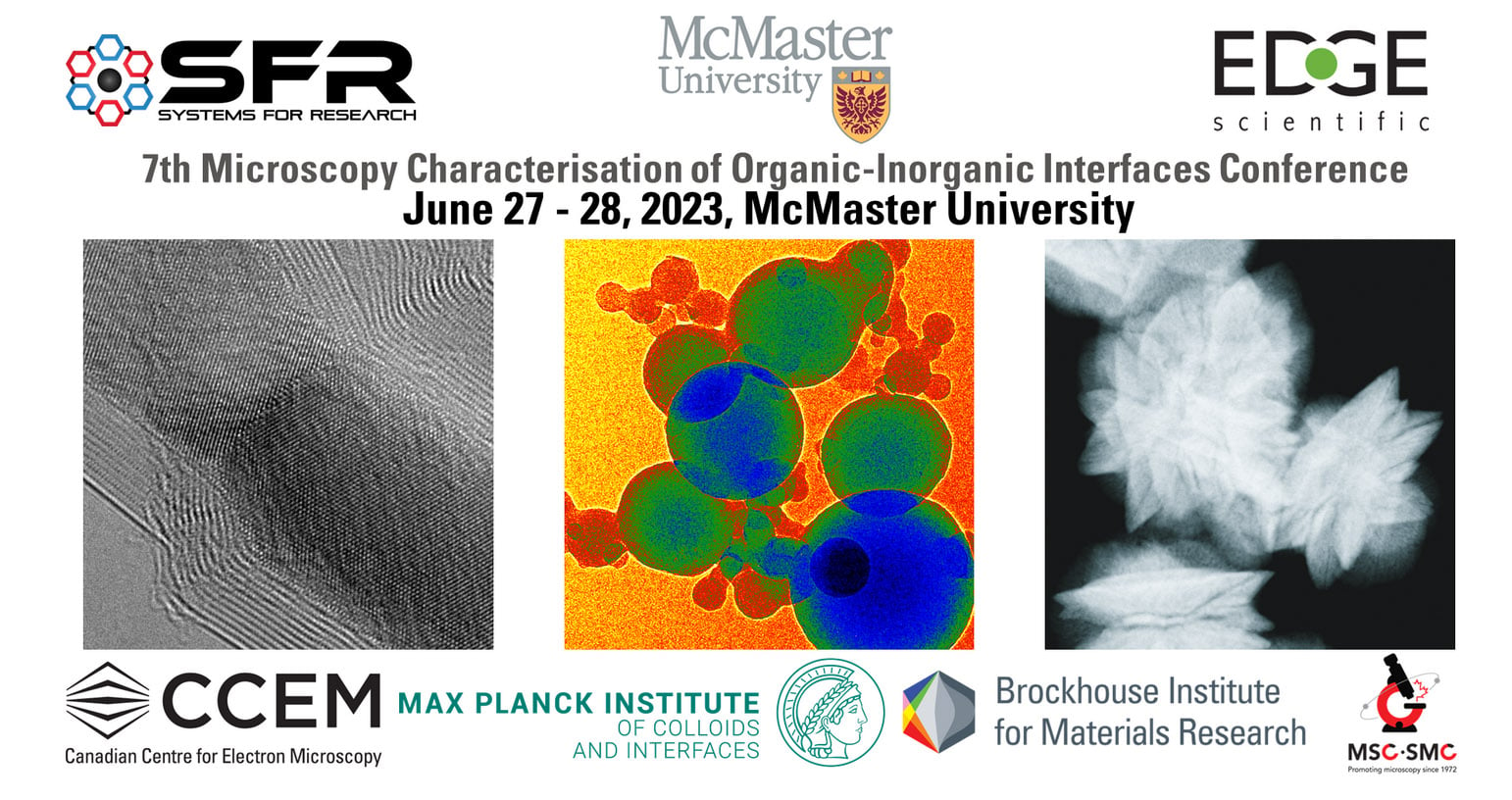
7th Microscopy characterisation of organic-inorganic interfaces meeting
|
In McMaster University, Hamilton, Canada
The 7th Microscopy Characterisation of Organic-Inorganic Interfaces (MCOII) meeting will return to an in-person format in 2023 and will be hosted for the first time in North America at McMaster University in Hamilton, Canada, home of the Canadian Centre for Electron Microscopy. The transatlantic scientific organizing team of Nadja V. Tarakina (MPIKG, Germany) and Kathryn Grandfield (McMaster University, Canada) have put together an exciting two-day programme. As usual, the first day will be more general, covering a broad range of microscopy approaches (correlative microscopy solutions, in-situ liquid microscopy methods, low-voltage electron microscopy and many more) in the context of imaging hybrid and soft matter.On the second day, a special Focus Lecture Series, entitled "Multi-dimensional and multiscale microscopy of organic-inorganic interface" will cover a more-detailed range of lectures on tomographic methods spanning light, X-ray and electron microscopy, as well as atom probe tomography and in situ electron microscopy/tomography. This conference will bring together world-leading experts in microscopy, highlighting the latest achievements, new opportunities and outstanding challenges in probing beam-sensitive and hybrid materials and their interfaces.
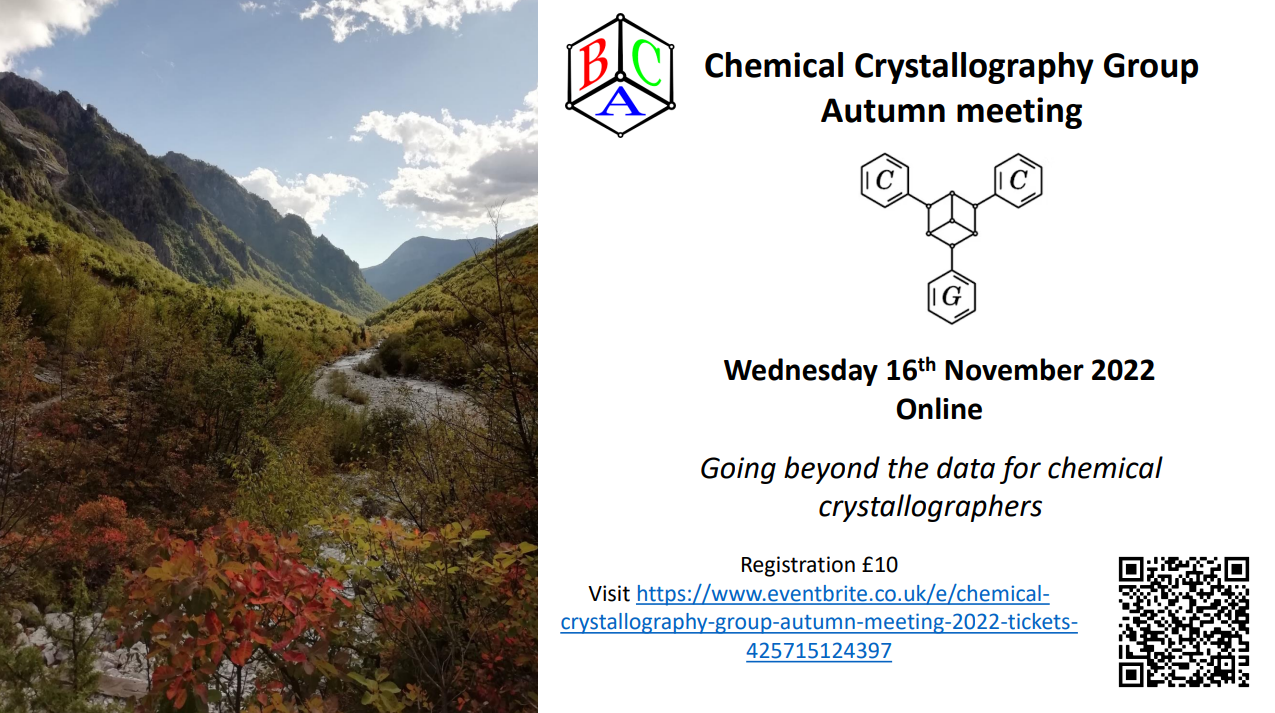
British Crystallographic Association Chemical Crystallography Group Autumn meeting 2022
|
In Online
BCA CCG Autumn meeting 2022
Going beyond the data for chemical crystallographers
Registration for the Chemical Crystallography Group Autumn meeting is now live! The meeting will be held online on Wednesday 16th November 2022. For details and registration, visit: https://www.eventbrite.co.uk/e/chemical-crystallography-group-autumn-meeting-2022-tickets-425715124397
European Conference on Neutron Scattering (ECNS 2023)
| - |
In Garching near Munich
The MLZ is delighted to host the Eighth European Conference on Neutron Scattering after successful events atÂ
- Interlaken 1996
- Budapest 1999
- Montpellier 2003
- Lund 2007
- Prag 2011Â
- Zaragoza 2015
- St. Petersburg 2019
The conference is organized on behalf of the European Neutron Scattering Association (ENSA) and is one of the most important scientific events in the field of neutron research.Â
The conference will take place at the TUM Department of Mechanical Engineering and the new Science Congress Center Munich - both located in the immediate vicinity of the MLZ at Garching.Â
After a warm Welcome on March 19th, we are looking forward to four days of thrilling talks, pleasant posters, and decent discussions of the European neutron scattering community between March 20th and 23rd!Â
Â
2022 IUCr High Pressure Workshop â€Å"Advanced High Pressure Crystallographyâ€Â
| - |
In Chicago
For the past three decades high pressure research has made breakthrough progress in many fields of science mainly due to the significant improvements in the high-pressure apparatus and developments of advanced static and dynamic probes. Most of the experiments at extreme conditions are very challenging and require dedicated techniques to collect crystallographic data with unprecedented speed and resolution to quantitatively characterize pressure/temperature induced transformations in the crystalline lattice. The tunability, brilliance, and collimation of synchrotron X-ray sources provides scientists with unique capabilities for probing the structural, chemical, and physical properties of various types of materials in-situ at extreme pressure, temperature, and strain with ultra-high spatial, temporal and energy resolution. However, in many cases the complex energy landscapes of multicomponent chemical systems require the use of the predictive power of computational methods that play an essential role in extreme-conditions crystallography coupled with physical experiments.
The purpose of the 2022 workshop of the International Union of Crystallography (IUCr) Commission on High Pressure is to bring together researchers who apply extreme-conditions crystallography in combination with other experimental and computational methods to study a wide range of material properties covering various fields of science, including condensed-matter physics, solid-state chemistry, geophysics, materials science, biology, nanotechnology etc. The workshop aims to facilitate extensive discussion and interdisciplinary collaboration.
Students, postdocs and early carrier scientists in particular will find this workshop helpful in gaining improved familiarity with available state-of-the-art methods and how they can be applied to their research.
We plan to organize a tour to the relevant APS beamlines for workshop attendees (pandemic permits) and a half-day tutorial with hands on examples.
IEEE Around-the-Clock Around-the-Globe (AtC-AtG) Magnetics Conference 2022
|
In Worlwide
Dear Colleagues,
It is our great pleasure to announce the 'IEEE Around-the-Clock Around-the-Globe (AtC-AtG) Magnetics Conference 2022', a virtual event hosted by the IEEE Magnetics Society covering the vast field of magnetism. Following the great success of the previous editions, this unique 24-hour non-stop virtual conference will take place on August 31st, 2022, with contributions from speakers spanning six continents.
The AtC-AtG Magnetics Conference offers a diverse and inclusive virtual environment that foments collaboration between junior and senior researchers across the many subfields of magnetism. The invited speaker lineup includes both junior and senior scientists with outstanding research contributions. More information can be found on the dedicated conference website.
Join us by registering through our website before 24th August!Â
Highlights:
 - Invited talks from leading experts in magnetism
 - Covers all continents and time zones
 - Interactive online broadcasting with questions and discussions
 - Student presentation and poster awards
 - NO REGISTRATION FEE
Call for Abstracts:
Abstract submission for the contributed talks at AtC-AtG Conference is now open! Young researchers are encouraged to submit abstracts (oral and poster) and join us on this fantastic platform to meet researchers worldwide!
The abstract template and submission form are available on our website. Submissions close on June 12th!
Looking forward to seeing you all connected!
Best Regards,
On behalf of the AtC-AtG Organization Committee (2022)
Virtual Microscopy Characterisation of Organic-Inorganic Interfaces 2022
|
In Virtual
The 6th Microscopy Characterisation of Organicâ€"Inorganic Interfaces (MCOII) meeting will again be hosted virtually, but it will keep the main goals and aspirations of all the previous editions.  We will use the advantages of the virtual format and this time not only connect experts from different branches of the microscopy community (the life sciences and materials science) but also bridge two continents in a joint discussion on the challenging but increasingly important topic of studying hybrid organicâ€"inorganic materials.
The transatlantic scientific organiser team of Nadja V. Tarakina (MPIKG, Germany) and Lena F. Kourkoutis (Cornell University, USA) have put together an exciting two-day programme. As usual, the first day will be more general, covering a broad range of microscopy approaches (correlative microscopy solutions, in-situ gas and liquid microscopy methods, low-voltage electron microscopy and many more) in the context of imaging hybrid and soft matter.
On the second day, the special Focus Lecture Series will provide an in-depth view on "Advances in Analytical Cryo-Electron Microscopy: From sample preparation to data acquisition to data analysisâ€. Cryo-electron microscopy has transformed life sciences by enabling the structure of macromolecules to be imaged down to the atomic scale. Recent developments in instrumentation and techniques have opened new opportunities for scientific discovery not only in life sciences but also in physical sciences and in areas where the two fields intersect. This lecture series will bring together world-leading experts in analytical electron microscopy, highlighting the latest achievements, new opportunities and outstanding challenges in probing beam-sensitive and hybrid materials and their interfaces.Â
Â
International School of Crystallography. 46th Course, Crystallography under extreme conditions: the future is bright and very compressed
| - |
In Erice
Subjecting matter to extreme conditions reveals a multitude of fascinating phenomena, and is applicable to a wide range of disciplines. From the extremophiles that exist in the deepest depths of our oceans to the exotic new materials that are made when atoms are pushed ever closer together, understanding the structure of materials at extreme conditions affects Biology, Chemistry, Physics, Geoscience and Material Science. In order to achieve its goals, high pressure research has been always at the vanguard of technical progress. It is a discipline in which equipment plays a particularly important role. State-of-the-art diamond anvil cells can now achieve megabar ranges of pressure, millions of times atmospheric pressure, with this beaten by an order of magnitude in dynamic compression experiments. In this manner, scientists are able to mimic the conditions in the interiors of giant planets. Nature is even more ambitious, as in the stars petapascal pressures (the order of tens to hundreds billion atmospheres) are reached. In the laboratory, we can even create conditions of pressure, temperature and magnetic fields that are not found naturally, allowing us to complement nature to explore more exotic phases of matter.
Therefore, the course will cover broad ground in the application of extreme conditions crystallography. The topics will span from fundamentals of high-pressure single crystal and powder diffraction, to presenting the many flavors of static and dynamic compression, to reviews of sources for extreme conditions work (synchrotrons, neutrons and free electron lasers). Complementary experimental (Mössbauer spectroscopy, X-ray magnetic circular dichroism, X-ray absorption spectroscopy, inelastic scattering) and computational methods will also be discussed. Diffraction analysis on the structure of liquids, glasses and nanocrystalline materials as well as multigrain crystallography will also be introduced. The lectures will be harmonized with the related sessions of interactive tutorials, providing hands-on experience to the attendees. These workshops will be focused on basic laboratory skills and the elements of data processing software related to the high pressure.
To.Sca.Land: Total Scattering for Nanotechnology in Al Andalus
| - |
In Granada
- Frontier Aspects of Engineered Nanomaterials for High-Tech, Energy, Environment and Bio Applications
- X-ray Powder Diffraction and Beyond: Theory of Scattering and Experimental Techniques
- Fundamentals of the Pair Distribution Function Analysis of Nanomaterials and Applications
- Fundamentals of the Debye Scattering Equation Method and Applications to Nanomaterials
- Small Angle X-ray Scattering Techniques
- Electron Diffraction PDF Analysis
- Static and Dynamic Light Scattering Techniques
- Hands-on Sessions on PDFGUI and Debussy Software
- New Equipment and Tools for Nanomaterial Characterization
2nd International School on Advanced Porous Materials (MOFschool 2021)
| - |
In Online from Como
IV LACA School (Latin American Crystallogaphic Association): Phase identification and Microstructural Characterization of Materials using X-Ray powder Diffraction Techniques
| - |
In ValparaÃso
Preliminary list of Invited Instructors:
• Claudio Aguilar (UFSM, ValparaÃso, Chile)
• Tom Blanton (ICDD, USA)
• Raúl Cardoso-Gil (MPI-CPFS, Dresden, Germany)
• Miguel Delgado (ULA, Venezuela)
• Graciela DÃaz de Delgado (ULA, Venezuela)
• David Rafaja (TUB, Freiberg, Germany)
• Diego G. Lamas (UNSM, Argentina)
• Karen Tellez (UFSM, ValparaÃso, Chile)
Â
Main Topics:
- Symmetry in Crystals / The International Tables for Crystallography
- Fundamentals of X-Ray Diffraction
- The Diffraction phenomenon. The Structure Factor
- Fundamentals of XRPD / Data Collection (Practical session)
- Fundamentals of Phase-ID / (Hands-on sessions)
- Microstructural characterization using the Rietveld Method
- Microstructural characterization using LPA & WPPM / (Hands-on sessions)
- Other Techniques for the Characterization of the Microstructure.
30 participants will be selected, prioritizing graduate students and young scientists.
Based on the progress of the Covid-19 vaccination achieved in Chile, the school is
being planned to be an in-person event. However, plans for remote transmission
have been implemented for participants who cannot travel to Chile.
Additional participants could be accommodated to attend the lectures only.
Â
Applications
Virtual Workshop: How to analyse small molecules interactions with Full Interaction Maps.
|
In Virtual
Wednesday, 14th July from 12.30pm to 2pm (BST)
Â
In this workshop you will explore tools from the CSD Software to assess structural stability, in particular studying intermolecular interactions for small molecules using Full Interaction Maps (FIMs). You will:
- Learn how informatics and data-driven approaches can be used to understand the solid state.
- Familiarise yourself with what tools are available in the CSD-Materials suite and what they can be used to do.
- Learn how to use Full Interaction Maps to analyse a structure.
Â
Requirements:
- Feeling comfortable with basics of Mercury visualisation:
- Navigating the Mercury interface.
- Editing styles, and colours.
- Displaying packing diagrams.
- Displaying hydrogen bonds.
If not, consider reviewing our self-guided visualisation workshop before the event.Â
- A current, valid CSD licence - CSD-Material or above.

Virtual Workshop: How to analyse molecular geometry with Mogul
|
In Virtual
Wednesday, 7th July from 10am to 11.30am (BST)
In this virtual workshop you will explore how to use Mogul to assess the geometry of a molecule using the information in over 1.1 million structures in the CSD by learning:
- How to run a geometry check in Mercury.
- How to launch Mogul from Mercury.
- How to interpret the results obtained.
- How to restrict the geometry check to a specific feature of a molecule loaded.
Â
Requirements:
- Feeling comfortable with basics of Mercury visualisation:
- Navigating the Mercury interface.
- Editing styles, and colours.
- Displaying packing diagrams.
If not, consider reviewing our self-guided visualisation workshop before the event.Â
- A current, valid CSD licence - CSD-Core or above.
22nd American Conference on Crystal Growth and Epitaxy (ACCGE-22) and 20th US Workshop on Organometallic Vapor Phase Epitaxy (OMVPE-20)
|
In Virtual conference
The 22nd American Conference on Crystal Growth and Epitaxy (ACCGE-22)
will be held jointly with
The 20th U.S. Biennial Workshop on Organometallic Vapor Phase Epitaxy (OMVPE-20)
These jointly-held conferences are premier forums to discuss the modern advances in all aspects of crystal growth, both in the bulk and as epitaxial films. We will continue the tradition of numerous ACCGE and OMVPE meetings and bring together the topmost experts in the field from industry, academia, and government laboratories. Joining the two conferences affords an exceptional opportunity to present and discuss original results and provides a venue for newcomers to embrace new advances in science and technology.Â
Plenary Speakers will be Shuji Nakamura (UC, Santa Barbara) 2014 Nobel Prize in Physics and Valeria Molinero (University of  Utah)
Topics will include the following areas:
Fundamentals of Crystal Growth
Modeling of Crystal Growth Processes
Bulk Crystal Growth
Biological and Biomimetic Materials
Thin film growth, epitaxy, and superlattices
Lattice-mismatched epitaxy and alternative
epitaxial substrates
2D materials, surfaces and interfaces
Nanocrystals, quantum dots, and nanowires
Advanced Crystal Growth Technology and Equipment
Detector Materials: Scintillators and Semiconductors
Nonlinear Optical and Laser Host Materials
Advanced OMVPE: novel materials and devices
Advanced OMVPE techniques: equipment, epitaxy, and
characterization
Characterization Techniques for Bulk and Epitaxial
Crystallization
III-V Epitaxial Growth for Devices
III-V Wide Bandgap Nitride Semiconductors and Devices
III-Vs on Silicon
Narrow Bandgap Semiconductors and Devices
Silicon Carbide and Gallium Oxide Materials and
Devices
Materials for photovoltaics and other energy technologies
Symposium on Twisted Crystals
Symposium on Metal Nanoparticle Nucleation and
Growth
Symposium on Nucleation in Microfluidics
Third Symposium on Complex Oxides
Third Symposium on Ferroelectric Crystals and Textured
Ceramics
Fifth Symposium on 2D and Low Dimensional Materials
Boron Nitride Epitaxial Growth and CharacterizationÂ