Topics
Characterisation of materials
The 7th CrysAC Workshop â€Å"Provenance in Art and Cultural Heritageâ€Â
|
In Slovak National Gallery, RieÄna 1, Bratislava, Slovakia
In keeping with the terms of reference of the Commission, the CrysAC workshop on “Provenance Studies in Art and Cultural Heritage†is within the series of one-day workshops organized by the IUCr Commission on Crystallography in Art and Cultural Heritage, aimed to stimulate knowledge exchange between crystallographers, researchers and other experts interested in Cultural Heritage investigations. Different communities are invited to present reviews of established research, recent results and envisaged trends in key areas of Archaeometry and Conservation Science.
The present workshop, organised as a satellite meeting of the 7th International Congress Chemistry for Cultural heritage (CHemCH 2024, Bratislava, Slovakia), will invite scientists from research institutions, museums, and conservation bodies, in order to illustrate state-of-the-art studies focusing on determining origin of materials (manufacturing method or natural sources) and provenance of art objects (whether in the sense of regional, workshop, or period) using methods of advanced materials analysis. Although only invited contributions are planned, all interested people are invited to exchange ideas and discuss the presented topics.
Â
There is no fee for participants but because of limited capacity the registration is required.
Please register using this online formular.
The workshop will be streamed thus you can watch it online using the link sent you by e-mail after your registration.
65th Polish Crystallographic Meeting - Konwersatorium Krystalograficzne
| - |
In WrocÃ...‚aw
The Polish Crystallographic Meeting, Scientific Workshop and Session of the Young Crystallographers Sections of PCrA will be held at the Institute of Low Temperature and Structure Research of the Polish Academy of Sciences, ul. Okólna 2 in Wrocław.
The Workshop is devoted to selected issues and problems of modern crystallography.
The Scientific Session of the Young Crystallographers Section of PCrAÂ is a forum for exchanging experiences addressed primarily to students, PhD students and young doctors (maximum 5 years after defense).
The topics of the Meeting include basic and applied research on the ideal and real structure of crystals carried out with the use of X-ray radiation obtained both with traditional methods and in synchrotrons, research with the use of neutrons and electrons, problems of symmetry, phase transformations and crystal growth, new research and computational methods and all other aspects of crystallography. The conference is an annual meeting place and a forum for exchanging ideas of all Polish crystallographers.

ElCryS24 : Electron Crystallography School 2024
|
In Padova, Italy
Synclight 2024 - São Paulo School of Advanced Science on 4th Generation Synchrotron Techniques
|
In Campinas
Promoted by CNPEM and funded by São Paulo Research Foundation (FAPESP), SyncLight 2024 aims to gather young researchers from Brazil and around the world to discuss the recent opportunities offered by advanced experimental synchrotron techniques available at Sirius, the Brazilian 4th generation light source.
Over the past decades, synchrotron light sources have played a significant role in the development of modern natural sciences and engineering. With a wide range of experimental techniques available, synchrotron light sources have revolutionized the way scientists study and characterize materials in the fields of Physics, Chemistry, Biology, Health, Energy, New Materials, Environmental Sciences, and many others.
The interdisciplinary nature of the event, combined with the collaboration of the LNLS User Committee, which includes researchers from various institutions across Brazil, will contribute to the exchange of experiences among young researchers, professors, and experienced researchers. The event's program includes lectures, poster sessions, and guided tours at the facilities will also be organized. Tutorials on experiments conducted, demonstrations on the control of the accelerators, as well as data analysis and simulations taught by LNLS researchers, at the laboratory's beamlines, are also planned.
The theme is particularly relevant to the Brazilian scientific scenario, as Sirius is one of the most modern and brilliant synchrotron light sources in the world. Currently, ten beamlines are open to the scientific and technological community, out of a set of 14 initially planned to cover a wide range of scientific programs. One of the objectives of SyncLight 2024 is precisely to assist in the training and formation of a new generation of user-researchers, capable of benefiting from this large scientific infrastructure in operation in Brazil.
SyncLight 2024 is part of the São Paulo School of Advanced Science (SPSAS) modality, funded by FAPESP, which provides resources to promote short courses in different areas of knowledge in the State of São Paulo.

EMAS 2024 - 14th REGIONAL WORKSHOP ON: The Edge of new EM and Microanalysis Technology
| - |
In Brno
The core topics of the 14th EMAS Regional Workshop are:
- Fundamentals of new EM technology
- Introduction to SEM
- Introduction to TEM
- Introduction to FIB-SEMs
- Overview of microanalytical techniques
- Volume analysis by FIB-SEM
- In-situ experiments in SEM/TEM
- Visits to and programme organised by Tescan and Thermo Fisher Scientific at their development labs
- Applications of new EM technology
- Sample preparation for SEM, microanalysis and EBSD
- Application of EM in steel research
- Application of EM in mineralogy/geology
- Multiscale analysis of materials
- Combined SEM + AFM studies
- Sample preparation for SEM, microanalysis and EBSD

EMAS 2025 - 18th European Workshop on MODERN DEVELOPMENTS AND APPLICATIONS IN MICROBEAM ANALYSIS
| - |
In Mataró
5th workshop on Electron Probe Micro-Analysis: epmaAthens2024
| - |
In Online via Zoom
The workshop targets MSc students, PhD students, postdoctoral researchers, early career scientists, lab managers, and established scientists from across the globe (EU and beyond).
29th Conference of The Serbian Crystallographic Society
| - |
In Ruma
The annual meeting of the Serbian Crystallographic Society. The Conference will be a live event.
Language
The official language of the Conference is English.
Topics
All fields of crystallography.
Presentations                                                       Â
- Plenary lectures
- Oral presentations
- Poster presentations
Awards
“The Best Oral Presentation†and “The Best Poster Presentation†prizes will be awarded at the Conference closing session.
Social activities
On Thursday afternoon, June 27th, an excursion will be organized.
On Friday evening, June 28th, SCS will organize a Conference dinner.
The price of the excursion and gala dinner is included in the regular registration fee.
Conference material
At the beginning of the Conference every participant will receive the Book of abstracts in Serbian and English.
ECCG-8. 8th European Conference on Crystal Growth
| - |
In Warsaw
- Bulk crystal growth
- 2D-epitaxial growth
- 3D-epitaxial growth
- Relation between optical/electrical properties of crystals and their microstructure
- Crystallization in the semiconductor industry
- Crystallization in biology and medicine
- Crystal characterization methods
17th International Conference on Scintillating Materials and their Applications. SCINT2024
| - |
In Bicocca, Milan
The conference is an international forum on scintillator materials spanning  from fundamental aspects to technological applications. Topics include:
- Mechanisms and theory of scintillation
- Characterizations of scintillators
- Crystals: growth and structural control
- Optical ceramics and glasses
- Nano- and metamaterials, hybrids, and other novel materials
- Scintillators for fast timing detection and imaging
- Scintillators for neutron detection and imaging
- Applications of scintillators: fundamental research, health, environment, energy, metrology, industrial controls.
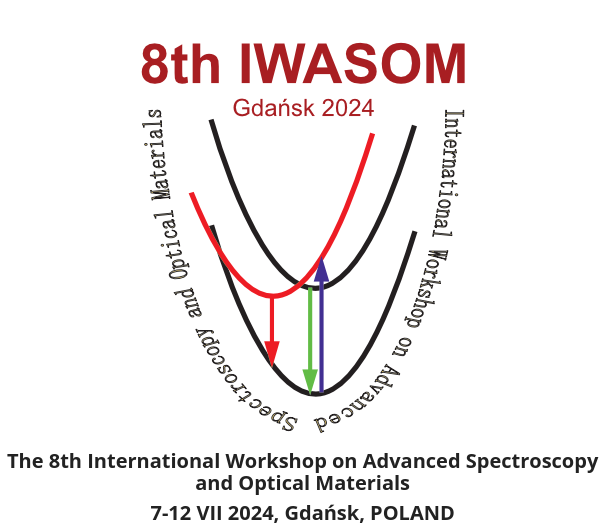
International Workshop on Advanced Spectroscopy and Optical Materials (IWASOM 2024)
| - |
In Gdansk
Topics
- Nanoscale optical materials and single nano-objects
- Thin films and low-dimensional systems
- Optical control and detection of quantum systems
- Phosphors: recent progress, new materials, and applications
- Radioluminescence, optically and thermally stimulated luminescence in solids
- Luminescent sensors
- Hybrid and organic optical materials
- Novel fluorophores, optical materials, devices for biosensing, biomedical and environmental applications
- Characterization techniques for optical materials
- Photovoltaic and photocatalytic materials
- Theory and modeling
9th Asian Conference on Crystal Growth and Crystal Technology. CGCT-9
| - |
In Jeju
PSCM User Meeting 2024
| - |
In Grenoble
XVIIIth International Conference on Electron Microscopy (EM 2024)
| - |
In Zakopane
The XVIIIth International Conference on Electron Microscopy is jointly organized by the Institute of Metallurgy and Materials Science of the Polish Academy of Sciences and the Polish Microscopy Society. The conference is to be held in southern part of Poland in the picturesque Zakopane resort.
The conference will bring together researchers from different fields of science and engineering including materials science, chemistry, physics, life science (biology and medicine), whose focal point is on application of electron microscopy to study of materials and materials related properties. The broad spectrum of topics comprises analytical electron microscopy, imaging in SEM/STEM, crystallography and HRTEM techniques, 3D imaging, in-situ electron microscopy, cryomicroscopy, as well as applications of electron microscopy to study materials spanning from traditional engineering materials to highly advanced functional materials, nanomaterials and biological materials.
The conference also welcomes scientists, engineers and representatives of electron microscopes manufacturers, whose focus is on instrumentational developments to showcase and review the latest technical advances. It will provide a forum for the exchange of thoughts and ideas, news on the latest trends in the field of electron microscopy as well as to promote cooperation between the participants from science and industry.
Hope to see you in Zakopane!
Distinguished Lectures on Quantum Crystallography and Complementary Fields: Lectures 33 and 34
|
In Online
Lecture 33:Â "Dipolar group polarizability as a multipurpose tool for predicting molecular and bulk properties" by Anna Krawczuk (Univ. of Gottingen, Germany)
Lecture 34: "Reliable predictions of crystal structures entirely from quantum mechanics" by Krzysztof Szalewicz (Univ. of Delaware, Newark, USA)
2024 ACA Summer Course in Chemical Crystallography
| - |
In Purdue University, West Lafayette, IN, USA
The ACA Summer Course in Chemical Crystallography is a program that is now into its third decade of instruction here in the United States. The current incarnation of the course is directed towards Single-Crystal Chemical Crystallography and Powder Diffraction techniques, as applicable to small molecule studies. The course is designed to instruct attendees in the theory and practice of these two aspects of crystallography.
The course is held every summer, in even years now at Purdue University, and in odd years at Northwestern University. For updates on the course, click here.
No prior knowledge of crystallography is expected from attendees. However, a good understanding of undergraduate level chemistry, physics and mathematics is desirable. While the course is geared towards graduate level attendees, applications from strong undergraduate students will be considered. Â Past course attendees have included faculty members and industrial researchers.
18th European Powder Diffraction Conference (epdic18)
| - |
In Padova
The EPDIC Conference is the biennial meeting dedicated to all aspects of the analysis of polycrystalline materials by diffraction methods. It brings together experts from universities, research institutes and instrumentation companies to share their knowledge and discuss the current trends and challenges in powder diffraction.
In agreement with the traditional character of this Conference, EPDIC18 will yield an exciting scientific program that will cover a broad range of hot traditional and new topics interesting to the powder community.
The Conference will be held in Padova, at the Padova Congress Centre on behalf of AIC. It will be organized in synergy with ECM34, which will precede EPDIC18 in the same location.
CCDC Webinar: Exploring Morphology Prediction and Handy Tips for CSD-Particle
|
In Online
4:00 PM - 5:00 PM GMT
Anticipating the physical characteristics and surface properties of a structure by analysing its chemical attributes can save significant costs and time within the pharmaceutical industry. CSD-Particle software allows formulation scientists to gain insights into particle behavior, rapidly analyse the mechanical and chemical properties of a crystal particle, and address potential manufacturing issues with its visual and statistical tools.
During the webinar, Andy Maloney (Particle Science Team Leader) will demonstrate:
- Different approaches to morphology prediction.
- Rapid particle description and analysis using CSD-Particle and the CSD Python API.
Who should attend:
- Crystallization scientists
- Formulation scientists
- Chemical engineers
- Crystallographers
- Solid form scientists
- Materials scientists
7th CrysAC Workshop
|
In Weizmann Institute of Science, Rehovot, Israel
7th CrysAC workshop on "Bio-apatite, humans, archaeology, and environment"
Â
The workshop is the 7th in the series of very successful events organized by the IUCr commission on "Crystallography in Art and Cultural Heritage" (CrysAC), aiming to increase the interaction between crystallographers and different communities working in the area of Cultural Heritage.
This specific workshop focuses on several aspects of apatite crystal structure, crystal chemistry, and microstructure in materials of different nature. Apatite is an incredibly important compound for the geochemistry of phosphorus and for the biochemistry of modern and ancient bones. Its importance in medicine, archaeology, mineralogy, palaeoanthropology, environmental sciences can not be underestimated. The workshop gathers several of the leading experts in apatite investigation from very different research areas: it is expected that such a multi-disciplinary approch will critically present the state-of-the-art of apatite research, with benefit of all participants.