Topics
Computing
NJUST/CCP4 school: From data processing to structure refinement and beyond
| - |
In Nanjing
The first CCP4 Chinese crystallographic school will take place at the Nanjing University of Science and Technology (NJUST). It will focus on macromolecular structure solution, refinement and validation from X-ray diffraction image data.
The school will cover many modern crystallographic software packages including CCP4, XDS and SHELX, taught by authors and other experts. It will be organized in three sections â€" lectures, tutorials and hands-on trouble-shooting.
Applicants: Graduate students, postdoctoral researchers and young scientists at the assistant professor level are encouraged to apply. Only 20 applicants will be selected for participation. Participants of the workshop are strongly encouraged to bring their own problem data sets or crystals so the problems can be addressed during the school.
Application information: The application deadline is Friday August 7th. The application form, the program, contact info and other details can be found at
http://www.ccp4.ac.uk/schools/china-2015/index.php
Fees: There is no fee for the workshop. The students will be responsible for their transportation and lodging. The workshop organizers can help make the reservations for hotel accommodation close to NJUST. The likely total cost for lodging and meals will be in the region of 2500 RMBs.
Data Processing and Structure Solution Workshop
The aim of this workshop will be to cover all aspects of the structure solution process in macromolecular crystallography, starting from data processing, through phasing and refinement, and ending with validation and deposition.
The workshop will cover many popular programs used for data processing and structure solution with the software developers available to help throughout the week. Programs covered will include: Mosflm, Scala, DIALS, XDS, Refmac, ArpWarp, Phaser, Coot, SHELXC/D/E, BALBES, MrBUMP, Buccaneer and many more.
Summer School for Big Data in Biology
| - |
In Austin, TX
The Center for Computational Biology & Bioinformatics at The University of Texas at Austin is proud to host the 2nd annual Summer School for Big Data in Biology.
The Summer School offers intensive four-day workshops on diverse topics for analysis of large-scale DNA, RNA, and protein datasets. The summer schools provides a unique hands-on opportunity to acquire valuable skills directly from experts in the field, with courses tailored towards novices or intermediate and advance users.
This year we offer 10 workshops. Each workshop will meet for four half-days (either mornings or afternoons) for a total of twelve hours. Instructors will post lectures, datasets, exercises, and course information on a website accessible to enrolled participants. There will be no examinations, but participants may request certificates of completion. Academic credit will not be issued. Please carefully check the specified prerequisite knowledge before enrolling in a course.

ICTMS 2015. 2nd International Conference on Tomography of Materials and Structures
| - |
In Quebec
The ICTMS 2015 is the biannual conference of the IntACT (International Association of Computed Tomography).
This four full day congress is dedicated to CT-Scanning for non-medical applications. The 2nd International Conference on Tomography of Materials and Structures will bring together an international group of scientists to discuss a broad range of issues related to the use of computed tomography in materials and structures and all its related topics.
- X-ray and neutron tomography acquisition hardware, software and set-ups.
- Recent advances in CT imaging.
- Case studies including applications on miscellaneous materials and structures.
Presentations will be made within 2 parallel oral sessions. Contributions from universities, government and industry are welcome.
Themes
Themes of the congress encompass, but are not limited to, the following topics:
1Â X-Ray and Neutron Tomography, acquisition hardware, software and set-up.
- 1.1 â€" Synchrotron. (Chairmen: Robert Winarski & Jan Carmeliet)
- 1.2 â€" Micro-CT. (Chairmen: Matthieu Boone, Jan Van den Bulcke & Adrian Sheppard)
- 1.3 â€" Interferometry. (Chairmen: Leslie Butler & Francesco De Carlo)
- 1.4 -Physics of X-Ray. (Chairmen: Philippe Després & Giovani Grasselli)
2 â€" Recent Advance in CT & Synchrotron Imaging
- 2.1 â€" Advance in reconstruction algorithms. (Chairman: Andrew Kingston) Â
- 2.2 â€" Geotechnic. (Chairmen : Jacques Desrues & Stephen Hall)
- 2.3 â€" Multi-tissue quantitative Imaging technique. (Chairmen : Eric Landis & Sabine Rolland de Roscoat)
- 2.4 â€" 3D imaging. (Chairmen : Dominique Bernard & Khalid Alshibi)Â
- 2.5 â€" Developing image analysis tools for synchrotron imaging and microscopy. (Chairmen : Xianghui Xiao & Ross Harder)
3 â€" Case studies
- 3.1 â€" Hydraulics and sediment transport. (Chairmen : William Arnott & Bernard Long)
- 3.2 â€" Geomaterial, Materials, Structures and Mineralogy. (Chairmen : Jean-Yves Buffière & Yosuke Higo)
- 3.3 â€" Wood. (Chairmen : Dominique Derome, Jan Van den Bulke & Gabor Szathmary)
- 3.4 â€" Sedimentology and Palaeontology. (Chairmen : Richard Ketcham & Patric Jacobs)
- 3.5 â€" Quaternary Deposits. (Chairmen : Pierre Francus & Mathieu Duchesne)Â
- 3.6 â€" Innovative ;Geotechnical Applications. (Chairmen : Jun Otani, Gioacchino Viggiani & Didier Perret)
- 3.7 â€" Rock porosity and gas sequestration. (Chairmen : Patrick Selvadurai & Michel Malo)
- 3.8 â€" Concrete & building rocks. (Chairmen : Jacques Marchand & Veerle Cnudde)
- 3.9 â€" Porous Material. (Chairmen : Nicolas Lenoir & Takafumi Sugiyama)
- 3.10 â€" Hydrogeology, water infiltration and pollution. (Chairmen: Richard Martel, Subhasis Ghoshal)
- 3.11 â€" Archaeology. (Chairmen : Réginald Auger & Geneviève Treyvaud)
- 3.12 â€" Biogenic sedimentary structure and dynamics: marine, fresh water, and terrestrial systems. (Chairmen : Robert Aller & Emma Michaud)
- 3.13 â€" Petroleum core analysis. (Chairmen : Mike London & Caliskan Sinan)

17th iWoRiD. International Workshop on Radiation Imaging Detectors
| - |
In DESY, Hamburg
Making the most of PDB and EMDB data
|
In Rovinj

Metadata for raw data from X-ray diffraction and other structural techniques
| - |
In Rovinj
ECM29 satellite meeting organised by John R. Helliwell (University of Manchester), Brian McMahon (IUCr) and Aleksandar Višnjevac (Croatian Association of Crystallographers)
As part of the continuing activities of the IUCr Diffraction Data Deposition Working Group, this workshop will seek to define the necessary metadata that needs to be captured and deposited alongside experimental diffraction images in order that such raw data may be subsequently re-evaluated or re-used in more detailed scientific studies. The workshop will also explore the metadata requirements of other structural experimental techniques used by crystallographers.
Confirmed speakers: Loes Kroon-Batenburg, Utrecht University, The Netherlands; Simon Coles, Southampton University and UK Crystallography Service, UK; John Helliwell, University of Manchester, UK; Brian McMahon, IUCr.
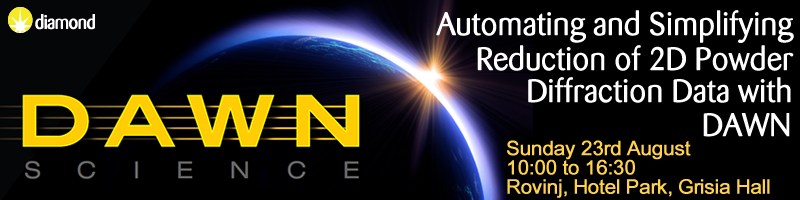
DAWN: Automating and Simplifying Reduction of 2D powder diffraction data with DAWN. ECM29 satellite
|
In Rovinj
ECM29 satellite meeting organised by Diamond Light Source & Croatian Association of Crystallographers
Accurate calibration and reduction of two dimensional powder X-ray diffraction patterns is crucial to obtain high-quality data for subsequent analysis. The DAWN data analysis platform (www.dawnsci.org) has recently added two new tools to address these issues, which allow simple, rapid and accurate processing of large amounts of data. In this workshop, participants will first learn about the theoretical treatment of the raw data and then see how this is applied through tutorials using the new powder calibration tool within DAWN. They will then gain hands-on experience preparing and using data analysis pipelines to streamline data reduction of large and/or complicated data sets. We will demonstrate the use of these tools in the context of different and demanding experiment types, from in situ crystallisation through to extreme-conditions. As this workshop will provide a very hands-on introduction to the DAWN data analysis package, we recommend that participants bring their own laptops. DAWN can be freely downloaded in advance of the workshop from our website, but we will also be distributing the most up-to-date version of the software on the day. We welcome participants bringing their own data so that they can see how the DAWN package can be applied to their own work, but we would ask that they contact the organisers in advance.
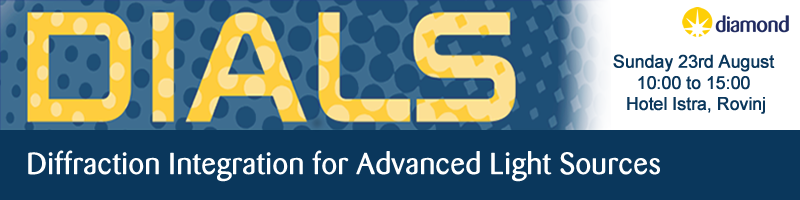
DIALS workshop - Diffraction Integration for Advanced Light Sources
|
In Rovinj
ECM29 Satellite meeting organised by Diamond Light Source & Croatian Association of Crystallographers
DIALS (Diffraction Integration for Advanced Light Sources) is a new integration package being developed as a collaboration between Diamond Light Source, CCP4 and Lawrence Berkeley National Laboratory, with significant input from the MRC-LMB and funding from Biostruct-X workpackage 6. The aim of this workshop is to introduce new users to the package, with a view to using the software for X-ray diffraction data processing from macromolecular samples. Since the software is completely free and open source the workshop attendees will have the opportunity to bring their own laptop computers to have the software installed, and will need to do so to run the tutorials.
Â
Introduction to the Cambridge Structural Database (CSD)
| - |
In Frankfurt/Main
Workshop of the Cambridge Crystallographic Data Centre (CCDC) in connection with the working group 1Molekülverbindungen' of the German Crystallographic Society â€" DGK. Organisation: Dr. Steven Maginn (CCDC, Cambridge) and Prof. Dr. Martin U. Schmidt (Goethe University, Frankfurt).
The Cambridge Structural Database (CSD) and its accompanying software for search and analysis (ConQuest, Mercury, IsoStar and Mogul) - together known as the CSD System (CSDS) - is a fundamental resource in structural chemistry, finding applications in academia and in industry across a broad range of topics such as drug design and discovery, drug development and formulation, and materials science.
The workshop will provide information about the CSD itself, its content and its production. The CSDS software will be described, and a number of hands-on examples of the use of the CSDS to address real problems of both industrial and academic importance will be followed. These will include:
"Discovery Chemistry"
- Finding similar molecules to known actives
- Understanding factors affecting molecular conformation
- Searching for new medicinal chemistry ideas using structural information on known active molecules
- Checking the reported structures of ligands in protein-ligand crystal structures against observed conformations in the CSD
"Materials Chemistry"
- Looking for similar crystal packing motifs
- Calculating the propensity of a molecule to form multiple accessible polymorphs
- Looking for suitable co-crystallisation partner molecules
- Inspecting the interactions present in a crystal structure and comparing them with those formed by the molecule's constituent functional groups in the CSD, as a guide to polymorphic relative stability
- Inspecting the preferred interactions at a crystal surface as a guide to the design of habit modifiers.
The CSDS is constantly developing to ensure the widest possible use and application of crystallographic knowledge. New ways of accessing this information are being made available, such as API access to CSDS functionality, web services and web applications. These new ways of including crystallographic information in solutions will be described, discussed and demonstrated in the workshop.

ECS2. Second European Crystallography School
| - |
In Mieres (Asturias)
Crystallography: Fundamentals, Online Tools and Applications
The European Crystallographic Association (ECA) and the University of Oviedo invite the world-wide crystallographic community (and all scientists and students working in any related field) to an intensive session of working together and learning crystallography from each other.
With help from our sponsors, we have achieved a registration cost of 570 euros (young academic, including accommodation and meals). We expect to have student bursaries available to reduce the cost further for a limited number of attendees. The number of attendees is limited to 90 students.
The application deadline is March 31st, 2015.
Programme
The programme schedule aims to answer the new and challenging requirements of the crystallography education and training during the 2nd century of modern crystallography. It is divided into four different modules:

Pre-school basic tools:
- Matrix calculus in crystallography
- Symmetry elements and symmetry operations
- Basic group theory
- Introduction to Reciprocal Space
Fundamental Crystallography:
- Symmetry groups and types of symmetry in direct space
- Space groups and their description in International Tables for Crystallography, Vol. A
- Group-subgroup relations â€" On line tools.
- Crystal-structure descriptions â€" On line tools.
- Crystal-structure relations â€" On line tools.
- Diffraction and Phasing.
- Diffraction Methods for Metal-Organic and Inorganic crystals.
- Diffraction Methods for biological crystals.
- Diffraction Methods for Nanomaterials â€" Electron diffraction.
- Diffraction Metodos for Magnetic Materials.
- Practical sessions on Online Tools â€" Tutorials : Sir/Expo-Janaâ€"Toposâ€"Fullprof
 Specific Subjects:
- Biological Crystallography
- Materials Crystallography
- On line tools â€" Tutorials: CCP4, SHELX, SIR
Hot topic Subjects:
- Time resolved Crystallography
- XFEL Crystallography
- Electron Crystallography
- Crystallography in the Space
Advanced Software Development for Crystallographers
| - |
In Duga Uvala
ECACOMSIG - the European Crystallographic Association's Computing Special Interest Group
Â
Â
The Workshop will be held over two full days (21st & 22nd August); there will be an introductory lecture and "get-together" on the evening of 20th August, so participants should plan to arrive on that afternoon. Provided there is sufficient demand, transport will be provided (and included in the registration fee) to ECM29 in Rovinj on the morning of 23rd August.
The Workshop will be open to a maximum of 40 applicants. A limited number of bursaries will be available to assist with the cost of attendance.
Generous sponsorship has allowed us to set the registration fee (including lunch and refreshments on 21st and 22nd August) to € 100, excluding accommodation.
Registration (including accommodation bookings) is via the ECM29 website
All queries should be sent to either Harry Powell or Andrea Thorn.
Confirmed speakers include
George Sheldrick - Georg-August-Universität, Göttingen, Germany Eleanor Dodson - University of York Santosh Panjikar - Australian Synchrotron, Melbourne, Australia Luc Bourhis - Bruker AXS, France Kay Diederichs - Universität, Konstanz, Germany Harry Powell - MRC Laboratory of Molecular Biology, Cambridge Andrea Thorn - MRC Laboratory of Molecular Biology, Cambridge
5th Annual CLS Mx Data Collection School
| - |
In Saskatoon
With special topic: Phenix
The Canadian Macromolecular Crystallography Facility (CMCF) is pleased to announce an intensive 5-day hands-on synchrotron data collection school at the Canadian Light Source. Participants will attend a series of lectures and be actively engaged in macromolecular crystallography (Mx) data collection at CMCF beamlines. Completing the school will enable participants to make effective use of the beamlines remotely and will better equip participants to collect diffraction data on-site. This year's invited speaker is Dr. Paul Adams from the Lawrence Berkeley Laboratory. He will guide participants through an in-depth look at using Phenix during structure solution. Participants should have a basic grounding in crystallography prior to attending the course. Given enough interest, an optional introductory review will be offered on Monday, June 1.

NSCCS User Meeting 14/15. EPSRC UK National Service for Computational Chemistry Software
|
In London
Swiss Chemistry Society Fall Meeting
|
In EPFL, Lausanne
- Analytical Sciences
- Catalysis Science & Engineering
- Computational Chemistry
- Inorganic & Coordination Chemistry
- Medicinal Chemistry & Chemical Biology
- Organic Chemistry A & B
- Physical Chemistry
- Polymers, Colloids & Interfaces
Mantid Training Courses 2015
| - |
In ISIS, Didcot
Mantid Training Courses Feb 2015
Following the success of our previous sessions of these training courses we would like to offer them again in February 2015. These courses are open to both facility staff and any interested people from other institutions.
The following courses will be based at ISIS, RAL and are:
Monday 16th February 1-5pm: Mantid Introduction An introduction to the Mantid interface, how to graph and visualize your data, manipulate it with the built in algorithms, together with an introduction to curve fitting and live data analysis.
Tuesday 17th February 9-12am: Introduction to Python This half day course will introduce you to the Python scripting language, no previous experience required, although some understanding of loops and conditional if statements will be expected.
Tuesday 17th February 1-5pm: Python in Mantid This course concentrates on using Python to build analysis scripts within Mantid as well as controlling the Mantid GUI from python, and accessing the underlying data within Mantid workspaces.
Wednesday 18th February 9-5pm: Extending Mantid using Python For the more adventurous among you this course will introduce you to the many ways you can use Python to extend the capabilities within Mantid adding Python Algorithms and curve fitting functions, as well as diving deeper into the structure of workspaces. After the feedback from the previous run this course has been extended to a full day course, together with adding more material.
Booking a place If you are interested in any other these courses please send an email to [email protected] letting me know which ones you wish to attend. For the courses we will supply PCs, so there is no need to bring a laptop unless you really want to. Spaces are limited to 13 people per course so please book early to avoid disappointment. If a course is over booked we will try to arrange another session in the future, so if you cannot make that specific date let me know and I’ll let you know about any subsequent courses. I’ll send out calendar appointments to you once your place on the course is booked.
For visitors from UK academic institutions: Are sometimes able to offer assistance with travel and lodging costs while attending the courses. Let me know when you are booking the courses and I’ll get back to you with details. If we are able to help, then you travel and hotel must be booked through the ISIS user office.
For visitors from elsewhere: While we can offer this course for free, we cannot unfortunately offer any help with travel or subsistence costs. However please let me know that you will be visiting when you reply so that I can arrange site access.

Basic & Advanced Rietveld Refinement & Indexing Workshop
| - |
In Newtown Square, PA
Workshop Outline
Powder pattern Indexing and Rietveld structural refinement techniques are complementary and are often used to completely describe the structure of a material. Successful indexing of a powder pattern is considered strong evidence for phase purity. Indexing (with derived space group and lattice symmetry determinations) is considered a prelude to determining the crystal structure, and permits phase identification by lattice matching techniques. The Rietveld method is used to refine crystal structures and is perhaps best considered whole- pattern-fitting structure refinement, i.e., we must account not only for the crystal structure but also the instrumental resolution and diffraction physics effects (e.g., crystallite size and strain). The aim is to perform quantitative phase analysis and identification.
This workshop introduces the theory and formalisms of various indexing methods and structural refinement techniques. One unique aspect of this workshop is the extensive use of computer laboratory problem solving and exercises that teach method development in a hands-on environment.
We will use EXPGUI and GSAS for the Rietveld laboratory work; Crysfire (especially Dicvol, Ito and Treor) will be used for indexing exercises.
Lecture Components
Basic Crystallography
- Emphasis on space groups, conventions, etc.
Powder Pattern Indexing
- Data reduction methods for peak finding
- We will use Dicvol 04, Treor and Ito indexing examples
- Crysfire will also be discussed
Rietveld Structural Refinement
- History and motivation for development of this technique
- Qualitative description of various sample and instrument-related functions for profile shape, background, etc.
- The use of least-squares constraints will be explored
LeBail and Pawley Fitting Procedures
- What to do when atomic coordinates are not available
- Discussion on use of these tools for structure determination
- Use in powder pattern indexing
Computer Laboratory Components
Exercise problems will include:
- Single phase indexing
- Single phase refinement (all crystalline materials)
- Multiphase refinement (all crystalline materials)
- Nanophase, and small crystallite size content
- Amorphous phase + crystalline phase(s)
3rd National Conference on Hierarchically Structured Materials (NCHSM 2015)
| - |
In Chennai
Topics
Nanomaterials and Biomaterials
Metallic and Inter-metallic materials
Electronic and Optoelectronic materials
Magnetic and Semiconductor materials
Electronic structure of materials
Thin films and applications
Ion beam irradiation on matters
Crystal Growth and Characterization
Ceramics, Polymeric & Composites materials
Smart materials and Sensors
Materials Characterization
Computational Modeling
Ionic and Catalytic materials
Structure of Organic and Inorganic materials
For further information is given in NCHSM2015.pdf. For a registration form click here
APS Data collection workshop and CCP4 school: From data collection to structure refinement and beyond
| - |
In Argonne National Laboratory
8th annual CCP4 USA Crystallography School
The first two days will be dedicated to data collection and processing. The rest of the school will focus on structure solution, refinement and validation.
The course is intended mainly for graduate students, postdoctoral researchers and young scientists in the area of structural biology from all across the globe. The school is not meant as an introductory level course to protein crystallography. It is designed more for applicants with reasonable expertise in crystallography and experience with the CCP4 suite. The purpose of the school is to address specific problems that the applicants face while collecting diffraction data and while solving and refining novel structures. Applicants with crystals for data collection or with already collected data will be given strong consideration, although these are not mandatory requirements.
Several of the leading PX software developers from around the world will present lectures and tutorials on their software and will also be available to help with problems during hands-on sessions of the school.
Â

Practical X-ray course on methods in protein crystallography: data collection, data processing, and phasing
| - |
In Oulu
The course will be organised by Lari Lehtiö, Kristian Koski, Tiila Kiema, Ari-Pekka Kvist and Rik WierengaÂ
The course is supported by Biostruct-X, Biocenter Oulu, and the University of Oulu
There will be an international X-ray course at the Faculty of Biochemistry and Molecular Medicine of the University of Oulu, Oulu, Finland. The course will focus on data collection and data processing using iMOSFLM and XDS, to be complemented by lectures and tutorials on experimental phasing (SHELX) and molecular replacement phasing (CCP4). In addition there will be lectures on new techniques (XFEL diffraction and neutron crystallography). On the last day of the course there will be a remote data collection demonstration at Diamond Light Source, Oxford. The outline of the course follows the previous format, aiming for approximately 16-20 students, who will be provided with a computer in our linux class room. Data collection from own crystals will be possible using our in-house Bruker microfocus X-ray generator or remotely at Diamond.
Current approximate outline:
Monday, May 18:
Basic concepts of biomolecular crystallography, by Bernhard Rupp (USA)
Emerging techniques: XFEL by Janos Hajdu (Uppsala, Sweden): “The basic principles of the XFEL technology and molecular imaging"
Tuesday, May 19/Wednesday, May 20 (data processing):
XDS, Manfred Weiss, BESSY, Berlin, Germany (also XDSapp as available at Bessy)
iMOSFLM, Harry Powell (LMB, Cambridge, UK) Â (also data processing pipelines at Diamond)
Tuesday afternoon lecture by Bernhard Rupp on ligand binding studies
Wednesday, May 20/Thursday, May 21: (experimental and molecular replacement phasing)
Experimental phasing by SHELX, Thomas Schneider (EMBL, Hamburg)
Molecular replacement phasing by CCP4, Andrey Lebedev (CCP4, STFC)
Wednesday afternoon lecture on neutron crystallography by Dr. Zoe Fisher (ESS, Lund)
Thursday afternoon lecture by Thomas Schneider on the X-ray beamlines at EMBL, Hamburg
Â
Friday, May 22:
Remote data collection at Diamond (Martin Walsh, Diamond)
Crystal sample management and data tracking from crystal to PDB by xtalPiMS (Ed Daniel, Oulu)
Â
Throughout the course students will have time to work on their own topics in the linux class room and we will also provide the opportunity to collect data with our own equipment. Crystals that should be used for data collection in house or at Diamond should be available for freezing on the first day of the course or should be sent in advance to Oulu.
There will be a registration fee of 350Euro to cover the costs of accommodation and meals. We will try to make available fellowships to cover these costs. When applying to attend this course follow the instructions attached below.  Please provide information on crystals and/or datasets that you would like to send in advance. Indicate also if such a fellowship is needed when being accepted for this course. In case of oversubscription, students with own crystals and / or own data sets will be prioritised.
Please apply by by 10.01.2015
Â

DSE2015. 100 Years of the Debye Scattering Equation
| - |
In Cavalese, Trentino
A workshop dedicated to the centenary of the publication of P. Debye’s paper on «Zerstreuung von Röntgenstrahlen» (Feb. 25th, 1915), which first provided an expression for the diffraction from a randomly oriented powder of scatterers.Â
Over the past twenty years, the rising interest in nanomaterials, and the ever growing power and availability of computers has revived interest in the Debye Scattering Equation (DSE), which is now a paradigm in the analysis of the matter at the nanoscale. Besides and beyond the DSE, stemming from the same root, Total Scattering methods have grown steadily, gaining increasingly popularity with the Pair Distribution Function (PDF) approach. The common root is in the description of scattering based on atomic distances in clusters of atoms/molecules and nanoparticles, as an alternative to the concept of unit cell and translational symmetry of the traditional crystallography for ideal bulk crystals.
This workshop is dedicated to DSE history, methodology, new ideas and representative applications, with further interest in PDF and Total Scattering methods to study matter at the atomic scale independently of its degree of order, be it amorphous, nanocrystalline or simply a disordered crystal.
As a focused and intensive workshop DSE2015 is limited to 50 participants. Besides a restricted number of invited speakers, admission to the workshop is conditioned by the acceptance of an abstract; as an alternative to an abstract, a motivation letter can also be presented. Admission is decided (no appeal) by the Scientific Committee (Billinge-Cervellino-Neder-Scardi). Title and abstract submitted at this stage can then be modified if/when necessary before the workshop.
The program, distributed over four days, provides for a single session with extended time for discussion after keynote and contributed talks. A half-day session is dedicated to Poster presentations.
The choice of a limited and selected participation and the location in a comfortable resort nearby a small town of the Dolomitic mountain area of Italy, are intended to promote free discussions and to foster the beginning of collaborations and projects.
Written contributions of accepted talks/posters will be considered for publication â€" after the workshop â€" in special issues of peer-reviewed (ISI-Scopus) Journals. More details to be provided soon.
Â