Topics
Computing
Synchrotron Radiation Techniques and Nanotechnology: a Synergic Approach to Life Sciences and Medicine
| - |
In Cape Town
The Abdus Salam International Centre for Theoretical Physics (ICTP, Trieste, Italy), in cooperation with iThemba Labs - National Research Foundation (SA) Cape Town Campus, Stellenbosch, South Africa is organizing an Advanced School on Synchrotron Radiation Techniques and Nanotechnology: A Synergic Approach to Life Sciences and Medicine to be held in Cape Town, Stellenbosch, South Africa.Â
In the post-genomic era the emphasis has shifted from genes to proteins and to the understanding of their structure and biological function. The rapid development of nano-sciences has made available a new range of tools and approaches that have revolutionized biological and medical research, by allowing scientist to manipulate nano-particles and macromolecular objects and to monitor the behaviour of single molecules. Not only is this having a great impact on basic biological research, but its applications have become a driving and innovative force in the modern economic and industrial framework, particularly for health and biotechnology.
Topics will include:
- Macromolecular crystallography,
- Single particle electron microscopy,
- Small angle X-ray scattering,
- Computational biology,
- Nano-biophysics,
- High resolution atomic force microscopy,
- Nano-mechanics and tissue engineering.Â
Crystal Structure prediction using the USPEX Code
| - |
In Lausanne
Crystal structure prediction using the USPEX code
October 22, 2012 to October 26, 2012 Location : CECAM-HQ-EPFL, Lausanne, SwitzerlandOrganisers
- Andriy Lyakhov (SUNY Stony Brook, USA)
- Gilles Frapper (University of Poitiers, France)
- Artem Oganov (SUNY Stony Brook, USA)
- Mario Valle (Swiss National Supercomputing Centre, Switzerland)
Description
Crystal structure prediction has long remained a major unsolved problem in physical sciences [1]. A number of approaches have been formulated over years - most of these are summarized in the recent book [2]. Crystal structure prediction is a powerful tool for designing new materials "in silico", thus replacing the traditional Edisonian trial-and-error approach with design by artificial intelligence. It is also a major instrument for discovering new phenomena at extreme conditions. Crystal structure prediction should thus be an everyday tool at the hands of nearly every computational materials scientist.Â
A major advance in this field happened with the development of the evolutionary algorithm USPEX for crystal structure prediction [3], which has led to a number of important findings [4-6]. This proved to be a very efficient and reliable method, and the USPEX code, based on it and freely distributed to academic scientists, is currently used by over 500 researchers worldwide and this number grows rapidly. We should note that in addition to the evolutionary structure prediction, USPEX code features many other techniques, such as random sampling, metadynamics, minima hopping, particle swarm optimization - all of which can be used in real applications or tested against one another. Thus, familiarity with this code will imply a solid background in other structure prediction techniques. USPEX is the widest used crystal structure prediction code and there is a need to train new users through hands-on tutorials and workshops. One such workshop was organized in Poitiers, France (June 2011) and proved to be a great success. Another workshop will take place in Xi'an, China (August 2011). Through a regular series of such pedagogical events we want to train a new generation of users and developers of crystal structure prediction techniques.Our program will consist of theory lectures, hands-on tutorial sessions, and round table discussions. Morning theory lectures will focus on the nature of the crystal structure prediction problem, various ways to address it (in particular evolutionary algorithms), theory of energy landscapes, applications of crystal structure prediction, problems related to low-dimensional systems. Afternoon tutorials will give each participant to tackle a real research project, and special attention will be paid to the tools for data analysis and visualization.
References
 [1] Maddox J. (1988). Crystals from first principles. Nature 335, 201.Â
[2] Oganov A.R. (Ed.) (2010). Â Modern methods of crystal structure prediction. Berlin: Wiley-VCH, ISBN 978-3-527-40939-6.Â
[3] Oganov A.R., Glass C.W. (2006). Crystal structure prediction using ab initio evolutionary techniques: principles and applications. J. Chem. Phys. 124, 244704.Â
[4] Ma Y., Eremets M.I., Oganov A.R., Xie Y., Trojan I., Medvedev S., Lyakhov A.O., Valle M., Prakapenka V. (2009). Transparent dense sodium. Nature 458, 182-185.
[5] Oganov A.R., Chen J., Gatti C., Ma Y.-M., Yu T., Liu Z., Glass C.W., Ma Y.-Z., Kurakevych O.O., Solozhenko V.L. (2009). Ionic high-pressure form of elemental boron. Nature 457, 863-867.
[6] Oganov A.R., Lyakhov A.O., Valle M. (2011). How evolutionary crystal structure prediction works - and why. Acc. Chem. Res. 44, 227-237.
Dynamic Structural Photocrystallography in Chemistry and Materials Science
| - |
In Buffalo, NY
Topics
- Chemical reactions, linkage isomers, and photoinduced molecular excited states
- Experimental techniques used for in-house experiments at high intensity sources, at synchrotron beamlines, and at Free-Electron Laser sources
- New computational techniques for processing time-resolved data
- Interpretation of the results
The program will consist of lectures, software exercises, a poster session, and demonstrations. The workshop will open with a welcoming reception on the evening of Sunday, June 16th and close in the morning of June 20th.
Class size is limited to 45 participants. Registration deadline is April 1st or until the workshop is filled.
Organizing Committee
- Philip Coppens, general organization
- Elzbieta Trzop and Bertrand Fournier, software exercises
- Lisa Zimmerman, organization and facilities
International Advisory Committee
- Eric Collet, Professor, University of Rennes, France
- Masaki Takata, Professor, University of Tokyo, Japan
The Future of Dynamic Structural Science
| - |
In Erice
Purpose of the Course
The determination of three dimensional structures of new materials is frequently the starting point for mechanistic studies, revealing structure-property relationships, modelling of molecular variants and intelligent design for specific properties. However, these are traditionally static results and although we can follow structure evolution with temperature and pressure, it is far less easy to study time evolution when the time scales of the processes involved are short. The latest high intensity X-ray sources, fast detectors, new techniques and modern software are now taking us into the regime of conducting timeâ€"resolved studies and it is this aspect of structural science that we shall be exploring during this course.
X-ray and neutron diffraction are the most powerful methods for elucidating full 3-D structures from single crystals and microcrystalline powder samples for many forms of matter. The techniques are continuously evolving enabling ever more challenging questions to be addressed and the most difficult of problems to be solved. We shall be describing time resolved studies in crystallography, spectroscopy and computation and looking also at applications of this work as well as looking forward to the future and exciting opportunities and challenges that facilities such as XFEL will bring to the field.
We shall concentrate during the course on:
1) Photocrystallography â€" obtaining structural information from short lived crystalline species.
2) Time resolved spectroscopy - identifying and characterising intermediates and correlating these results with structural data.
3) The future â€" current and upcoming developments in dynamic structural techniques.
4) Theoretical calculation â€" correlating with and supporting experimental studies through computational calculations.
And in addition to the lectures we shall be presenting demonstration and workshop sessions providing training in using modern computer programs in these aforementioned areas.
Workshop on Crystallographic Software
| - |
In Tokyo
MaThCryst Workshop on Crystallographic Software
Tokyo, 12-16 December 2011Program
The workshop presented lectures and practical exercises on the following crystallographic software packages.- Vesta
- MoPro
- Bilbao Crystallographic Server
- Jana 2006
- Geminography
- Chardi
Lecturers
- Dr. Koichi Momma, Tsukuba
- Prof. Michal Dusek, Prague
- Dr. Benoît Guillot, Nancy
- Prof. Massimo Nespolo, Nancy
- Prof. Mois Aroyo, Bilbao
Local Organizing Committee
- Dr. Kenjiro Fujimoto, Chair
- Prof. Shigeru Ito
- Prof. Yasushi Idemoto
- Miss Chihiro Yamakawa
International Program Committee
- Prof. Massimo Nespolo, Nancy (Chair)
- Prof. Izumi Nakai, Tokyo
- Prof. Mois Aroyo, Bilbao
- Prof. Michal Dusek, Prague
Venue
The workshop was held at the Tokyo University of Science, Noda campus. It was postponed from the original scheduled dates of 22-26 May 2011 because of the tsunami.Crystallography Online: International School on the Use and Applications of the Bilbao Crystallographic Server
| - |
In Zarauz
Crystallography online: International School on the use and application of the Bilbao Crystallographic Server
Lekeitio, Spain, 21-27 June 2009Supported by the:
- Spanish National Committee for Crystallography
- IUCr Commission on Teaching Crystallography
- ECA Special Interest Group No. 5 "Mineral and Inorganic Crystallography"
List of main topics
- Symmetry databases for point and space groups
- Applications of group-subgroup relations between space groups
- Crystal structure transformations and alternative descriptions
- Solid-state physics and chemistry applications of group theory
- Selection rules in spectroscopy; phonon selection rules
- Structural pseudosymmetry
- Symmetry-mode analysis of ferroic structures
- Domain-structure analysis
- Structural phase transitions
- Symmetry in ab-initio calculations
Lectures
- Mois I. Aroyo (Bilbao, Spain)
- J. Manuel Perez-Mato (Bilbao, Spain)
- Karen Friese (Bilbao, Spain)
- Massimo Nespolo (Nancy, France)
- Gervais Chapuis (Lausanne, Switzerland)
- Michele Catti (Milan, Italy)
- Yuri Kitaev (Saint-Petersburg, Russia)
- Juan Rodriguez-Carvajal (Grenoble, France)
- Harold Stokes (Utah, USA)
Third Annual School on Advanced Neutron Diffraction Treatment using the FullProf Suite
| - |
In Tenerife
FullProf School-2010, 2-7 May, 2010
Chair:       Juan Rodriguez-Carvajal Co-chairs:   Marie-Hélène Lemée-Cailleau, Gabriel CuelloScientific scope:
Precise crystallography has significantly contributed to the success and recent developments in materials science, solid state physics and chemistry. Among the available programs for diffraction data analysis, the FULLPROF SUITE is one of the most widely used packages by the scientific community working in these fields. Â
By creating a regular school on the FULLPROF SUITE, our aim is to contribute directly to the training of the upcoming generation of scientists. These intensive, hands-on, schools are focus on the analysis of diffraction data with the FULLPROF SUITE.Â
After two successful issues, 2008 on "heterogeneous data coming from powders, single crystals, X-rays and time-of-flight neutron diffraction" and 2009 on "Magnetism", the third school, FPSchool 2010, took place in Grenoble from 2 to 7 May. It continued with the tradition of dedicating the first part to generalities and the second part of the school to a more specialized topic: complete diffraction-data treatment under constraints (powders and single crystals) using a symmetry mode approach for extended ionic/covalent materials and rigid body constraints for molecular materials.Lectures
The school lasted 5 days: three days dedicated to general applications plus two days dedicated to the specialised topic that will change each year. This year the school was mainly devoted to under constraint refinements.Theoretical introductory lectures (max. 1 hour/lecture) were followed by hands-on practical computing sessions. The afternoon was mostly dedicated to practical sessions.
Structure Elucidation by Combining Magnetic Resonance, Computation, Modelling and Diffraction (SMARTER)
| - |
In Aveiro
Virtual Conference on Computational Chemistry
| - |
In Worldwide
Welcome to the Virtual Conference on Computational Chemistry
The first Virtual Conference on Computational Chemistry (VCCC-2013) was held from 1st to 31st August 2013. Following the success of this conference, we are now planning for the second virtual conference, VCCC-2014, from 1st to 31st August 2014. Â Chemistry is no more about test-tubes and experiments but it also involves the use of efficient and accurate computational methods.Â
This virtual conference will also be held as part of the International Year of Crystallography. Computational chemistry is also  used to complement research involving crystallography.
ICT can be used effectively for conferences and thus, virtual conferences have gained popularity. The major advantage of virtual conference is the lower cost involved for participation. One simply has to have access to the Internet or email to be involved in the conference.
We look forward to your participation.
Professor Ponnadurai Ramasami
Chairman of VCCC-2014
How will the virtual conference take place?
- There will be a call for abstracts.
- Scientific committee will evaluate suitability of each submitted abstract.
- For each accepted abstract, author/s will be invited to submit the e-presentation in MS Word, MS Powerpoint, PDF or any other relevant format. Some examples are:
- PDF format (15-20 pages)
- Powerpoint format (15-20 slides)
- Video (10-15 minutes)
- E-presentations will be displayed on the website (secured).
- Registered participants will be able to download all the e-presentations.
- Participants can ask questions by sending email/s (using the online platform) to the corresponding author for each e-presentation.
- When a participant sends an email, the same email is received by all the registered participants. However, it is the responsibility of the corresponding author to reply to the question/s being asked within 24 hours. When the corresponding author responds by replying the email, the same is received by all the participants.
- Full paper (optional) will be reviewed and accepted papers will be collected in the conference proceedings.
International EXPO/SIR workshop
| - |
In Bari
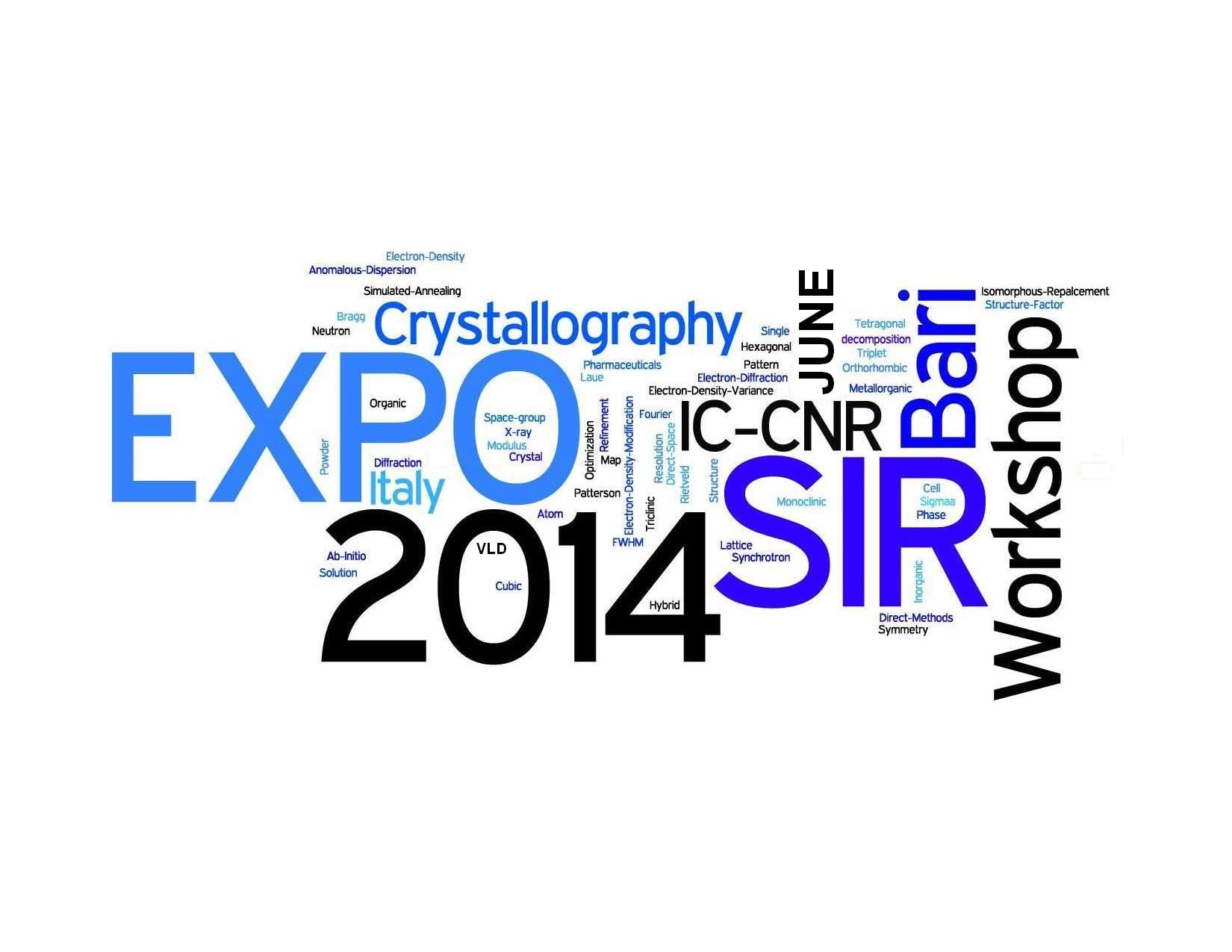
In particular, it will be devoted to the use of the latest versions of EXPO and SIR, two packages widely used by the international scientific community. The workshop will include theoretical and practical sessions. Participants will have the opportunity to personally use EXPO and/or SIR under the supervision of the authors.
EXPO is able to solve crystal structures by powder diffraction data using reciprocal as well as direct space methods. It is able to carry out the full pathway of the solution process, from indexing to Rietveld refinement. With respect to the previous version, it has been enriched with new powerful computing tools: e.g. the covariance principle based completion method (COVMAP) for structure model optimization; the RAndom Model based Method (RAMM) and the Hybrid Big Bang-Big Crunch approach for structure solution in reciprocal and direct space, respectively. The graphical interface has been improved making the program very user friendly.
SIR can solve ab initio crystal structures of small- and medium-size molecules, as well as protein structures, using X-ray or electron single crystal diffraction data. Several new abilities have been implemented: e.g. a new phasing method (VLD), simulated annealing techniques to exploit prior knowledge of the molecular geometry, molecular replacement methods for solving proteins, including a pipeline useful to automatically refine and complete the structure. The graphical interface has been further improved and allows the straightforward use of the program even in difficult cases.
Bachelor Summer Program
| - |
In Grenoble
What is the Bachelor Summer Program ?
The Bachelor Summer Program gives you the opportunity to study at UJF, obtain credits for your home university and meet students from all over the word! It is also open to French UJF students with whom you will interact daily.This 6 week program offers scientific courses taught in English and French. You may choose among three scientific topics (physical computing, large scale facilities, biochemistry). Each of them is made up of lessons, tutorials, practical work and scientific visits.
You will discover different aspects of French life through cultural excursions within the city and in its beautiful mountain environment.
When does the Summer Session take place in 2014 ?
From June 2 to July 13, 2014Who is it for ?
It is designed for English speaking undergraduate students from 2nd to 4 th year. A good level in science is required, with different prerequisites for each course. Beginners in French as well as more advanced ones are welcome.Scientific courses
60 hr. courses, 3 different topics:- Physical Computing
- Large Scale Facilities
- Biochemistry
French courses 45 hr. courses and cultural visits

MDANSE2014 School - Molecular Dynamics (and Lattice Dynamics) to Analyse Neutron Scattering Experiments
| - |
In ILL, Grenoble
MDANSE school 2014: Molecular Dynamics to Analyse Neutron Scattering Experiments
This school aims to train the participants in the use of modern simulation tools in the context of analyzing and interpreting experimental, neutron scattering data. It will be focused mainly on practical training, so the number of participants is limited to 30. Taking into account the QENS2014 and WINS 2014 conferences in the nearby location of Autrans from May 11 to May 16 (http://www.ill.eu/news-events/events/qens-2014-wins-2014/), the school will be a satellite event. Therefore the school will be focused on the use of Molecular Dynamics simulations to explore diffusive processes on the time scales covered by quasielastic neutron scattering spectrometers and Lattice Dynamics to study phonon dispersion curves and vibrational densities of states that are typically measured with inelastic neutron scattering spectrometers. Â The goal of this school is therefore to show how widely-available simulation tools can be applied to the analysis and interpretation of neutron scattering data. The school will last 2 days and will concern mainly the practical aspects of running and analyzing simulations so that, firstly, numerical and experimental data can be directly compared and, secondly, simulations can then be investigated in atomic detail. A range of simulation codes allowing electronically complex materials, molecular and polymer systems, porous media and bio-molecules to be handled, will be made available to participants on the cluster at ILL. Simulation analysis will focus on using the nMoldyn code. McStas will be used to incorporate the instrument response in a virtual experiment. Model analysis and fitting tools applicable both to simulated and experimental data will also be presented. Lectures on the fundamental aspects of running and analyzing simulations will be complemented by hands-on tutorials.
Molecular Simulations and Visualization - Faraday Discussion 169
| - |
In Nottingham
Faraday Discussion 169: Molecular Simulations and Visualization
Introduction
Biology, chemistry and materials science make extensive use of computational methods ranging from applications at the cellular level to detailed atomistic simulations of molecular assemblies, materials or small molecules. Many of these computational methods are nowadays routinely used to complement experimental studies. However, despite maturity of this intrinsically multi-disciplinary field, recent progress in the computational sciences has only slowly found its way into numerical simulations. In particular, the enormous potential of immersive and interactive virtual reality approaches, and advanced visual analysis of simulation data, have not been well explored so far.Â
Molecular simulations and visualization represent formidable communication and learning tools that could significantly speed up understanding of complex biomolecular systems. Interactive and immersive scientific computing includes aspects from the natural sciences, such as biology, chemistry and material sciences, and from the computational sciences, such as HPC architectures, graphical rendering, human-computer interaction, virtual reality and game design. We want to gather experts in these disciplines to stimulate discussions and initiate research aimed at deeper involvement, going beyond the boundaries of each discipline. Â
Aims
This meeting aims to illustrate and discuss the potential of human computer interaction and virtual reality for computational molecular sciences (biology, chemistry, materials science).Â
Format
The Faraday Division have been organising high impact Faraday Discussions in rapidly developing areas of physical chemistry and its interfaces with other scientific disciplines for over 100 years. Â
Faraday Discussions have a special format where research papers written by the speakers are distributed to all participants before the meeting, and most of the meeting is devoted to discussing the papers. Everyone contributes to the discussion - including presenting their own relevant research. The research papers and a record of the discussion are published in the journal Faraday Discussions.Â
Themes
- virtual and augmented reality; immersive molecular simulationsÂ
- advanced visualization and visual analyticsÂ
- computing power revolution and new algorithms: GP-GPUs, clouds and more
- applications and serious games: from docking to protein folding               Â
Computational Structural Biology - From Data to Structure to Function: EMBL-EBI Training Course
| - |
In Cambridge
EMBO Practical Course on Computational Structural Biology - from data to structure to function
Venue: European Bioinformatics Institute, CB10 1SD, United Kingdom
Overview
This course aims to teach computational aspects of protein structure determination, validation and analysis. It will cover the background of different structural biology techniques and provide hands-on experience in building a model from X-ray diffraction data. In addition, participants will learn how to critically assess the quality of data and models, and gain expertise in the integration and visualisation of data from different techniques, thus enabling the analysis of protein structure data for functional relationships. The importance of protein structure to drug discovery will also be illustrated with sessions dedicated to small-molecules, protein-ligand docking and model validation.Audience
This course aims to teach computational aspects of protein structure determination, validation and analysis to PhD students and post-docs working on the collection and analysis of protein structure data. The course will be highly interactive and will include many practical sessions. Attendees are strongly encouraged to bring their own data and ideas of work to be addressed during these sessions.