Topics
Small-angle scattering
SAS2024 (The XIX edition of the International Small-Angle Scattering Conference)
| - |
In Taipei
International BioXFEL Conference and Workshop
| - |
In San Juan, Puerto Rico
RapiData 2023
| - |
In Menlo Park, CA
RapiData 2023 at SSRL is a practical course in macromolecular X-ray diffraction data collection, data processing and structure solution. The aim of the RapiData course is to educate and train young scientists in data collection and processing methods at synchrotron beamlines, using state-of-the-art software and instrumentation.
The course will comprise hands-on experiments at the SSRL beamlines, software tutorials, and lectures on the following topics:
- Specimen preparation, tactics in data collection
- X-ray light sources
- X-ray detectors
- Data reduction
- Structure solving by MAD, SAD and Molecular replacement
- Complementary methods (spectroscopy and small angle scattering)
European Conference on Neutron Scattering (ECNS 2023)
| - |
In Garching near Munich
The MLZ is delighted to host the Eighth European Conference on Neutron Scattering after successful events atÂ
- Interlaken 1996
- Budapest 1999
- Montpellier 2003
- Lund 2007
- Prag 2011Â
- Zaragoza 2015
- St. Petersburg 2019
The conference is organized on behalf of the European Neutron Scattering Association (ENSA) and is one of the most important scientific events in the field of neutron research.Â
The conference will take place at the TUM Department of Mechanical Engineering and the new Science Congress Center Munich - both located in the immediate vicinity of the MLZ at Garching.Â
After a warm Welcome on March 19th, we are looking forward to four days of thrilling talks, pleasant posters, and decent discussions of the European neutron scattering community between March 20th and 23rd!Â
Â
7th International Conference of the Bangladesh Crystallographic Association
| - |
In Dhaka
The aim of the conference is to bring together scholars and students of all areas of crystallography-related science to share their recent research findings. The conference will also promote the interest and understanding of crystallography with respect to teaching and research in Bangladesh. It is expected that regional and international scientists will join the conference, which will allow Bangladeshi crystallographers to interact and collaborate with foreign participants. The Organizing Committee may arrange one or two sessions in hybrid mode.
Abstract submission deadline: 15 October 2022
Registration deadline: 30 November 2022Â
IEEE Around-the-Clock Around-the-Globe (AtC-AtG) Magnetics Conference 2022
|
In Worlwide
Dear Colleagues,
It is our great pleasure to announce the 'IEEE Around-the-Clock Around-the-Globe (AtC-AtG) Magnetics Conference 2022', a virtual event hosted by the IEEE Magnetics Society covering the vast field of magnetism. Following the great success of the previous editions, this unique 24-hour non-stop virtual conference will take place on August 31st, 2022, with contributions from speakers spanning six continents.
The AtC-AtG Magnetics Conference offers a diverse and inclusive virtual environment that foments collaboration between junior and senior researchers across the many subfields of magnetism. The invited speaker lineup includes both junior and senior scientists with outstanding research contributions. More information can be found on the dedicated conference website.
Join us by registering through our website before 24th August!Â
Highlights:
 - Invited talks from leading experts in magnetism
 - Covers all continents and time zones
 - Interactive online broadcasting with questions and discussions
 - Student presentation and poster awards
 - NO REGISTRATION FEE
Call for Abstracts:
Abstract submission for the contributed talks at AtC-AtG Conference is now open! Young researchers are encouraged to submit abstracts (oral and poster) and join us on this fantastic platform to meet researchers worldwide!
The abstract template and submission form are available on our website. Submissions close on June 12th!
Looking forward to seeing you all connected!
Best Regards,
On behalf of the AtC-AtG Organization Committee (2022)
7th School of Small Angle X-ray Scattering (SAXS School)
| - |
In Campinas-SP
As part of the scientific activities of the 18th edition of the International Small-Angle Scattering Conference (SAS), the LNLS/CNPEM is organizing the 7th School of Small Angle X-ray Scattering (SAXS School). The satellite school will take place at Sirius on 16 to 20 September 2022, which are the following days of the 18th SAS 2022 Conference.
In this edition, the school will be focused on the scattering data analysis of biological systems, like proteins and membranes. Moreover, there will be both international and national well-known researchers giving classes.
Â
To the present date, the organizing committee are planning a 100% on-site school since it will be included “hands-on†experiments at Cateretê beamline.
The school is proposed for students and early career scientists enthusiastic to learn SAXS.
Â

SAS2022: XVIII International Small Angle Scattering Conference
| - |
In Campinas-SP (and online)
FEBS2022 Advanced course: Lost in Integration - Probing Biomolecules with Electrons, Photons, Neutrons and Magnetic Spins
| - |
In Spetses Island
To.Sca.Land: Total Scattering for Nanotechnology in Al Andalus
| - |
In Granada
- Frontier Aspects of Engineered Nanomaterials for High-Tech, Energy, Environment and Bio Applications
- X-ray Powder Diffraction and Beyond: Theory of Scattering and Experimental Techniques
- Fundamentals of the Pair Distribution Function Analysis of Nanomaterials and Applications
- Fundamentals of the Debye Scattering Equation Method and Applications to Nanomaterials
- Small Angle X-ray Scattering Techniques
- Electron Diffraction PDF Analysis
- Static and Dynamic Light Scattering Techniques
- Hands-on Sessions on PDFGUI and Debussy Software
- New Equipment and Tools for Nanomaterial Characterization
1st on-line edition of the International School on Synchrotron Radiation, Fundamentals, Methods and Applications
| - |
In Online (from Muggia, Trieste)
Topics
The main topics will be:
- Production and properties of Synchrotron Radiation;
- Basics of the interaction between matter and radiation;
- X-ray Absorption Spectroscopy (EXAFS and XANES);
- X-ray Diffraction (single crystal and powder diffraction, anomalous scattering);
- Small angle X-ray scattering;
- Photoemission (from valence and from core levels; angular, time and spin resolved);
- IR spectroscopy and microscopy;
- Imaging;
- Data analysis on X-ray Absorption, Powder Diffraction and Core Level Photoemission Spectroscopy experiments
- Applications in many fields (materials, nanoscience, catalysis, earth science, environmental science, cultural heritage, biology and medicine).

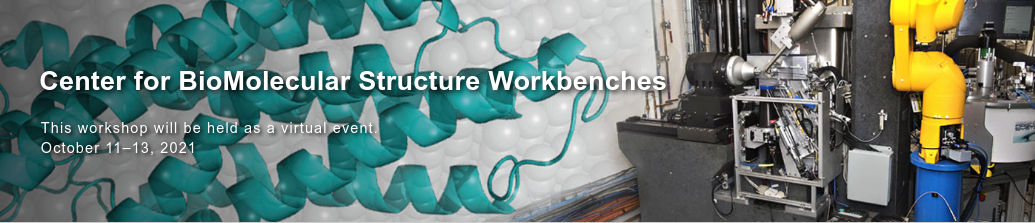
CBMS Workbench - SAXS & MX
| - |
In Virtual
The Center for Biomolecular Structure will host workbenches on solution scattering and macromolecular crystallography
Â
Registration is open for the October 11 through 13, 2021 session and is free.Â
Choose between workbenches or select both and learn of alternative structure determination methods. Participants will have the opportunity to send samples to measure during the workbench. Data analysis will be shared. If you are planning to send samples, make sure to register early to obtain the necessary credentials for remote access to the beam lines.

Invited Speakers:

- Elspeth Garman (University of Oxford)
- Al Kikhney (Xenocs Nordic ApS.)
- Kay Diederichs (Universitaet Konstanz)
- Dorothee Liebschner (Berkeley Lab)
Strategy for future EMBL research infrastructures in the Life Sciences in Hamburg
| - |
In Online
We are pleased to announce the virtual Workshop „Strategy for future EMBL research infrastructures in the Life Sciences in Hamburg" taking place on Monday, 29th and Tuesday, 30th March 2021. The aim of this workshop is to explore possible future directions for research and research services in structural biology. All interested scientists (user community, stake holders, funding organisations etc.) are most cordially invited to participate. Details about the workshop can be found at https://indico.embl-hamburg.de/event/2/ Registration is open on a first come first serve basis with a limited number of places available.
Magnetic Small Angle Neutron Scattering â€" From Nanoscale Magnetism to Longâ€Range Magnetic Structures
| - |
In Evangelische Akademie Tutzing

LiX Solution Scattering Workbench
| - |
In Online
Scope
This workbench is a three half-day, virtual training class that provides an introduction to data collection for new/prospective users at the LiX beamline. Our goal is to build and sustain a solid user community at LiX. We will provide you with an opportunity to collect preliminary data and encourage you to utilize this to enhance your proposal for future beam-time at LiX. Since there is limited data collection time, this workbench is not designed for you to finish an entire project, so please keep this in mind when choosing the samples you will bring.
Workshop Instructors
Beamline Staff (BNL)
Join the Workshop Remotely
The Zoom connection information will be provided to you prior to the start of the event. Please do not give out this connection information. It is only for registered attendees.
About 16-ID LiX Beamline
The Life Science X-ray Scattering (LiX) beamline currently supports experiments in two scientific areas: biomolecular solution scattering and microbeam diffraction from biological tissues.
For solution scattering, several modes of measurements are available. During routine operations, we can switch instantaneously between high throughput static measurements and in-line size exclusion chromatography (SEC), both of which are based on flow cells.

Small Angle X-ray Scattering for Materials Research at the new beamline P62 (-SAXSMAT-)
| - |
In Online
Therefore, the P62 team wants to discuss with the potential users about requirements concerning sample handling, sample environment, measurement strategies, data evaluation, etc. The contributions of participants are deeply appreciated by presenting their research plans at the future instrument and the technical requirements for these experiments to make them feasible. Postdocs and Ph.D. students are strongly encouraged to present their research as a poster contribution during the workshop.
At the workshop the main research areas of the SAXSMAT beamline will be covered:
- Anomalous SAXS/WAXS
- Mapping in reciprocal space: SAXS/WAXS computed tomography
- In situ and operando SAXS/WAXS
- High throughput SAXS
#TheLightStuff: Neutron Scattering: An Invaluable Addition to the Nuclear Materials Characterization Toolbox
|
In Online
Online lectures on materials science with scattering and diffraction
#TheLightStuff: Neutron Scattering: An Invaluable Addition to the Nuclear Materials Characterization ToolboxStart: 13/11/2020 03:30 PM End: 13/11/2020 04:30 PM
Location
Zoom online
see meeting join link below
Organized by: Bundesanstalt für Materialforschung und -prüfung and Diamond Light Source, UK
Please note the given time above is CET (UTC + 1).
Topic
Neutron Scattering: An Invaluable Addition to the Nuclear Materials Characterization Toolbox
Presenter: Dr Caleb Massey, ORNL, US
Summary
Small angle neutron scattering (SANS) is an effective tool for understanding processing and irradiation effects on materials, especially when combined with other complimentary analysis techniques. In this presentation, the value of this technique will be highlighted using two recent case studies pertaining to nuclear materials: irradiation enhanced Cr-rich precipitation in FeCrAl alloys and nanoprecipitate optimization in oxide dispersion strengthened Fe-based alloys.
Registration fee
These lectures are free and can be attended via Zoom by to up to 100 attendees.
The lectures will be recorded as well, and (with permission of the presenter) will be made available online afterwards for a broader educational reach.
To participate, use the meeting join link here.
For further questions, please contact [email protected].
International conference on Materials Science and Engineering
| - |
In Brisbane
It is a great pleasure and honour to invite colleagues from academia and business, as well as young researchers and students from all parts of the world to attend the Materials Science Conference. The conference, scheduled from October 11-14, 2021 is organized by Prism Scientific Services in collaboration with The University of Queensland.
Â
The conference will underpin the need and importance of collaboration and cooperation by individuals from a wide range of professional backgrounds. Materials Oceania will bring together a multidisciplinary group of scientists and engineers from all over the world to present latest findings and to exchange their ideas. This in turn paves the way for further discoveries, which most often happen where disciplines and specialists meet and congregate. In fact the development of materials was, is and will be fundamental for all technological applications, and in the entire field of applied science targeting the improvement of quality of life for humanity. At the end of the materials conference, we hope that attendees will feel they have generated the most up-to-date information available.
Â
We hope that you will join us for a symphony of outstanding science, and to also take a little extra time to enjoy the spectacular and unique beauty of Brisbane City.
#TheLightStuff: The path to LoKI & SANS at the ESS
|
In Online
Start 09/10/2020 03:30 PM End 09/10/2020 04:30 PM
Location
Zoom online - see meeting join link below
Organized by
Bundesanstalt für Materialforschung und -prüfung and Diamond Light Source, UK
Please note the given time above is CEST (CEST = UTC + 2; BST = UTC + 1)
Topic: The path to LoKI & SANS at the ESS
Presenter: Dr Judith Houston, ESS, SE
Summary
As one of two small-angle neutron scattering beamlines under construction at the ESS, LoKI has been designed specifically with the needs of the soft matter, materials, and bio-science communities in mind. For example, its high flux and wide simultaneous Q-range will make it ideal for performing spatially-resolved and time-resolved studies.
In this talk, we want to take you through LoKI’s design, our progress with construction, and finally, give some highlights of the main scientific areas which are expected to benefit from this instrument.
Registration fee
These lectures are free and can be attended via Zoom by to up to 100 attendees.
The lectures will be recorded as well, and (with permission of the presenter) will be made available online afterwards for a broader educational reach.
To participate, use the meeting join link here.
For further questions, please contact [email protected].