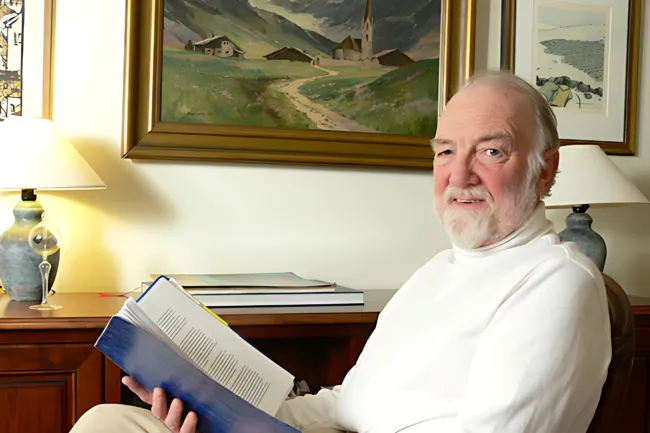
It is with great sadness that the American Crystallographic Association (ACA) shares the passing of longtime ACA member Dr. Ian David Brown, who died peacefully on June 29, 2026, at the age of 94. Known simply as David to his friends and colleagues, he leaves behind an extraordinary legacy that has shaped the field of crystallography for generations.
One of the world's most influential crystallographers, David dedicated his career to advancing our understanding of crystal structures and chemical bonding. Best known for developing the bond valence model, his work transformed the way crystallographers, chemists, mineralogists, and materials scientists interpret and validate crystal structures. Decades after its introduction, the bond valence model remains a cornerstone of crystallographic research and education, and its impact continues to shape discoveries across the physical sciences.
David was also instrumental in building the original Crystallographic Information File (CIF), which is used at the end of a crystal structure refinement to report in a simple text form all the details of the refinement. This is used extensively by the IUCr and other organizations using crystal data, to help in checking the validity of submitted crystal structures for publication, as well as acting as a useful input to crystal structure drawing and related software.
David was born in Edgware, a suburb in North London, and on the outbreak of World War 2 he was sent to Montreal through the Rotary Club for safety. His later undergraduate degree was in General Science and Honours Physics at King's College, London. For his postgraduate studies he was supervised by Jack Dunitz at the Royal Institution in London, then under the directorship of Sir W.L. Bragg. In 1959 he returned to Canada to teach in the Physics Department at McMaster University.
A longtime faculty member at McMaster University, David was a proud Canadian scientist whose career helped establish Canada as a leader in crystallographic research. As the international crystallographic community prepares to gather in Calgary this August for the XXVII Congress and General Assembly of the International Union of Crystallography, it is especially meaningful to remember and celebrate one of Canada's most distinguished crystallographers. His contributions have left a lasting mark not only on Canadian science but on the global crystallographic community that will soon come together in his home country. He carried out 45 research works with 2398 citations.
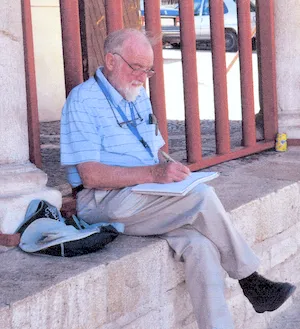
Beyond his scientific achievements, David was widely respected for his generosity, intellectual curiosity, and dedication to mentoring students and colleagues. He was a thoughtful collaborator who freely shared his knowledge and encouraged others to approach science with both rigour and curiosity. Those who knew him remember not only his groundbreaking research but also his kindness, humility, and willingness to engage in meaningful scientific discussion.
David was a valued member of the ACA for many years, and his contributions to the field continue to inspire crystallographers around the world.
Those wishing to learn more about David's remarkable career and lasting contributions are encouraged to visit the ACA History website, where his memoir and other historical articles are available. The site also features the 2024 video interview, "I. David Brown, Interview with Mojtaba Abbasi: Interview with Prof. David Brown, Inventor of the Bond Valence Theory," offering the opportunity to hear David reflect on his life, his scientific career, and the development of one of crystallography's most influential theories in his own words.
The ACA extends its heartfelt condolences to David's family, friends, former students, and colleagues. We are grateful for his many years of dedication to crystallography, and for the extraordinary legacy he leaves behind. His work, mentorship, and passion for discovery will continue to inspire generations of crystallographers to come.
David's full obituary and information about sharing condolences are also available through his family's memorial page.
The ACA also welcomes members of the crystallographic community to share their memories of David. Those who wish to contribute a longer tribute, personal reflection, or article celebrating David's life and scientific legacy are invited to contact the ACA Executive Office.
Author Information
Kristin Stevens
Related content