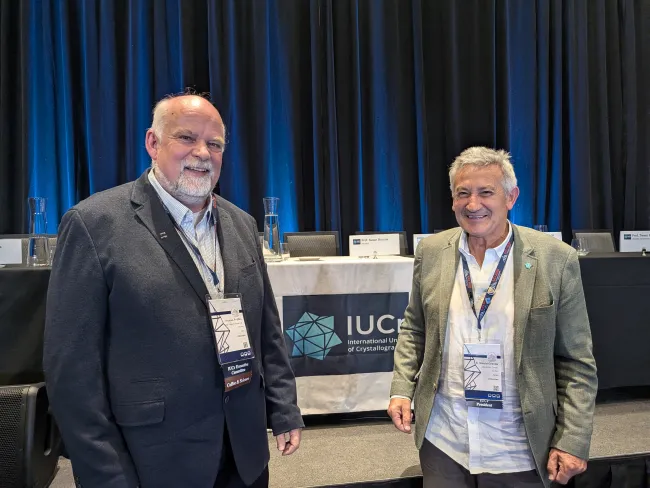
A magnificent conference to bring my presidency to a close.
From 11 to 18 August 2026, the 27th IUCr Congress and General Assembly took place in Calgary, Canada. This event marked the end of the three-year term of the Executive Committee, which was elected at the 26th Congress and General Assembly held in Melbourne, Australia. The renewal of the Executive Committee resulted in the departure of Vice President Graciela Díaz, Secretary General and Treasurer Trevor Forsyth, and Officer Angela Altomare and Immediate Past President Hanna Dabkowska.
The new Executive Committee comprises the newly President, Thomas Profen, and Vice President Manfred Weiss. Both were members of the outgoing Executive Committee. Petra Bombicz was elected Secretary General and Treasurer, and three new officers joined the committee: Louise Dawe, Annalisa Guerri, and Charles Bond.
The new Executive Committee will serve the IUCr — and all of us — until the conclusion of the 28th Congress and General Assembly, which will take place in Berlin, Germany, in 2029.
The Calgary conference was extraordinary in every respect. Not only was the scientific programme excellent, but the organizers also provided us with the best possible setting in the unbeatable convention center, as well as an extremely appealing social programme. With approximately 1,800 participants, it was particularly encouraging to see young researchers taking the lead with inclusive initiatives and gaining prominence within our Union. There were excellent presentations throughout the conference, from the opening session — where Gautam Desiraju received the Ewald Prize — to the Bragg, Struchkov, Gjonnes Medal or Sheldrick Prize winners, alongside younger recipients who demonstrated the bright future of structural science.
During this congress, we have seen structural science operating at its full potential. The scientific programme has demonstrated that structural science continues to evolve rapidly, by integrating ultrafast methods, hybrid experimental pipelines and quantum-level modelling, all while maintaining the rigour that defines our discipline.
I would like to thank all the plenary speakers, session chairs and all presenters. Their contributions have advanced our knowledge and clarified the direction of our field, moving us towards higher resolution, higher throughput, and deeper integration of techniques. I would like to highlight the convergence of methods, the importance of open data and the FAIR principles and reproducible workflows; structural science in addressing global challenges; progress made in building community and future directions. We are committed to training, accessibility and international participation. Thank you for your contributions, engagement and commitment to advancing structural science. The contribution of companies and other sponsors proved vital to the conference’s success and allowed us to witness the strong commitment of corporations to our scientific community.
The General Assembly, which was perfectly organized and supervised by our team in Chester, formally established the important new Industrial Structural Science Committee, which will help strengthen the connection between industry and academia in structural science. In addition to this, the assembly elected all union officers and reported on the union’s financial status. Another important milestone was the formal incorporation of the Early Career Scientific Division into the structures of the IUCr. The consolidation of the Commission on Crystallography of Materials was another notable development.
The announcement of a new Editor-in-Chief, Jon Agirre, who succeeds Andrew Allen after nine years of outstanding service, allows us to look optimistically toward the future of our journals, which must undergo significant transformations to become more attractive to authors and generate the necessary funds so that the Union can, with sufficient resources, pursue its goals of promoting and supporting structural science globally. In particular, we must paid close attention to younger communities and emerging regions.
This is my final contribution as president - now Immediate past president - and I am pleased to make it in collaboration with the new president. I believe that the greatest success of our Union is the cohesion of our community—passing the torch with the conviction that those who follow us will complete our projects and undertake even more ambitious and timely ones, always striving with renewed vigour to emulate those who came before us.
As I have said before, I have been extremely fortunate to be accompanied by excellent colleagues in Chester and on the Executive Committee, as well as by a unique community that build the best science every day in their laboratories, teaches and trains the young generations, and shares this work with society.
In conclusion, I encourage you to continue enjoying your membership of the IUCr with pride. Structural science is a science of relationships — between atoms, between methods and between people. Thank you all!
Santiago García Granda (Immediate Past President)
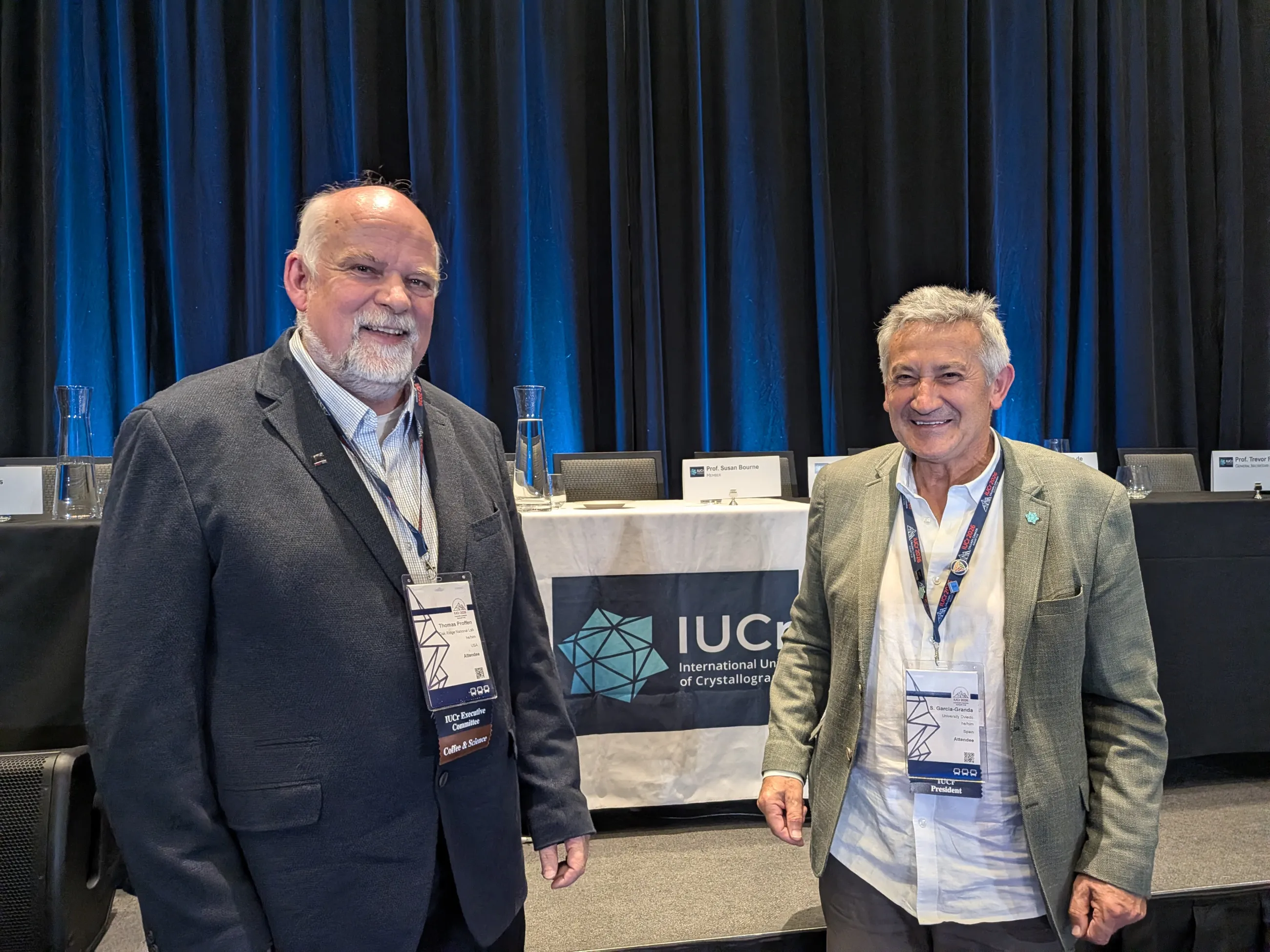
Thomas Proffen (IUCr President) and Santiago García Granda (Immediate Past President)
Looking Ahead
It is a great honour to begin my term as President of the IUCr following the wonderful IUCr Congress in Calgary. My entire scientific life has been shaped by this remarkable international community, and I see the next three years as an opportunity to build on the Union’s extraordinary strengths while also looking outward. Crystallography is fundamental to modern science, technology, medicine and materials research, yet its importance is not always visible beyond our own community. We need to make our science more accessible, communicate its relevance more broadly, and ensure that the IUCr remains a welcoming home for scientists at every career stage and from every part of the world. This includes a renewed commitment to young and early-career scientists, diversity and inclusion, and to the education that brings the next generation into our field. An article in this newsletter, Mapping the teaching of crystallography in French universities, highlights a decline in formal crystallographic education in France—but this is not simply a French problem. Across many countries, crystallography is increasingly being learned indirectly, embedded within other disciplines rather than taught as a coherent subject. We should view this as a call to action: to find new and creative ways to teach the principles of crystallography and to demonstrate why they remain essential in a rapidly changing scientific landscape.
At the same time, we should be proud of what makes our community distinctive. Crystallography has been a leader in open, structured and reproducible scientific information for decades. With CIF, machine-readable dictionaries and rigorous validation, we were making data FAIR long before that terminology became common. As science increasingly embraces large-scale data analysis and artificial intelligence, we have an opportunity to lead rather than follow, bringing modern computational approaches together with the rigor and standards that have earned crystallography its reputation.
This issue also marks the launch of a new IUCr website, designed around usability, transparency and legacy. It preserves the extraordinary depth of information accumulated by the Union over many decades while making it easier to navigate and discover everything the IUCr has to offer. Even something as practical as keeping Commission pages current will become considerably easier. For me, this is symbolic of the broader task ahead: preserving what is valuable while making the IUCr more accessible, more visible and better equipped for the future. I believe strongly in listening, building consensus and, above all, service. I look forward to working with the IUCr community over the coming three years to strengthen our Union, champion our science and ensure that crystallography continues to thrive in an increasingly interconnected world.
Thomas Proffen (President)
Author Information
Professor Santiago García Granda
Thomas Proffen