In recent years, the presence of crystallography in higher education curricula in France has been diminishing. This study presents an in-depth analysis based on a targeted survey across five major French universities traditionally involved in crystallographic teaching and research. By examining course structures, teaching volumes, and staff profiles from 2000 to 2022, we identify a global decline in both the quantity and visibility of crystallography instruction. This decline appears to be particularly marked in biology and physics, but relatively limited in chemistry, and is leading to a shift in teaching towards the final years of university. The crystallography-teaching program is now fragmented, often diluted within broader subjects, and increasingly marginalized notably at the undergraduate level. While research in the field remains vigorous, crystallography suffers from systemic and structural challenges within academic institutions.
A Perception Put to the Test
There is a growing perception within the scientific community that crystallography is steadily disappearing from university teaching programs. This perception seems all the stronger given that teachers of crystallography are generally passionate about their subject, and indeed, much thought has been given to how best to teach it (Helliwell, 2021; Kantardjieff, 2010; Zheng, 2018), including in high schools (Irmer, 2025) or for a wider audience (Murray, 2024), the latter often playing on crystal growth (Wouters, 2022). However, anecdotal evidence, drawn from conversations in academic settings, suggests a decline in course offerings, reduced training for students, and fewer faculty positions focused on the field. These observations raise concerns about the long-term sustainability of crystallographic expertise in academia as well as in industry. The discomfort associated with this perception of decline is growing to the point where it has become a particularly important concern within the French university system and is discussed behind the scenes at most meetings and conferences. However, to paraphrase the French philosopher Gaston Bachelard we can say that “In science, we don't believe, we verify”. Perceptions must indeed be validated by data. To that end, the present study aims to examine the current state of crystallography education in French universities and to trace its evolution over the past two decades.
Aware of the need to quantify developments in this field of teaching, an initial survey was conducted by the French Ministry of Higher Education and Research in 2021. This survey was based on a campaign of requests sent by email to academics identified as being involved in teaching crystallography. However, the very low response rate and the bias linked to differences in response rate between disciplines, academic position and level of respondents showed that this method was probably not the best. Furthermore, the complexity of the educational architectures of the university degree programs specific to each University —of which there are 71 in France—made it inappropriate to send out a single national questionnaire. As a result, this previous study was nor validated nor fully completed. Recognizing the limitations of a prior national survey which, to be exhaustive and representative, would have to mobilize considerable forces, we decided to launch a more focused investigation, the results of which we discuss here.
Survey and Scope
Our investigation targeted five large universities with strong historical ties to crystallography: Sorbonne University (SU), Aix-Marseille University (AMU), the University of Bordeaux (UB), the University of Lorraine - Nancy campus (UL), and the University of Strasbourg (US). The approach combined the analysis of official course descriptions and program structures with internal expertise and direct consultation with faculty members in order to clarify what is actually being taught, as a single word on a program can conceal many different levels of learning. The aim was to gather both quantitative data (e.g., teaching hours, number of students, course status) and qualitative insights (e.g., content, perceived importance, interdisciplinary links). In practical terms, the five authors of this article, all of whom are involved locally in crystallography research and teaching, not only examined the programs of the various courses in their university campus but, more importantly, interviewed when relevant the teachers concerned directly. This is therefore a field investigation. The latter, which began in 2022, provides a view at a given moment, knowing that the French higher education system reviews the content of these training courses approximately every five years.
One of the first obstacles encountered in the local investigation concerns crystallography itself: its disciplinary boundaries. Crystallography probably occupies a unique position in the scientific landscape. It is inherently transdisciplinary, grounded in the study of the crystalline state and deeply interconnected with fields such as chemistry, physics, biology, mineralogy, pharmacy, materials science, and even mathematics and computing. Its core includes the theory of symmetry, diffraction of radiation (X-rays, neutrons, electrons), structure determination, and crystal growth. At the same time, contemporary research in crystallography addresses frontier topics such as superspace modeling, in situ measurements under extreme conditions, the study of electron density and interatomic interactions, and the integration of large-scale data processing using artificial intelligence. Crystallography is both a fundamental science and a practical mean of investigation, applied in diverse areas ranging from pharmaceuticals and structural biology to cultural heritage and geosciences and of course materials science. This breadth is a strength, but it also creates challenges in defining and defending its institutional identity. This transdisciplinary feature leads some colleagues to omit the word crystallography from courses that are unquestionably related to it, and these same colleagues to feel that this discipline does not concern them. The causes and overall consequences of this attitude are not the subject of this article and will not be discussed here, but they constitute a significant obstacle for a realistic overview of the teaching of crystallography without a local inquiry. To overcome this obstacle, the decision to conduct field research by experienced and committed crystallographers proved indeed to be the right one. Of course, the findings set out below are based on the assumption that the situation observed in these five major universities reflects national trends; the authors of this article are firmly convinced of the relevance of this hypothesis. It should also be noted that these universities were also chosen with the aim of representing the national territory, given their geographical locations and histories.
Note that, in the following, “License” refers to the License level (lasting three years in France), “Master” includes the years in between the License and the doctorate levels (two years in France), “University” includes here any higher education institution present on the site.
A Snapshot of Crystallography Teaching in France
The current state of crystallography teaching in France reveals a highly fragmented and heterogeneous picture (Fig. 1). The total number of hours devoted to teaching crystallography may seem high: 279 hours for UB, 330 hours for AMU, 403 hours for UL, 217 hours for SU, and 285 hours for US. However, this should be considered in relation to the very large number of courses spreading across a wide variety of university programs, feature that is common to the five universities (Fig1a). Across these institutions, crystallography is present into a wide variety of academic tracks, including License’s and Master’s programs, engineering schools, technical diplomas, and preparatory classes. Without surprise indeed, it appears in disciplines as varied as chemistry, physics, life and earth sciences, pharmacy, archeometry and materials science. On the contrary, the distribution between the number of compulsory hours and the number of optional hours varies greatly from one university to another, optional courses ranging from 4% to 54 % (Fig1b). The same applies to the distribution between License's and Master's degrees, Master courses ranging from 25 to 55 % of the total License-Master courses.
However, this overall view, while reflecting a diversity of situations, has little meaning at the individual student level. When we look at students' curricula in detail (Table ESI), we see that the number of hours of crystallography actually taken (when available) by a student also varies greatly, from 1,5 hours to more than 100 hours during their studies. The data collected highlight significant disparities in teaching volumes, both across institutions and between disciplines. In a few cases that might be seen as exceptions indeed, significant teaching in crystallography is available. At UB, some chemistry students complete 90 hours of crystallography as part of the full License-Master-Doctorate curriculum. At UL, physics students can take more than 70 hours in the Master's program, while engineering school students complete approximately 100 hours. At AMU, Polytechnic students receive over 70 hours of instruction. At SU, physics students can take around 60 hours in the Master's program dedicated to materials science and nano-objects. Finally, at US, both physics and chemistry students complete approximately 55 hours of crystallography in the Master's program. However, these high volumes of teaching hours are mostly only available in the form of optional courses, and in most cases, compulsory courses have low volumes, down to a token presence of less than 5 hours – some crystallography courses being lasting less than 2h in total. In all cases, the most substantial instruction in crystallography now occurs at the Master's level. At the undergraduate level, its presence is minimal or absent, particularly in biology and earth sciences.
Apart from the number of hours, content is clearly a crucial factor in evaluating teaching. Crystallography is now rarely taught under its own name. Instead, crystallographic content is often embedded within broader course titles such as solid-state physics, materials chemistry, analytical methods, or structural biology. This semantic dilution contributes to the erosion of the field’s visibility and coherence within curricula. The type and depth of content taught depends heavily on disciplinary context. In programs rooted in physics and chemistry, courses tend to focus on diffraction theory and symmetry groups. In biology and pharmacy, the emphasis may be on structural characterization and the relationship between molecular structure and function. Crystal growth, surface phenomena, and microstructural analysis are more often covered in engineering or materials science tracks. However, regardless of the context, instruction in crystallography is typically distributed across several disconnected units, rather than forming a coherent, standalone module. This fragmentation often prevents students from gaining a unified and in-depth understanding of the field.
We were also able to retrieve accurate data on crystallography teaching carried out in 2000 at two sites (UB, SU) in order to compare it with the current situation. Faculty recollections and institutional records suggest a marked decline in crystallography teaching over the past two decades. The situation appears highly contrasted across disciplines. At the UB site (Fig.2), for instance, in chemistry, the number of compulsory crystallography teaching hours at the Master’s level has decreased by about 30%. However, when non-compulsory courses are considered, the overall volume has increased by roughly 30%. This suggests that while the core curriculum accessible to all Master-chemistry students is in marked decline, a smaller group of students now receives more advanced instruction in crystallography. A similar trend is observed in the physical-chemistry track, where the common core has been reduced by approximately 40%, yet optional teaching has led to an overall increase of about 20%. In strong contrast, physics students at the same institution have experienced a 60% decrease in crystallography teaching hours over the past two decades. The decline is even more pronounced in biology, where the teaching volume has nearly vanished (-95%).
At the SU site (Fig 3.), we had access to data from 2000 and 2010 in addition to the present study. This refers to the Master's program in Physics, which has historically been strongly oriented towards crystallography due to the presence of internationally recognized research laboratories on the SU campus. Nevertheless, in terms of teaching volume, instruction decreased by 80% in the first year of the Master's program and by 50% in the second year from 2000 to 2022, with the 2010 data being exactly intermediate, indicating a continuous decline. Furthermore, the content of teaching hours had to incorporate numerous remedial courses, as foundational knowledge was no longer covered earlier in the curriculum. This had a negative impact on the course content itself, due to lack of time. The decrease in volume is therefore accentuated by a decrease in the depth of the content. It also seems clear, in this regard, that remaining courses are only possible thanks to a very small number of highly motivated professors of crystallography.
To summarize, the findings indicate that teaching hours have markedly declined—most notably in physics and biology—with limited persistence in chemistry where content has shifted away from fundamental concepts. Instruction is now fragmented across broader courses, hindering coherent and comprehensive education in crystallography. The shift towards modular, interdisciplinary curricula has exacerbated this trend, with crystallography often sidelined in favor of more fashionable or generic subjects. Teaching crystallography is increasingly confined to the Master’s and doctoral levels.
In parallel, a rapid survey of the teaching pool shows that the number of teaching staff in crystallography at these universities varies from around 10 (SU) to around 30 (US), with all colleagues involved in crystallography research activities, either directly or indirectly. However, the lack of young instructors (< 45 years old) and absence of recruitment raise significant concerns for the continuity and renewal of crystallography education at short term.
Why is Crystallography Losing Ground?
The relative decline in crystallography teaching arises from a combination of systemic and field-specific factors. At the systemic level, higher education in France has undergone a general reduction in hours allocated to traditional scientific disciplines. This trend is driven by the expansion of cross-cutting competencies (e.g., languages, digital tools, project work, professional development) and the frequent overhaul of curricula every few years. These structural changes tend to disadvantage transdisciplinary fields like crystallography, which struggle to maintain a foothold within rigid institutional frameworks. Indeed, since crystallography spans various academic disciplines (physics, chemistry, geology, etc.), teachers are spread across different committees and think tanks and, as a result, rarely have the critical mass needed to exert significant influence in debates, which is fatal in times of reduced teaching volumes.
At the disciplinary level, many crystallographers have retired or are nearing the last part of their careers, with administrative responsibilities taking up most of their time, leading to a decline in the number of lecturers. The teaching that remains is therefore sometimes provided by non-specialists—users of crystallographic techniques rather than experts in the underlying science. Introducing crystallography is made easier by major advantages such as the attractive visual aspect of crystal structures and the practical and easy nature of crystal growth, which can be exploited from elementary school to university, with numerous methods and workshops described in the literature and put into practice (Grazulis et al., 2015; Caro et al., 2023). However, accessing crystallography beyond an introductory level requires in-depth knowledge of concepts such as symmetries and their mathematical manipulations, the necessary background to explore radiation diffraction, and a mastery of atomic architectures and therefore interatomic interactions. This aspect requires teachers who are experts in the field and a significant amount of teaching time, which is no longer the case in many university programs.
Furthermore, as a general matter, crystallography suffers from a widespread confusion between science and technique, which sometimes prompts even the most experienced crystallographers to take a step back and reaffirm that crystallography is, above all, a science (Watkins, 2010). The dominance of X-ray diffraction as a tool has led many to equate crystallography with a routine analytical method, rather than a scientific discipline in its own right. For instance, in some cases, the increasing automation of structure determination via brilliant software has further eroded the perceived need for in-depth instruction. The fight against this belief is a daily struggle for crystallographers working in academia, and is certainly not new, but closely linked to the defense of teaching hours. One of the consequences is the strong tendency over the past two decades to recruit technicians or engineers as crystallographers in research laboratories who, a priori, are not involved in academic teaching or discussions about program content in the French system. In fact, we can anticipate that, like an avalanche effect, this same loss of teaching and skills will also prevent the recruitment of competent technicians and engineers in laboratories.
So what
The following sentence by the writer Sylvain Tesson probably applies to the perception of the teaching of crystallography: France is a paradise whose inhabitants believe they are in hell (Tesson, 2015). Indeed, though clearly in decline, the teaching of crystallography is still robust in some cases. However, as is probably the case in many countries, education in crystallography needs to be revitalized, clarified and expert staff recruited and this immediately, before it is too late. Research should be used as a basis for this, since crystallographic research in France remains very dynamic and internationally recognized, as well as action towards a large audience from elementary schools to a general public (Bordet et al., 2022). National scientific societies and professional networks provide support for the community, and major research facilities offer infrastructure and visibility. Numerous international and national conferences, doctoral schools, and short courses are regularly organized (see AFC website). In recent years, several initiatives have aimed to address the teaching gap, including MOOCs and advanced training programs for doctorate students. There is also renewed public interest in crystallography, fostered by outreach activities and the recent inclusion of basic concepts of crystallography in some high school curricula.
Obviously, this study focuses on the situation in France—and even then, only on 5 out of 71 universities. However, it is highly likely that many countries follow the same pattern, with variations due to their educational systems. Crystallography is the science of structure—central to understanding matter at the atomic scale and to applications in chemistry, physics, biology, and materials science. While research in the field remains strong, the educational foundation is eroding. The decline in dedicated teaching, though contrasted across disciplines and diverse from one site to another, poses a threat to the continuity of expertise and the future of the discipline. The crystallographic community must now seize the opportunity to redefine its educational strategy and ensure that crystallography continues to be taught with the depth and rigor it deserves.
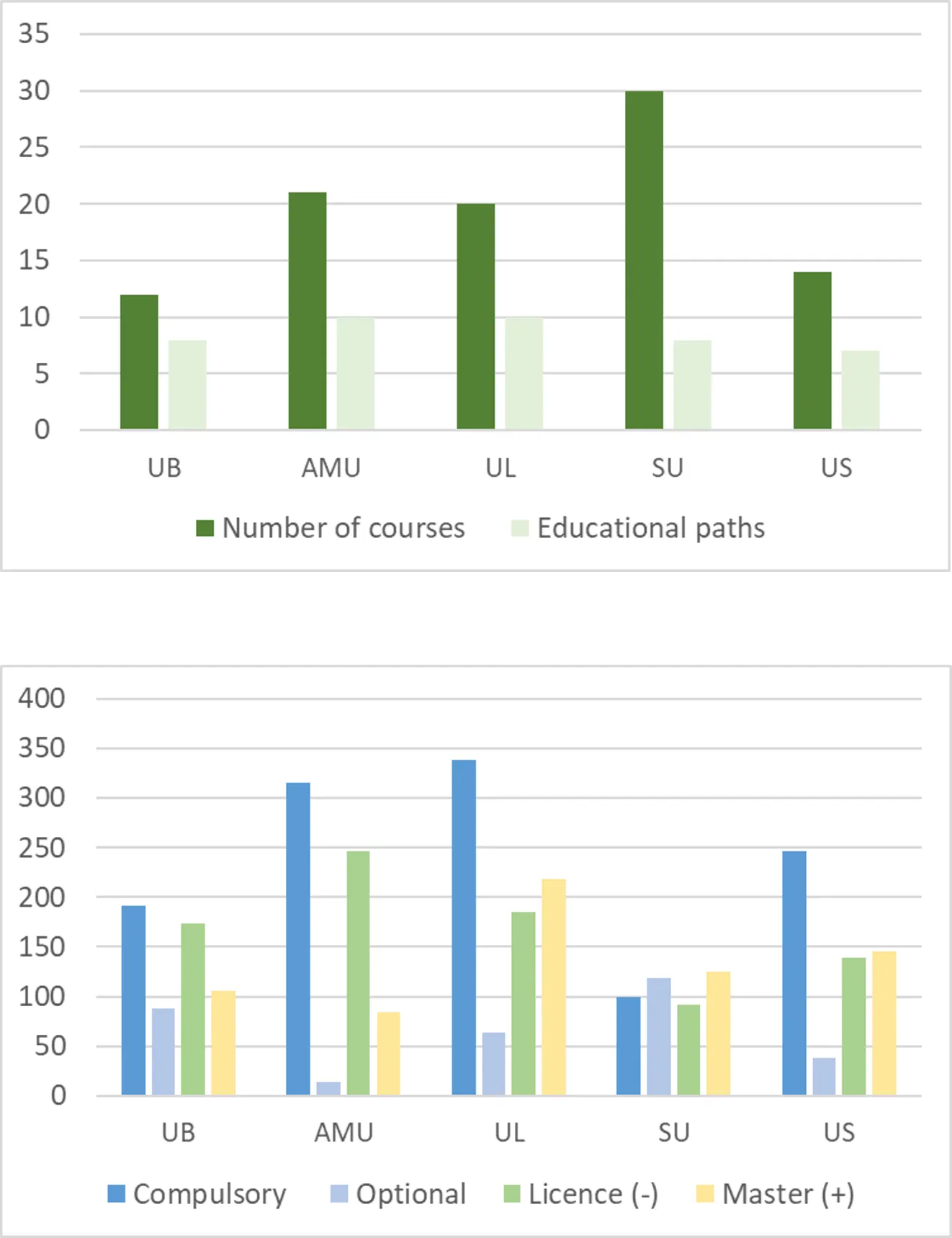
Figure 1 Global view of crystallography teaching in the five universities in 2022 (see text). (top) Histogram showing the total number of courses involved and the corresponding number of possible educational paths associated and (bottom) histogram showing the repartition of the total number of hours as a function of their status (compulsory or optional) and the educational level (License or lower, Master or higher).
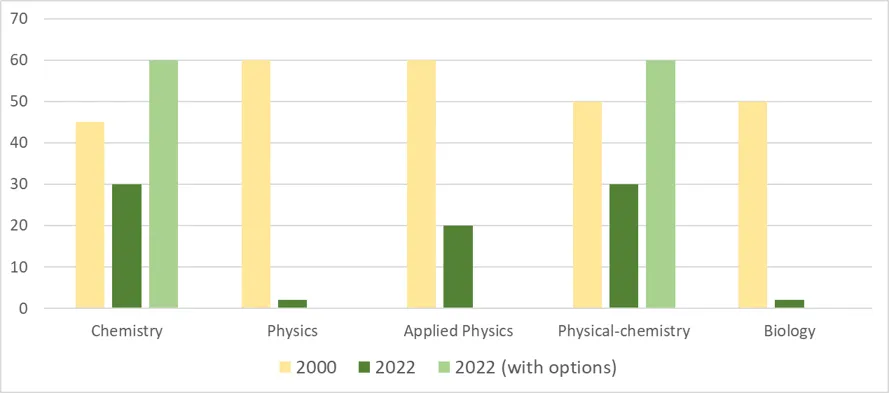
Figure 2 Number of hours of crystallography teaching in Master's programs by discipline at the UB site in 2000 and 2022.
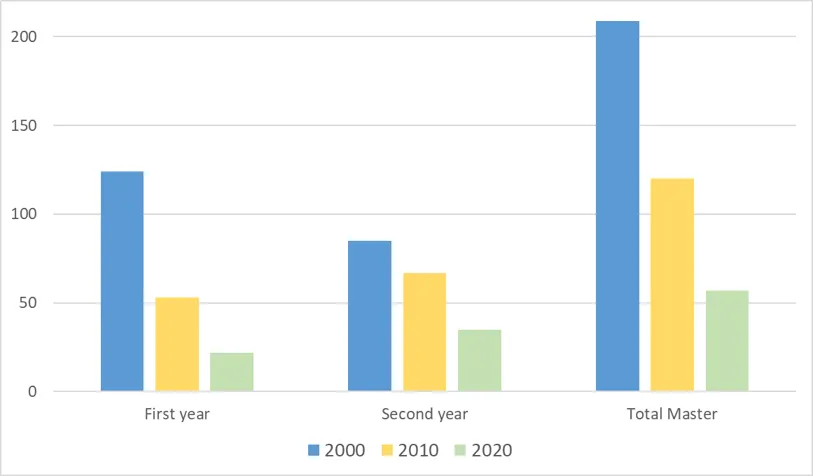
Figure 3 Number of hours of crystallography teaching in the Master of physics at the SU site in 2000, 2010 and 2022.
Author Information
Delphine Cabaret, Michel Giorgi, Sébastien Pillet, Claude Sauter, Philippe Guionneau
References
AFC – French Crystallography Web Site, https://www.afc.asso.fr/
Bordet, P., van der Lee, A., Timmins, J., Balan, E., Cabaret, D., Guinebretière, R., Velázquez, M. & Guionneau, P. (2022). IUCr Newsletter, 30(1), 27 pp.
Caro, V., Carter, B. A., Millunchick, J. & Reeves, S. (2023). Chem. Educ. Res. Pract. 24, 394–406.
Grazulis, S., Sarjeant, A. A., Moeck, P., Stone-Sundberg, J., Snyder, T. J., Kaminsky, W., Oliver, A. G., Stern, C. L., Dawe, L. N., Rychkov, D. A., Losev, E. A., Boldyreva, E. V., Tanski, J. M., Bernstein, J., Rabeh, W. M. & Kantardjieff, K. A. (2015). J. Appl. Cryst. 48, 1964–1975.
Helliwell, J. R. (2021). Crystallography Reviews, 27(3–4), 135–145.
Irmer, E. (2025). J. Appl. Cryst. 58, 1802–1809.
Kantardjieff, K. A., Kaysser-Pyzalla, A. R. & Spadon, P. (2010). J. Appl. Cryst. 43, 1137–1138.
Murray, C., Maynard-Casely, H. E., Harrington, R., McCready, S., Sneddon, D. J., Thomas, L. & Warren, A. J. (2024). J. Appl. Cryst. 57, 181–186.
Tesson, S. (2015). Bérézina. Paris: Éditions Guérin.
Watkin, D. J. (2010). Crystallography Reviews, 16(3), 197–230.
Wouters, J. & Van Meervelt, L. (2022). Acta Crystallogr. E Crystallogr. Commun. 78(Pt 9), 874–879.
Zheng, S.-L., Chen, Y.-S., Wang, X., Hoffmann, C. & Volkov, A. (2018). J. Appl. Cryst. 51, 909–914.