Topics
Synchrotron radiation
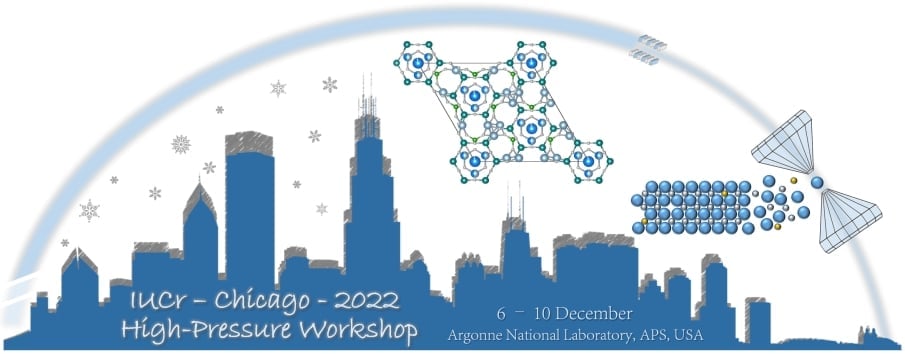
2022 IUCr High Pressure Workshop â€Å"Advanced High Pressure Crystallographyâ€Â
| - |
In Chicago
For the past three decades high pressure research has made breakthrough progress in many fields of science mainly due to the significant improvements in the high-pressure apparatus and developments of advanced static and dynamic probes. Most of the experiments at extreme conditions are very challenging and require dedicated techniques to collect crystallographic data with unprecedented speed and resolution to quantitatively characterize pressure/temperature induced transformations in the crystalline lattice. The tunability, brilliance, and collimation of synchrotron X-ray sources provides scientists with unique capabilities for probing the structural, chemical, and physical properties of various types of materials in-situ at extreme pressure, temperature, and strain with ultra-high spatial, temporal and energy resolution. However, in many cases the complex energy landscapes of multicomponent chemical systems require the use of the predictive power of computational methods that play an essential role in extreme-conditions crystallography coupled with physical experiments.
The purpose of the 2022 workshop of the International Union of Crystallography (IUCr) Commission on High Pressure is to bring together researchers who apply extreme-conditions crystallography in combination with other experimental and computational methods to study a wide range of material properties covering various fields of science, including condensed-matter physics, solid-state chemistry, geophysics, materials science, biology, nanotechnology etc. The workshop aims to facilitate extensive discussion and interdisciplinary collaboration.
Students, postdocs and early carrier scientists in particular will find this workshop helpful in gaining improved familiarity with available state-of-the-art methods and how they can be applied to their research.
We plan to organize a tour to the relevant APS beamlines for workshop attendees (pandemic permits) and a half-day tutorial with hands on examples.
IEEE Around-the-Clock Around-the-Globe (AtC-AtG) Magnetics Conference 2022
|
In Worlwide
Dear Colleagues,
It is our great pleasure to announce the 'IEEE Around-the-Clock Around-the-Globe (AtC-AtG) Magnetics Conference 2022', a virtual event hosted by the IEEE Magnetics Society covering the vast field of magnetism. Following the great success of the previous editions, this unique 24-hour non-stop virtual conference will take place on August 31st, 2022, with contributions from speakers spanning six continents.
The AtC-AtG Magnetics Conference offers a diverse and inclusive virtual environment that foments collaboration between junior and senior researchers across the many subfields of magnetism. The invited speaker lineup includes both junior and senior scientists with outstanding research contributions. More information can be found on the dedicated conference website.
Join us by registering through our website before 24th August!Â
Highlights:
 - Invited talks from leading experts in magnetism
 - Covers all continents and time zones
 - Interactive online broadcasting with questions and discussions
 - Student presentation and poster awards
 - NO REGISTRATION FEE
Call for Abstracts:
Abstract submission for the contributed talks at AtC-AtG Conference is now open! Young researchers are encouraged to submit abstracts (oral and poster) and join us on this fantastic platform to meet researchers worldwide!
The abstract template and submission form are available on our website. Submissions close on June 12th!
Looking forward to seeing you all connected!
Best Regards,
On behalf of the AtC-AtG Organization Committee (2022)
6th CrysAC workshop: "Micro- and nano-diffraction for cultural heritage"
|
In Paris
The 6th CrysAC workshop on "Micro- and nano-diffraction for cultural heritage" is coming soon!
Date: August 23, 2022, 9.00-16.00 Place: C2RMF, Porte des Lions, Palais du Louvre, Paris, France Organisers: Gilberto Artioli ([email protected]) and Partha Pratim Das ([email protected]) Registration: no official registration is needed, but please send a message to the organizers ([email protected] and [email protected]) indicating the intention to attend, so you will be in the list of people allowed in the C2RMF building Programme: download hereThe upcoming CrysAC workshop is planned as a satellite meeting of the 33rd European Crystallographic Meeting, France (https://www.ecm33.fr/satellite-meetings). In keeping with the terms of reference of the Commission, the CrysAC workshop on "Micro- and nano-diffraction for cultural heritage" is within the series of one-day workshops organized by the IUCr Commission on Crystallography in Art and Cultural Heritage, aimed to stimulate knowledge exchange between crystallographers and researchers interested in Cultural Heritage investigations. Different communities are invited to present reviews of established research, recent results and envisaged trends in key areas of Archaeometry and Conservation Science.
The present workshop will invite scientists from research institutions, museums, and conservation bodies, in order to illustrate state-of-the-art applications of diffraction techniques in the sub-micron spatial resolution. Recent instrumental and methodological advances, mainly based on electron diffraction and synchrotron radiation, are opening novel fields of research on cultural heritage materials, to understand chemico-physical processes and structural transformations with unprecedented spatial resolutions.
Although only invited contributions are planned, all interested people are invited to exchange ideas and discuss the presented topics.


2022 Workshop on Experimental Environments for Coherent Diffractive Imaging (CDI)
| - |
In Virtual
15th International School and Symposium on Synchrotron Radiation in Natural Science (ISSRNS 2022)
| - |
In PrzegorzaÃ...‚y (near Krakow)
The Polish Synchrotron Radiation Society (PSRS) has been organizing this International School and Symposium on Synchrotron Radiation (ISSRNS) since 1991. The aim of this interdisciplinary meeting is to bring together scientists and students working with synchrotron radiation. The meeting will focus on novel applications of synchrotron radiation in physics, chemistry, materials and life sciences.
The programme of the Symposium will comprise invited lectures (40 min), oral presentations (20 min), short contributions (10 min) and poster presentations. The short contributions are for students to present their research results. The official language of the meeting is English.
14th International Conference on Biology and Synchrotron Radiation (BSR14)
| - |
In Lund
MAX IV, the pioneer in multi-bend achromat synchrotron technology, would like to invite the synchrotron and free electron laser (FEL) life science community to Lund to discuss the latest and hottest developments in the field at the 14th BSR.
By 2022, several other synchrotron facilities will also have upgraded their sources or have defined upgrade plans and the organizers feel it would be opportune to discuss and highlight the latest developments and the possibilities for biological experiments at the next generation of synchrotrons and FELS.
Main themes
- Membranes: lipids and proteins
- Synchrotrons and FELS for pandemic research
- Hybrid or correlative approaches to complex biology
- Scientific computing for life sciences
- Coherence approaches
- Environmental and bioeconomy/industrial and pharma
- Tissues and cells
- Dynamics and ultrafast science

Gordon Research Conference - Crystal Engineering
|
In Sunday River, Maine (USA)
The 2022 Gordon Research Conference on Crystal Engineering (GRC-CE) is a biannual meeting. The 2022 GRC-CE will bring together organic, inorganic, physical, computational chemists, as well as pharmaceutical scientists, materials scientists, data scientists, and others in a uniquely and highly interactive environment to discuss latest results at the cutting edge of the field. The program for the 2022 GRC-CE GRC includes sessions on Order, Disorder and Defects, Crystal Assembly, Polymorphs and Mixtures, Crystals Under Pressure, Crystal Reactivity, Pharmaceuticals and Cocrystals, Big Data and Informatics, Porosity and Open Framework Materials, and Engineering Across Different Length Scales.Â
An associated Graduate Research Seminar (GRS) prior to the GRC-CE conference ensures that young scientist are well represented as attendees at the GRC-CE. The highly interactive format of both the GRC and GRS ensures it will be a valuable experience for the next generation of researchers in the field. Â
FEBS2022 Advanced course: Lost in Integration - Probing Biomolecules with Electrons, Photons, Neutrons and Magnetic Spins
| - |
In Spetses Island
International School of Crystallography. 46th Course, Crystallography under extreme conditions: the future is bright and very compressed
| - |
In Erice
Subjecting matter to extreme conditions reveals a multitude of fascinating phenomena, and is applicable to a wide range of disciplines. From the extremophiles that exist in the deepest depths of our oceans to the exotic new materials that are made when atoms are pushed ever closer together, understanding the structure of materials at extreme conditions affects Biology, Chemistry, Physics, Geoscience and Material Science. In order to achieve its goals, high pressure research has been always at the vanguard of technical progress. It is a discipline in which equipment plays a particularly important role. State-of-the-art diamond anvil cells can now achieve megabar ranges of pressure, millions of times atmospheric pressure, with this beaten by an order of magnitude in dynamic compression experiments. In this manner, scientists are able to mimic the conditions in the interiors of giant planets. Nature is even more ambitious, as in the stars petapascal pressures (the order of tens to hundreds billion atmospheres) are reached. In the laboratory, we can even create conditions of pressure, temperature and magnetic fields that are not found naturally, allowing us to complement nature to explore more exotic phases of matter.
Therefore, the course will cover broad ground in the application of extreme conditions crystallography. The topics will span from fundamentals of high-pressure single crystal and powder diffraction, to presenting the many flavors of static and dynamic compression, to reviews of sources for extreme conditions work (synchrotrons, neutrons and free electron lasers). Complementary experimental (Mössbauer spectroscopy, X-ray magnetic circular dichroism, X-ray absorption spectroscopy, inelastic scattering) and computational methods will also be discussed. Diffraction analysis on the structure of liquids, glasses and nanocrystalline materials as well as multigrain crystallography will also be introduced. The lectures will be harmonized with the related sessions of interactive tutorials, providing hands-on experience to the attendees. These workshops will be focused on basic laboratory skills and the elements of data processing software related to the high pressure.
1st on-line edition of the International School on Synchrotron Radiation, Fundamentals, Methods and Applications
| - |
In Online (from Muggia, Trieste)
Topics
The main topics will be:
- Production and properties of Synchrotron Radiation;
- Basics of the interaction between matter and radiation;
- X-ray Absorption Spectroscopy (EXAFS and XANES);
- X-ray Diffraction (single crystal and powder diffraction, anomalous scattering);
- Small angle X-ray scattering;
- Photoemission (from valence and from core levels; angular, time and spin resolved);
- IR spectroscopy and microscopy;
- Imaging;
- Data analysis on X-ray Absorption, Powder Diffraction and Core Level Photoemission Spectroscopy experiments
- Applications in many fields (materials, nanoscience, catalysis, earth science, environmental science, cultural heritage, biology and medicine).

Diamond-CCP4 Data Collection and Structure Solution Workshop 2021
| - |
In Online
This year's online workshop will be two weeks long, bringing together leading experts in the field of MX to teach best practice in data collection and analysis. Open to PhD students, postdocs and young researchers bringing their own crystals or data.
CHESS Ambient Crystallography Workshop
| - |
In Online
The Cornell High Energy Synchrotron Source will host an online workshop identifying forefront research questions probing applications and consequences of macromolecular crystallography under ambient (room temperature to physiological) conditions. A secondary lens will be experimental methods that support this research, including both synchrotron-based and complementary tools.
Â
Registration is free.
Â
School on Synchrotron Light Sources and their Applications | (smr 3611)
| - |
In Online
An ICTP Virtual Meeting
There is no registration fee
Organizers: Simon Connell (University of Johannesburg AfLS), Andrea Lausi (SESAME), Kirsi Lorentz (Cyprus Institute), Alessandro Migliori (IAEA), Ed Mitchell (ESRF AfLS), Sekazi Mtingwa (LAAAMP AfLS), Ian Swainson (IAEA NEFW), Local Organiser: Nadia Binggeli
African Light Source conference
|
In Online via Zoom
The African Light Source (AfLS) Foundation, in partnership with X-Tech Lab, the African Physical Society (AfPS) and the Pan-African Conference on Crystallography (ePCCr) cordially invite you to partake in the forthcoming African Light Source conference (15 â€" 19 November 2021)
Â
The cross-disciplinary conference seeks to showcase the recent advancements in science and engineering on the African continent, with a specific focus on the role that advanced light sources have played, and may play, in promoting continued high-level scientific advancement.
Â
The conference programme consists of joint plenaries, workshops, town hall gatherings, and streams of parallel sessions on a comprehensive array of scientific sub-disciplines. We are excited to announce that the conference website is now live and is currently accepting registrations and abstract submissions.

CSHL X-ray Methods in Structural Biology Course
| - |
In Cold Spring Harbor, NY
We anticipate holding the course in person as long as the pandemic situation continues to improve. Appropriate COVID-19 precautions will be followed to ensure the safety of all participants. Everyone will be required to provide documentary proof of a prior FDA or EMA approved vaccine.
Â
This immersive course is an outstanding place to learn both the theoretical and practical aspects of Macromolecular Crystallography because of the extensive lectures from world-renowned teachers, which are combined with hands-on experiments. This 2021 course will be lead by Jim Pflugrath (Rigaku, ret.), Tassos Perrakis (NKI), Paul Adams (LBL), Janet Newman (CSIRO; likely remote)), Tom Peat (CSIRO; likely remote) and an All-Star cast of lecturers. Attendees can expect to participate in a course that is unparalleled in the world, with experts each devoting several days to teaching the fundamentals, theory and practical considerations of crystallographic structure solution.
Topics to be covered include
- Basic diffraction theory
- Crystallization (proteins, nucleic acids, complexes and membrane proteins)
- Synchrotron X-ray sources and optics
- Data collection and processing
- Structure solution by experimental phasing methods (SAD, MAD, MIR, and others) and molecular replacement
- Electron density maps improvement
- Model building and refinement
- Structure validation
- Coordinate deposition
- Structure presentation
The course is limited to 16 participants due to the very hands-on nature of the experiments and the intimate seminar room and laboratory settings. Please check the above web link for more details. In particular, please note the information about fellowships, scholarships, and stipends that are available. It is often possible for applicants to receive some level of support to help offset the course fee.
8th South American Macromolecular Crystallography School 2021
| - |
In Online
Structural Biology to enhance high impact research in health and disease
Â
Main Topics: · data collection (remotely @ Diamond synchrotron); · data processing; · phasing and structure determination; · model refinement and validation. 25 participants will be selected, prioritizing advanced PhD students, postdocs and young researchers. No registration fee, please look in the www site for details on application procedures. Participants will have the opportunity to collect data from their own crystals at Diamond Light Source synchrotron via remote access, with the assistance of Diamond staff. The workshop will be virtual considering the pandemics constraints. It will combine excellent lectures with hands-on problem-solving sessions. Tutorials of state-of-the-art software will include XDS, Dials, Phaser, ShelX, Coot, Refmac, Buster-TNT, PISA, among others. Since the workshop is virtual additional participants may elect to attend lectures only. If you wish to do this please complete the registration form and indicate that this is your choice. Invited speakers and tutors : • Rafael Junqueira Borges (Instituto de Biociências UNESP, Botucatu, Brazil) • Kevin Cowtan (University of York, UK) • Eleanor Dodson (University of York, UK) • Paul Emsley (Laboratory of Molecular Biology MRC, Cambridge, UK) • Elspeth Garman (University of Oxford, UK) • Beatriz GuimarÄes (Instituto Carlos Chagas Fiocruz, Curitiba, Brazil) • Marin van Heel (Lab. Nacional de Nanotecnologia CNPEM, Campinas, Brazil) • Ronan Keegan (STFC Rutherford Appleton Lab â€" CCP4, Didcot, UK) • Eugene Krissinel (STFC Rutherford Appleton Lab â€" CCP4, Didcot, UK) • Andrey Lebedev (STFC Rutherford Appleton Lab â€" CCP4, Didcot, UK) • Natalia Lisa (Instituto de BiologÃa Molecular y Celular, Rosario, Argentina) • JoÄo Muniz (Instituto de FÃsica de São Carlos, Brazil) • Garib Murshudov (Laboratory of Molecular Biology MRC, Cambridge, UK) • James Parkhurst (Diamond Light Source, Didcot, UK) • Randy Read (University of Cambridge, UK) • Silvia Russi (Stanford Synchrotron Radiation Lightsource, USA) • Nukri Sanishvili (Argonne National Laboratory, Chicago, USA) • Isabel Usón (Instituto de BiologÃa Molecular de Barcelona, Spain) • Clemens Vonrhein (Global Phasing Ltd, Cambridge, UK) Organizers: Nicole Larrieux, Clinical Biochemist. Institut Pasteur de Montevideo, Uruguay Kyle Stevenson, DPhil. CCP4, STFC Rutherford Appleton Laboratory, United Kingdom Alejandro Buschiazzo, PhD. Institut Pasteur de Montevideo, Uruguay
The application deadline is June 30, 2021.

Strategy for future EMBL research infrastructures in the Life Sciences in Hamburg
| - |
In Online
We are pleased to announce the virtual Workshop „Strategy for future EMBL research infrastructures in the Life Sciences in Hamburg" taking place on Monday, 29th and Tuesday, 30th March 2021. The aim of this workshop is to explore possible future directions for research and research services in structural biology. All interested scientists (user community, stake holders, funding organisations etc.) are most cordially invited to participate. Details about the workshop can be found at https://indico.embl-hamburg.de/event/2/ Registration is open on a first come first serve basis with a limited number of places available.
NSLS-II Workshop on Current and Future Trends in Macromolecular Crystallography Experiments: Focus on Automation, High Data Rate Analysis and User Interfaces
| - |
In Online via Zoom
The format of the workshop is online (using Zoom) and is scheduled to take place on March 16, March 17 and March 18 from 12:00 PM (ET) to 6:00 PM (ET) for all three days. There is no fee to participate in the workshop. For each session, there will be up to 9 presentations and 2 discussion sessions. We would like to encourage participation from synchrotron facilities worldwide.
Â
Â
 Synchrotron Radiation Macromolecular Crystallography has been on the forefront of biological studies requiring access to structural information. It has seen several major updates and new developments ranging from sample standards, robotic sample changers, micro-focus beamlines, pixel array detectors to distributed and automated data processing, and the list goes on. In the last few years, several major facilities began operation and a few more were upgraded to what is the state of the art today. Along these upgrades, all facilities have updated and upgraded equipment, high performance computing and the associated software to allow researchers to continue pursuing the most impactful areas of life science research. In the coming years, more facilities will be upgraded, including two in the US.

All of these advances are required for groups from academia and industry to increase their rate of discovery, relying on either the brightest beams to tackle the most challenging projects, or on higher levels of automation, so that researchers can not only achieve more, but most importantly can invest valuable time in tackling the difficult projects and rely on automation for their other projects.

In this workshop, we will have presentations dealing with sample automation and standards (March 16; chair Jean Jakoncic), about high data rate MX analysis (March 17; chair Dale Kreitler), and on user interfaces and remote access (March 18; chair Martin Fuchs). In all sessions, we will emphasize the current state of the art and planned upgrades. Ideally, we would like the spirit of the workshop to be cooperative, even sparking collaborations to elaborate common solutions to deal with common problems.
If you are interested in contributing at any of the 3 sessions, please send requests to: [email protected]
MX Macromolecular Training Workbench
| - |
In Online
Motivation
This workbench is a three half-day virtual training class aimed at researchers that would like to know more about fore-front techniques and methods employed at the macromolecular crystallography beamlines at the Center for Biomolecular Structure at BNL. A short introduction to the methods will provided while focus will be on study of advanced methods. Attendees will be provided time to collect and analyze data from their own samples. This will serve to train and recruit new researchers to MX and provide the opportunity to obtain preliminary data to use in a beamtime proposal request to sustain a solid community at the FMX and AMX beamlines.Topics: Macromolecular crystallography, serial crystallography and radiation damage.
About 17-ID-1 AMX Beamline
The beamline offers ultrabright (>4 1012 ph.s-1) x-rays delivered by a canted in-vacuum undulator source (IVU21) with x-ray energies ranging from 5keV to 18keV and a beam size of 7*5 μm2.
The beamline has an adaptable optical system consisting of white beam slits, a double crystal Si(111) monochromator with horizontal theta-axis, tandem flat beam deflecting silicon mirrors (Pd and Si lanes) and Kirkpatrick-Baez focusing silica mirrors, which are Pd coated and able to bent adaptively using 16 piezo actuators.
Each optical element is preceded by slits and its transmitted beam is monitored by beam position monitors or retractable screens.
About 17-ID-2 FMX Beamline
The Frontier Microfocusing Macromolecular Crystallography (FMX) delivers a flux of 3.5x10¹² ph/s at 1 Ã... wavelength into a 1x1.5 to 10x10 µm2 (VxH) variable beam focus, covering an energy range from 5 - 30 keV. Its flux density surpasses current MX beamlines by up to two orders of magnitude.
The FMX optical system features a highly stable horizontal bounce Si 111 double crystal monochromator, as well as 16-segment bimorph bending mirrors in a single stage vertical and a dual stage horizontal focusing scheme. More...
Join the Workshop Remotely
The Zoom connection information will be provided to you prior to the start of the event. Please do not give out this connection information. It is only for registered attendees.

LiX Solution Scattering Workbench
| - |
In Online
Scope
This workbench is a three half-day, virtual training class that provides an introduction to data collection for new/prospective users at the LiX beamline. Our goal is to build and sustain a solid user community at LiX. We will provide you with an opportunity to collect preliminary data and encourage you to utilize this to enhance your proposal for future beam-time at LiX. Since there is limited data collection time, this workbench is not designed for you to finish an entire project, so please keep this in mind when choosing the samples you will bring.
Workshop Instructors
Beamline Staff (BNL)
Join the Workshop Remotely
The Zoom connection information will be provided to you prior to the start of the event. Please do not give out this connection information. It is only for registered attendees.
About 16-ID LiX Beamline
The Life Science X-ray Scattering (LiX) beamline currently supports experiments in two scientific areas: biomolecular solution scattering and microbeam diffraction from biological tissues.
For solution scattering, several modes of measurements are available. During routine operations, we can switch instantaneously between high throughput static measurements and in-line size exclusion chromatography (SEC), both of which are based on flow cells.