Topics
Synchrotron radiation
HZB Photon School 2024
| - |
In Berlin-Adlershof
The 12th European NESY Winterschool & Symposium on Neutron and Synchrotron Radiation
| - |
In Bad Aussee
including topical highlight lectures on Crystallographic Methods & The 1st Austrian Crystallography Day ACD' 24
ESRF User meeting and satellite microsymposia
| - |
In Grenoble
European XFEL Users Meeting 2024
| - |
In Hamburg
Struktura 2024
| - |
In LouÄná nad Desnou Hotel Dlouhé StránÄ›
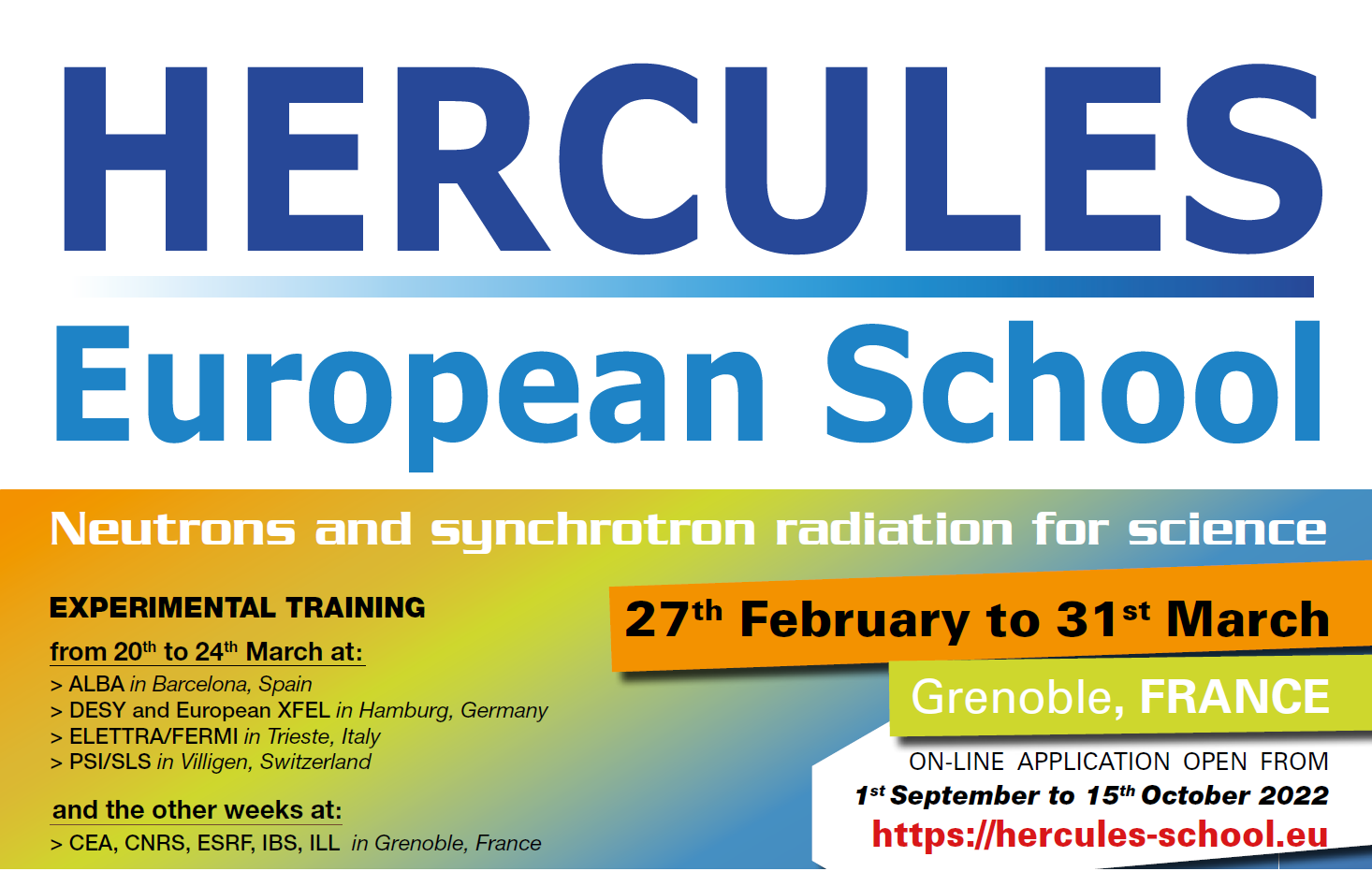
HERCULES school: neutrons & synchrotron radiation for science
| - |
In Grenoble
Hercules European School is a five week course coordinated by the Université Grenoble Alpes (UGA). The school provides training for students, postdoctoral and senior scientists from European and non-European universities and laboratories, in the field of Neutrons, X-ray Synchrotron Radiation, and Free Electron Laser for condensed matter studies (Biology, Chemistry, Physics, Materials Science, Geosciences, Industrial applications). Neutron and X-ray science is integrated with complementary techniques like (but not only) optical and electron microscopy, NMR, optical spectroscopy.Â
It includes lectures, practical work, tutorials, and visits of Large Facilities: ALBA in Barcelona, KIT in Karlsruhe, DESY and European XFEL in Hamburg, Elettra and FERMI in Trieste, ESRF and ILL in Grenoble, SOLEIL in Paris-Saclay, and PSI in Villigen.Â
Â
The language of the course is English.Â
Â
15th International Conference on Synchrotron Radiation Instrumentation (SRI) 2024
| - |
In Hamburg
The international Conference on Synchrotron Radiation Instrumentation (SRI) is a successful conference series continuing for nearly 40 years, organised by the community of worldwide synchrotron radiation (SR) and X-ray free electron laser (XFEL) facilities. The last conference in 2022 (postponed from 2021) was hosted by Deutsches Elektronen-Synchrotron (DESY) and the European XFEL from 28 March to 1 April 2022 (online).
ECM-34. European Crystallographic Meeting
| - |
In Padova
The flagship of the European Crystallographic Association (ECA) activities is the European Crystallographic Meeting (ECM), held every year, except when there is an IUCr Congress. The ECMs are the main meeting point for crystallographers in the ECA area to show their recent research. Microsymposia at ECMs are proposed and organized by ECA SIGs.
ECM 34 will be organized at the Padova Congress Centre on behalf of ECA and AIC. It will include all topics of interest to crystallography and it will be organized in synergy with EPIDC 18, which will follow ECM 34 in the same location.
Advanced Methods for Ambient Crystallography at ESRF-EBS Workshop
|
In Grenoble
Room temperature data collection is experiencing a resurgence in structural biology due to its capacity to reveal physiological relevant conformations that could be hindered at cryogenic temperatures. The ESRF and EMBL Joint Structural Biology Group has been laying the groundwork for the future development of this field with two main projects: the refurbishment of MASSIF-1, including a CrystalDirect Harvester, allowing full automation of single crystal RT data collection and the new ID29 for time resolved serial crystallography data collection on high viscosity extruders and fixed targets. This 2.5 days workshop will cover the different practical and theoretical aspects of room temperature data collection and structure determination on the first day, followed by practicals at the beamlines and on data processing on the following days.
A total number of 10 participants will be selected and we will accept a limited number of participants' samples to be tested during the workshop. There is no registration fee and meals and accommodation during the workshop will be provided free of charge. Bursaries are available to cover travel expenses for the participants.
Deadline for application for the workshop is on 15th August. Applications can be submitted at the following link https://survey.esrf.fr/index.php/212282?lang=en
10th Anniversary Meeting of the Young Crystallographers
|
In Hamburg, Germany
The Young Crystallographers are a working group within the German Society for Crystallography (DGK). For 10 years, we meet regularly in autumn at different universities or the STOE facilities.
These meetings specifically aim to provide a platform for networking and scientific exchange for young scientists with an interest in crystallography, as well as to establish contacts with industry and research institutions.
We want to give young scientists the opportunity to gain early experience in scientific presentation in a relaxed atmosphere and without the stress of a larger conference.
For our grand anniversary, we are happy to meet at the DESY facilities! We are working hard to allow you deep insights as well as a great overview of the possibilities at this large-scale facility.
During the 3-day meeting, you willÂ
- present your own work as a poster (A0 portrait) and lightning talk (~5 min.)
- have the DESY campus tour
- participate in an experiment and get a hands-on experience at a beamline of your choice at PETRA III (see The Experiments)
- hear academic talks from senior scientists
- hear industry talks from our sponsors/partners
At the end of the meeting, you will also have the chance to join a tour of the European XFEL Campus. If you intend to participate, please indicate so during registration. Note that you will need to get to the XFEL facilities by public transport as it is a bit outside the main DESY campus.
The registration fee of 60 € includes the tours and experiments at DESY, coffee breaks as well as lunch and BBQ on Thursday.
Deadline for registration is 22.08.23.
ECRS-11 European Conference on Residual Stresses
| - |
In Prague
ECRS is a well-established conference series that focuses on residual stresses in structural and functional materials. From experimental methods via modelling techniques to industrial applications a broad gamut of residual stress-related topics is addressed. The series is well attended by scientists, PhD students and engineers from both academia and industry.
Previous editions have been successfully held in Karlsruhe (1983), Darmstadt (1990), Frankfurt/Main (1992), Cluny (1996), Delft (1999), Coimbra (2002), Berlin (2006), Riva del Garda (2010), Troyes (2014) and Leuven (2018).Â
This gathering brings together scientists, students, and engineers with a shared interest in residual stresses, a phenomenon that affects the physical properties of materials and surfaces across various scales. While its core focus lies in mechanical engineering and materials science, residual stresses also hold relevance in solid-state physics, life sciences, geology, and the chemical reactivity of solids. Managing residual stresses can unlock improved material and structural properties, such as enhanced fatigue life and geometrical stability. The analysis of residual stresses, being a highly sensitive parameter influenced by micro/nano-structure, provides valuable insights into the history of materials and structures. This conference offers an interactive platform for experts from diverse disciplines including mechanics, physics, optics, chemistry of solids, manufacturing, diffraction, and engineering. Attendees can exchange their perspectives and share recent advancements through experimental, theoretical, and numerical approaches.
 Two tutorials are planned
Main topics
- Diffraction Methods
- Mechanical Relaxation Methods
- Acoustic Methods
- Electromagnetic Methods (Barkhausen effect)
- Electron Microscopy Methods
- Instrumentation
- Modelling methods
- Stresses in Microelectronics
- Stresses in Additive Manufacturing
- Microstructures, Composites and Nanomaterial
- Thin Films and Coatings
- Welding, Fatigue and Fracture
- Cold Working and Machining
- Heat Treatments and Phase Transformations
International BioXFEL Conference and Workshop
| - |
In San Juan, Puerto Rico
7th Microscopy characterisation of organic-inorganic interfaces meeting
|
In McMaster University, Hamilton, Canada
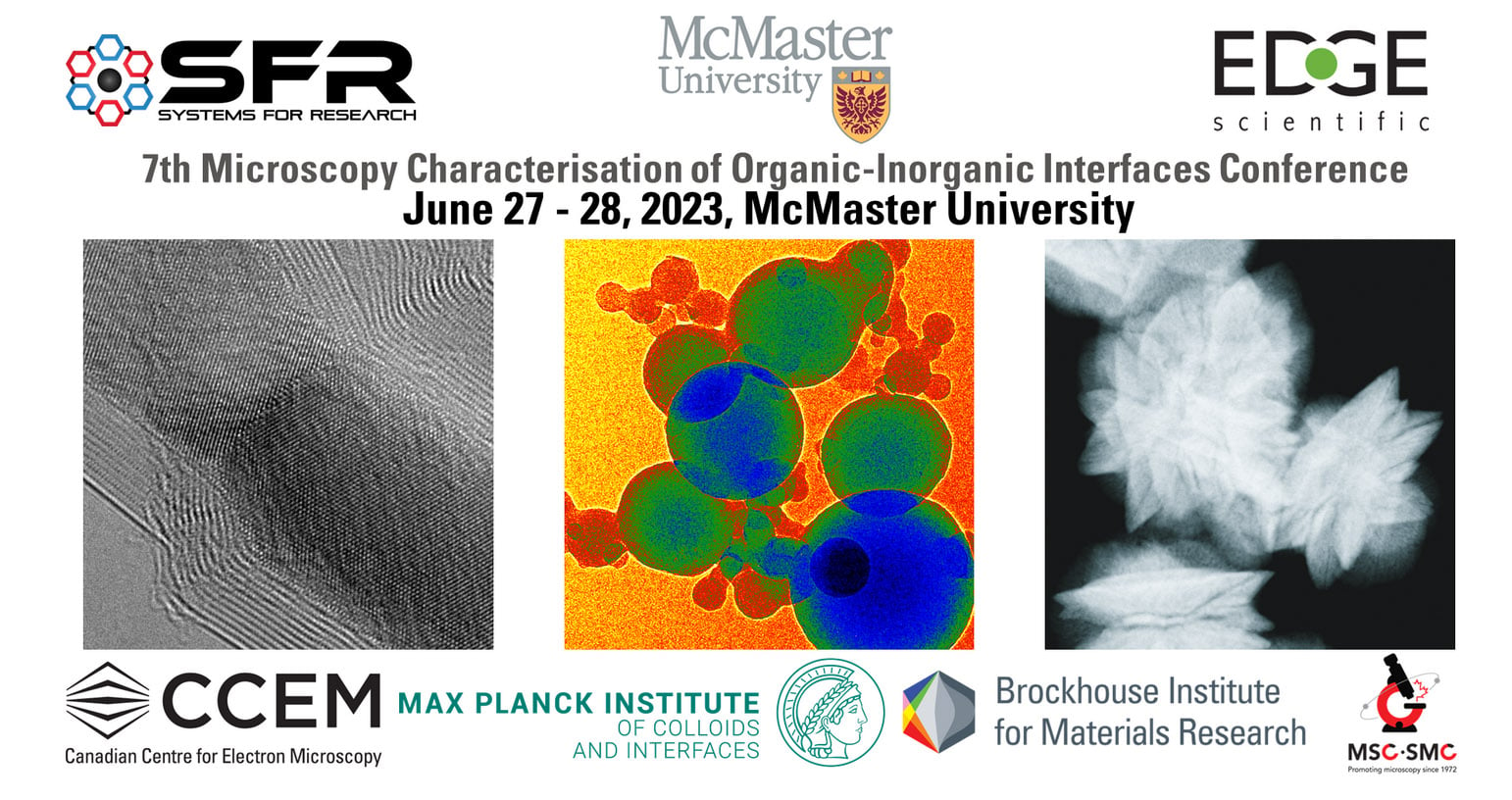
The 7th Microscopy Characterisation of Organic-Inorganic Interfaces (MCOII) meeting will return to an in-person format in 2023 and will be hosted for the first time in North America at McMaster University in Hamilton, Canada, home of the Canadian Centre for Electron Microscopy. The transatlantic scientific organizing team of Nadja V. Tarakina (MPIKG, Germany) and Kathryn Grandfield (McMaster University, Canada) have put together an exciting two-day programme. As usual, the first day will be more general, covering a broad range of microscopy approaches (correlative microscopy solutions, in-situ liquid microscopy methods, low-voltage electron microscopy and many more) in the context of imaging hybrid and soft matter.On the second day, a special Focus Lecture Series, entitled "Multi-dimensional and multiscale microscopy of organic-inorganic interface" will cover a more-detailed range of lectures on tomographic methods spanning light, X-ray and electron microscopy, as well as atom probe tomography and in situ electron microscopy/tomography. This conference will bring together world-leading experts in microscopy, highlighting the latest achievements, new opportunities and outstanding challenges in probing beam-sensitive and hybrid materials and their interfaces.
Raw diffraction data reuse: the good, the bad and the challenging
|
In Melbourne
A major effort of the IUCr Diffraction Data Deposition Working Group (2011 to 2017) and now the IUCr Committee on Data since 2017 has been exploring the practicalities, the costs and benefits, and the opportunities for new crystallographic science arising from large-capacity data archives that have become available.  We think it timely to hold a full-day workshop aimed at: (1) discussing current practices in raw data archival and sharing, (2) educating those who generate and deal in crystallographic data on best practices in data reuse in various categories of crystallographic science by leading experts, (3) offering a summing up, including the role of IUCrData’s new Raw Data Letters. We expect attendees to learn about the opportunities for raw data reuse, including the use of raw data as test data sets for machine learning, and to achieve an understanding of how to effectively archive their own raw data to maximise the potential for data sharing and reuse in the future. This workshop will explore in detail the successes and challenges in practice of raw data sharing and reuse. Being a full day, it will complement the proposed microsymposium on "Raw diffraction data reuse: warts and all" in the Congress itself; most importantly the microsymposium will allow for the usual submission of up to four abstracts from anywhere in the world whereas the workshop is principally made up of invited speakers. Furthermore, the microsymposium will highlight the importance of databases. Of the workshop and the microsymposium the proposed keynote on the "European Photon and Neutron Open Science Cloud" (by Andy Götz of ESRF) is the major highlight, making it the world leading effort of this consortium of more than ten European synchrotron and X-ray laser radiation sources with raw data management and sharing.
 ÂReminder: The CommDat user forum is at https://forums.iucr.org
British Crystallographic Association Chemical Crystallography Group Autumn meeting 2022
|
In Online
BCA CCG Autumn meeting 2022
Going beyond the data for chemical crystallographers
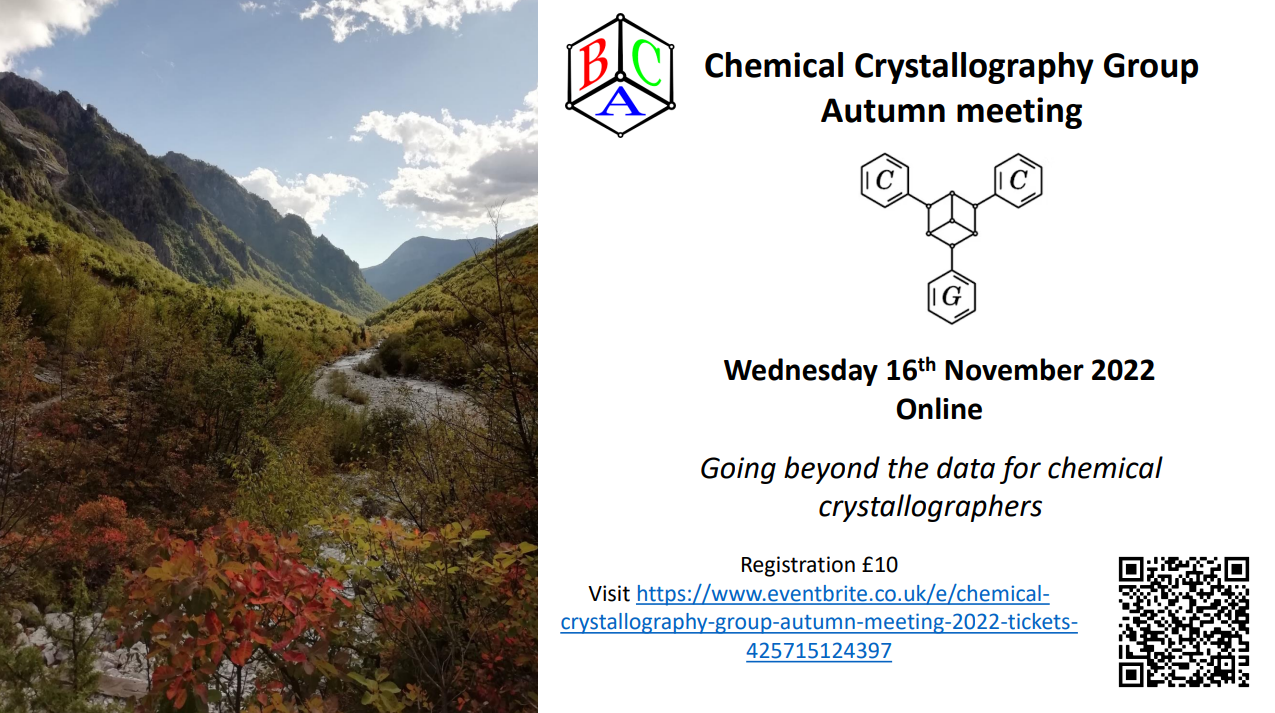
Registration for the Chemical Crystallography Group Autumn meeting is now live! The meeting will be held online on Wednesday 16th November 2022. For details and registration, visit: https://www.eventbrite.co.uk/e/chemical-crystallography-group-autumn-meeting-2022-tickets-425715124397
8th European Crystallography School
| - |
In Berlin
ECS8, the 2023 European Crystallographic School, is planned as an in-person event.
The school will be held in Berlin, at the site of the BESSY II electron storage ring operated by the Helmholtz-Zentrum Berlin.
Up to 100 young international students and scientists will have the chance to meet with renowned lecturers and tutors and become acquainted with the most up-to-date principles and applications of X-ray crystallography.
Topics
- Fundamentals of Crystallography
- Single Crystal Diffraction
- Powder Diffraction
- Synchrotron Radiation in Crystallography
- Macromolecular Crystallography
- Applications of CrystallographyÂ
Fundamental lectures will be taught during the mornings. Afternoons will be dedicated to lectures on applications and hands-on tutorials.
Application for ECS8 is open until 28 February 2023.

SLAC 2022 SSRL/LCLS users' meeting
| - |
In Virtual
SESAME-Africa Online Workshop
|
In virtual
Diffraction Methods in Structural Biology Gordon Research Conference
|
In Lewiston, ME; USA
Structural biology is entering a new era. Not just the virus and biomedicine, not just astounding breakthroughs in prediction, but new and complimentary approaches are exploding onto the scene. It is time to imagine what could be achieved if there were no barriers to structural information, and to contemplate how we will combine our diverse strengths to overcome obstacles we always believed were insurmountable. An excellent place to start is crystallization, where the impact of any improvement would be very high, but predictive theory remains elusive. Preparation of electron microscopy grids faces a similar challenge. Each session will focus on a critical barrier in structural biology, and the goal will be formulating the best advice to newcomers to the field who will face these challenges. Where possible, test data with a clear scoring system will be defined, and friendly competition between proponents of different approaches will be encouraged. Current best practices will be described, evaluated and compared and the relative effectiveness of alternative approaches will be announced at the meeting. Open discussion is expected to uncover new insights, new approaches, new algorithms, and no doubt flaws in the tests. By the end of the meeting we will have established not only new best practices, but also improved the criteria we use to assess them.