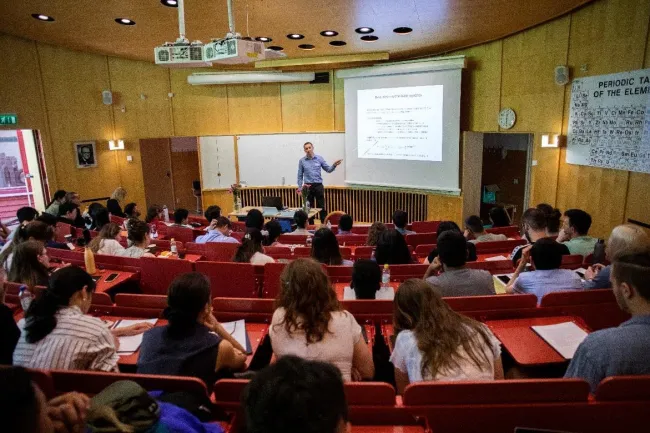
The 11th European Crystallography School (ECS11) was held in Stockholm, Sweden, at the Department of Chemistry of Stockholm University (SU) from June 28 to July 3, 2026, followed by an optional excursion on July 4. The school was an official event of the European Crystallographic Association (ECA), that was co-organized by a local organizing committee that targeted the development of crystallographic skills for young scientists working in chemistry, physics, materials science and related fields.
ECS11 attracted considerable interest with 60 participants attending (25 F, 35 M) out of over 130 applications. Ultimately, participants from institutions in 24 countries attended the school, including Bachelor students, Master students, PhD students, postdoctoral researchers and permanent staff members.
The lectures and practical sessions covered the fundamentals of small molecule crystallography through to modern methods for structure determination, with particular focus on the techniques of single-crystal X-ray diffraction (SCXRD), powder X-ray diffraction (PXRD) and three-dimensional electron diffraction (3D ED). The program was designed to progress systematically from fundamental concepts to practical applications and included 13 lectures/seminars, 2 tutorials/demonstrations, laboratory tours and 2 full days of hands-on workshops.
The 10 invited speakers (4 F, 6 M), together with representatives from industrial sponsors, contributed to the scientific program. Poster sessions were held across two days, further encouraging interaction between participants and lecturers. The final two days were devoted to practical training. For these hands-on workshops, the participants were divided into two groups, with one group attending the PXRD workshop and the other the 3D ED workshop on the first day, before exchanging workshops on the following day. Four poster prizes were awarded at the conclusion of the school, sponsored by the IUCr and the CCDC.
Particular attention was also given to creating a relaxed environment to break the ice and encourage interactions between participants, teachers and organizers. A welcome reception was held on the first evening, followed on the second evening by a barbecue with activities including a Swedish “tipspromenad” walking quiz. Later in the week, the school dinner was held at a rowdy Viking-themed restaurant Aifur in Stockholm's Old Town. The school concluded with an optional excursion to Ytterby mine where numerous elements were discovered, followed by a boat trip through the Stockholm archipelago via Vaxholm, before a visit to the Nobel Prize Museum.
The feedback received after ECS11 was very positive. Thirty-two participants completed the feedback survey and rated their overall experience at ECS11 with average score of 4.84 out of 5. Participants particularly appreciated the lectures, the organization of the school, the friendly atmosphere, as well as the personal career and research talks. Several participants specifically commented that the school provided skills directly applicable to their own research. The feedback indicates that ECS11 successfully achieved its principal objectives of providing quality crystallographic training while strengthening networks within the next generation of the international crystallographic community.
Author Information
Andrew Kentaro Inge