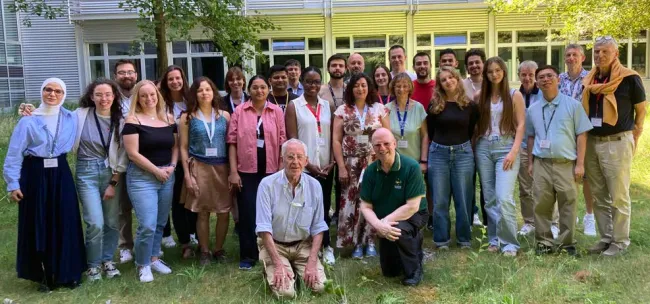
The 12th Zürich School of Crystallography was held as usual in the Department of Chemistry at the University of Zürich (UZH). The 19 participants, 12 female and 7 male, comprised one BSc, 2 MSc and 13 PhD students, and 3 postdocs. They came from 13 countries: Brazil, Costa Rica, Denmark, Estonia, Finland, France, Germany, Norway, Poland, Sweden, Switzerland, The Netherlands, and the USA. The levels of experience of the participants ranged from minimal to moderate. Their back-grounds were more diverse than usual: while most were chemists, the group included people with in-terests in physics, biomedical/mathematics, geology/materials, and computational chemistry. The co-hort was rounded out by 11 full-time tutors/lecturers and one part-time lecturer.
The aim of the School is to introduce the participants to the theory and practice of X-ray diffraction and single-crystal small-molecule structure determination. We cover all stages from crystal growth through to interpretation of the results and preparing material for publication. We limit the focus to single-crystal small-molecule crystallography so as to be thorough.
The daily activities included lectures, tutorials, and practical sessions. Several lectures covered the theory of X-ray diffraction, topics that receive little attention in most university courses and in workshops geared at ‘how to’ aspects. Some lectures included short quizzes, where the Wayground and Kahoot apps were used to underpin the key messages of the lecture. These fun quizzes were introduced for our 2024 School and are well appreciated. Most tutorials were done in discussion groups of five participants mentored by at least two tutors, and proved to be popular. Some ad hoc discussions also arose in the hotel lobby after dinner on some evenings.
The practical sessions are done in our traditional and highly appreciated two participants per tutor groups, where the participants are guided through the full process of solving, refining and assessing a series of carefully chosen example structures exhibiting a range of commonly encountered challenges. We used Olex2 once again, because of its comprehensive palette of useful tools and graphics, alongside the SHELX programs, PLATON, Mercury, and other readily available software. After completing the example structures, the participants could then tackle the structure determination of their own crystalline sample that they had sent ahead of the School (or which we provided if necessary). Post-refinement derivation and interpretation of interesting features of any structure is important and the participants completed the analysis of their own structure by writing a short report using the very structured and easy-to-follow style of an Acta Cryst E paper as a template. This report contributed up to 25% of their exam mark and everyone completed this task adeptly and on time. The practical sessions included working with one of five diffractometers, where experience with an instrument and its software could be obtained. The diffractometers are located in the Chemistry Departments of UZH and the nearby ETH-Zurich.
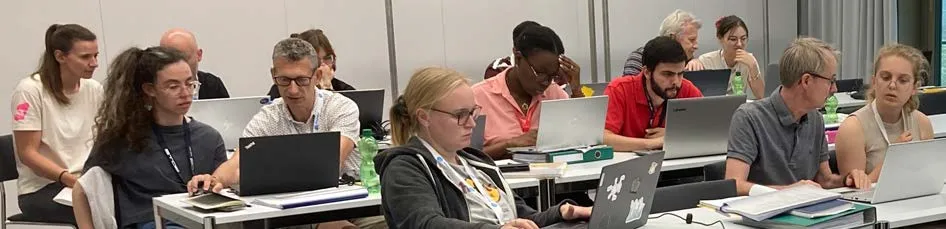
Overall, the participants become well-equipped to determine their own structures when they return home and to recognise when they need to seek advice for a challenging problem. The participants were extremely enthusiastic and worked assiduously throughout the School. Sometimes they focused so intently and were so involved in discussions with their tutors that they had to be urged to break for coffee or lunch. It was rewarding to see everyone interacting with each other.
The concepts of symmetry have consistently been a challenging theme. For the 2026 School, we reorganised the symmetry lectures and tutorials and found that the participants more easily understood the concepts.
Two freely available helper programs developed locally by Nils Trapp and his colleagues are pgtrainer, which displays images of objects possessing the various point groups, and zsgh, which is a tool for determining the space group from diffraction data. During the tutorials, we also used 3D-printed models of molecules representing all point groups. The participants found that being able to handle such models helps them see the point symmetry more easily than with the online tools.
Short feedback sessions allowed the participants to express their feelings about their experience that day. A two-hour written exam enabled the participants to qualify for ECTS credit points or to self-test their knowledge. After the exam, the final day included some brief presentations on advanced topics designed to give the participants a taste of other possibilities, such as Hirshfeld atom refinements, incommensurate structures and electron diffraction, with some talks being company presentations.
The sumptuous final banquet culminated in fond fare-wells amongst members of the class of 26 where many new friendships and networks had been created. The two participants with the best exam results received prizes: a UZH-branded insulated water bottle (1st) and a UZH carry bag (2nd). Each participant received a certificate of attendance, a copy of The Non-Ambient Guide donated by Anton Paar, and a copy of the IUCr publication A Little Dictionary of Crystallography. The tutors were then kept busy signing the books. The personal impressions of two participants are given below.
We gratefully acknowledge the generosity of our sponsors and supporters: Department of Chemistry of the University of Zürich, Swiss Society for Crystallography, International Union of Crystallog-raphy, European Crystallographic Association, Cambridge Crystallographic Data Centre, Rigaku Ox-ford Diffraction, Dectris Ltd, Bruker AXS, Anton Paar, Eldico Scientific AG, and Amsterdam Scien-tific Instruments. Bursaries were kindly provided by the IUCr, ECA, CCDC, and ASI.
The Zürich School of Crystallography 2026 – impressions from participants
I attended the school at the University of Zürich shortly after completing my master's degree in theoretical and computational chemistry, with the aim of complementing my theoretical background with practical experience and learning to use the main crystallographic software packages. My previ-ous degree already gave me an introduction to many of the topics discussed during the summer school, but here I had the opportunity to study them from a completely different point of view. Moreover, we had the chance to learn the concepts through practical exercises, plastic models, videos and software training.
The programme brought together participants from many countries with diverse scientific back-grounds and levels of experience, making the environment stimulating and international. The cultural exchange was one of the most rewarding aspects of the school, and I particularly appreciated the friendly atmosphere among the participants, which encouraged discussions not only during the ses-sions but also during breaks and dinners, making the learning experience highly collaborative. It was a pleasure to be surrounded by such enthusiastic, knowledgeable, and kind people. Despite coming from different backgrounds, we quickly established a genuine connection, and I was fortunate to form friendships that I hope will continue beyond the duration of the course.
The summer school provided an excellent, high-level environment for learning, exchanging ideas, and connecting with expert researchers in the field. The course programme was intensive and very well organized, combining lectures, tutorial sessions, and discussions. Every student received highly per-sonalized guidance, thanks to the high number of professors. This is my favourite aspect, because one student could always clarify concepts with the tutors, who were always available to answer questions, and create a very tailored experience! The lectures covered the complete process of single-crystal structure determination, and I particularly appreciated the way theoretical concepts were continuously linked to practical examples. The sessions on symmetry and space-group determination were especial-ly useful, as these topics often represent one of the most challenging aspects of structure analysis. The data collection has been a very exciting part of the school. Each student had the possibility to provide their own crystal, for which the data were collected on one of the five diffractometers available in the chemistry departments of the University of Zurich and the ETH Zurich. I am so thankful because, being into computational studies, I couldn't synthesize my own sample, so I had the possibility to choose a crystal, and the teachers provided it for me!
The practical sessions, which focused on data processing and software to analyse diffraction data, were very useful to expand my skill set. We first worked on example datasets and then we applied the same methods to data of our own samples. Throughout these sessions, the tutors explained the reason-ing behind each procedure, and we were followed one by one. This approach gave me the confidence to critically analyse and interpret results.
This school was such an enriching experience, both from a scientific and a personal perspective and I recommend it to both experimental and theoretical chemists. The knowledge I gained during these weeks will have a positive impact on my future research as a PhD student in computational chemistry. I work on materials and, although my work is primarily theoretical, a deeper understanding of crystal-lographic theory, techniques and symmetries will allow me to better interpret structural data and files, communicate with experimental collaborators, and evaluate the crystals used in my computational research. Lastly, I would like to thank the organizers for all the support I received about my food in-tolerances. They have been so sweet and caring to always provide very good meals and also food that was healthy for me! Thank you very much!
Irene Mattiuzzo, Uppsala Universitet
 Before attending the school, my practical experience with crystallography was limited, and crystallographic theory received little attention in my coursework. As a master’s student in organometallic chemistry, I had grown dissatisfied with this gap in my knowledge. The search for further training in single-crystal XRD led me to the Zürich School of Crystallography 2026 (ZSC26), which I had the exciting opportunity to attend.
To begin, I would only highly recommend the school to anyone with an interest in SCXRD. Over the two-week programme, you are introduced to both the theoretical foundations and practical aspects of data collection, structure solution, and refinement through a combination of lectures, hands-on exercises, and short quizzes. An especially rewarding aspect of the course is the “bring your own crystals” approach, allowing you to work on a sample from your own research. During practicals, you are working in a 2-to-1 ratio of students to tutors, each an experienced and enthusiastic crystallographer, which creates ample opportunity to ask questions and discuss concepts. Personally, I found the quality and enthusiasm of the tutors were among the school's greatest strengths, particularly given the intensity of the programme.
Despite the intensive schedule, the programme allowed time to explore Zürich and interact with other participants beyond the classroom. The shared dinners and coffee breaks, which provided opportunities for informal conversations with tutors and fellow students, were a particular highlight. These interactions helped foster friendships and connections that extended beyond the course and made the final farewell a bittersweet moment.
Beyond the scientific programme, the school was organised very well. The lecture notes were distributed in advance, together with clear instructions on the required software and installation procedures. On the first day, tutors were available to help resolve any technical issues to enable a smooth start to the practical sessions. The choice of accommodation also contributed to the overall experience, providing a comfortable stay within easy reach of both the University of Zürich campus and the dinner venue.
Looking back, the Zürich School of Crystallography exceeded my expectations and was both an engaging and formative experience. Beyond improving my understanding of crystallography and providing my first hands-on experience in structure determination, the school equipped me with valuable practical tips and personal connections that I hope to carry forward. Moreover, it has had a lasting impact on my professional development, shaping the way I approach SCXRD in my own research. Finally, I would thank the organisers, tutors, and supporters of the school for creating such a valuable and memorable experience.
Kevin Harreither, University of Groningen, The Netherlands
Author Information
Tony Linden, Hans-Beat Bürgi
School Directors