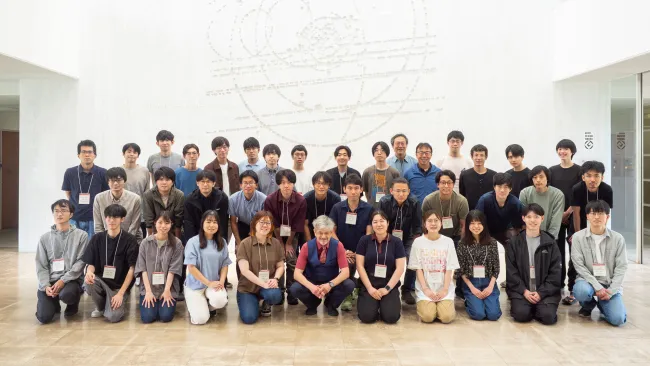
I am a PhD student in inorganic chemistry working with continuous SerialED and dynamical effects in electron diffraction data. My research is focused on how orientation-dependent effects influence diffraction intensities, and how such effects can be handled during early data processing, scaling and merging. Before attending the MaThCryst course in Tsukuba, I already knew that symmetry, reciprocal space and group theory were important for crystallography, but I had often encountered them as separate concepts rather than as parts of one connected framework.
I expected the course to be more lecture-based, but I was positively surprised by how interactive and inspiring the learning environment was. The course had a very good balance between algebra and geometry, and it included enough mathematics to make the concepts rigorous without making them feel disconnected from crystallographic practice. The exercises and discussions were especially valuable, because they forced me not only to listen, but to actively work with the ideas and test whether I had really understood them.
One part of the course that stood out to me was the way symmetry operations were presented through matrices. Seeing how determinants and traces can be used to identify the type of transformation, and to connect algebraic objects with crystallographic symmetry operations, made the subject much clearer to me. It was also very helpful to see how the relationship between real space and reciprocal space was built up step by step and then used throughout the course. Reflection conditions and systematic absences became much easier to understand when they were connected both to real-space symmetry and to their consequences in reciprocal space. The same was true for basis changes, which became much less abstract once they were placed inside the framework developed during the course.
As for my own research in continuous SerialED, many snapshot electron diffraction patterns are collected from crystals in different orientations. In this type of data, dynamical effects and orientation-dependent intensity distortions are central problems. During the course, many things started to connect for me in a new way: symmetry, reciprocal-space geometry, orientation space, and the mathematical description of crystallographic transformations. It made me realize that the problems I am working on are not only technical data-processing problems, but also problems that fit very naturally within mathematical crystallography.
I would strongly recommend this course to anyone who wants to work seriously with crystallography. Even for those who mainly use crystallography as a tool, the course gives a much deeper confidence in understanding and discussing symmetry, space groups, reciprocal space, systematic absences and related concepts. It does not only teach definitions. It changes the way one thinks about crystallographic problems. For me, it gave a sense of clarity and made me feel more secure in the direction I want to take with my own PhD research.
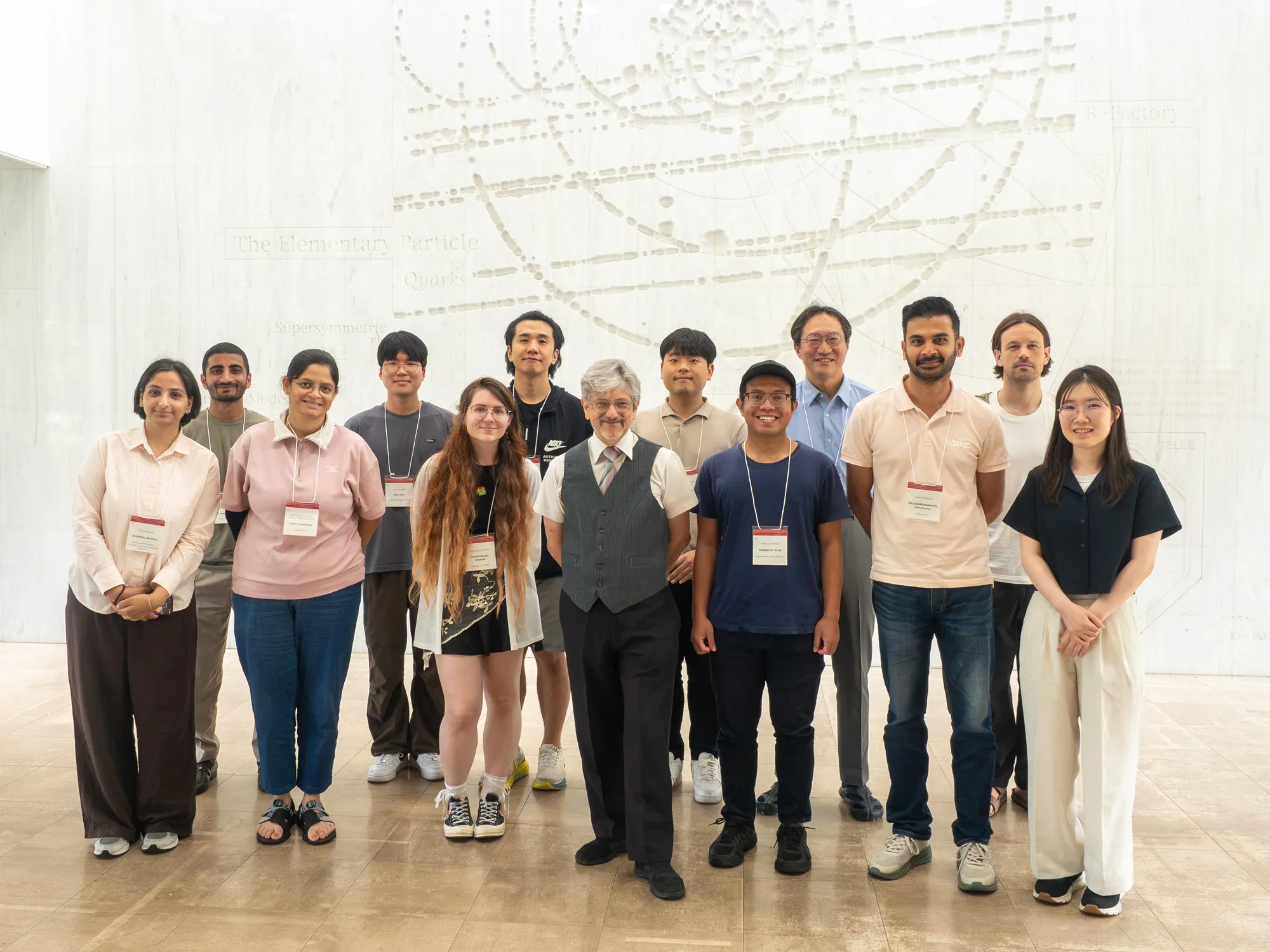
I am very grateful to Professor Massimo Nespolo, lecturer of the whole course, founder and former chair of the MaThCryst commission of IUCr, Ms. Yoshimi Takahashi, secretary, and Professor Noriyuki Igarashi, responsible of the course organization, for the time, energy and enthusiasm they put into the course. It was an inspiring and valuable experience, and I believe many more students and young researchers would benefit from the MaThCryst course and working through this material.
Author Information
Buster Blomberg
Department of Chemistry, Stockholm University