From crystalline phase evolution to nanoscale porosity, Anton Paar’s X-ray solutions reveal how structure determines material performance
As battery research moves toward new materials and manufacturing routes, understanding structure across multiple length scales is becoming increasingly important. In a number of recent studies, Anton Paar demonstrated how laboratory X-ray diffraction (XRD) and small-angle X-ray scattering (SAXS) can provide complementary insights into emerging battery materials – from monitoring structural changes during dry-electrode processing to revealing closed nanopores in hard-carbon anodes.
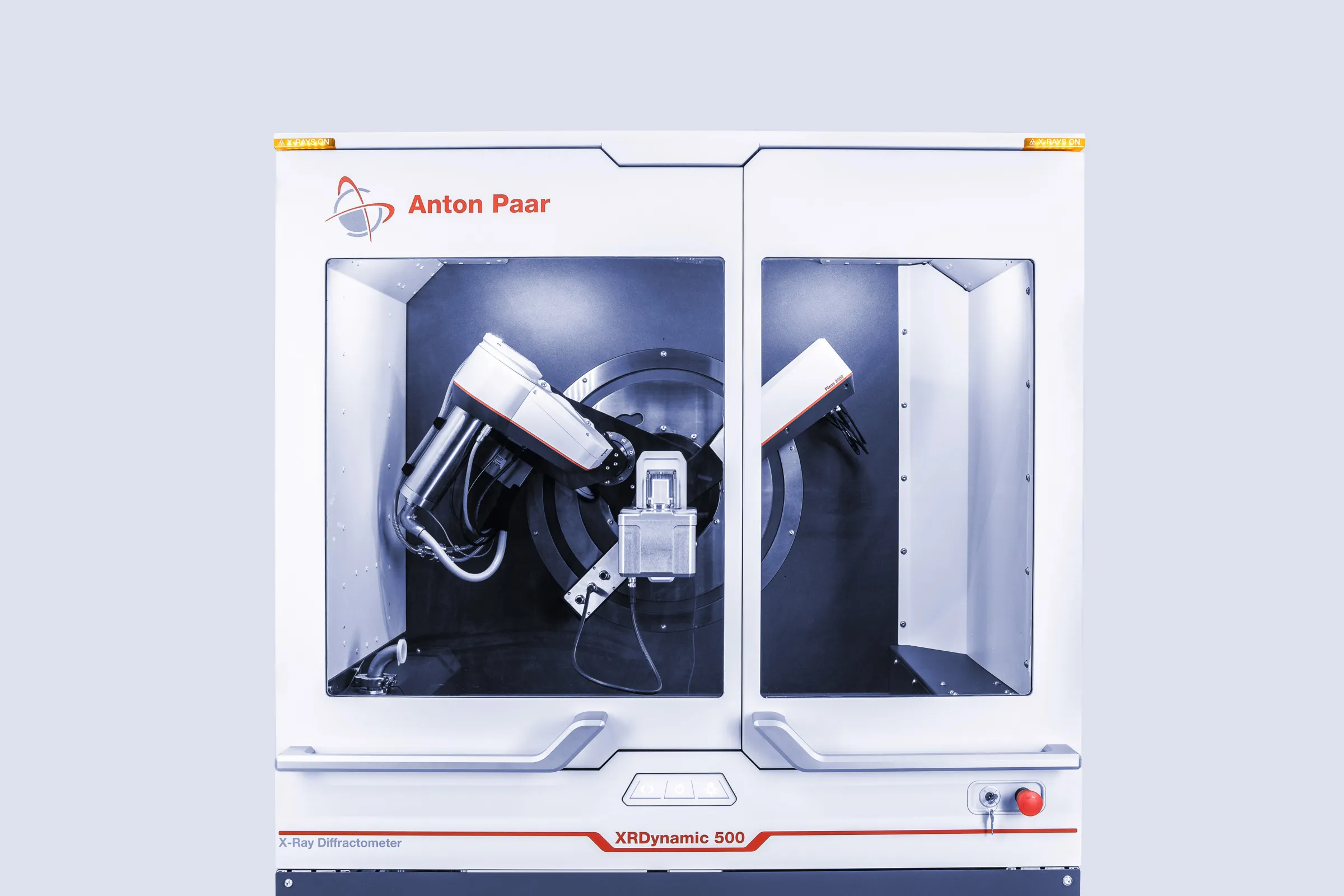
One study investigated the fibrillation of polytetrafluoroethylene (PTFE) binder during dry battery electrode processing using an XRDynamic 500 automated multipurpose X-ray diffractometer. Dry coating is attracting attention as an alternative to conventional slurry-based electrode manufacturing because it avoids the solvent application, drying, and recovery steps associated with wet coating. During dry processing, PTFE forms fibrils under temperature and shear. This transformation affects its crystalline structure and can be followed using XRD through changes in the characteristic PTFE (100) reflection around 18° 2θ.
Measurements of graphite-based formulations containing 1 %, 3 %, and 5 % PTFE showed decreasing peak intensity and increasing peak broadening with processing time, indicating reduced crystallinity during fibrillation. Even the weak PTFE reflection at only 1 % binder concentration could be resolved. Nine samples with different compositions and processing times were measured as one automated batch, demonstrating how XRDynamic 500 combines sensitive phase identification with efficient multi-sample characterization.
For crystallographers, such experiments illustrate how XRD can move beyond conventional phase identification and become a tool for following process-induced structural evolution. With its evacuated beam path, high resolution, and flexible sample handling, XRDynamic 500 provides a platform for advanced materials research. Its capabilities can be extended further with Anton Paar’s non-ambient XRD chambers, enabling researchers to investigate structural transformations under controlled temperature, atmosphere, and other sample environments.
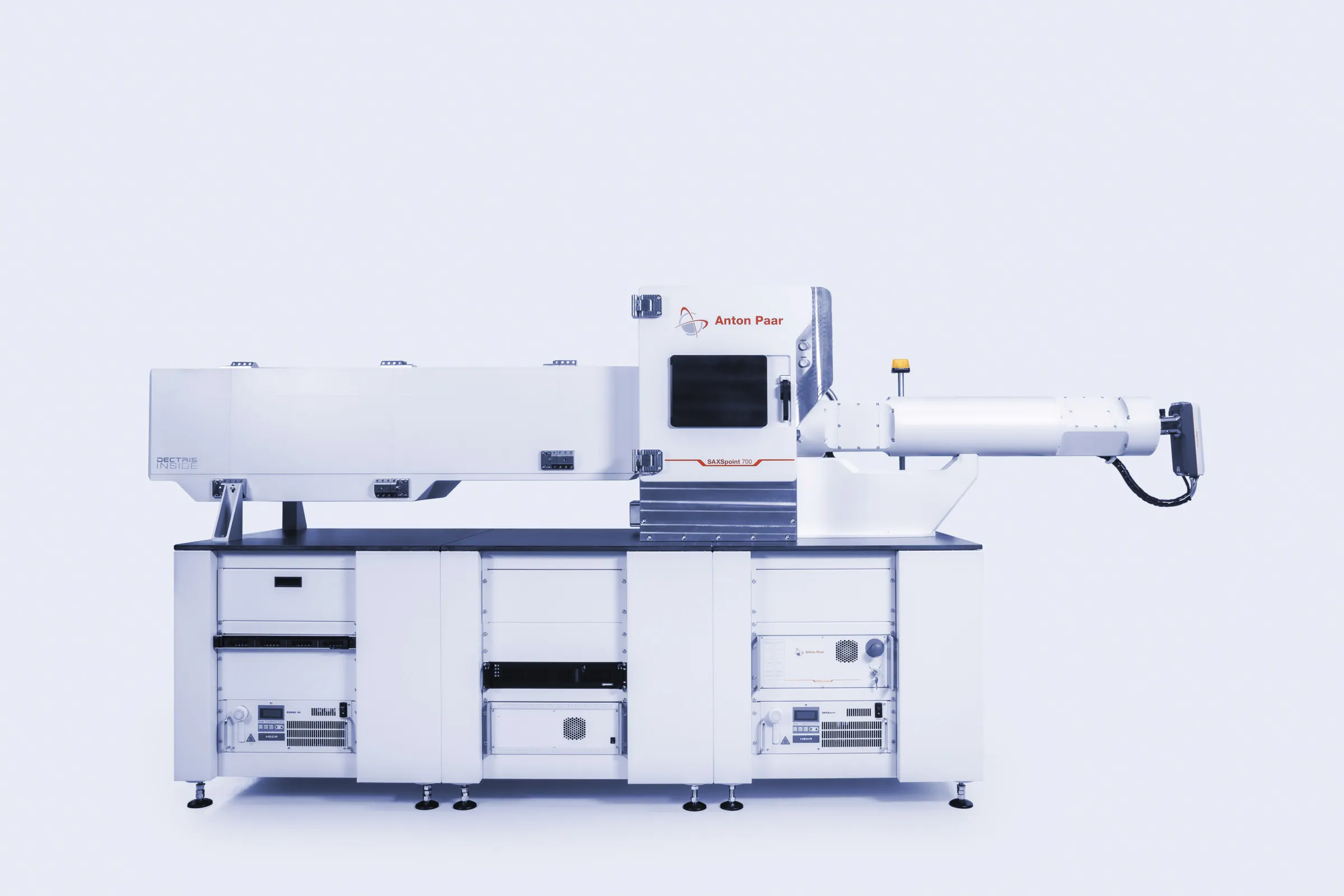
While XRD reveals crystalline structure and phase evolution, SAXS opens another structural window. Using SAXSpoint 700, Anton Paar investigated hard carbon, an important anode material for sodium-ion batteries whose performance is strongly influenced by nanoscale porosity. Unlike nitrogen adsorption, which probes accessible surfaces, SAXS detects electron-density contrast and can therefore provide information about both open and closed pore structures.
The study revealed a dominant contribution from structures below 10 nm and a correlation length of just 0.48 nm, supporting the presence of pronounced nanoscale heterogeneity and densely distributed nano-voids. Combining SAXS with conventional BET measurements therefore provides a more comprehensive picture of hard-carbon structure and its relationship to electrochemical performance.
Together, Anton Paar’s XRDynamic 500, non-ambient XRD chambers, and SAXSpoint 700 offer complementary capabilities for investigating materials from atomic-scale crystalline order to nanoscale morphology – providing insights into not only which structures are present but also how they evolve during processing and ultimately influence material performance.
Related content