When Mary Helene Marmande and Bailey Baxter travelled to Japan for eight weeks of undergraduate research, they expected to develop their skills as chemists. They returned with contributions to a crystallographic publication, greater confidence in their scientific abilities and a lasting appreciation of the community that had welcomed them.
The University of South Alabama students, both Goldwater Scholars, joined their research mentor, David Forbes, during his seven-month sabbatical at the Institute of Transformative Bio-Molecules (ITbM), Nagoya University. Working with the Crudden laboratory during summer 2026, they continued their senior honours projects while learning to navigate a new laboratory, language and culture.
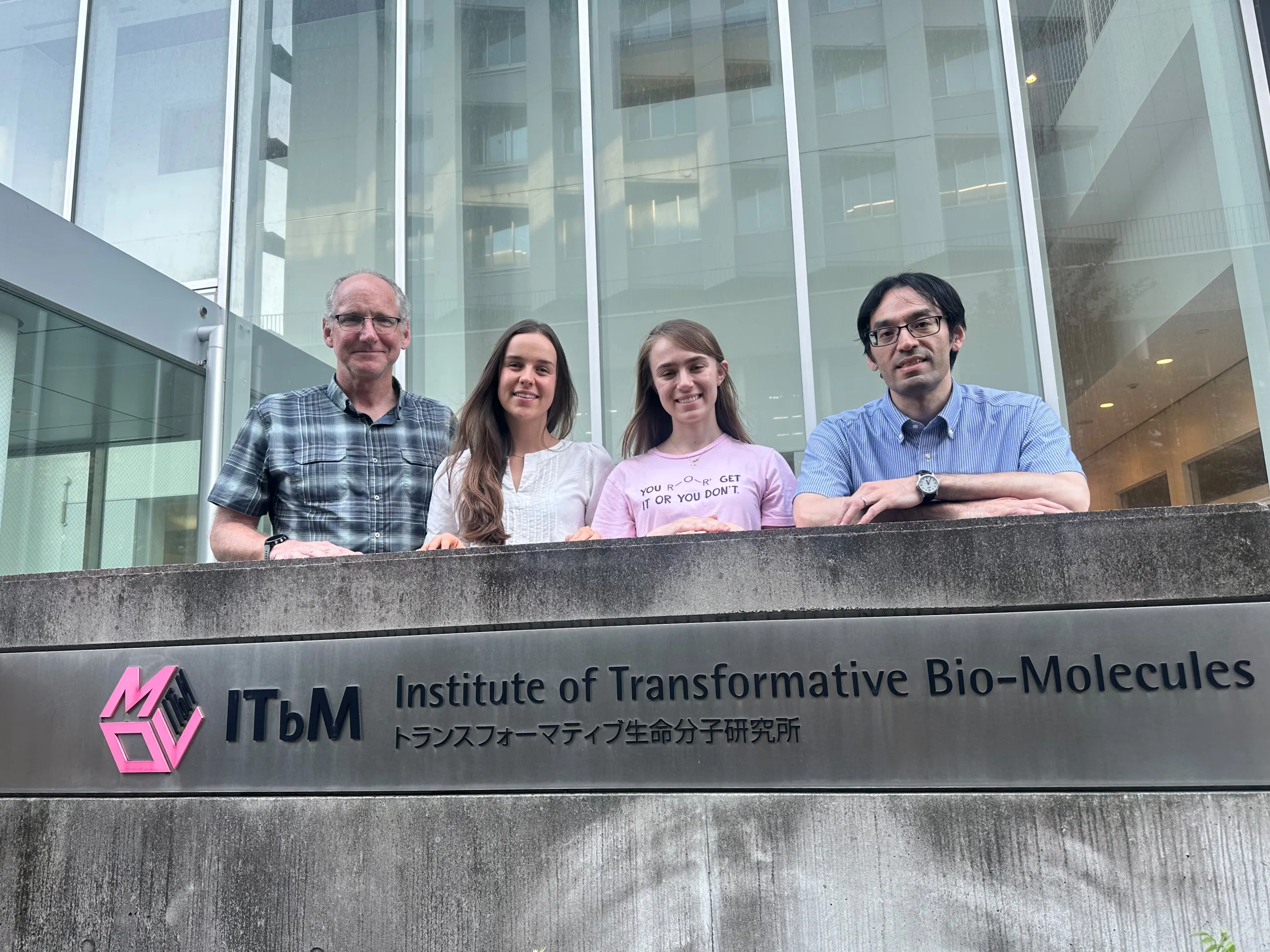
David Forbes, Bailey Baxter, Mary Helene Marmande and Masakazu Nambo (left to right) at the Institute of Transformative Bio-Molecules, Nagoya University, Japan, during summer 2026. Photograph supplied by David Forbes.
‘Research was not separate from our education abroad experience; it was the purpose and central component of it,’ they explain in their joint statement. ‘We were charged and responsible for every step of the synthetic process from the preliminary literature searches to the characterization of our target systems.’
Their work contributed towards their honours theses and introduced them to advanced analytical techniques, including single-crystal X-ray diffraction and high-resolution mass spectrometry. Using complementary methods helped them understand how experimental evidence establishes the identity, composition and structure of a compound.
One outcome was their co-authorship of a research communication in Acta Crystallographica Section E, published online on 8 September 2026. The paper reports the synthesis and crystal structure of N-benzyl-5,6-epoxy-7-oxabicyclo[2.2.1]heptane-2,3-dicarboximide, a norcantharidin analogue. For the students, the publication marked a tangible achievement from a summer spent taking increasing responsibility for their research. Forbes also reported submitting a second manuscript to Molbank in September.
Forbes emphasises that the students’ contributions were essential to the crystallographic paper. Alongside his gratitude to hosts Cathleen M. Crudden, Masakazu Nambo and their colleagues, he singles out its first author, Dr Joseph F. ‘Joey’ DeJesus, whose ‘passion for science, scholarship, and stewardship’ helped make the experience so meaningful.
For Marmande, the scientific challenges were only part of the learning.
‘Spending 8 weeks living in Japan to conduct research transformed my understanding of learning. I expected to be challenged scientifically, but I did not anticipate how profoundly living and working in an unfamiliar environment would change how I approach problems, relationships, and uncertainty.’
Advice from international colleagues offered fresh approaches to laboratory setbacks. Everyday practices, from removing shoes before entering rooms housing important instruments to learning different ways of presenting research, also prompted her to consider how culture shapes laboratory life.
Outside the laboratory, unfamiliar customs required patience and a willingness to reconsider familiar habits.
‘Navigating language barriers, unfamiliar customs, and cultural misunderstandings required me to adjust my communication and relearn a sea of new etiquette: walking on the left, bowing, keeping my trash with me, and lowering my volume in public,’ Marmande recalls. ‘When I grew frustrated with how long it took to adapt, I had to give myself grace and develop slow persistence.’
Over time, she came to understand these practices as expressions of respect and consideration. She also saw connections between her experiences in Japan and her ambition to become a physician-scientist.
‘In the lab, I learned to approach failure through new perspectives, while owning my project built confidence in my independence as a researcher. Building relationships with Japanese colleagues also equipped me with cultural awareness I can use to build trust with patients.’
For Baxter, working alongside more experienced researchers initially brought its own uncertainty.
‘At ITbM, we were the only undergraduate researchers in our lab group, working alongside graduate students, postdoctoral researchers, and experts in our field. Presenting our research to people with far more experience was intimidating, yet it gave me confidence in the perspective and skills I bring to science.’
Those exchanges strengthened her sense that she could contribute through both her own research and collaboration across disciplines and cultures. Equally important was the welcome the students received beyond their experimental work.
‘Despite the language barrier, we were welcomed into lab outings, conversations, and celebrations, with everyone willing to meet halfway, even through a translator app,’ Baxter writes.
One farewell gesture captured that sense of belonging.
‘At our farewell dinner, the group presented us with a handmade card signed by everyone in the lab. That small gesture chased away feelings of self-doubt and reminded me that our work, effort, and presence were valued.’
Daily journeys on foot, by subway and by train, together with adapting to the laboratory’s working day, encouraged Baxter to think differently about time, productivity and community. Like Marmande, she sees those lessons extending into her future career.
‘As I pursue medicine and research, I hope to carry forward the willingness to listen, adapt, and recognize that understanding perspectives beyond my own can transform competent care into truly compassionate and effective care.’
Based on correspondence supplied by David Forbes and a joint statement by Mary Helene Marmande and Bailey Baxter. Direct quotations retain the contributors’ original wording.