Before the first crystal, there was a corner.
When I returned to the University of Jordan in 2013 after completing my DPhil at Oxford, I wanted to establish protein crystallography research in Jordan. I knew the kinds of structural questions I wanted to ask. What I did not have was a laboratory in which to ask them. During the International Year of Crystallography in 2014, I spoke about establishing protein crystallography in Jordan and what access to structural biology could make possible.
I was not given a laboratory. I was given part of an existing room. I went to the university's technical workshop, looked through materials that were sitting there unused, chose what we could work with, and asked the technicians to partition the space. I also realised that we could use the new wall as storage, so we designed it with shelving and cupboards. That corner became the beginning of Jordan’s first Protein Crystallography Laboratory.
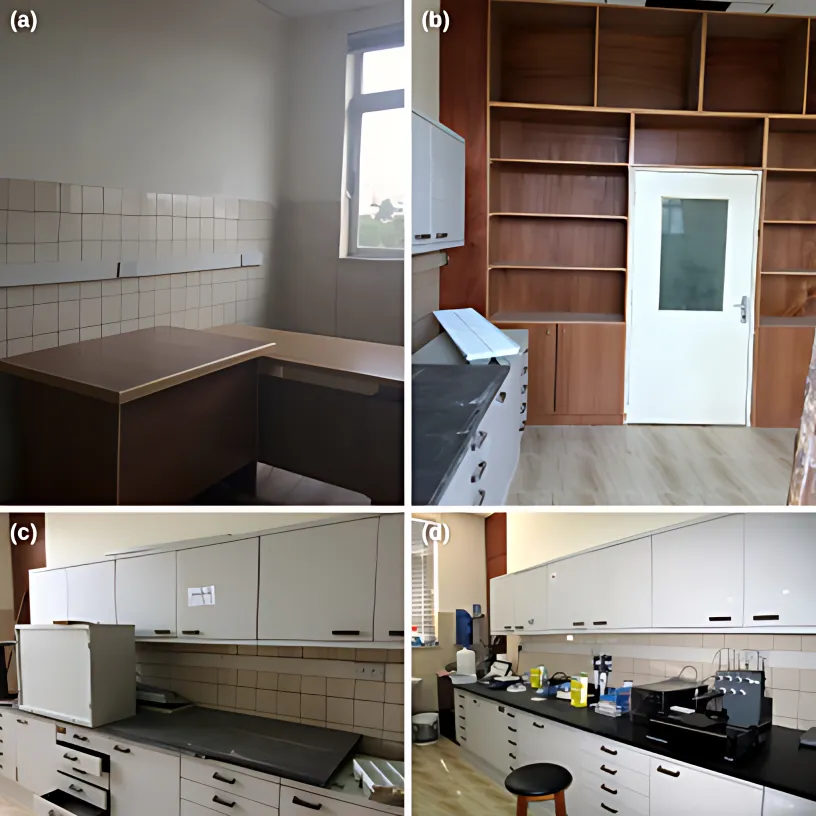
Figure 1. Building the physical space for the Protein Crystallography Laboratory at the University of Jordan. (a) The corner originally allocated for the laboratory. (b) The partition built using materials available through the university's technical workshop. (c) The laboratory during fitting and installation. (d) The working laboratory after the equipment was installed.
Creating the room solved only the first problem. Protein crystallography depends on much more than a microscope and a crystallisation plate. We needed equipment, working protocols, students who could use them, and ways to reach facilities that we could not reproduce locally. I wrote funding proposals, made the case for the instruments we needed, worked out what could realistically be done in Jordan, and built collaborations for what we could not.
Building a scientific capability is not the same as buying equipment. Instruments can sit unused. A laboratory becomes useful when people know what questions to ask, how to design the experiment, what to do when it fails, and how to connect the result to the next question.
The first protein crystals grown in the laboratory were lysozyme.
They were not scientifically novel. Lysozyme is the protein many crystallographers meet first because it is accessible and reliably crystallises. Our crystals were grown by students during the first practical workshop we ran in 2017.

Figure 2. The first practical protein crystallography workshop at the University of Jordan, “Protein Crystallography in Drug Discovery: An Introduction”, run with the Pharmacy Students Research Club (PSRC) at the School of Pharmacy. (a) Workshop participants. (b–d) Practical training sessions in the laboratory.
I was delighted by them.
Those crystals meant that a student could walk into a laboratory at the University of Jordan, set up a protein crystallisation experiment and see crystals grow. Something that had previously belonged to papers, lectures, or laboratories elsewhere was now happening in front of them. The crystals were not the destination. They were proof that we could begin.
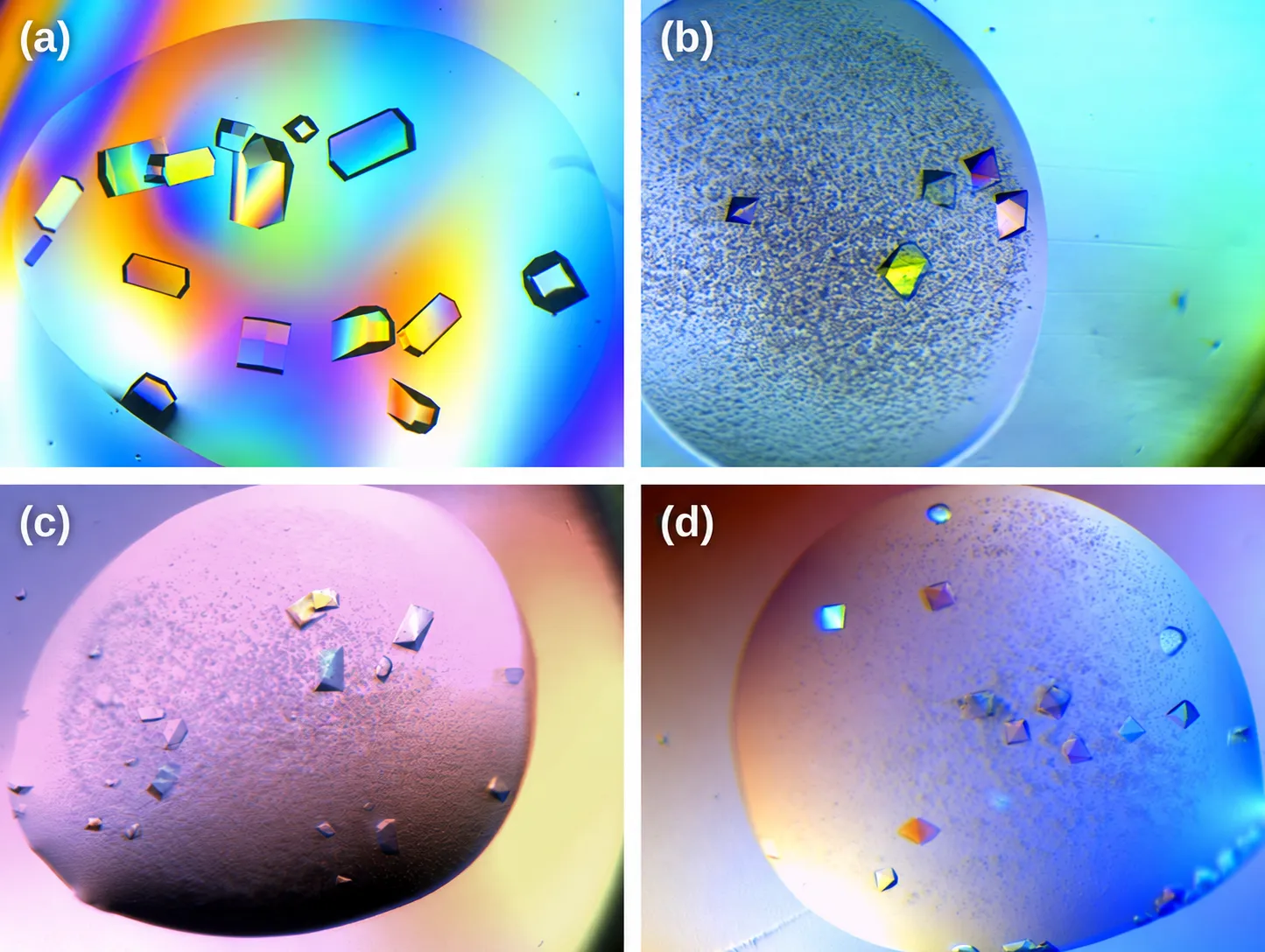
Figure 3. Protein crystals grown at the University of Jordan. (a) Lysozyme crystals grown during the workshop shown in Figure 2. (b–d) Carbonic anhydrase–ligand complex crystals grown as part of the subsequent structure-based drug-discovery work and student thesis research.
Later in 2017, at the IUCr Congress in Hyderabad, I presented the first protein X-ray crystallography research project carried out in Jordan, using a structure-based approach to study carbonic anhydrase III and its interactions with small molecules.
Building this way had a cost. My own research moved more slowly than it would have in an established structural biology environment. In Oxford, much of the infrastructure was already there. In Jordan, an experiment could begin with another task first: finding access, establishing a method, training someone, or solving a practical problem that had already been solved elsewhere. That is part of the story too. The slower pace was frustrating at times, but each problem we solved changed the starting point for the next student.
What I learned from building the laboratory was not that limited resources do not matter. They matter enormously. It was that “we do not have this here” is information, not a conclusion.
If something essential was missing, my instinct became to ask what would make it possible. Sometimes the answer was funding. Sometimes it meant finding access elsewhere. Sometimes it meant starting with a much simpler experiment and building from there. The point was to keep the scientific question alive while finding a route to it.
In 2025, Baroness Royall, then Principal of Somerville College, invited me to give the Dorothy Hodgkin Memorial Lecture. Speaking about Dorothy at Somerville while I was a Marie Skłodowska-Curie Fellow felt both an honour and a responsibility. The invitation also carried a quiet personal resonance. Before beginning her chemistry degree at Oxford, Dorothy had spent time at Jerash (41 km from the University of Jordan, where my laboratory is), drawing Byzantine mosaic pavements. At Oxford, she went on to analyse glass tesserae from the site. Part of her early scientific journey ran from Jordan to Oxford, carrying with it an attention to pattern and material. Mine ran in the opposite direction. I returned from Oxford to Jordan fascinated by crystals and what they can reveal, and determined to build the capability to do that science at home.
That instinct has stayed with me. I am finishing my Marie Skłodowska-Curie Fellowship at the University of Bristol this month, where I have been extending my work into cryo-electron microscopy. Cryo-EM requires a very different scale of infrastructure and investment from the laboratory I started in Jordan. I look at it and still find myself asking the same question: could we ever build this capability in Jordan?
My answer is yes.
I do not know the whole route yet. I know the scale of the challenge. But not knowing the how has never meant to me that something cannot be done. I will figure out the how.
I still get disproportionately happy when I see beautiful protein crystals. The ones I remember most, though, are those first lysozyme crystals. By the time they appeared, the hardest part of the experiment had already happened. We had made it possible for them to exist, and the next student did not have to start from zero.
Author Information
Areej Abuhammad
School of Pharmacy, University of Jordan, Amman, Jordan
School of Biochemistry and Biomedical Sciences, University of Bristol, Bristol, UK