The loosest known regular sphere packing (with only 5.5% of the 3D space filled by the spheres) was described by Heesch & Laves (HL, 1933) almost a century ago (Dauter & Jaskolski, 2026). It has cubic I4132 symmetry and consists of 24 symmetry-equivalent spheres per unit cell, propagated from a certain point on the two-fold axis of this space group. It is interesting and instructive to investigate what arrangements of spheres are obtained by moving to other points along this two-fold axis. Indeed, such analysis reveals a wide variety of arrangements with different symmetries and topologies. Some of these arrangements form proper sphere packing, where any pair of spheres is always connected by a path of touching (or ”kissing”) spheres. Other arrangements consist of isolated islands of spheres.
Fig. A shows the twofold axis ⅛,y,¼-y within the cubic unit cell of the I4132 space group. The characteristic points on this axis, generating packing of spheres of different topologies, are numbered and marked on this axis by dots of different colours. Table 1 summarizes each of these packings and other arrangements generated by intermediate sphere positions along this axis. They are analyzed in detail in the following paragraphs. Fig. B shows how the sphere diameter and space coverage change when the spheres are moved along the two-fold axis.
In general, the points along the ⅛,y,¼-y line lie at the Wyckoff h position (Int. Tables for Crystallography, Vol. A, 2016) and have twofold site symmetry. However, certain points lie at cross-sections with other symmetry axes and have higher site symmetry. The point numbered 1 in Table 1 at ⅛,½,-¼ at the Wyckoff d position has 222 site symmetry. Similarly, the point numbered 6 at ⅛,0,¼ at the Wyckoff c position also has 222 site symmetry, although these two are not equivalent. The point ⅛,⅛,⅛ is positioned at the intersection of the threefold axis with three twofolds and has the 32 site symmetry of the Wyckoff a position. The two directions of each twofold axis meeting at the 222 site are equivalent, since these axes are mutually perpendicular. As a consequence, the part of the ⅛,y,¼-y axis between points 1 and 7 is unique and can be treated as a kind of “asymmetric unit” of this axis. At the 32 site the three intersecting dyads are not perpendicular to each other and the two poles of each are not equivalent by symmetry. The equivalence of regions 1-6 and 1’-6’ is apparent in Fig. B. The points 1, 4, 6 (at the Wyckoff positions d, a, c) with site symmetry higher than 2 have special properties, different from other points, as evidenced in Fig. B.
The point 2-3b in Table 1 at ⅛,¼,0 lies not only on the twofold axis, but also on the 41 screw axis ¼+x,¼-z,y-¼, and similarly the point 1-2b at ⅛,11/24,-5/24 lies at the cross-section of the twofold axis with the threefold screw axis ½+z,½+x,y-½, both still at the Wyckoff h position. This will be addressed in the following sections.
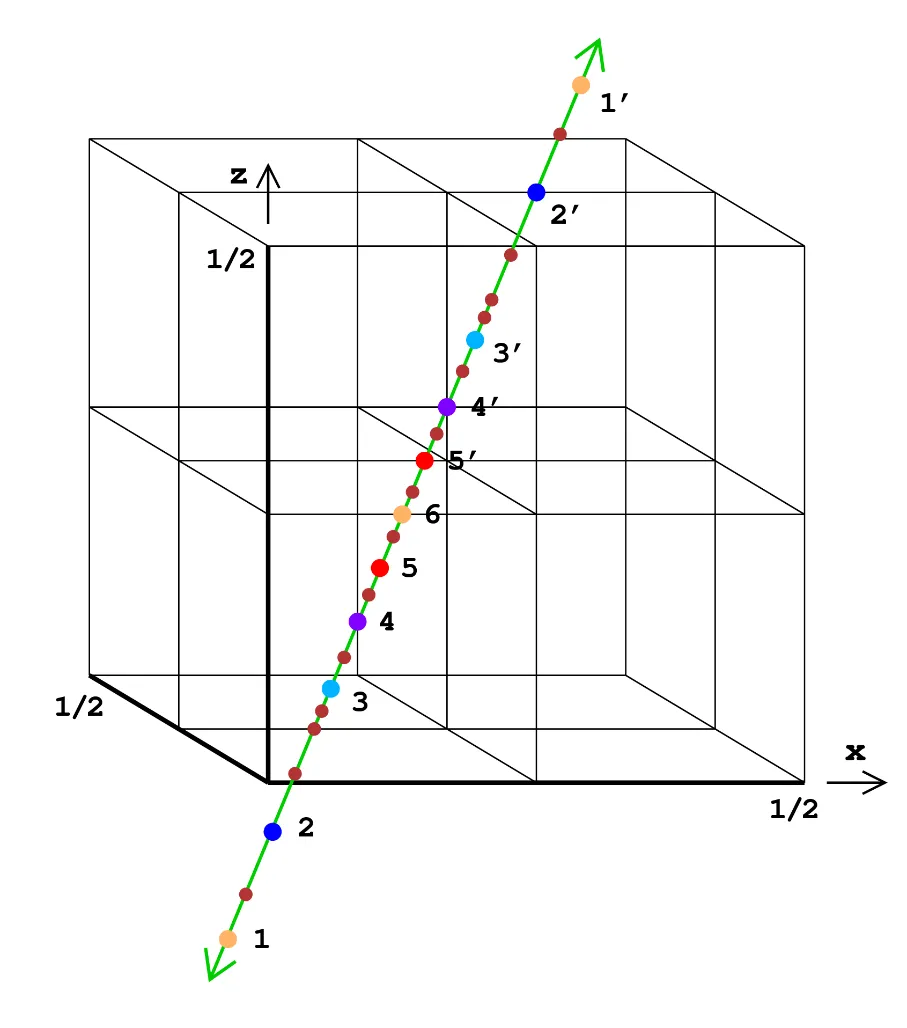
Fig. A. One octant of the unit cell and the twofold axis ⅛,y,¼-y of the I4132 space group with characteristic points generating various arrangements of spheres, marked by different numbers and colours.
Table. Characteristics of different sphere arrangements from Fig. 1.
| No. | Packing yes/no | Wyckoff site | Site symm. | Coord. no. | Space cover (%) | x | y | z | d |
|---|---|---|---|---|---|---|---|---|---|
| 1 | y | d | 222 | 4 | 18.04 | 0.125 | 0.5 | -0.25 | 0.30619 = √6/8 |
| 2 | y | h | 2 | 9 | 55.54 | 0.125 | 0.375 | -0.125 | 0.35355 = √2/4 |
| 3 | y | h | 2 | 4 | 20.51 | 0.125 | 0.22855 | 0.02145 | 0.25365 = √(9-6√2)/8 |
| 4 | y | a | 32 | 3 | 18.52 | 0.125 | 0.125 | 0.125 | 0.35355 = √2/4 |
| 5 | y | h | 2 | 3 | 5.55 | 0.125 | 0.05801 | 0.19189 | 0.16409 = (2√6-3√2)/4 |
| 6 | y | c | 222 | 4 | 18.04 | 0.125 | 0.0 | 0.25 | 0.30619 = √6/8 |
| 5’ | y | h | 2 | 3 | 5.55 | 0.125 | -0.05801 | 0.30811 | 0.16409 = (2√6-3√2)/4 |
| 4’ | y | a | 32 | 3 | 18.52 | 0.125 | -0.125 | 0.375 | 0.35355 = √2/4 |
| 3’ | y | h | 2 | 4 | 20.51 | 0.125 | -0.22855 | 0.47855 | 0.25365 = √(9-6√2)/8 |
| 2’ | y | h | 2 | 9 | 55.54 | 0.125 | -0.375 | 0.625 | 0.35355 = √2/4 |
| 1’ | y | d | 222 | 4 | 18.04 | 0.125 | -0.5 | 0.75 | 0.30619 = √6/8 |
| 1-2†a | n | h | 2 | 2 | 0.77 | 0.125 | 0.47 | -0.22 | 0.08485 |
| 1-2b | n | h | 2 | 2 | 30.23 | 0.125 | 0.45833 | -0.20833 | 0.28868 = √3/6 |
| 1-2c | n | h | 2 | 2 | 41.99 | 0.125 | 0.4 | -0.15 | 0.32210 |
| 2-3a | n | h | 2 | 2 | 24.53 | 0.125 | 0.3 | -0.05 | 0.26926 |
| 2-3b | n | h | 2 | 2 | 19.63 | 0.125 | 0.25 | 0.0 | 0.25 |
| 2-3c | n | h | 2 | 2 | 19.82 | 0.125 | 0.24 | 0.01 | 0.25080 |
| 3-4 | n | h | 2 | 2 | 14.26 | 0.125 | 0.175 | 0.075 | 0.12247 |
| 4-5 | n | h | 2 | 2 | 0.29 | 0.125 | 0.1 | 0.15 | 0.06124 |
| 5-6 | n | h | 2 | 1 | 0.77 | 0.125 | 0.03 | 0.22 | 0.08485 |
†A symbol of the form s-t denotes all points on the twofold axis in Fig. A, between points s and t.
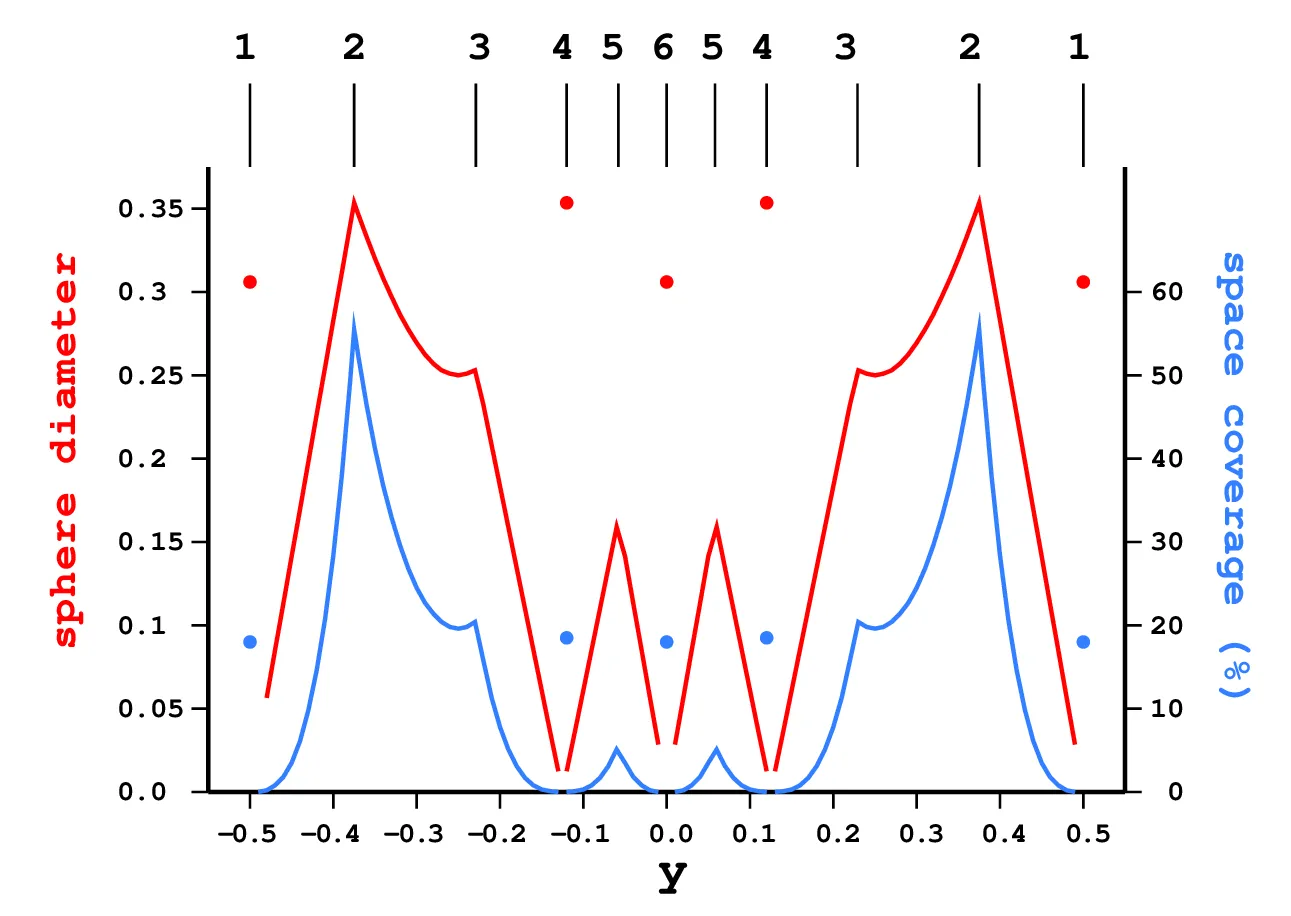
Fig. B. Sphere diameter (equal to the distance between centres of kissing spheres), red, and the space coverage (%), blue, for arrangements of spheres located along the twofold axis ⅛,y,¼-y in Fig. A. The numbers on top of the graph refer to the points included in Fig. A and Table 1.
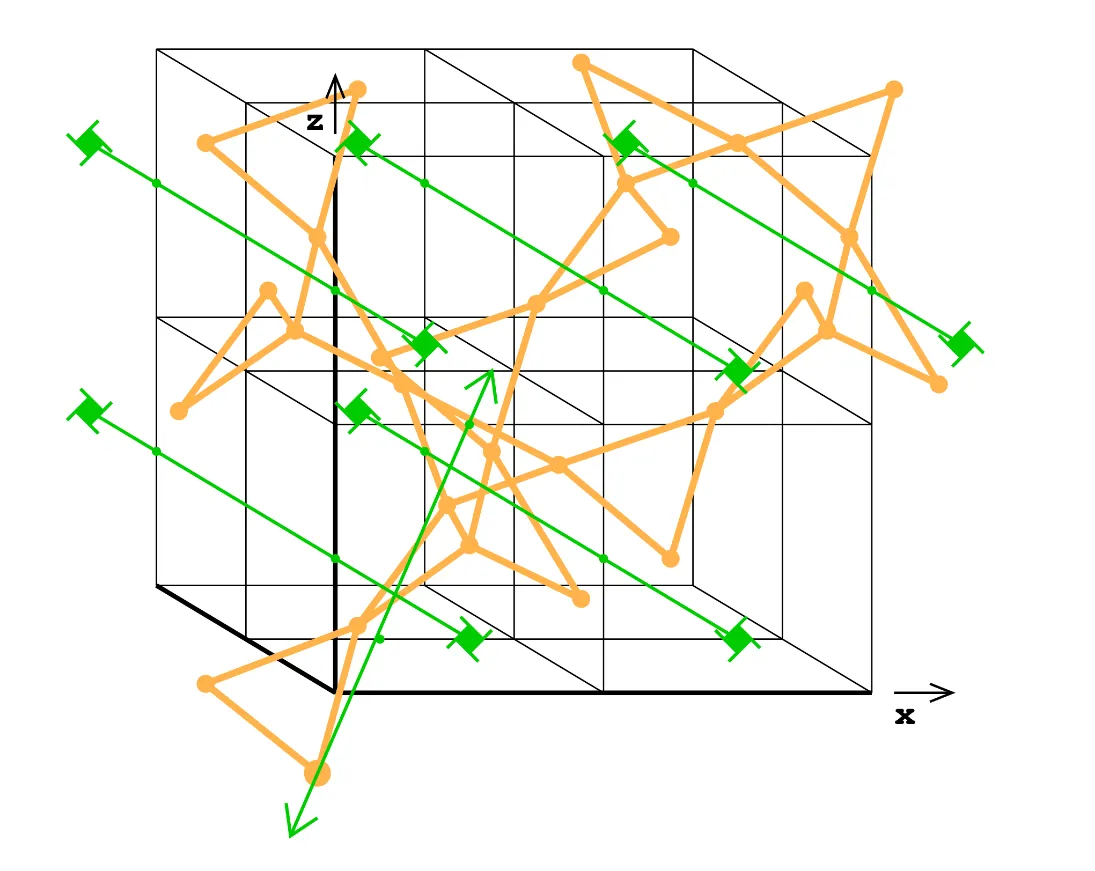
Fig. 1. Packing of spheres at position 1 of Table 1 and Fig. A, x = 0.125; y = 0.5; z = -0.25, and symmetry equivalents.
Point 1 lies at the Wyckoff position d with 222 (fourfold) site symmetry (Fig. 1; this and all following figures are numbered as the entries in Table 1). It is therefore the limiting point of the “asymmetric unit” along the twofold axis ⅛, y, ¼-y. The sphere packing consists of triangles of spheres whose centers are located at threefold axes at x = y = z = -⅛ and seven other equivalent points in the unit cell at the Wyckoff positions b with the local symmetry 32. A pair of neighbouring triangles share one common sphere, and this sphere is in touch with (i.e. is coordinated by) four other spheres at the corners of an orthorhombic tetrahedron. The spheres (and their triangles) are grouped along the fourfold screw axes, forming wide helices along the 41 screws and narrow helices along the 43 screws of the I4132 space group.
The sphere diameter of 0.30619 is rather large, but the packing density (space coverage) of 18.04% is moderate.
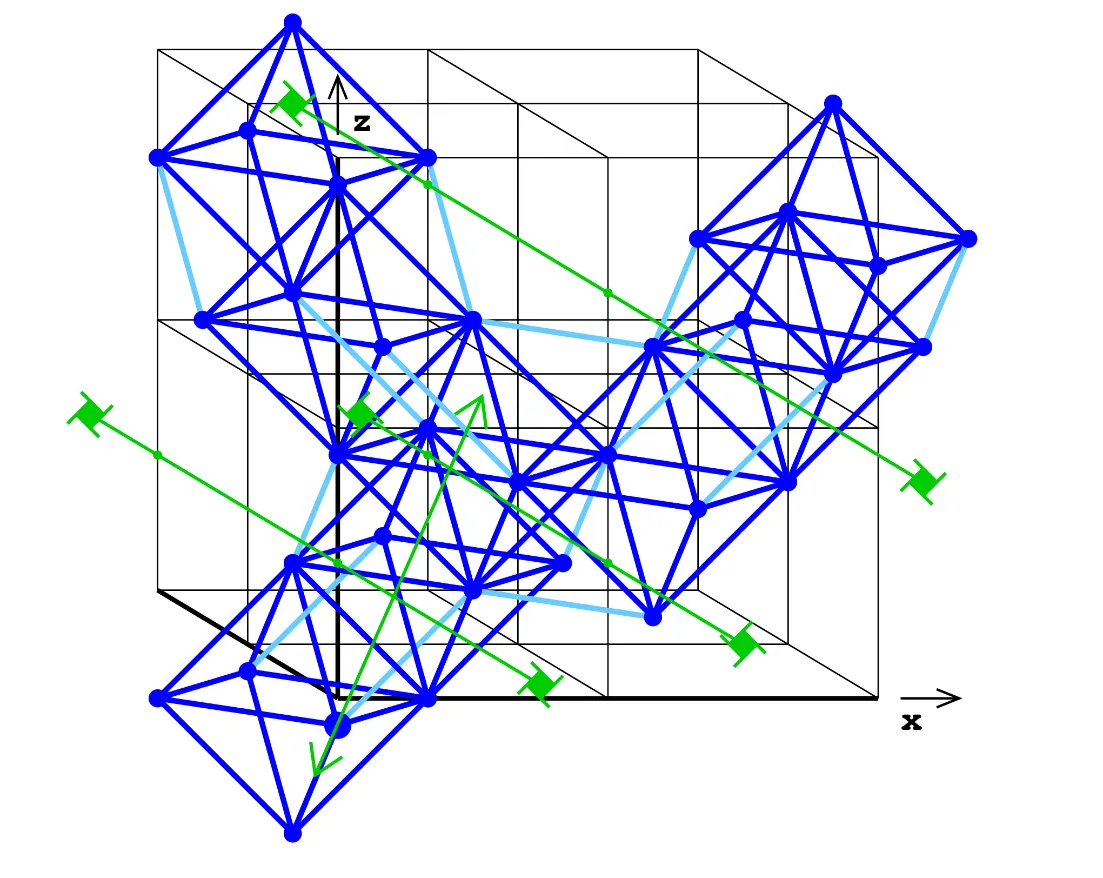
Fig. 2. Packing of spheres at position 2 of Table 1 and Fig. A, x = 0.125; y = 0.375; z = -0.125, and symmetry equivalents.
Point 2 lies at the Wyckoff position h on the twofold axis (Fig. 2). The sphere packing consists of octahedra of spheres centred at the Wyckoff b position with 32 site symmetry at x = ⅜, y = ⅝, z = ⅛ and seven other equivalent places in the unit cell. Each octahedron shares one edge (and two corners) with its three neighbours. Two tetrahedra are formed on both sides of such a pair of octahedra (enclosed by an additional edge, light blue in Fig. 2). The tetrahedra are located at the Wyckoff f position with the twofold axis site symmetry at x = ¼, y = ½, z = 0 and 23 other equivalent positions in the unit cell.
Each sphere is in contact with nine other spheres. The sphere diameter of √2/4 ≈ 0.35355 is relatively large and the space coverage of 55.54% is also rather high.
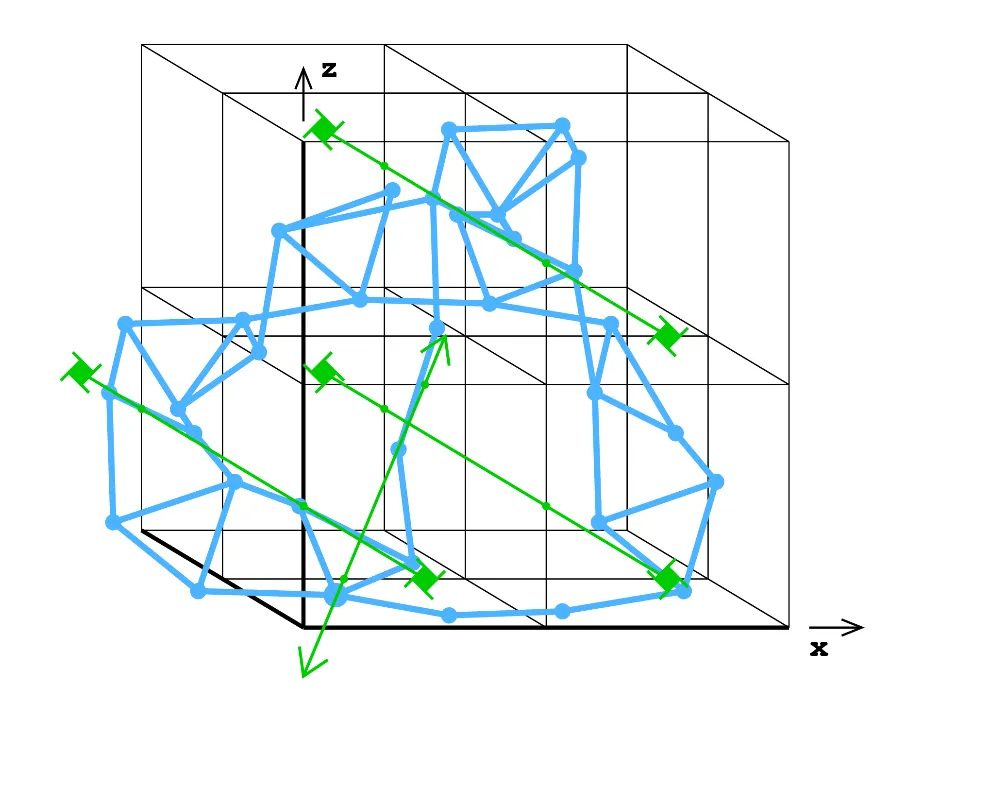
Fig. 3. Packing of spheres at position 3 of Table 1 and Fig. A, x = 0.125; y = 0.22855; z = 0.02145, and symmetry equivalents.
The orbit of point 3 (Fig. 3) with x = ⅛, y = (√8-1)/8, z = (3-√8)/8 consists of triangles of spheres centred at the threefold axes at the Wyckoff a position (x = y = z = ⅛). Each sphere is in contact with two spheres from two neighbouring triangles, so that a pair of triangles is joined by two extra edges. This creates a tetrahedron centred at the Wyckoff c position at 0,¼,⅛ (and all equivalents). However, this tetrahedron has not only the c site 222 symmetry, but tetragonal  2m symmetry with the
  axis along the x,¼+x,⅛ line. This “tetragonality” describes only the shape of the tetrahedron and does not extend to the overall symmetry of the sphere packing.
The sphere diameter (0.25365 = √(18-6√8)/4) and space coverage (20.51%) are medium in this case.
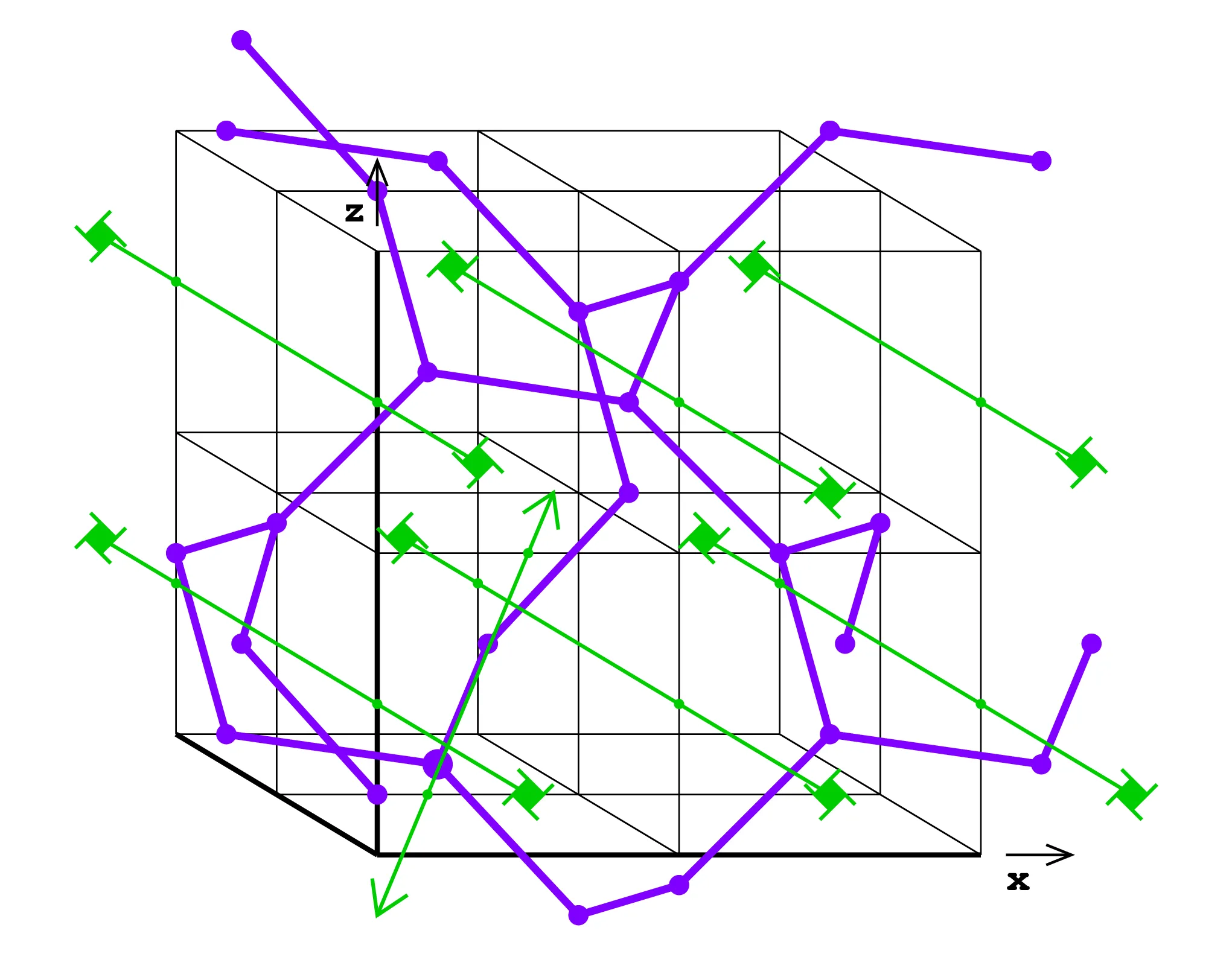
Fig. 4. Packing of spheres at position 4 of Table 1 and Fig. A, x = 0.125; y = 0.125; z = 0.125, and symmetry equivalents.
Point 4 lies at x = y = z = ⅛ at the Wyckoff a position with the six-fold site symmetry 32 (Fig. 4). Each sphere is surrounded by three neighbours located at the three twofold axes meeting at its centre.
In spite of the relatively large sphere diameter of 0.35355, the space coverage is medium (18.52%), since there are only eight spheres per unit cell.
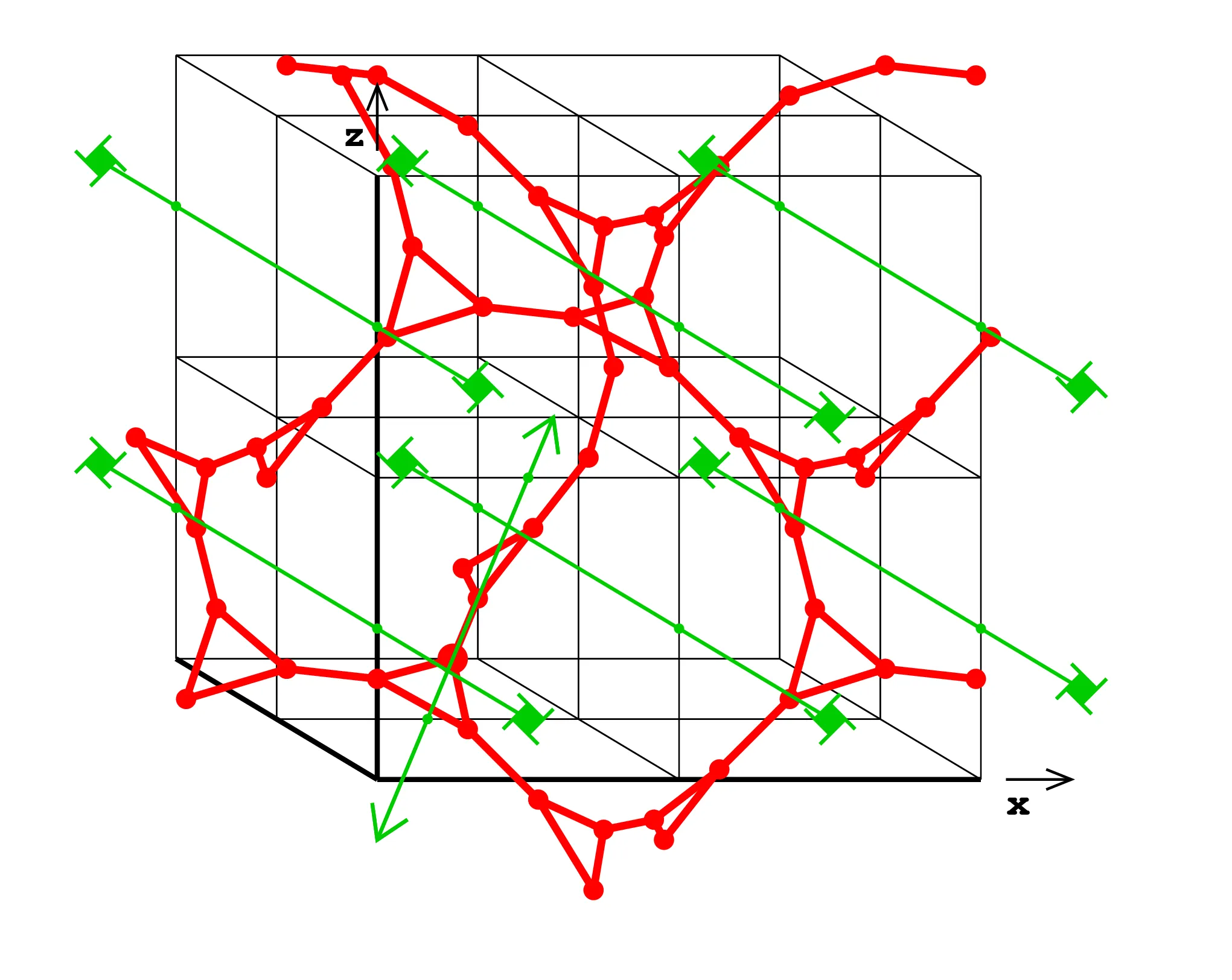
Fig. 5. Packing of spheres at position 5 of Table 1 and Fig. A, x = 0.125; y = 0.05801; z = 0.19189, and symmetry equivalents.
Orbit 5 consists of point x = ⅛, y = (2√3-3)/8, z = (5-2√3)/8 and its 23 symmetry equivalents in the unit cell (Fig. 5). All spheres lie at the twofold-axis Wyckoff h positions forming triangles around the Wyckoff a position at ⅛,⅛,⅛. Each sphere in one triangle is in contact with another sphere from a neighbouring triangle, and these contacts are along the twofold axes. The planes of two neighbouring triangles are twisted by 109.5° around the line joining them.
The sphere diameter d = 0.16409 = (2√6-3√2)/4 is very small, and with 24 spheres in the unit cell, the space coverage is only 5.55%. This is the smallest known space coverage for the regular sphere packing, described by Heesh & Laves (1933).
Each sphere is coordinated by three spheres forming an isosceles triangle. This coordination is therefore not stable, since the spheres are not locked at their positions.
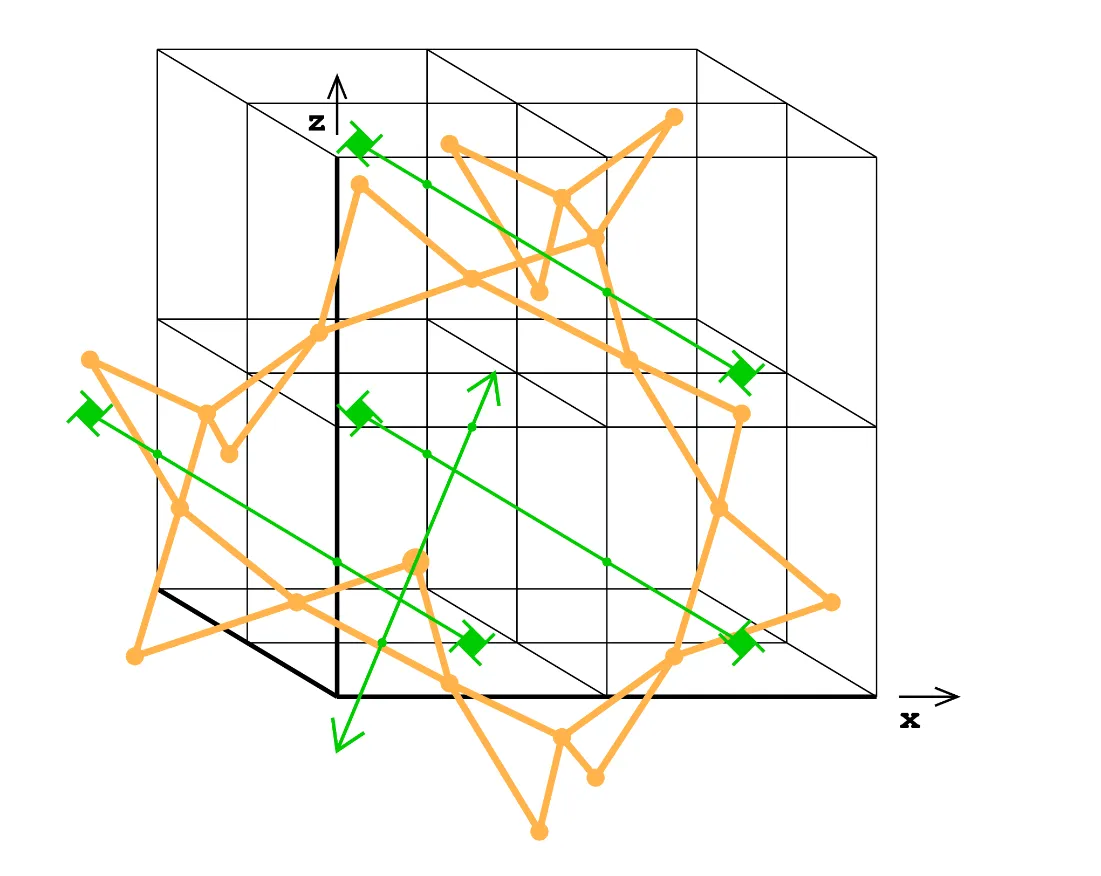
Fig. 6. Packing of spheres at position 6 of Table 1 and Fig. A, x = 0.125; y = 0.0; z = 0.25, and symmetry equivalents.
Packing 6 (Fig. 6) is similar to case 1, but the spheres are located at the Wyckoff c positions instead of d positions. The 222 site symmetry of these positions is the same, but the overall arrangement of spheres is different. Here, the triangles are located at x = y = z = ⅛ (and seven other equivalents) at the Wyckoff positions a, also with the local 32 symmetry. As a consequence, the “wide” helices run along the 43 screw axes and the “narrow” helices along the 41 axes.
Of course, the sphere diameter and the space coverage is the same as in case 1.
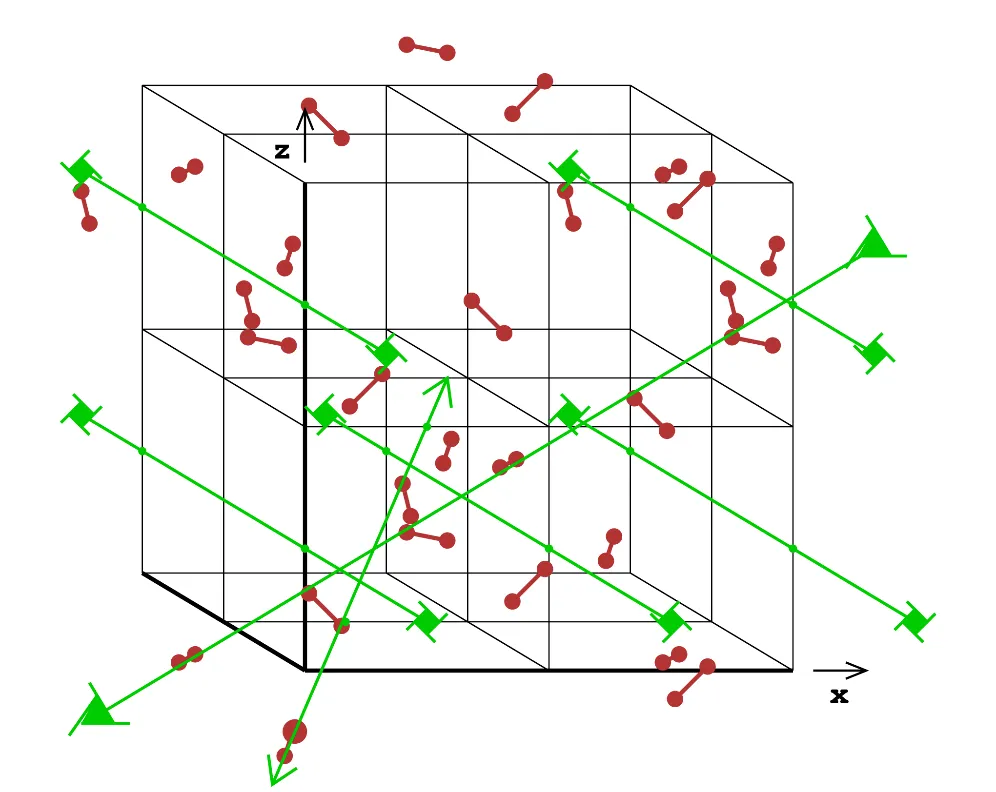
Fig. 1-2a. Packing of spheres at position 1-2a of Table 1, at x = 0.125; y = 0.47; z = -0.22, and symmetry equivalents.
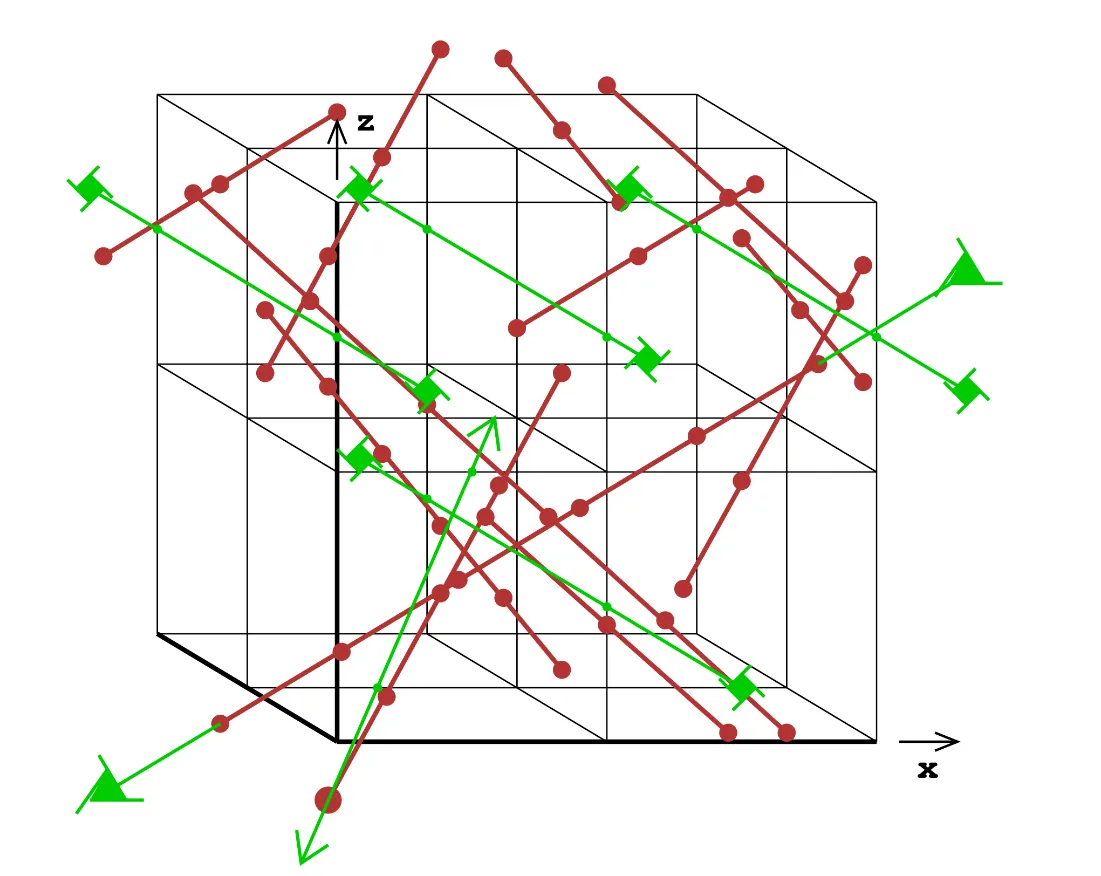
Fig. 1-2b. Packing of spheres at position 1-2b of Table 1, x = 0.125; y = 0.48533; z = -0.20833, and symmetry equivalents.
Spheres located at the first six positions of Table 1 form proper sphere packings, i.e. there is always a connection between any pair of spheres through a chain of touching spheres. However, spheres located along the twofold axis between these points form separate clusters and do not conform to the definition of sphere packing.
In the region between points 1 and 2, the spheres lie not only at the twofold axis, but also close to the threefold 31 screw axes (operation ½+z, ½+x, y-½ and equivalents).
In the vicinity of point 1 (at the 222 site, as in Fig. 1), the spheres are grouped into close pairs, related by those twofold axes, on which they do not lie.
Further away from the 222 site, closer to point 2, the spheres are arranged along the 31 axes forming separate helices running through the structure. The somewhat special point x = ⅜, y = 0.45833 = 11/24, z = -0.20833 = 5/24 lies exactly on the 31 axis and the spheres are positioned along straight lines, as in Fig. 1-2b.
The sphere diameter changes from infinitesimally small when the pairs of spheres are near point 1, to a value close to d = 0.35355 = √2/4 near point 2. The space coverage changes accordingly from near zero to almost 55.54%.
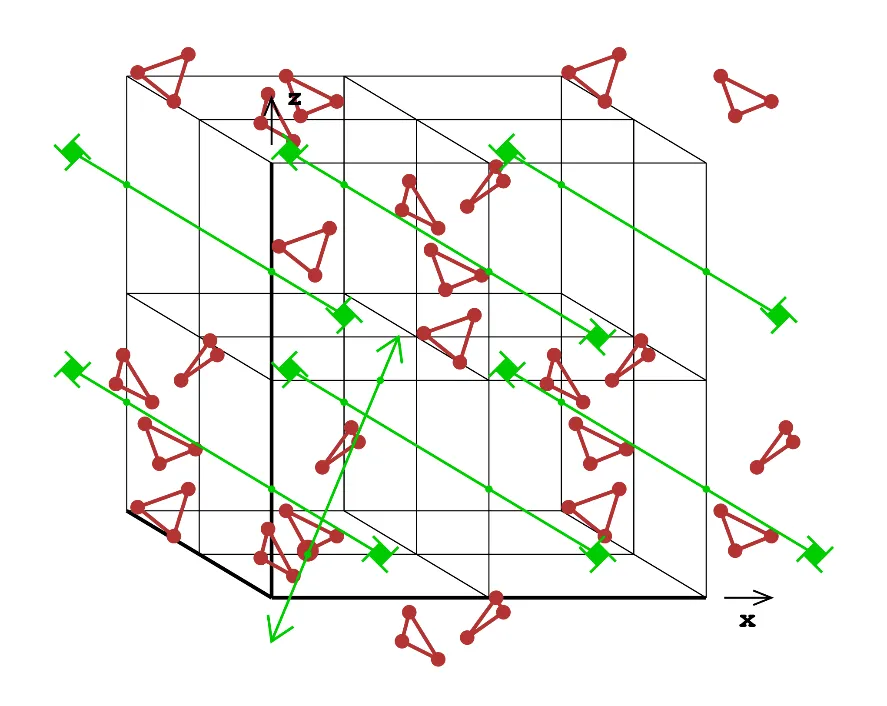
Fig. 3-4. Packing of spheres at position 3-4 of Table 1, x = 0.125; y = 0.175; z = 0.075, and symmetry equivalents.
The spheres in this region, between points 3 and 4 (Fig. 3-4), lie relatively close to the threefold axes, and prominent features of their arrangement are eight triangles of spheres scattered within the unit cell.
The sphere diameter changes from d = 0.256365 at point 3 to an infinitesimally small value near point 4, where three spheres slightly off the threefold axis have diameters close to zero. The space coverage varies between 20.51% and zero.
Author Information
Zbigniew Dauter1 and Mariusz Jaskolski2,3
1HKL Research, Inc., Charlottesville, USA (ORCID 0000-0002-8806-9066); 2Department of Crystallography, Faculty of Chemistry, Adam Mickiewicz University, Poznan, Poland; 3Institute of Bioorganic Chemistry, Polish Academy of Sciences, Poznan, Poland (ORCID 0000-0003-1587-6489);
Correspondence: [email protected], [email protected]
References
Dauter, Z. & Jaskolski, M. (2026). “Interesting packings of spheres in cubic space groups (3). From icosahedra to the loosest Heesch-Laves packing.” IUCr Newsletter 34, No. 4.
International Tables for Crystallography, Vol. A (2016). Space-group Symmetry, 6th ed. Aroyo, M. I., ed. Chichester: Wiley.
Heesch, H. & Laves, F. (1933). “Über dünne Kugelpackungen.” Z. Krist. 85, 443–453.
Related content