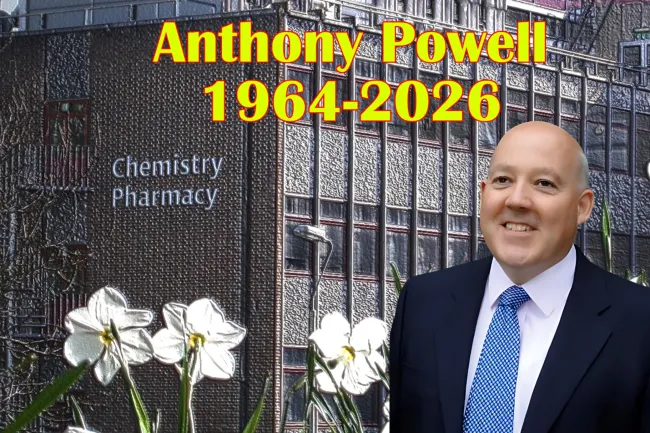
We are deeply saddened to report that Anthony Powell, Professor of Solid-State Materials Chemistry at the University of Reading, died on 22 May 2026 at age 62 after a long illness. Anthony had a distinguished academic career and made outstanding contributions to various areas of Solid-State Chemistry, most recently in thermoelectric materials, through multidisciplinary collaboration with physicists, materials scientists, and engineers worldwide.
Anthony studied chemistry at University College, Oxford and graduated in 1986. He went on to complete a DPhil. in 1990 in the Inorganic Chemistry Laboratory, Oxford, under the supervision of Dr Peter Dickens, focussing on uranium-oxide insertion compounds. After his doctorate, he undertook postdoctoral research in Oxford, first with Professor Sir Tony Cheetham FRS on zeolitic aluminophosphates, and then with Professor Peter Battle, investigating the structure and magnetic properties of 2nd- and 3rd-row transition-metal oxides. In 1992, Anthony moved north to join Heriot-Watt University as a Lecturer in Inorganic Chemistry, establishing a successful research group that initially worked on metal chalcogenides and later, with Paz Vaqueiro, on thermoelectric materials with potential applications in, for example, waste heat recovery. He was promoted to Reader in 2000 and to Professor of Solid-State Chemistry in 2008. Whilst at Heriot-Watt, he received a Royal Society of Edinburgh Research Fellowship and a Scottish Enterprise Proof-of-Concept award to further develop his work on thermoelectric materials. In 2013, he moved to the University of Reading to take up the roles of Head of the Department of Chemistry and Research Division Lead for Chemical Sciences.
Anthony was a strong supporter and leader of the UK thermoelectric research community. Together with Professor Robert Freer (University of Manchester), he founded and co-chaired the EPSRC-funded UK Thermoelectric Network. He was also recently appointed to the Board of the International Thermoelectric Society and served as an Associate Editor of the Journal of Solid State Chemistry. Despite these time-consuming roles, Anthony always found time to mentor, support and train research students. Many of his former students are employed in industry, central facilities, and universities worldwide and greatly appreciate the careful supervision they received during their time in his research group.
Throughout his career, X-ray and neutron diffraction underpinned most of Anthony’s research projects. He often reflected on how these techniques evolved over his scientific lifetime. In his early postgraduate years at Oxford, he still used a Guinier camera with photographic film! Not long after ISIS opened its doors to academic users, he carried out his first neutron experiment there, beginning a long and productive association with the facility. Over the years, he developed many close and lasting collaborations with scientists at ISIS and remained deeply committed to the value of central facilities. His final neutron diffraction measurements were made at ISIS in March this year, despite being seriously ill. Anthony made significant contributions to ISIS, serving on its Facility Allocation Panels (2004–2006) and Neutron Training Course Selection Panels (2013–2025). He also chaired the Science Advisory Committee (2006-12) for the development of the £3.5M upgrade to Polaris, helping to secure its position as a world-leading powder neutron diffractometer.
Anthony was an excellent colleague at Reading and is much missed by his family and friends.
Author Information
Ann Chippindale and Paz Vaqueiro
University of Reading