
I was fortunate to attend the Calgary IUCr Congress in August. This was such a huge meeting of around 1800 participants, with a substantial commercial exhibition and an inexhaustible list of scientific sessions covering just about every corner of crystallography. The organisers deserve several rounds of applause for having put together such a memorable and smooth-flowing conference. I have attended almost all the IUCr Congresses since Moscow in 1966, and I always enjoy them as a chance to meet up with old friends and fellow crystallographers and make new acquaintances.
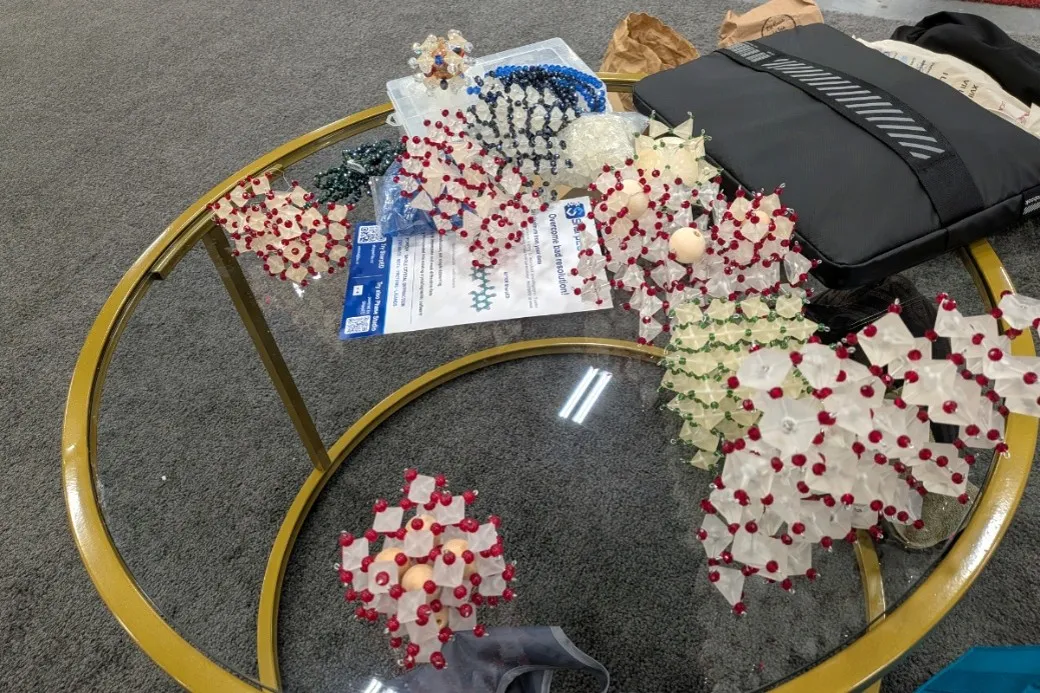
Models of the perovskite crystal structure made by Leo Suescun from Uruguay
I was delighted to meet once again my friend Leo Suescun from Uruguay, who brought to Calgary models of my favourite crystal structure, which made a beautiful display. Mind you, with each Congress I note that fewer of my old friends are around, having passed on in the intervening times. But rather than dwell on such gloomy matters, I found it particularly refreshing to see and meet so many young crystallographers. Our field of study continues to thrive, and the Calgary meeting truly showed this.
In my opinion, crystallography is a separate scientific discipline, not merely a tool for solving crystal structures, which today can be done almost automatically thanks to incredible developments in diffractometers and allied software. One look at, say, the Calgary Congress list of symposia shows how widely crystallography reaches across the sciences, including physics, chemistry, materials science, biology, electron diffraction, etc. A key area crystallographers have traditionally focused on is ensuring a unified language of communication, especially in respect of symmetry. I refer to the work many have done to define the terminology and nomenclature we use as part of our tools. This is as true in crystallography as it is in any science. By the way, did you know that the IUCr has an online dictionary of crystallographic terms?
However, for some obscure reason, crystallographic terminology continues to be used incorrectly in scientific publications, whereas this would not be accepted in any other scientific discipline. After all, no one would dare confuse terms such as entropy and energy in a publication, nor would they dare confuse energy and field, etc. Terminology exists to make sure everyone understands what we mean. Failing to appreciate this has, on occasion, led to disasters. For example, during the charge of the Light Brigade in 1854, a misunderstood order and command led to the deaths of over 270 soldiers at the Battle of Balaclava. Another example is the Mars Climate Orbiter (1999), which failed because of confusion between US and SI units. You can find many more examples online.
One of the most common misconceptions made by non-crystallographers (and unbelievably sometimes crystallographers too) is the perennial lattice-structure battle (see Nespolo’s article “The lattice sickness pandemic”). For the record, there are no atoms in a lattice! But it doesn’t stop there. Take a look at a recent book review by Massimo Nespolo, which illustrates an extreme example of flawed thinking.
In this issue, we have a fascinating article by Areej Abuhammad on starting protein crystallography in Jordan. Jordan already hosts the SESAME synchrotron for diffraction studies, so Areej’s work is a valuable contribution to developing modern crystallographic methods in the Middle East, despite the problems in the region with which we are familiar. Well done, Areej! Did you know that cockroaches actually produce crystals of milk! Leonard Chavas tells us about it and how he won the Ig-Nobel Prize. Crystallography is just everywhere.
Zbigniew Dauter and Mariusz Jaskolski once again discuss how to pack spheres within the confines of cubic space group symmetry. John Helliwell has also written about forming a new IUCr advisory committee on industrial structural science. This has come about through discussion with the IUCr Executive Committee during the Calgary meeting.
Finally, we have two obituaries: one for Anthony Powell (University of Reading, UK) and the other for Nobel Laureate Ada Yonath (Weizmann Institute, Israel). Anthony was well known for his work on the crystallography of materials, in particular thermoelectric materials. Ada shared the 2009 Nobel Prize in Chemistry with Venki Ramakrishnan (UK) and Thomas A. Steitz (USA). This was for her work on determining the structure and function of the ribosome. The ribosome is a ribonucleoprotein particle found in all cells that synthesises proteins by translating genetic information encoded in messenger RNA (mRNA). This involved determining the positions of nearly 270000 non-hydrogen atoms, a remarkable feat for its time. Much of this was achieved by the use of flash-cooling a crystal. To get some impression of how the ribosome creates new proteins, I recommend viewing this video.