





Obituary
Dr. L. M. Pant (1928-2025)
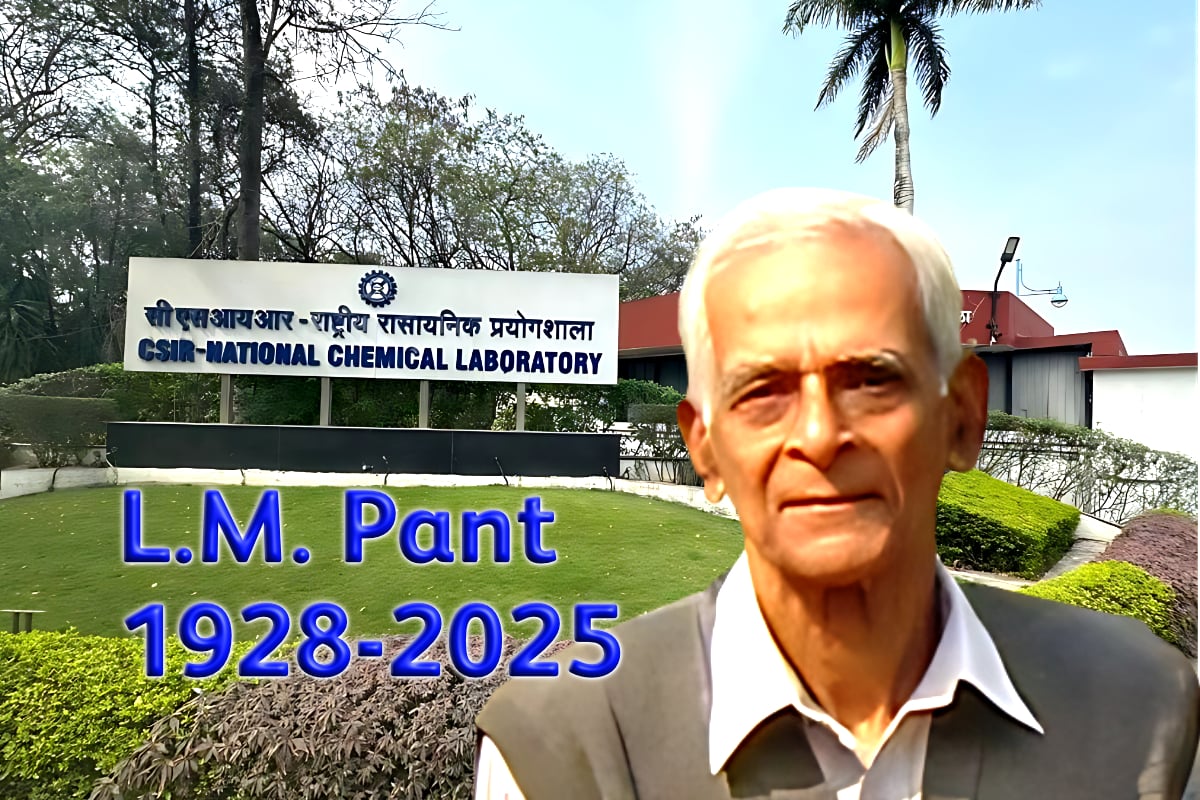
Dr. L. M. Pant, a distinguished scientist and one of the pioneers of X-ray crystallography in India, passed away on 2 December 2025 at Noida (Delhi NCR), Uttar Pradesh, at the age of 97. He was the founder of the X-ray Crystallography Group at the CSIR-National Chemical Laboratory (CSIR-NCL), Pune, where he made lasting contributions to structural chemistry and crystallographic research.
Dr. Pant was born to Hansa Dutt Pant and Laxmi Devi in Bareilly (in the state of Uttar Pradesh) on 19 August 1928. He had four siblings, two brothers and two sisters. He completed his schooling in Allahabad and his intermediate education at Government Inter College (GIC), Almora, Uttarakhand, before obtaining his B.Sc. and M.Sc. degrees from the University of Allahabad in 1945 and 1947, respectively. Although he joined initially for his doctoral work under the supervision of Prof. GB Deodhar in the University of Allahabad, later he went on to earn his Ph.D. in 1956 from University College London (UCL) under the supervision of Professor Dame Kathleen Lonsdale, one of the most eminent crystallographers of the twentieth century. Professor Lonsdale was among the first two women, along with Marjory Stephenson, to be elected a Fellow of the Royal Society (FRS) in 1945, and is renowned for establishing the planar hexagonal structure of benzene by single-crystal X-ray diffraction. During his time at UCL, Dr. Pant worked closely with Professor Lonsdale and Dr. Judith Milledge, gaining deep expertise in X-ray diffraction measurements and structure refinement. In the Lonsdale group, Dr. Pant was primarily responsible for experimental X-ray measurements, while computational aspects were handled by Dr. Milledge. His early research led to significant publications, including the crystal structures of 1,3,5-trichlorobenzene at -183 °C and 20 °C, as well as hexa- and deca-methonium bromides.
In 1959, Dr. Pant joined the CSIR-National Chemical Laboratory, Pune, in the Physical and Structural Chemistry Division headed by Dr. APB Sinha, during the directorship of Dr. K. Venkataraman. He established the X-ray Crystallography Group at NCL and set up the X-ray diffraction facility, including a Weissenberg camera, which was extensively used for single-crystal structure determination in that era. During his early years at NCL, he collaborated with senior scientists such as Dr. AB Biswas on the crystal structures of pyruvate derivatives, nickel β-alanine dihydrate, and several other compounds.
Dr. Pant’s primary research interest centered on the crystal structures of benzene derivatives, including o- and p-nitrobenzene, p-nitroaniline, and m- and p-nitrobenzoic acid. His work focused on understanding charge distribution in aromatic systems and on investigating the influence of electron-withdrawing (EW) and electron-donating (ED) substituents at the para position on the central C-C bond length of the benzene ring. He was particularly interested in low-temperature diffraction studies and charge-density analysis, an area that today aligns closely with what is known as quantum crystallography.
Throughout his career at NCL, Dr. Pant mentored and collaborated with several scientists who later became prominent figures in crystallography and structural chemistry, including the late Dr. S. S. Tavale, the late Dr. N. N. Dhaneshwar, Prof. T. N. Guru Row, Dr. Vedavati Puranik, and Prof. Ravi Acharya. He retired from CSIR service in 1988, leaving behind a strong legacy of crystallographic research and infrastructure at NCL.
He was married to Dr. Usha Pant, who was a cell-biologist at the National Institute of Virology in Pune. He is survived by two sons, Bharat and Dhruv.
Dr. Pant will be remembered as a dedicated scientist, a meticulous experimentalist, and a pioneer who laid the foundation for X-ray crystallography research at CSIR-NCL. His contributions continue to influence generations of crystallographers and structural chemists in India.
Dr. Pant was born to Hansa Dutt Pant and Laxmi Devi in Bareilly (in the state of Uttar Pradesh) on 19 August 1928. He had four siblings, two brothers and two sisters. He completed his schooling in Allahabad and his intermediate education at Government Inter College (GIC), Almora, Uttarakhand, before obtaining his B.Sc. and M.Sc. degrees from the University of Allahabad in 1945 and 1947, respectively. Although he joined initially for his doctoral work under the supervision of Prof. GB Deodhar in the University of Allahabad, later he went on to earn his Ph.D. in 1956 from University College London (UCL) under the supervision of Professor Dame Kathleen Lonsdale, one of the most eminent crystallographers of the twentieth century. Professor Lonsdale was among the first two women, along with Marjory Stephenson, to be elected a Fellow of the Royal Society (FRS) in 1945, and is renowned for establishing the planar hexagonal structure of benzene by single-crystal X-ray diffraction. During his time at UCL, Dr. Pant worked closely with Professor Lonsdale and Dr. Judith Milledge, gaining deep expertise in X-ray diffraction measurements and structure refinement. In the Lonsdale group, Dr. Pant was primarily responsible for experimental X-ray measurements, while computational aspects were handled by Dr. Milledge. His early research led to significant publications, including the crystal structures of 1,3,5-trichlorobenzene at -183 °C and 20 °C, as well as hexa- and deca-methonium bromides.
In 1959, Dr. Pant joined the CSIR-National Chemical Laboratory, Pune, in the Physical and Structural Chemistry Division headed by Dr. APB Sinha, during the directorship of Dr. K. Venkataraman. He established the X-ray Crystallography Group at NCL and set up the X-ray diffraction facility, including a Weissenberg camera, which was extensively used for single-crystal structure determination in that era. During his early years at NCL, he collaborated with senior scientists such as Dr. AB Biswas on the crystal structures of pyruvate derivatives, nickel β-alanine dihydrate, and several other compounds.
Dr. Pant’s primary research interest centered on the crystal structures of benzene derivatives, including o- and p-nitrobenzene, p-nitroaniline, and m- and p-nitrobenzoic acid. His work focused on understanding charge distribution in aromatic systems and on investigating the influence of electron-withdrawing (EW) and electron-donating (ED) substituents at the para position on the central C-C bond length of the benzene ring. He was particularly interested in low-temperature diffraction studies and charge-density analysis, an area that today aligns closely with what is known as quantum crystallography.
Throughout his career at NCL, Dr. Pant mentored and collaborated with several scientists who later became prominent figures in crystallography and structural chemistry, including the late Dr. S. S. Tavale, the late Dr. N. N. Dhaneshwar, Prof. T. N. Guru Row, Dr. Vedavati Puranik, and Prof. Ravi Acharya. He retired from CSIR service in 1988, leaving behind a strong legacy of crystallographic research and infrastructure at NCL.
He was married to Dr. Usha Pant, who was a cell-biologist at the National Institute of Virology in Pune. He is survived by two sons, Bharat and Dhruv.
Dr. Pant will be remembered as a dedicated scientist, a meticulous experimentalist, and a pioneer who laid the foundation for X-ray crystallography research at CSIR-NCL. His contributions continue to influence generations of crystallographers and structural chemists in India.
Rajesh Gonnade, CSIR- National Chemical Laboratory, Pune
Shekhar C. Mande, Savitribai Phule Pune University and National Centre for Cell Science, Pune
Copyright © - Prior permission is not required to reproduce short quotations, tables and figures from this article, provided the original authors and source are cited.
The permanent URL for this article is https://www.iucr.org/news/newsletter/volume-34/number-1/dr.-l.-m.-pant-1928-2025

