


Meeting report
Smart Crystals and Computational Design Among Highlights of BCS-13
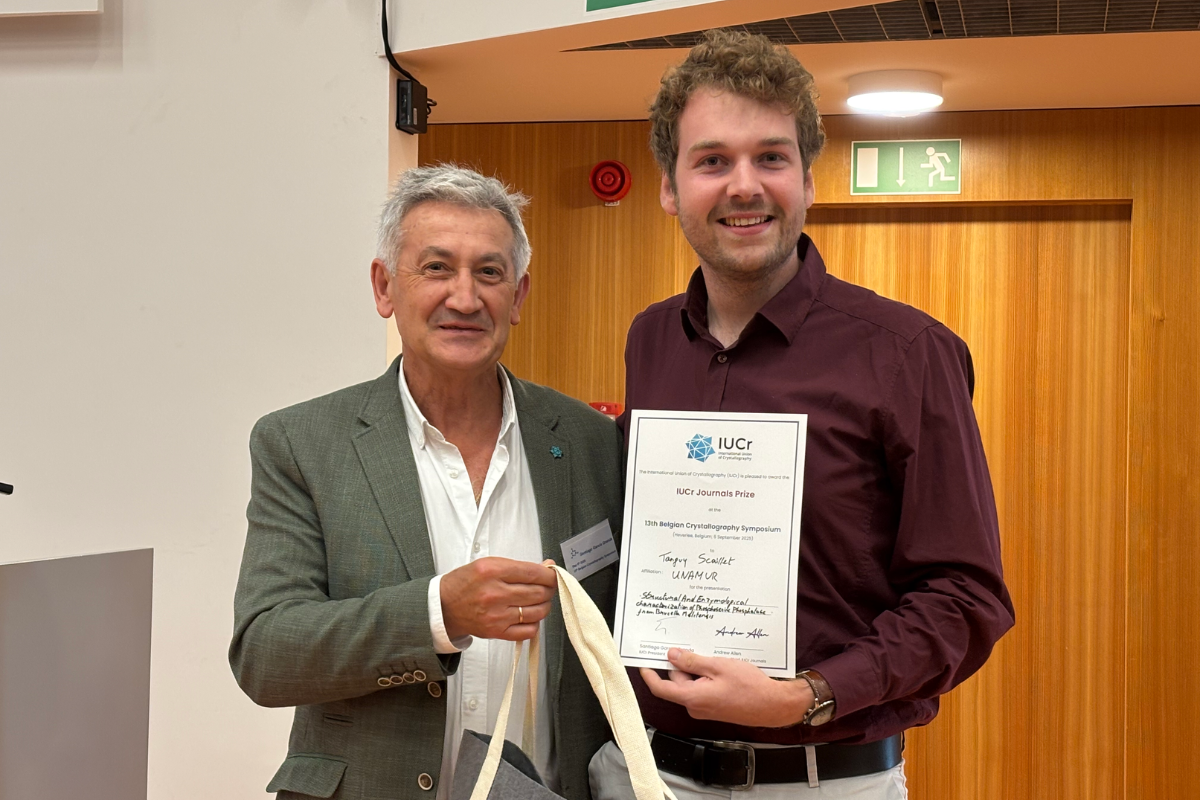
IUCr Journals prize awardee Tanguy Scaillet (UNamur) (right).
More than 90 participants attended the 13th Belgian Crystallography Symposium BCS-13, which took place on September 5, 2025, at the KU Leuven Campus in Heverlee. The National Committee for Crystallography organizes this symposium biennially to promote contacts between Belgian scientists who use diffraction and microscopy techniques for research in the fields of chemistry and physics, materials science, earth sciences, and life sciences. In his welcome address, Professor Tom Leyssens noted that the Academy's traditional location in Brussels had been moved to Leuven this time to mark the retirement of Professor Luc Van Meervelt, secretary of the National Committee since 2000.
The morning session was opened by Professor Santiago Garcia Granda (President of the IUCr), who emphasized the role of the IUCr in the 21st century and the future of structural science. The session was continued by Professor Juan Manuel Garcia-Ruiz (Granada). In his lecture, he highlighted the important role of silica in the origin of life on our planet. A revised Miller-Urey experiment demonstrated that the use of a borosilicate reactor is highly dependent on the reactor used and that silica, at high pH, induces the self-assembly of alkaline earth carbonates into biomimetic structures. At higher pH, silica combines with metals to form metal-oxide-silica membranes that catalyse the condensation of formamide into nucleobases and amino acids.
Before lunch, 13 flash presentations were given, including four from our sponsors. During the lunch break, participants had time to visit the poster session and our sponsors' booths. In the afternoon, Professor Kristof Van Hecke (UGent) showed several examples of flexible and photodynamic smart crystals. Organoboron-based Lewis acid-base type crystals exhibit photodynamic effects such as splitting, jumping and moving in response to ultraviolet or visible light. The motions are associated with topochemical [2+2] cycloaddition reactions. As the symposium was organised in collaboration with the FNRS contact group "Synchrotron radiation", Dr Carla Bittencourt (Mons) gave an overview of transnational access to synchrotron facilities and Professor Bart Goderis (KU Leuven) explained the transition of the DUBBLE beamline at ESRF to the Flemish beamline for Advanced Materials Exploration (FLAME). Referring to the 2024 Nobel Prize in Chemistry, awarded for computational protein design and protein structure prediction, Professor Arnout Voet (KU Leuven) gave a lecture on computational design and the crystallographic evaluation of functional protein assemblies. The computational design and structure determination of symmetric proteins were illustrated using proteins with names like Pizza, Cake, and Taco. The afternoon session concluded with a "Surprise" by Dr Koen Robeyns, highlighting the career of Professor Luc Van Meervelt.
During the closing remarks, two CCDC poster prizes were awarded to Marie Fastré (UNamur) and Guillaume Esser (UCLouvain), together with an IUCr Journals prize for Tanguy Scaillet (UNamur). This BCS-13 meeting was sponsored by Anton Paar, Malvern Panalytical, Bruker AXS, UCB, Rigaku, CGB-CBB, FNRS, KU Leuven, CCDC and IUCr Journals.
Copyright © - Prior permission is not required to reproduce short quotations, tables and figures from this article, provided the original authors and source are cited.



