Ilia A. Guzei
The provocative saying “All science is either physics or stamp collecting” is attributed to the Nobel Prize laureate physicist Ernest Rutherford. Any self-respecting chemist may take an issue with this statement, but not this article; the subject of this essay is a postage stamp that reconciles physics and philately – it depicts the likeness of a famous physicist, the winner of the very first Nobel Prize in physics in 1901, his laboratory, and a radiograph.
On March 23, 2025, Pakistan Day, Pakistan issued a postage stamp, Figure 1, and an imperforate souvenir sheet (ISS), Figure 2, commemorating the 130th anniversary of the discovery of X-rays by the German physicist Wilhelm Conrad Röntgen (1845–1923) [7]. The issue of the stamp and ISS also acknowledges the significant contributions of the global medical technology giant Siemens Healthineers to the advancement of healthcare in Pakistan. There are at least 56 official postage stamps and souvenir sheets dedicated to Röntgen and his discovery that have been released by 40 countries. In 2023, Munk & Peh described most of these stamps [6], and posters featuring my collection of such stamps is available on the UW–Madison X-ray laboratory’s website [4].
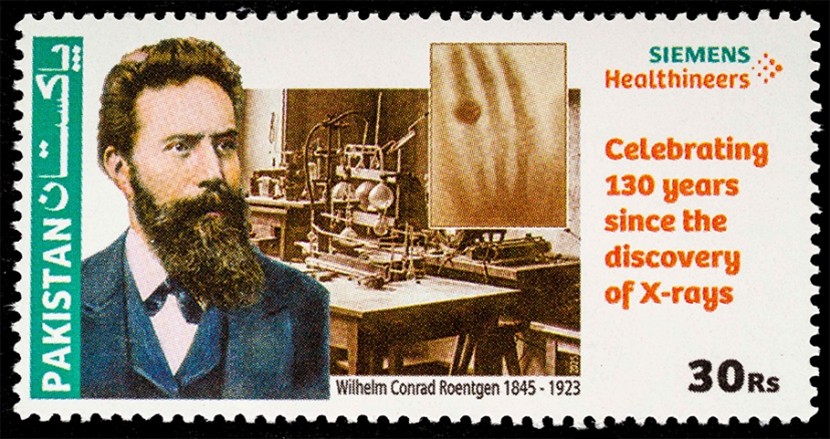
Figure 1. The 2025 Pakistani stamp commemorating the 130th anniversary of the discovery of X-rays by the German physicist Wilhelm Conrad Röntgen.
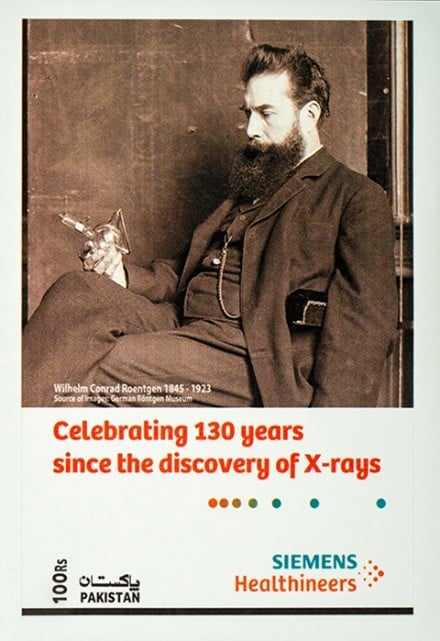
Figure 2. The 2025 Pakistani imperforate souvenir sheet commemorating the 130th anniversary of the discovery of X-rays by the German physicist Wilhelm Conrad Röntgen.
The 2025 Pakistani stamp shows a colorized photograph of Röntgen, a part of his laboratory at the former Physical Institute of the University of Würzburg, and an X-ray photograph of Frau Anna Bertha Röntgen’s hand. The story associated with the latter is that on December 22, 1895, Röntgen invited his wife to the laboratory and irradiated her left hand, placed on a photographic plate, for 15 minutes. It is said that Frau Röntgen, when asked what she thought when she saw the resultant (first ever) radiograph of her hand with a floating wedding ring, answered “I have seen my death”. Copies of the radiograph were critical for documenting the detection of a new type of light that Röntgen called X; X stands for the unknown. The first radiograph, as well as a much sharper, later one of Professor von Kölliker’s left hand are usually depicted on stamps celebrating Röntgen [12]. The discovery and genealogy of X-rays are comprehensively described in Otto Glasser’s “Wilhelm Conrad Röntgen and the Early History of the Röntgen Rays” [3]. Glasser, a significant figure in radiology himself, meticulously documented Röntgen’s life, experiments, and the immediate impact of X-rays, establishing the foundation for radiology as a medical and scientific discipline. A delightful book “Naked to the Bone (Medical Imaging in the 20th century)” [5] has a brief account of the discovery and also describes the birth of daughter technologies of X-rays, such as Magnetic Resonance Imaging, Positron Emission Tomography, and ultrasound.
The souvenir sheet features a thoughtful Röntgen with a Crookes cathode tube in his hand. The source of the photographs on the stamp and ISS is the Röntgen Museum in Würzburg, Bavaria, Figure 3. The full image, as displayed at the Museum, is shown in Figure 4.
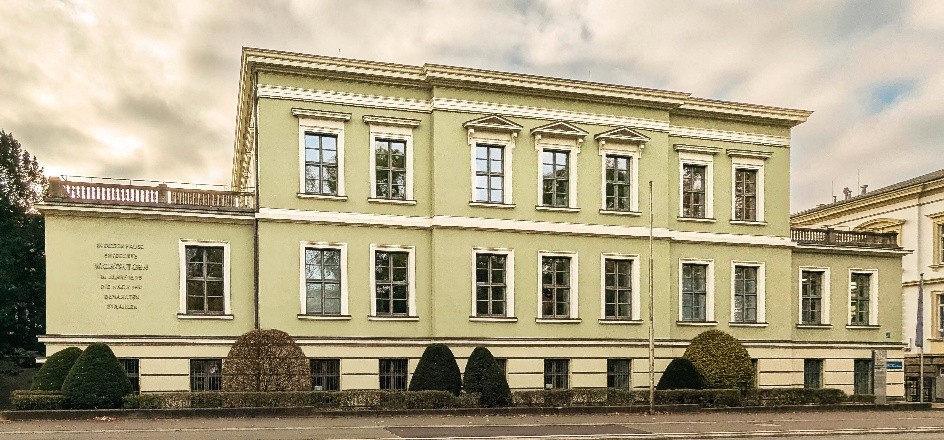
Figure 3. The former Physical Institute of the University of Würzburg, now the University of Applied Sciences Würzburg which houses the Röntgen-Memorial.
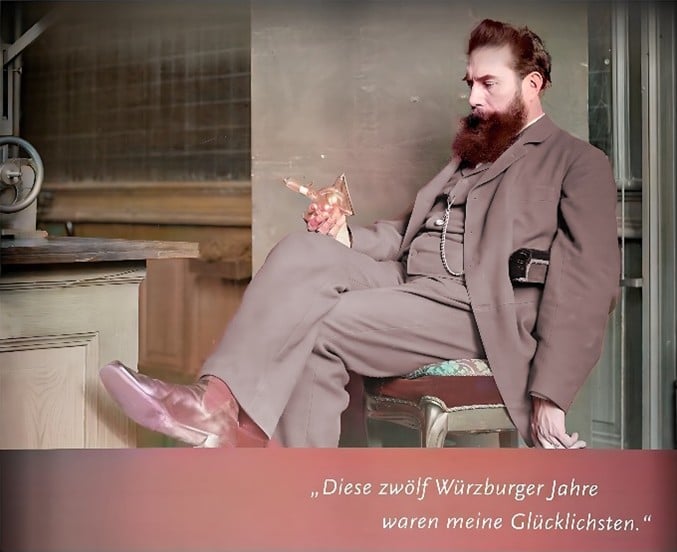
Figure 4. A colorized image of Conrad Röntgen as displayed at the Röntgen Museum in Würzburg. The text below the photograph reads "These twelve Würzburg years were my happiest."
The use of photographic images rather than paintings is appropriate because Röntgen was a photography enthusiast and often vacationed with a camera. In fact, his interest in photography was essential for documenting the discovery of X-rays. The photographic evidence served as irrefutable proof of X-rays’ unique penetrating power. Consequently, the visual nature of X-ray images played a critical role in how quickly the news traveled and was accepted globally. The depiction of Röntgen with a Crookes cathode tube is therefore highly fitting, underscoring that his background in photography provided the perfect technological means to record and present his groundbreaking scientific work effectively.
The Röntgen Memorial Museum, located at the University of Applied Sciences in Würzburg, is a remarkable place to visit [13]. Lewis Etter visited the museum 80 years ago and described it in the article “Post-war visit to Röntgen laboratory” [2]. The article, in part, motivated my wife and me to visit this historic place in December 2024. The museum is in the original former Physics Department that astonishingly survived the heavy bombing by Allied forces in 1945. The free museum consists of a few rooms, and visitors are allowed to roam free – there are no curators or security staff. Among other facts, Etter described a noteworthy detail that Röntgen’s gun stood in a corner intact with a note in English saying “This is the gun which Röntgen first photographed with his rays. If taken, please take it with care and precaution as it a museum piece”. Sadly, we did not see the gun, but did see many of artifacts described by Etter, including the postmortem moulage of Röntgen’s hands, Figure 5.
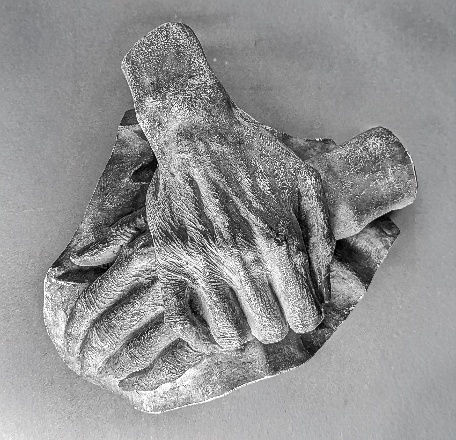
Figure 5. The postmortem moulage of Röntgen’s hands.
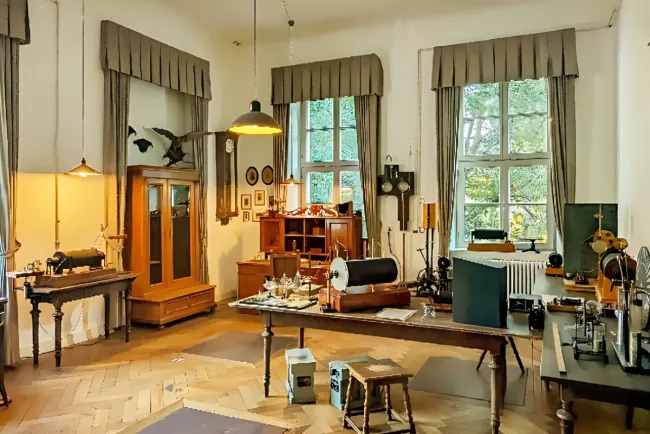
The exhibit has been rearranged since 1945, and the laboratory can be viewed only from its doorstep – there is no inside access, Figure 6. The exhibits include many informational posters, diplomas with Röntgen’s honorary degrees, a video show, and historical artifacts. We learned new things about the discoverer’s family, and seeing the famous laboratory in person was moving. It was fascinating to learn that at Röntgen’s time the city of Würzburg planned to lay a streetcar line on the street next to the building housing his laboratory. Röntgen figured that the vibration and electromagnetic interference to be caused by railroad traffic would affect the precision of his measurements and petitioned the city asking to reroute the tram line further from the department. The request was honored and even today the street next to the building features only traffic on pneumatic tires.
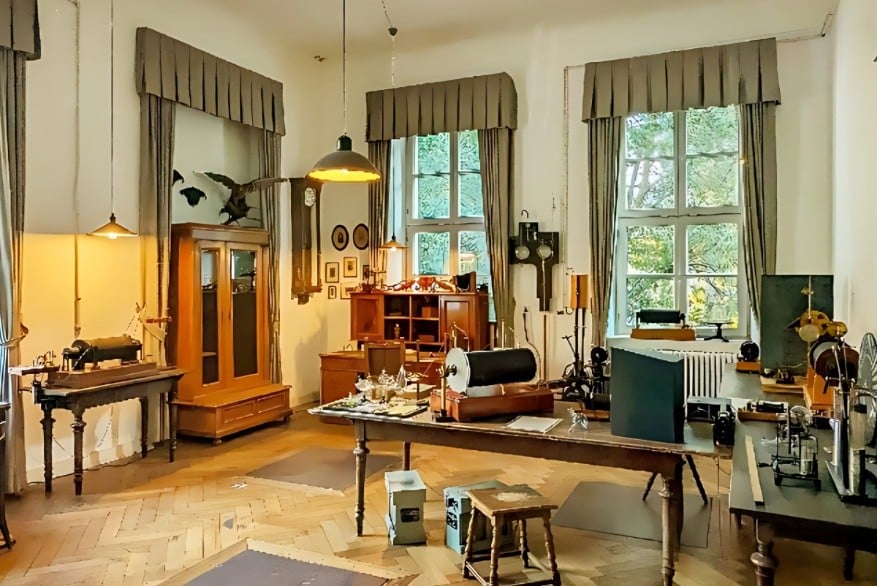
Figure 6. A view of Röntgen’s laboratory at the Röntgen Memorial in December 2024.
The entrance to the Physical Institute near the laboratory is tiled with a pattern and two formulae, Figure 7. Naturally, it was interesting to figure out the significance of the intriguing equations and both I and a few colleagues spent more time on the task than we care to admit.
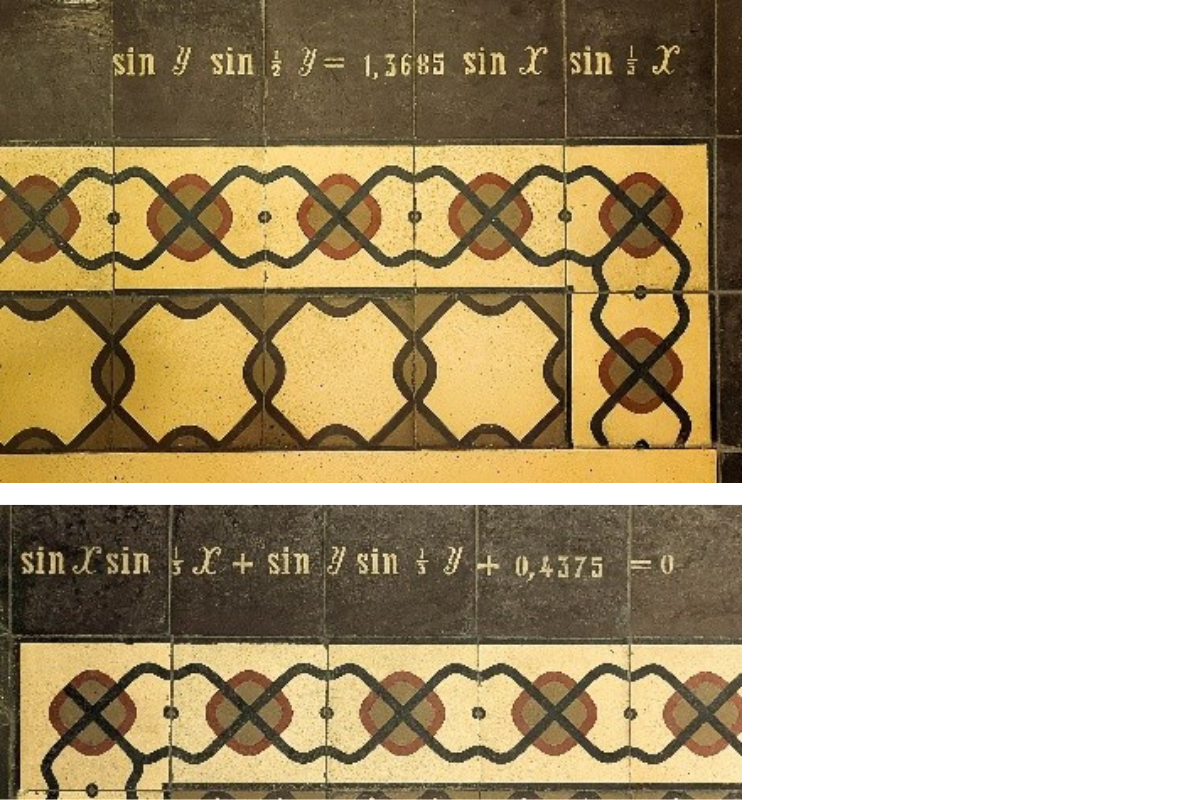
Figure 7 (above and below). Tiles and formulae near in Physical Institute near the Röntgen Memorial.
The formulae have nothing to do with crystallography and physics, but with mathematics: they describe the patterns featured on the tiles! The captivating story behind the formulae, dating to the 19th century, is described by A.J. Bracken in ‘Mathematics underfoot: The formulas that came to Würzburg from New Haven’ [1]. Whereas today the patterns can be easily reproduced with online graph calculators, e.g. https://www.desmos.com/calculator, charting the graphs must have been an involved procedure 130 years ago.
Fundamental discoveries and monumental occasions are regularly featured on postage stamps. For example, at least 32 stamps and souvenir sheets were issued by 14 countries to commemorate the International Year of Crystallography 2014 [8], [9], [10], [11]. The images include a likeness of Röntgen, Bragg’s law, crystals, lattices, snowflakes, minerals, molecules, diffraction patterns, and electron density graphs. How difficult would it be to design a stamp and have it approved by the Postal Office? I remember a chance meeting in 2013 with the president of the Israel Chemical Society in Istanbul, who said that it took the society over two years to lobby the Israel Postal Service to issue a postage stamp showing a diffraction pattern from a quasicrystal. Alas, the USA has never issued a stamp celebrating Röntgen, probably because the “U.S. postage stamps and stationery will primarily feature American or American-related subjects. Other subjects may be considered if the subject had a significant impact on American history, culture, or environment” [14]. The process of issuing a stamp is understandably involved, in part because they are considered a receipt for a prepaid service (mail delivery).
New stamps commemorating the discovery of X-rays are sure to appear in the future, and I look forward to updating my stamp collection and posters.
The author is grateful to Daniel Rabinovich for providing valuable help with the preparation of this article.
Additional note from the Editor:
For more information on the discovery of X-rays, see this article in the IUCr Newsletter.
Also see the speech made by Max von Laue in 1948 to the 1st IUCr Congress.
Ilia A. Guzei, 2124 Chemistry Department, University of Wisconsin-Madison, 1101 University Ave, Madison, WI 53706, USA. E-mail: [email protected]
6 January 2026
Copyright © - Prior permission is not required to reproduce short quotations, tables and figures from this article, provided the original authors and source are cited.
The permanent URL for this article is https://www.iucr.org/news/newsletter/volume-34/number-1/a-2025-pakistani-postage-stamp-commemorating-the-discovery-of-x-rays
References
[1] Bracken, A. J. (2019). https://arxiv.org/pdf/1911.02226. ↩
[2] Etter, L. E. (1945). American Journal of Roentgenology and Radium Therapy 54, 547–552. ↩
[3] Glasser, O. (1993). Wilhelm Conrad Röntgen and the Early History of the Roentgen Rays. Jeremy Norman Co. ↩
[4] Guzei, I. A. (2023). Wilhelm Conrad Roentgen on International Souvenir sheets and stamps, https://xray.chem.wisc.edu/crystallography-and-art/. ↩
[5] Kelves, B. H. (1998). Naked to the bone (medical imaging in the twentieth century). Helix Books. ↩
[6] Munk, P. L. & Peh, W. C. G. (2023). The Canadian Philatelist 71, 14–19. ↩
[7] Pakanalysis.com (2025). https://pakanalysis.com/a-historic-tribute-pakistan-post-siemens-healthineers-celebrate-130-years-of-x-ray-technology-with-special-postage-stamp-on-resolution-day-of-pakistan/. ↩
[8] Rabinovich, D. (2014a). Chemistry International November-December, 39-41. ↩
[9] Rabinovich, D. (2014b). Philatelia Chimica et Physica 36, 28-41. ↩
[10] Rabinovich, D. (2014c). Philatelia Chimica et Physica 36, 160-167. ↩
[11] Rabinovich, D. (2016a). Philatelia Chimica et Physica 37, 34-42. ↩
[12] Rabinovich, D. (2016b). RefleXions Summer, 6. ↩
[13] Roentgen-Memorial (2025). Roentgen-Memorial Musuem, https://wilhelmconradroentgen.de/en/home. ↩
[14] United_States_Postal_Service (2025). https://about.usps.com/publications/pub226.pdf. ↩