Stuart R. BattenBen Krinkel, Helen E. Maynard-Casely, Rosemary J. Young, Bronte A. Johnstone, Nathan L. Kilah, Alexandra C. Perry, Helen Y. McGuinness and Kate Pennycuick
One particularly memorable event at the IUCr2023 Congress in Melbourne was the building of the largest crystal structure model ever built (IUCr Newsletter 2023, 31(4)). In the more than two years since the Congress, the Bragg Your Pattern team behind the record-breaking model has been busy converting a conference highlight into a lasting legacy for school children across two countries.
The final model built, which was the structure of diamond, contained 62,356 atoms connected by 121,547 bonds, totalling 183,903 total components. These came from individual model kits, and once the conference finished, the laborious process of breaking the model back down again and putting the components back into their original individual boxes began. These kits are now being sent, free of charge, to primary schools all over Australia and New Zealand.
The inspiration for this project came from a similar previous project led by one of the team (SRB). The Elements Sets project (www.elementsets.net) created and donated more than 1600 sets containing 37 pure samples of chemical elements to secondary schools all over Australia, which will aid 1.5 million student lessons on the periodic table over the next decade. The Crystal Explorer kits now aim for a similar reach for primary school students across the region.
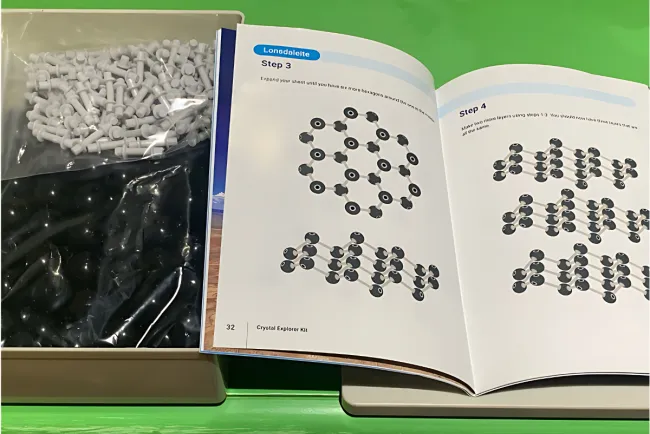
In addition to the model contents (at minimum, 91 tetrahedral atoms and 140 bonds, though we are erring on the side of generosity in reassembling the kits, which is being done by weight), we have written a 56-page glossy booklet to accompany each set. Support from ANSTO enabled the booklet to be produced by a professional graphic designer. It contains step-by-step instructions for building four different models (diamond, Lonsdaleite, buckminsterfullerene, and sodalite), a cut-out class activity for graphite, and background information on each structure. Further supporting resources, including further models to make, will be added over time on the project website (www.braggyourpattern.com), which also contains the link to the order form.

The Big Diamond (left) and the Crystal Explorer kit, including booklet (right). Photos: S. R. Batten.
Because of the limited number of sets we have available, the kits are restricted to schools with primary-aged students in Australia and New Zealand, and the activities in the kits have been deliberately pitched at this age group. There is also only one kit per school (or two if a large school (400+ primary students)), but kits are completely free of charge (we even cover postage!) thanks to the generous support of the Society of Crystallographers of Australia and New Zealand (SCANZ). Priority was given in the early rounds for rural, regional and remote schools, and for government (public) schools. However, they are now open for any primary school in Australia and New Zealand.
To date, more than 4,700 schools have been contacted directly, with 293 kits ordered by 263 schools. Orders have been received from (and sent to) schools as far apart as Tom Price, in outback Western Australia, to the Chatham Islands, 800km east of the South Island of New Zealand, giving a total span of over 6300km between sets. With the new school year about to start in the Southern Hemisphere, we now expect a fresh influx of orders in the coming weeks.
Finally, a portion of the kits is also being kept back to be included in outreach kits to be deposited with custodians in major cities around Australia and New Zealand. These will be available for loan by crystallographers for use in school outreach visits and other similar events. These outreach kits will not only include the Crystal Explorer kits, but also other activities based on the Crystal-a-con outreach event held at the IUCr2023 Congress (IUCr Newsletter 2023, 31(4)). Successful trials of these outreach kits have already been held at schools in Perth and regional NSW.

The current distribution map of the kits (as of January 2026). Photo S. R. Batten.
2 February 2026
Copyright © - Prior permission is not required to reproduce short quotations, tables and figures from this article, provided the original authors and source are cited.
The permanent URL for this article is https://www.iucr.org/news/newsletter/volume-34/number-1/crystal-explorer-kits-for-primary-schools