



Feature article
Insights from LACA and the MANACÁ Beamline
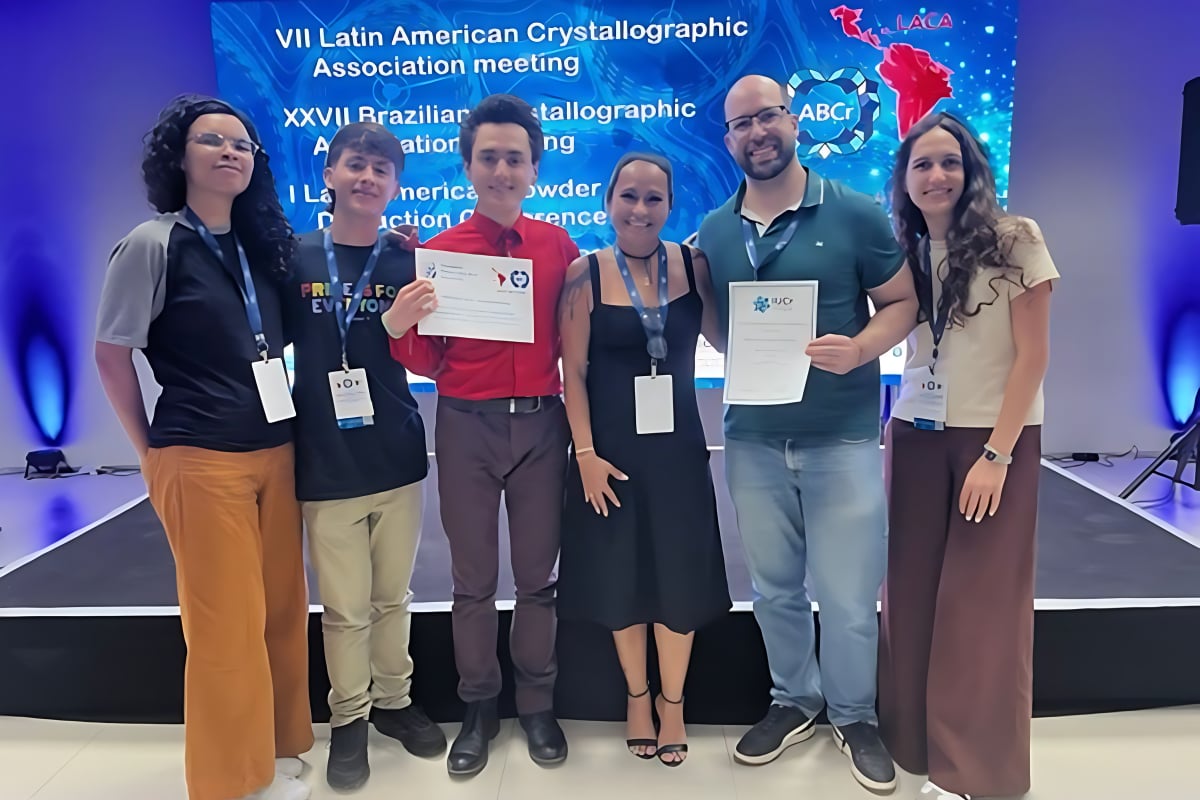
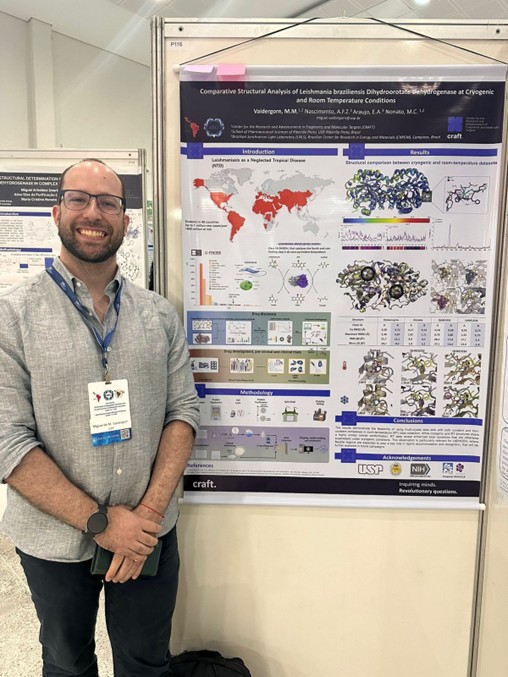
Participating in the Latin American Crystallographic Association (LACA) meeting was far more than attending a conference, as it marked a significant milestone in my scientific journey. As a postdoctoral researcher working with Structure-Based Drug Discovery (SBDD) and Fragment-Based Drug Discovery (FBDD) at the University of São Paulo (USP, Brazil), I have been deeply committed to developing new therapeutic strategies against neglected tropical diseases (NTDs). Receiving the IUCr Poster Prize was not only an honor, but also a validation that innovative crystallographic approaches can deliver meaningful advances toward biological targets related to NTDs.
In the presented work, we showcased the outcomes of a pilot study that, for the first time in our group, compared and validated the feasibility of integrating SBDD and FBDD under room-temperature (RT) conditions, in parallel with conventional cryogenic experiments. The results provided valuable structural insights into an essential enzyme for parasitic diseases and revealed that RT datasets may capture conformational flexibility that often remains hidden under cryogenic conditions, an emerging approach for future drug discovery efforts.
What made this experience particularly rewarding was the collaboration with the MANACÁ beamline team at the Brazilian Synchrotron Light Laboratory (LNLS–Sirius), where we were invited to contribute to their early development of room-temperature serial macromolecular crystallography (RT-SSX) pipeline to showcase this applicability of ligand and fragment screening as a new strategy as part of the drug discovery process. The research was carried out using the state-of-the-art scientific infrastructure available at LNLS–Sirius, Brazil’s fourth-generation synchrotron light source. At the heart of this work was the MANACÁ beamline, which played a key role in enabling high-quality structural studies under challenging experimental conditions. As the first beamline to come into operation at Sirius, MANACÁ was designed specifically for three-dimensional structural analysis of biological macromolecules using X-ray diffraction.
This infrastructure is especially powerful for fragment-based drug discovery (FBDD) experiments at room temperature, where maintaining crystal integrity while detecting weak fragment binding is often difficult. The stability and precision of MANACÁ make it possible to work with small, radiation-sensitive crystals and still obtain reliable structural information.
Evandro Araújo, a scientist at the MANACÁ beamline who leads these developments at LNLS, reflects on the experience: “The experiments at MANACÁ were a great example of teamwork and close interaction between scientists and beamline staff. We pushed the beamline to its limits to deal with challenging protein crystals, and the results were extremely rewarding. The combination of a highly stable, micrometer-sized X-ray beam, high photon flux, and the overall performance of a fourth-generation synchrotron allowed us to collect excellent room-temperature data. This is exactly the type of environment needed for FBDD studies, where subtle structural changes and weak fragment binding can make all the difference.”
This partnership not only enabled crystallographic experiments under more physiologically meaningful conditions but also highlighted the growing potential of Latin American facilities to play an active role in advancing structural biology and fragment-screening methodologies on a global scale.
Copyright © - Prior permission is not required to reproduce short quotations, tables and figures from this article, provided the original authors and source are cited.


