Elen Duverger-Nédellec
YCM2 took place from December 2 to 5, 2025, at the Rennes Institute of Chemical Sciences. During this event, 53 people were gathered to discuss a shared discipline: Crystallography. The audience was international, with 8 countries represented, and young, as the event targeted participants under the age of 40.
Six invited speakers (two award-winning professors and researchers, and four young talents) presented their research related to crystallography and highlighted the multidisciplinary nature of this field:
- Prof. Eric Collet from the Institute of Physics of Rennes and Dr. Fabrice Pointillart from the Rennes Institute of Chemical Sciences, both recipients of prestigious distinctions, presented crystallographic studies carried out on the Rennes campus.
- Prof. Elena Bykova from Goethe University Frankfurt presented her career path as well as the use of crystallography at very high pressures and temperatures, which is essential for understanding geological phenomena.
- Dr. Victor Gonzalez from the Supramolecular and Macromolecular Photophysics and Photochemistry Laboratory at Paris-Saclay presented the usefulness of crystallography in heritage science and in understanding the processes used by renowned painters such as Leonardo da Vinci (pigment selection, reactivity during mixing with binders, etc.).
- Dr. Serena Sirigu, beamline scientist at Synchrotron SOLEIL, presented her beamline, the needed of the bio-crystallographers community and the instruments developed on Proxima-1 and Proxima-2 to answer to these needs.
- Dr. Carlotta Giacobbe, product manager at Thermo Fisher, shared her academic and industrial career paths, her experiences and choices leading her in industry and explained her professional missions.
In order to provide an overview of the possible careers involving crystallography, representatives from our industrial sponsors (Rigaku, STOE, and Malvern Panalytical) also shared their experience within their respective companies.
In addition to the invited speakers’ presentations mentioned above, a significant part of the event was dedicated to participants’ oral and poster presentations: 26 talks and 13 posters were presented. Participants were able to discover applications beyond their own research fields, including presentations on two synchrotrons and technical developments related to high-pressure diffraction—topics that span many areas, from structural biology and structure prediction to heritage science, physics, and chemistry.
A session was dedicated to the presentation of various national and international crystallography associations and their young crystallographers group, followed by a discussion on actions that could be undertaken to further develop events such as YCM2 and to initiate more international collaborations between national groups of young crystallographers.
To this end, Martina Lippi, representative of the Italian young crystallographers (Giovani Cristallografi Italiani), presented her national association and the initiatives proposed and implemented by her group. The presentation of the Young Section of the French Crystallographic Association highlighted complementary actions to those proposed by the Italian group, emphasizing the potential for joint initiatives in the future.
All young crystallographers were then invited to discuss about their feeling to belong, or not, to the crystallographic community, about their needs and willingness to get involved actively in their national crystallographic association. For the “sens of belonging “discussion, a large part of the young ones is not feeling part of the community because of a lack of crystallographic knowledge. There is this idea that you need to be an expert to be part of the community. There is also the fact that this discipline is covering a lot of different fields and then all the members are not sharing the same problematic.
The main issue identified it that a large part of the young scientists present at the YCM2 are passing through XRD platforms with dedicated experts that measure and solve the structures for them, the training of the phD students is far from being systematically done which results in the fact that crystallography is mostly considered as a tool and not a discipline.
Concerning the actions that can be implemented to help the young crystallographers, the creation of an international online forum offering support for the use of crystallographic software and crystallographic discussions was extensively discussed. A unified Discord server could be created by an international association. A list of the already existing forums or online help tools can also be shared: most of the young scientists are not aware that these forums/solutions exist.
The participants were chemists, physicists and biologists, PhD students, postdoctoral researchers, engineers, researchers —all using crystallography in their research projects.
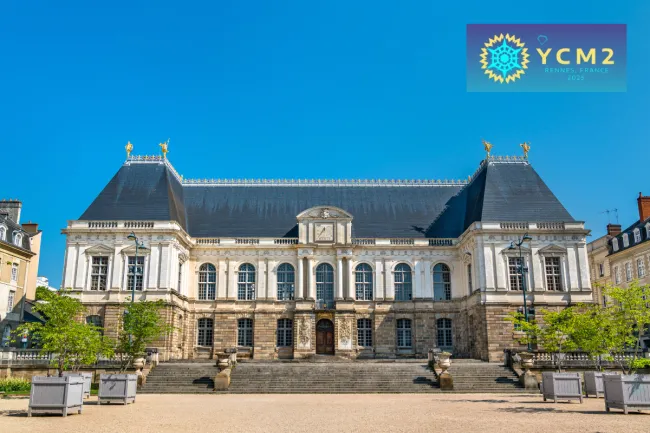
During the week, Rennes’ and Brittany’s local culture was also highlighted, with a visit of the historic center of Rennes and its parliament, followed by a tasting of local products during the gala dinner at a crêperie.
3 Best Communication Prizes were awarded during the congress:
- The CCDC Best Communication Prize, attributed by the audience by vote to Laurynas Paškevičius (Institut Parisien de Chimie Moléculaire, Paris), for the talk: “Investigation of Metal Ligand Bond Strengths Comparison of X ray Structural Features via DFT Calculations and Mass Spectrometry of Gold and Platinum Complexes”.
- The AFC Best Communication Prize, attributed by a jury constituted by some of the invited speakers to Romain Vincent (Institut de Biologie Moléculaire et Cellulaire Architecture et réactivité de l’ARN, Strasbourg), for the talk: “Structural and functional study of an unconventional dsRNA binding protein (dsRBP)”
- The IUCR Journals Best Communication Prize, attributed by a jury constituted by some of the invited speakers to Nour Maraytta (Karlsruhe Institute of Technology, Germany), for the talk: “Nuclear and Magnetic Structures of the AF1 Phase of Mn5Si3”.
To conclude, this event, rich in opportunities for exchanges and discussions, brought together 53 participants from across Europe, representing different research fields but all connected through the use of crystallography. Captivating talks were given by invited speakers and participants from a wide range of fields, a highlight was made on the career possibilities in the private sector and a discussion was led on the theme “Young Scientists & Crystallography”. We believe that this event was a success and we already asked other national young crystallographers groups if a YCM3 could be organized outside France in the future.
The organizing and scientific committees would like to warmly thank the International Union of Crystallography for its invaluable support and trust.
6 January 2026
Copyright © - Prior permission is not required to reproduce short quotations, tables and figures from this article, provided the original authors and source are cited.
The permanent URL for this article is https://www.iucr.org/news/newsletter/volume-34/number-1/young-crystallographers-meeting-2