


Old notices
These pages collect together notices posted on the IUCr web site in past years. They are retained for archival interest, but there is no guarantee (or likelihood) that many of the web links found in these notices will still be active.
Celebrating 100 years of the Debye scattering equation
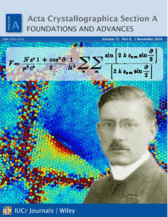 One hundred and one years ago, in 1915, the Dutch-American scientist Peter J.W. Debye published a scientific paper containing the fundamental formula of X-ray diffraction by matter. This formula is still used today. Its anniversary was celebrated at a dedicated workshop, "100 years of the Debye scattering equation, DSE 2015" (http://www.dse2015.org), a selection of papers from which are published in the November issue of Acta Crystallographica Section A.
Peter Debye was one of the greatest scientists of the 20th century, making valuable scientific contributions to many fields of physics and physical chemistry. His work spanned topics such as dipole moments, relaxation and polarizability, electrolytes, quantum theory, photon physics, X-ray diffraction, magnetism and cryogenics, light scattering, and the study and the characterisation of polymers. In 1936 he was awarded the Nobel Prize in Chemistry "for his contribution to our knowledge of molecular structure through investigations on dipole moments and on diffraction of X-rays and electrons in gases". For his scientific contributions to applied physics Debye is also rightly considered the founder of materials science. He was deeply respected for his skills in mathematics and theoretical physics, and for his extraordinary physical insights, which allowed him to reach the heart of a difficult problem and solve it in a pragmatic way. Debye was indeed a brilliant scientist, as skilled a theoretician as he was an experimentalist.
Today the Debye scattering equation is finding application in many diverse fields of applied sciences ranging from nanotechnology to biology, solid-state physics and chemistry. This special issue presents a small snapshot of the various ways in which the equation is currently being applied, along with a fascinating review of Debye’s career.
P. Scardi, S. J. L. Billinge, R. Neder and A. CervellinoGuest editors