

Old notices
These pages collect together notices posted on the IUCr web site in past years. They are retained for archival interest, but there is no guarantee (or likelihood) that many of the web links found in these notices will still be active.
Scorpionate chemistry at the 50th anniversary
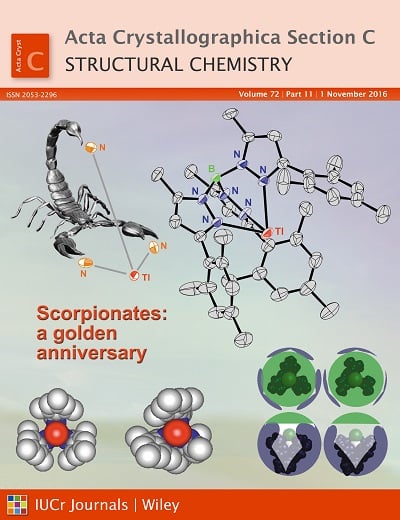 The year 2016 marks the 50th anniversary of the discovery of scorpionates, a class of compound with proven versatility afforded by the ease of tuning the steric bulk and electronic properties at the metal coordination site. In a seminal report by Trofimenko, a new class of chelating polypyrazolylborate ligands, trispyrazolylborates (Tp), was created by reaction of potassium borohydride with three equivalents of pyrazole. The resulting anion was then observed to coordinate to a large range of divalent metal ions.
Before 1966 there were only a few examples of polysubstituted boron compounds with B-N bonds, with all of them behaving as noncoordinated spectator anions.
In a 1993 review, Trofimenko notes the multidentate features of Tp and states, "Nature provides the closest analogy to these features in the scorpion. This creature grabs its prey with two identical claws and then may proceed to sting it with the sharp point of the curving tail. Therefore, I found it appropriate to coin the term scorpionate ligands".
In 2013, the first special issue for Acta Crystallographica Section C was published featuring scorpionates. After just three years, the continued productivity of the field has made it necessary to publish a follow-up special issue featuring a further sixteen cutting-edge papers on scorpionate chemistry. This clearly shows that the chemistry is as vibrant and relevant today as it was 50 years ago.
Kiyoshi Fujisawa & Glenn P.A. YapGuest editors