




Meeting report
![[ACA logo]](https://www.iucr.org/__data/assets/image/0011/3503/ACA07-Logo.gif) 2007 ACA meeting
2007 ACA meeting
Salt Lake City, UT USA, July 21-26, 2007
www.amercrystalassn.org
![[Angelo Gavezzotti]](https://www.iucr.org/__data/assets/image/0013/3505/Gavezotti.gif) Angelo Gavezzotti
Angelo Gavezzotti
![[Frank Herbstein]](https://www.iucr.org/__data/assets/image/0017/3536/SmallHerbstein.gif) Frank Herbstein
Frank Herbstein
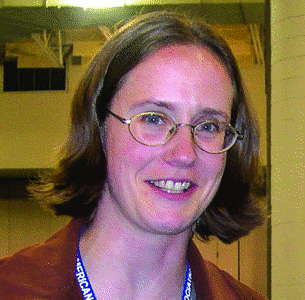 Cora Lind
![[Sue Bryam, Roger Komberg and Chris Hill]](https://www.iucr.org/__data/assets/image/0014/3506/NobelSueRogerChris2.gif) Sue Byram, Roger Komberg, and Local Chair Chris Hill
Sue Byram, Roger Komberg, and Local Chair Chris Hill
![[Supramolecular chemistry personnel]](https://www.iucr.org/__data/assets/image/0012/3504/10.03KWheeler_kwheeler.gif) An all-day session on Supramolecular Chemistry addressed the general theme of decoding the architectures and utility of supramolecular assemblies. (Photos courtesy of Kraig Wheeler). Silas Blackstock, Miguel Garcia-Garibay, Tara Burchell, Kenneth Doxsee, Jesus Valdés-Martinez, Radu Custelcean, Bruce Foxman, Alicia Beatty, Len Barbour, Greg Hogan and Chester Aakeröy. (photo by Peter Müller)
An all-day session on Supramolecular Chemistry addressed the general theme of decoding the architectures and utility of supramolecular assemblies. (Photos courtesy of Kraig Wheeler). Silas Blackstock, Miguel Garcia-Garibay, Tara Burchell, Kenneth Doxsee, Jesus Valdés-Martinez, Radu Custelcean, Bruce Foxman, Alicia Beatty, Len Barbour, Greg Hogan and Chester Aakeröy. (photo by Peter Müller)
![[Speakers on crystallography in industry]](https://www.iucr.org/__data/assets/image/0014/3542/4.01ImpactIndustry.gif) Speakers on the session on Crystallography in Industry. From left: John Badger, Tim Rydel, Doug Davies, John Barker, Giovanna Scapin, Ping Chen, Rick Bott, John DiMarco.
Speakers on the session on Crystallography in Industry. From left: John Badger, Tim Rydel, Doug Davies, John Barker, Giovanna Scapin, Ping Chen, Rick Bott, John DiMarco.
![[Speakers on non-ambient crystallography]](https://www.iucr.org/__data/assets/image/0016/3544/5.01Non-Ambient_CLind.gif) Speakers in the session on non-ambient crystallography: Mateusz Pitak, Milan Gembicky, Roger Willett, Davide Viterbo, Scott Speakman. In front: Jana Bezjak, Claudia Rawn, Amy Gindhart.
Speakers in the session on non-ambient crystallography: Mateusz Pitak, Milan Gembicky, Roger Willett, Davide Viterbo, Scott Speakman. In front: Jana Bezjak, Claudia Rawn, Amy Gindhart.
![[Speakers on crystallographic minerology]](https://www.iucr.org/__data/assets/image/0018/3546/5.02Chakamoukos-_-Duax1.gif) Speakers in the session on Crystallographic Mineralogy: Chris Tulk, Lee Groat, Gary Enright, Claudia Rawn, Bob Bau, Davide Viterbo; in back: Bryan Chakoumakos, Ron Petersen, George Lager, Ton Spek, Claude Lecomte, Hongwu Ya, Cora Lind. (Photo by Bill Duax)
Speakers in the session on Crystallographic Mineralogy: Chris Tulk, Lee Groat, Gary Enright, Claudia Rawn, Bob Bau, Davide Viterbo; in back: Bryan Chakoumakos, Ron Petersen, George Lager, Ton Spek, Claude Lecomte, Hongwu Ya, Cora Lind. (Photo by Bill Duax)
![[Speakers on biomolecular assemblies and biomembranes]](https://www.iucr.org/__data/assets/image/0003/3549/13.03BioAssem_cgc.gif) The session on Biomolecular Assemblies and Biomembranes focused on the application of non-crystalline small angle scattering to biological macromolecular assemblies and biomembranes. From left: William Heller, Lin Yang, Günter Grossman, Susan Krueger, Jan Lipfert, Jill Trewhelia, Tracy Nixon, Joanna Krueger and Thomas Weiss. (photo by Peter Müller)
The session on Biomolecular Assemblies and Biomembranes focused on the application of non-crystalline small angle scattering to biological macromolecular assemblies and biomembranes. From left: William Heller, Lin Yang, Günter Grossman, Susan Krueger, Jan Lipfert, Jill Trewhelia, Tracy Nixon, Joanna Krueger and Thomas Weiss. (photo by Peter Müller)
A session on “Non-Ambient Crystallography” focused on phase transitions by variable temperature diffraction in alloys, ceramics, and organic/inorganic compounds with a wide range of potential applications, such as thermal barrier coatings, microwave dielectrics, and composite materials with zero thermal expansion.
The session on “Crystallographic Mineralogy”, chaired by Bryan Chakoumakos (Oak Ridge National Lab, USA) and Lee Groat (U. of British Columbia, Canada), hosted a broad range of studies concerned with deep earth and the surface of Mars; manmade problems in acid mine drainage, and the benefits of synthetic materials with useful properties. An underlying theme was that even for seemingly simple chemical compounds, the crystallography can be complex and difficult at the conditions of interest.
An emerging theme in the session on “Neutron Macromolecular Crystallography”, and one that generated a great deal of excitement and discussion, was the use of both X-ray and neutron diffraction data during “XN” refinement. This approach, originally developed by Wlodawer and Hendrickson many years ago, has the advantage of increasing the data-to-parameter ratio and hence the accuracy of the structures.
A full day session highlighted the advances in the field of structure determination from powder diffraction data and its application in various materials related research. “The crystal structure of kryptonite/jadarite”
was presented by Pamela Whitfield (NRC, Canada). This new mineral, LiNaSiB3O7(OH), which has the unique chemistry of “Kryptonite” as described in the film “Superman Returns” was identified in a mine in Serbia. Unlike the fictitious green compound that can drain Superman’s powers the real mineral is white and harmless. Pavol Juhas (Michigan State U., USA) described a very different technique to get structural information for non-crystallized molecules and nano-materials based on an atomic Pair Distribution Function (PDF) technique. He described the European-Soccer-League-inspired Liga algorithm that was successfully used to solve the molecular structure of C60 from distances obtained from neutron PDF data. This suggests tantalizing options for studying structural properties of a vast number of systems where periodic order is not present and conventional crystallographic methods cannot be applied.A session on “Surface and Interface Characterizations” provided a comprehensive overview of the use of scattering techniques to characterize surface chemistry, materials, and physics of nano-objects on substrates in various environments, including reactive gas, vacuum, and aqueous solutions. Developments and applications of reflectivity and grazing incident small/wide angle X-ray scattering techniques were discussed.
A symposium, emphasizing the importance of small molecule crystallography to science, was dedicated to the memory of F.A. Cotton. The depth and breadth of the research presented to a large audience provided a fitting memorial to Cotton, whose contributions to chemistry would in large part not have been possible without crystallography.
“Advances in Data Collection” focused on new techniques in sample preparation, data collection, and data processing. Talks in a session on “Detectors” ranged from detectors already in widespread use to new detector hardware designs and their potential applications for correcting and improving crystallographic data. A session on “Time and Field Dependent Responses in Scattering co-organized by the Small Angle Scattering and Materials SIGs, covered a broad range of experimental research, in which response to external fields as well as evolution over time is essential. A session on “Energy Storage and Conversion” offered a broad view of the synthesis and characterization of hydrogen storage materials.
The 2008 ACA meeting will convene in Knoxville, TN from May 31-June 5.
Condensed from ACA Reflections,
No. 3, Fall, 2007
![[Gadgets]](https://www.iucr.org/__data/assets/image/0019/3637/13.09_PeterMueller.gif) From Left: Peter Müller, Bruce Foxman, Jörg Kärcher, Jenny Gluster and Henk Schenk. Some speakers are holding gadgets. (Photo by Peter Müller.)
From Left: Peter Müller, Bruce Foxman, Jörg Kärcher, Jenny Gluster and Henk Schenk. Some speakers are holding gadgets. (Photo by Peter Müller.)
![[Cordes]](https://www.iucr.org/__data/assets/image/0016/3670/WallyHead.gif)